
Wristwatches · Wristwatch
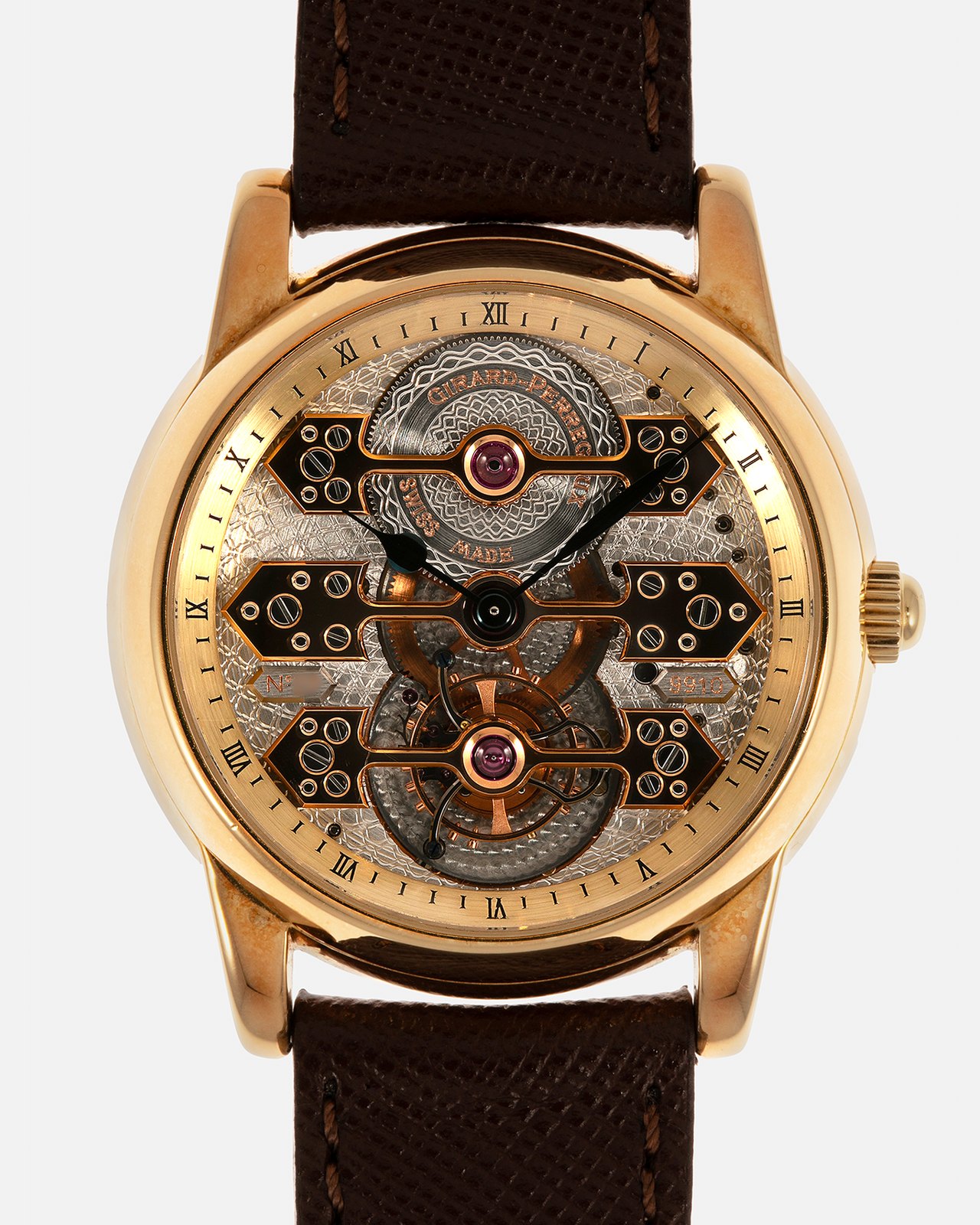
Girard Perregeux Three Bridges Tourbillon Sous Trois Ponts d'Or 99000 First Generation, 1990s
- Maker / attribution
- Girard (maker)
- Date
- 1990s
- Historical period
- Mechanical Renaissance (1990 – 2010)
- Country of origin
- Unrecorded in source
- Object type
- Wristwatch
- Dimensions
- Case 39 mm
- Stock no.
- Product 7679803555927
- Credit line
- Dealer listing, S.Song Watches (product 7679803555927)
- Catalogue title (original)
- Girard Perregeux Three Bridges Tourbillon Sous Trois Ponts d'Or 99000 First Generation (English)
View the source record (dealer listing) ↗ (opens another website in a new tab)Suggest a correction
Record summary
Catalogued by S.Song Watches (dealer), Seattle (stock number Product 7679803555927), this is a wristwatch by Girard, dated 1990s. The Atlas places it in the Mechanical Renaissance period (1990 – 2010) of its Wristwatches collection. Recorded dimensions: Case 39 mm. The record is illustrated with 6 photographs.
Assembled from the source record's structured fields. Dates and attributions are given as the source states them; where a field is missing the Atlas leaves it blank rather than estimating.
Catalogue description
Dealer description — S.Song Watches
In watchmaking, truly original movement layouts are exceptionally rare. Most manufacturers refine existing ideas, introducing incremental improvements in precision, reliability, or decoration. Every so often, however, a watchmaker creates something that becomes inseparable from the identity of a brand. For Girard-Perregaux, that achievement came through the work of Constant Girard and the Three Gold Bridges. Introduced in 1867, Girard's tourbillon pocket chronometer arranged the barrel, gear train, and tourbillon along a single axis, supported by three prominent bridges. The layout was mechanically logical, but what set it apart was its presentation. At a time when movement construction was largely hidden from view, Girard placed the structure itself on full display. The concept quickly proved its technical merit, earning a First Class Bulletin from the Neuchâtel Observatory before evolving into the Three Gold Bridges configuration that became synonymous with the manufacture. The design reached international acclaim in 1889 when Girard-Perregaux presented its Three Gold Bridges tourbillon at the Paris Universal Exhibition, where it received a gold medal. More importantly, it established a design language that outlived the exhibition itself. While many historically significant movements are remembered for technical innovations that remain invisible to the wearer, the Three Bridges became instantly recognisable through its form alone. More than a century later, it remains one of the few movement designs that is immediately identifiable at a glance. The appeal of the layout extends beyond aesthetics. The barrel, wheel train, and tourbillon follow the natural flow of power through the movement, while the bridges simultaneously serve structural and decorative purposes. Achieving this apparent simplicity, however, is far from straightforward. Numerous components must be positioned out of sight to preserve the symmetry of the display, while the bridges themselves leave nowhere to hide imperfections in finishing. Every surface, edge, and angle is exposed to scrutiny. Although the mechanism remained central to Girard-Perregaux's heritage, it largely disappeared from production throughout much of the twentieth century. It returned in 1981 through a faithful recreation of the historic pocket watch before being successfully miniaturised into wristwatch form around 1991 with the introduction of the Tourbillon Sous Trois Ponts d'Or. The name itself describes the watch's defining feature: a tourbillon displayed beneath the three gold bridges. This represented more than just a simple reduction in size. Girard-Perregaux managed to preserve the proportions and character of a movement originally conceived for a pocket watch while adapting it for everyday wear on the wrist. The present example belongs to the early production years of the reference and is an early-number example manufactured shortly after the model's introduction. Notably, it represents the second execution of the 99000, distinguished by its slimmer bridge arms, finely executed guilloché on the baseplate, and an embellished barrel cover beneath the upper bridge. Executed in 18-carat yellow gold and measuring 39mm x 10.5mm, the watch remains remarkably faithful to the historic blueprint. The guilloché baseplate forms a richly textured backdrop to the movement, allowing the eye to travel naturally from the barrel at 12:00 through the centre wheel and ultimately to the one-minute tourbillon at 6:00. The composition feels purposeful and uncluttered, with each component occupying a clearly defined place within the overall design. More importantly, it retains the balance and visual coherence of the original concept before later generations evolved into increasingly elaborate interpretations of the Three Bridges architecture. Powering the watch is the manually wound Girard-Perregaux Cal. 9910. Rather than treating the bridges as decorative elements applied to an existing movement, the calibre was conceived around the architecture itself. Unlike many tourbillon wristwatches, where the tourbillon becomes the sole focal point, the regulating organ here forms just one element within a carefully balanced composition. The emphasis remains on the relationship between the three bridges and the movement they support. Importantly, the movement is far more than a mere historical exercise, offering a substantial 75-hour power reserve together with practical refinements such as a self-compensating balance spring and Kif shock protection. Today, the Three Bridges collection stands as the defining signature of Girard-Perregaux, but examples such as this reveal how the modern lineage began. As an early-number example from the model's formative years, it belongs to the period when the brand first succeeded in translating its celebrated nineteenth-century pocket watch architecture into wristwatch form. More than a simple exercise in miniaturisation, the achievement lay in preserving the balance, proportions, and visual clarity of the original design while adapting it to a far smaller canvas. More than three decades later, it remains one of the purest expressions of the concept, retaining the restraint, coherence, and sense of proportion that distinguished these early examples from many of the more elaborate interpretations that followed.
Historical context
Mechanical Renaissance (1990 – 2010)
Mechanical watches return as cultural objects; independent watchmaking flourishes.
Mechanical watches returned as cultural and luxury objects. Complications, tourbillons and new materials proliferated; independent watchmakers such as George Daniels, F.P. Journe and Philippe Dufour revived artisanal watchmaking; collecting vintage watches became a major field.
Read the period in the timelineMore wristwatches from this periodEarlier: Quartz Revolution
Atlas type guide
Wristwatches
Bracelet watches were worn by women from the early nineteenth century — Breguet made one for Caroline Murat, Queen of Naples, in 1810–12 — but the wristwatch only became a man's instrument with military use and aviation in the early twentieth century. Between the World Wars it overtook the pocket watch; the 1920s and 1930s brought rectangular Art Deco cases, water-resistant cases and the first automatic winding systems.
After 1945 the wristwatch became a carrier of identity — dress watches, sports and dive watches, chronographs, calendars — produced by Swiss, American, Japanese, German, Soviet and Chinese industries. The quartz revolution after 1969 and the mechanical renaissance since the 1990s, including the rise of independent watchmakers, complete the story.
What to look for
- The reference number (between the lugs or inside the case back) and serial number, the starting point for dating.
- The calibre: its maker and number are often stamped under the dial or on the bridge.
- Originality of dial, hands and crown — refinished ('redial') dials are common.
- Case material marks: 18K/750, 14K/585, stainless steel, gold-filled, plated.
Dating clues
- Wire-lug cases: before c. 1925.
- Water-resistant screw-down cases: from 1926.
- Quartz movements: from 1969; sapphire crystals widespread after c. 1980.
General guidance written by the Atlas editors about this kind of object. It is not a statement about this particular piece; for that, rely on the source record above and on physical examination.
Related records
Wristwatches · c. 2006
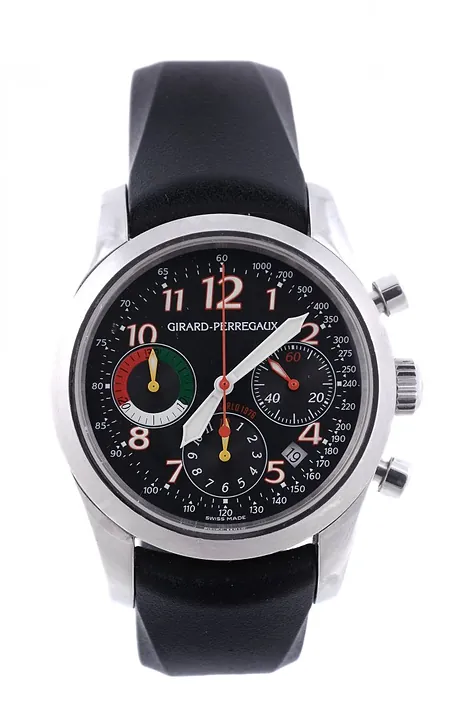
Girard Perregaux, Monte Carlo 1976, ref. 49541, a, c. 2006
LiveAuctioneers auction archive
Wristwatches · 1950s
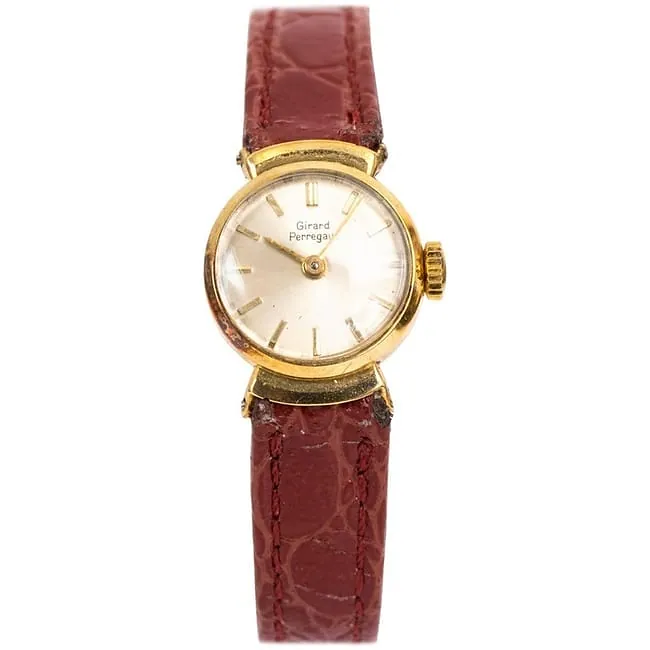
Girard Perregaux Ladies Yellow Gold Wristwatch, 1950s
LiveAuctioneers auction archive
Wristwatches · c. 1970
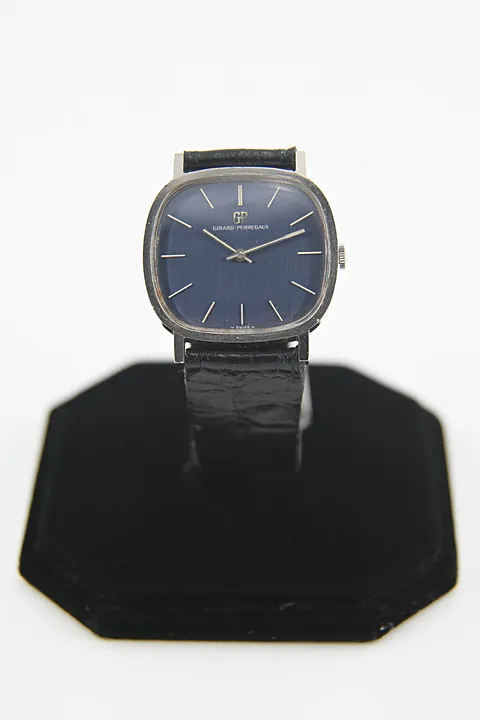
Girard Perregaux Mens Steel Manual Wind Wristwatch, Blue Dial, circa 1970
LiveAuctioneers auction archive
Wristwatches · c. 1970
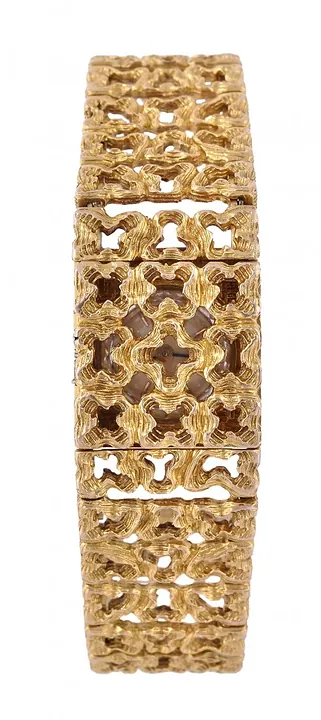
Girard Perregaux, a lady's 18 carat gold bracelet, c. 1970
LiveAuctioneers auction archive
Wristwatches · 1999
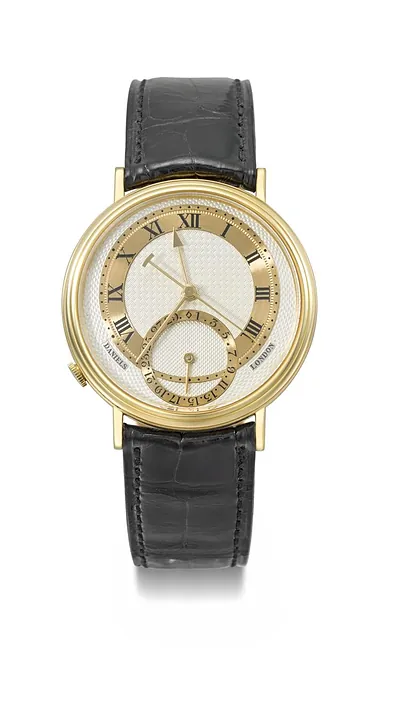
'Millennium' co-axial wristwatch by George Daniels and Omega, England, 1999
Science Museum Group, London

Wristwatches · 2008
Wristwatch by Breitling?, 2008
Museum Rotterdam
Wristwatches · 2008
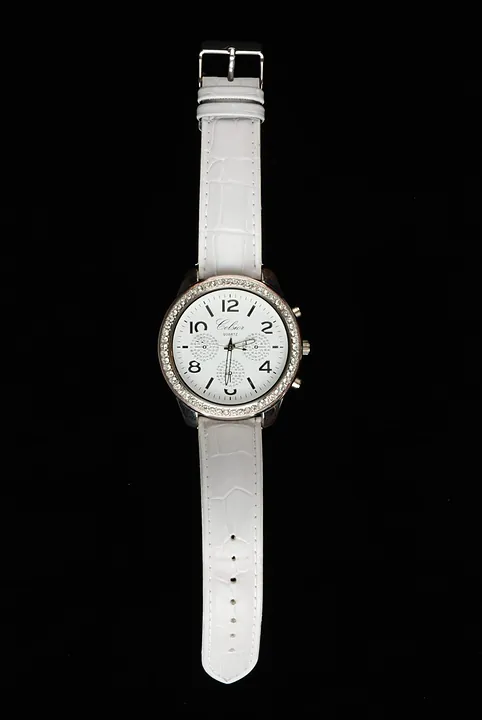
Wristwatch by Celsior Quartz, 2008
Museum Rotterdam
Wristwatches · 2008
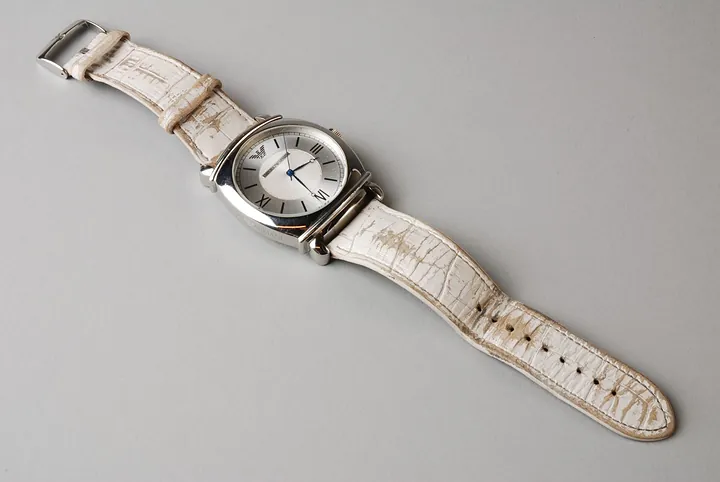
Wristwatch possibly by Emporio Armani, 2008
Museum Rotterdam