
Wristwatches · Wristwatch
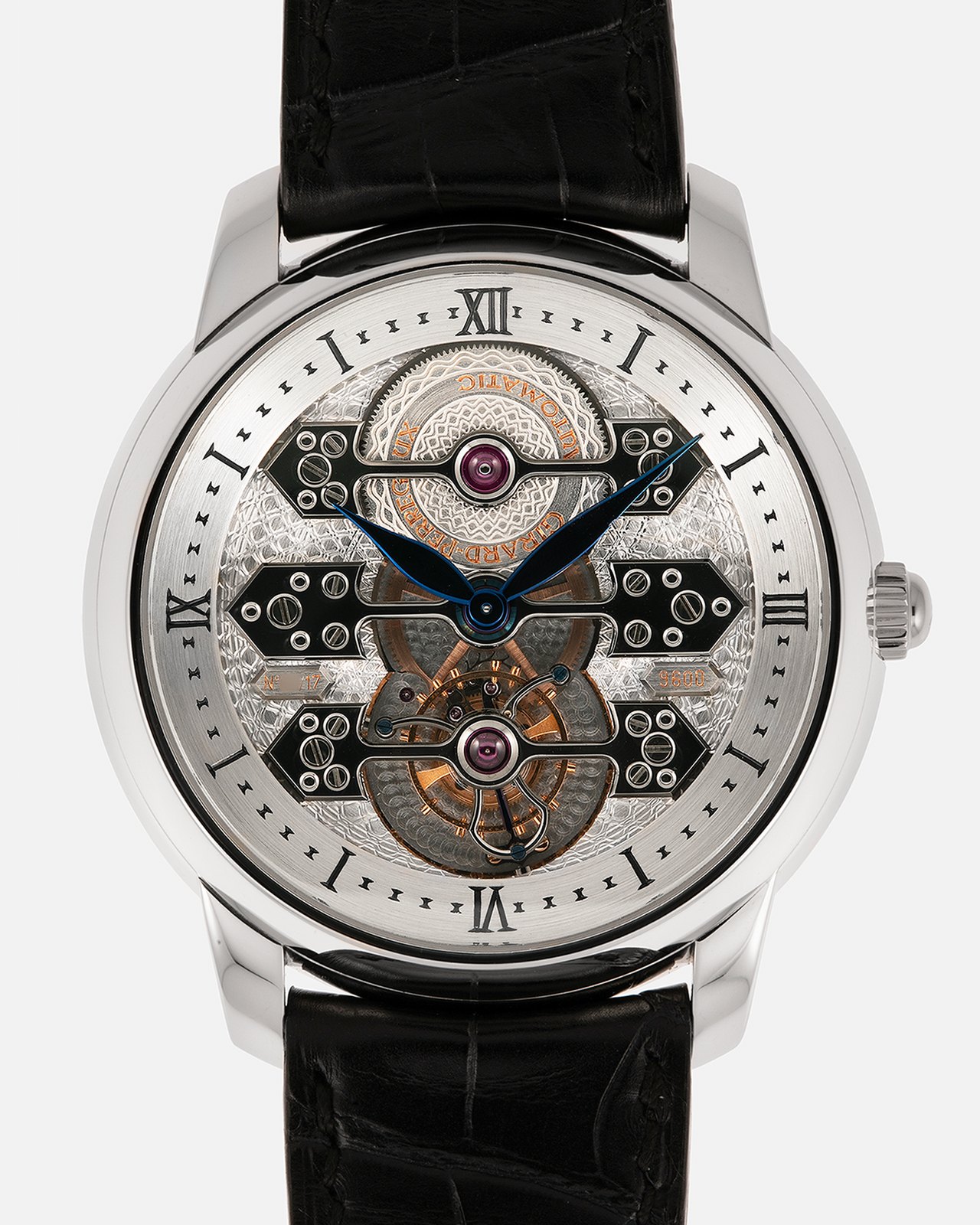
Girard Perregaux Three Bridges Tourbillon 99095 Sincere Edition Platinum, 2007
- Maker / attribution
- Girard-Perregaux (maker)
- Date
- 2007
- Historical period
- Mechanical Renaissance (1990 – 2010)
- Country of origin
- Switzerland
- Object type
- Wristwatch
- Materials / technique
- platinum
- Dimensions
- Case 42 mm
- Stock no.
- Product 7561607217239
- Credit line
- Dealer listing, S.Song Watches (product 7561607217239)
- Catalogue title (original)
- Girard Perregaux Three Bridges Tourbillon 99095 Sincere Edition Platinum (English)
View the source record (dealer listing) ↗ (opens another website in a new tab)Suggest a correction
Record summary
Catalogued by S.Song Watches (dealer), Seattle (stock number Product 7561607217239), this is a wristwatch by Girard-Perregaux, made in Switzerland, dated 2007. The Atlas places it in the Mechanical Renaissance period (1990 – 2010) of its Wristwatches collection. Materials and techniques recorded by the source: platinum. Recorded dimensions: Case 42 mm. The record is illustrated with 6 photographs.
Assembled from the source record's structured fields. Dates and attributions are given as the source states them; where a field is missing the Atlas leaves it blank rather than estimating.
Catalogue description
Dealer description — S.Song Watches
In watchmaking, designing a watch that feels both contemporary and timeless is no easy feat, and in the 19th century, it was hardly considered. You see, back then, movement architecture was judged almost exclusively on reliability and precision, with little to no attention to visual expression. Against this backdrop, Girard‑Perregaux founder Constant Girard introduced something entirely unexpected. In 1867, he created a tourbillon pocket chronometer featuring three nickel bridges, arranging the movement in a clear, linear structure that was both visually intentional and mechanically precise. This functional solution quickly proved its merit, earning a First Class Bulletin from the Neuchâtel Observatory—an endorsement reserved for movements demonstrating exceptional precision under rigorous trials. Buoyed by this acclaim, Girard pushed the concept further in 1884, patenting the first tourbillon movement with three gold bridges, a design that would become inseparable from the brand’s identity. Rather than a single bridge spanning the movement, he introduced three substantial, decorated bridges arranged in parallel, combining structural integrity with visual intent. The design attained international recognition in 1889, when it was presented at the Paris Universal Exhibition and awarded a gold medal. Its most celebrated expression, the 1889 La Esmeralda pocket watch, once owned by the President of Mexico, is now preserved in the Girard‑Perregaux museum. Beyond its historical importance, the Three Bridges configuration was mechanically coherent. The linear arrangement of the barrel, gear train, and tourbillon follows the natural flow of energy from mainspring to escapement and balance, with each component efficiently supported along the bridges. Crucially, these bridges were designed to be admired, elevating structural necessity into a defining visual language. Mind you, achieving this level of clarity is far from straightforward: some components had to be concealed on the reverse to keep the dial clean, while the solid-gold bridges required meticulous hand-polishing and precise anglage . Over the years, Girard-Perregaux continued to refine the concept, though the Three Bridges design gradually fell into obscurity through much of the early to mid-20th century as tastes shifted and production priorities changed. After this long period of dormancy, it was revived in 1981 with the modern Three Gold Bridges pocket watch. A decade later, the architecture was then successfully miniaturised into a wristwatch tourbillon with the introduction of the Tourbillon Sous Trois Ponts d’Or around 1991, marking the brand’s bicentenary. What we have today is a compelling continuation of that evolution: the limited edition 99095 in platinum, produced in 2006 in a series of just 17 numbered pieces for Sincere Haute Horlogerie (SHH), the high-end independent watchmaking division of Singapore-based luxury retailer Sincere Fine Watches. True to the Three Bridges ethos, the dial side showcases exceptional overall finishing. The bridges are held in place by black-polished screws and are treated in ruthenium, which is a dark, corrosion-resistant finish that enhances contrast while preserving traditional hand-finishing, including extensive polishing and chamfering. Beneath this sits a richly detailed dial with a multitude of engraved surfaces, accompanied by a satin-brushed peripheral chapter ring with Roman numerals, and a set of blued hands at the centre. The one-minute tourbillon is positioned at 6:00, beating at 21,600 vph and maintaining consistent performance regardless of orientation. Altogether, this historic architecture is brought to the wrist in a highly wearable 42mm x 11mm case format, balancing engineering, craftsmanship, and artistic mastery all within a single cohesive package. At its heart lies Girard‑Perregaux’s in-house Cal. 9600, a highly decorated, hand-wound tourbillon movement developed specifically to support the Three Bridges architecture. Its linear construction aligns the barrel, gear train, and tourbillon on a single axis, allowing the bridges to serve both structural and visual roles. Even with a solid caseback fitted, the caliber is finished to a high standard and delivers 48 hours of power reserve when fully wound. Given its highly limited production numbers, this variation of the Three Bridges is an exceptionally rare one. It’s interesting to think that a concept conceived over a century ago still feels relevant and timeless today, perfectly illustrating how Girard‑Perregaux has transformed a historic innovation into a living design language, where engineering, aesthetics, and heritage coexist seamlessly.
Historical context
Mechanical Renaissance (1990 – 2010)
Mechanical watches return as cultural objects; independent watchmaking flourishes.
Mechanical watches returned as cultural and luxury objects. Complications, tourbillons and new materials proliferated; independent watchmakers such as George Daniels, F.P. Journe and Philippe Dufour revived artisanal watchmaking; collecting vintage watches became a major field.
Read the period in the timelineMore wristwatches from this periodEarlier: Quartz Revolution
Atlas type guide
Wristwatches
Bracelet watches were worn by women from the early nineteenth century — Breguet made one for Caroline Murat, Queen of Naples, in 1810–12 — but the wristwatch only became a man's instrument with military use and aviation in the early twentieth century. Between the World Wars it overtook the pocket watch; the 1920s and 1930s brought rectangular Art Deco cases, water-resistant cases and the first automatic winding systems.
After 1945 the wristwatch became a carrier of identity — dress watches, sports and dive watches, chronographs, calendars — produced by Swiss, American, Japanese, German, Soviet and Chinese industries. The quartz revolution after 1969 and the mechanical renaissance since the 1990s, including the rise of independent watchmakers, complete the story.
What to look for
- The reference number (between the lugs or inside the case back) and serial number, the starting point for dating.
- The calibre: its maker and number are often stamped under the dial or on the bridge.
- Originality of dial, hands and crown — refinished ('redial') dials are common.
- Case material marks: 18K/750, 14K/585, stainless steel, gold-filled, plated.
Dating clues
- Wire-lug cases: before c. 1925.
- Water-resistant screw-down cases: from 1926.
- Quartz movements: from 1969; sapphire crystals widespread after c. 1980.
General guidance written by the Atlas editors about this kind of object. It is not a statement about this particular piece; for that, rely on the source record above and on physical examination.
Related records
Wristwatches · 1970s
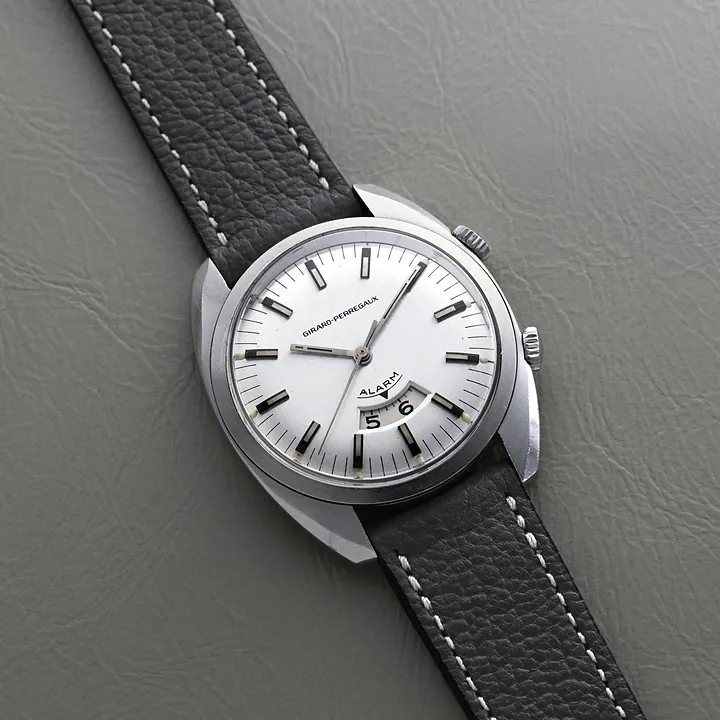
Girard Perregaux Alarm, 1970s
Analog/Shift (dealer), New York
Wristwatches · 1960s
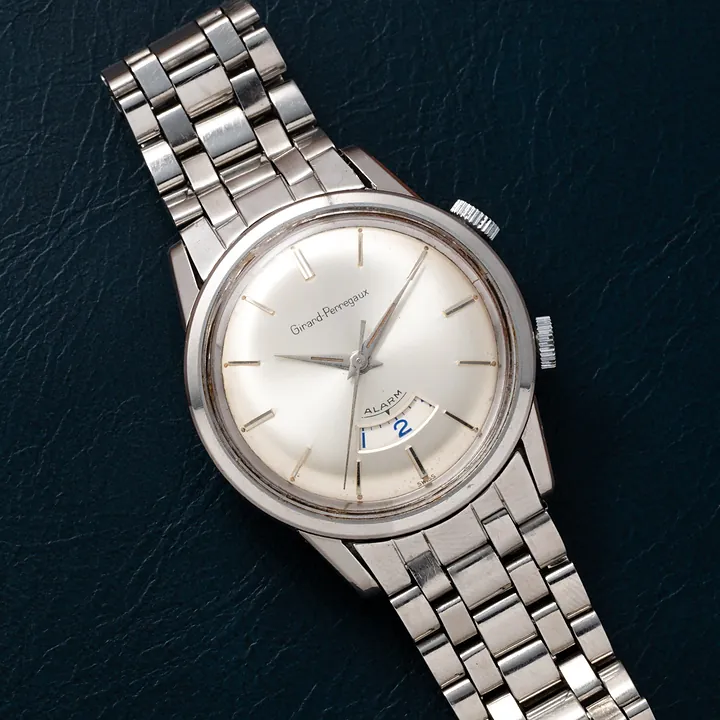
Girard Perregaux Alarm, 1960s
Analog/Shift (dealer), New York
Wristwatches · c. 1940s
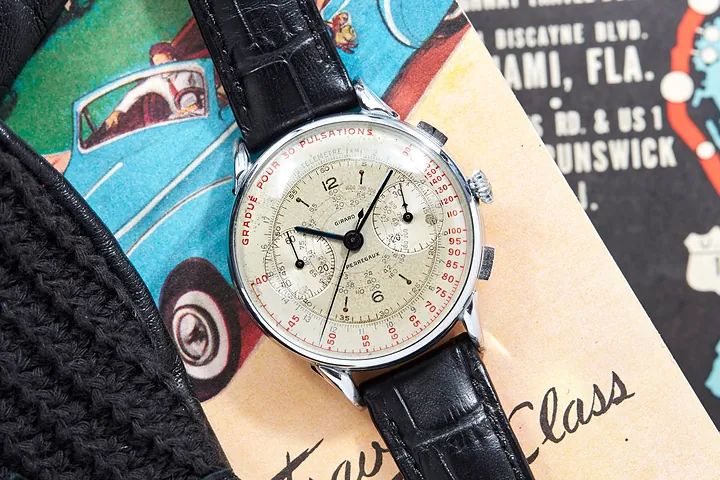
Girard-Perregaux Pulsations Chronograph, c. 1940s
Analog/Shift (dealer), New York
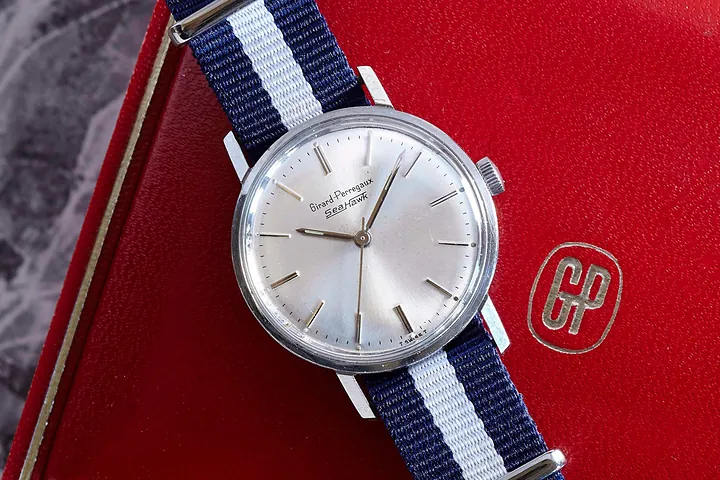
Wristwatches · 1960
Girard-Perregaux Seahawk, 1960
Analog/Shift (dealer), New York

Wristwatches · 2008
Wristwatch by Breitling?, 2008
Museum Rotterdam

Wristwatches · c. 1990s
Audemars Piguet Bamboo, c. 1990s
Antiquorum auction archive, Geneva

Wristwatches · c. 1990
Audemars Piguet Huitieme Perpetual Calendar, ref. 25696PT, c. 1990
Antiquorum auction archive, Geneva

Wristwatches · c. 1990
Breitling Chronomat, ref. b13050.1, c. 1990
Antiquorum auction archive, Geneva