
Wristwatches · Wristwatch
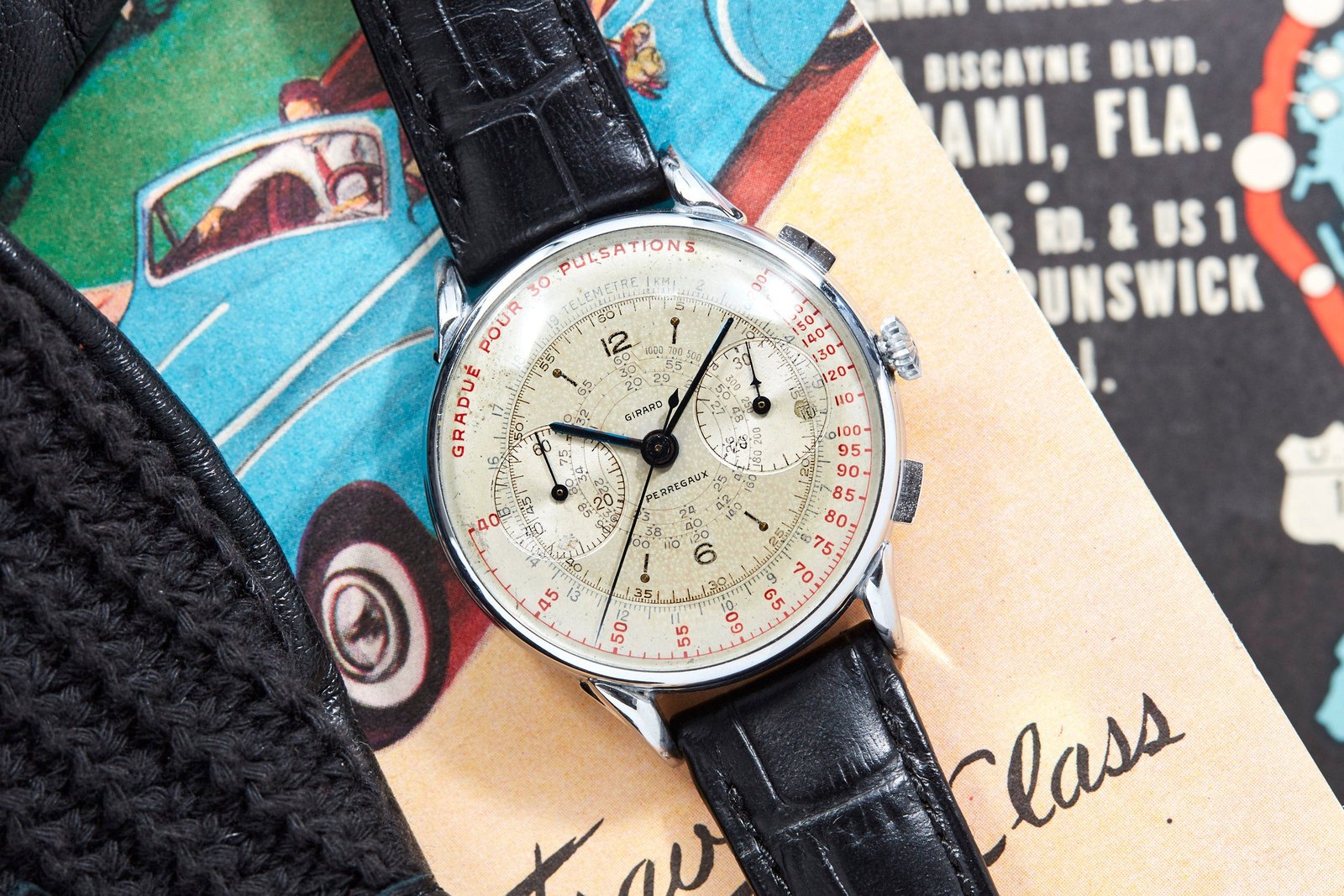
Girard-Perregaux Pulsations Chronograph, c. 1940s
- Maker / attribution
- Girard-Perregaux (maker)
- Date
- c. 1940s
- Historical period
- Golden Age of Mechanical Watchmaking (1900 – 1945)
- Country of origin
- Switzerland
- Object type
- Wristwatch
- Dimensions
- Case 42 mm
- Stock no.
- Product 272135651358
- Credit line
- Dealer listing, Analog/Shift (product 272135651358)
- Catalogue title (original)
- Girard-Perregaux Pulsations Chronograph (English)
View the source record (dealer listing) ↗ (opens another website in a new tab)Suggest a correction
Record summary
Catalogued by Analog/Shift (dealer), New York (stock number Product 272135651358), this is a wristwatch by Girard-Perregaux, made in Switzerland, dated c. 1940s. The Atlas places it in the Golden Age of Mechanical Watchmaking period (1900 – 1945) of its Wristwatches collection. Recorded dimensions: Case 42 mm. The record is illustrated with 6 photographs.
Assembled from the source record's structured fields. Dates and attributions are given as the source states them; where a field is missing the Atlas leaves it blank rather than estimating.
Catalogue description
Dealer description — Analog/Shift
When presented with a chronograph and pressed to name a purpose for it, many might spring to mind. For example, there are chronographs like the Breitling Co-Pilot or the Gallet Multi-Chron Regulator , which were used by pilots. Divers (both recreational and military) might find themselves descending into the murky depths with a JLC Deep Sea Chronograph or Fortis Marinemaster strapped to their wrists. And many of the best Formula 1 drivers tackled the turns of the world’s preeminent racecourses with a Heuer Autavia or a Heuer Camaro timing their laps. There are chronographs for yachting (the Yema Yachtingraf ), or just about any sport one can conceive of (like the Enicar Sherpa Graph ); even engineers have a chronograph they can use in their jobs (the Breitling Chronomat ). So when it comes to the medical field, a profession in which accurate timekeeping is a matter of life and death, it stands to reason that there would be a chronograph made specifically for doctors or nurses. Starting in the days of pocket watches, chronographs began to emerge with a specialized scale on the outer edge of the dial. Known as a a pulsometer or pulsograph, it measures heartbeats per minute on a scale of 15 to 30 heart beats. To calculate a patient's pulse, the wearer would stop the chronograph at the patient's 15th or 30th heartbeat, and the patient's pulse would then be indicated on the dial without any additional calculations necessary. The chronograph that we feature here is a pulsometer made by Girard-Perregaux. The brand’s history of innovation, which started from its earliest days in the 1880s, includes pioneering efforts in early wristwatches. Since their beginnings, the brand has filed for over 80 patents. Watches made by Girard-Perregaux found their way to the wrists of officers in the German Navy. This particular chronograph, dating from roughly the 1940s or 1950s, features a pulsometer scale on the outer edge of the dial, as well as an inner telemeter scale. Oversized for the era with a 42mm stainless steel case adorned with a large onion crown, and featuring oversized chronograph registers, it’s ideal for its intended purpose. Whether you’re a doctor, a nurse, or just desire a chronograph with an unusual use, this GP has it all.
Historical context
Golden Age of Mechanical Watchmaking (1900 – 1945)
The wristwatch displaces the pocket watch; waterproof cases, self-winding and grand complications.
The wristwatch overtook the pocket watch. Military use in the First World War, aviation, water-resistant cases (1926), automatic winding (1923–31), rectangular Art Deco designs and early chronographs and calendars defined the period.
Read the period in the timelineMore wristwatches from this periodEarlier: Industrial Revolution
Atlas type guide
Chronographs and split-seconds watches
A chronograph is a watch with an additional seconds hand that can be started, stopped and returned to zero independently of the timekeeping. Louis Moinet built an early example in 1816 and Nicolas Rieussec a recording 'chronographe' in 1821; Adolphe Nicole's heart-shaped reset cam (patented 1862) made the modern return-to-zero possible. Split-seconds (rattrapante) chronographs add a second hand that can be stopped for intermediate times; flyback chronographs restart instantly.
Chronographs were essential tools for doctors (pulsometer scales), artillery (telemeter), engineers and sport. In wristwatches, Valjoux, Venus, Lemania and later the automatic chronographs of 1969 (Zenith El Primero, the Chronomatic Calibre 11 group and Seiko 6139) are milestones.
What to look for
- Push-pieces on the case band or a single button in the crown (monopusher).
- Subsidiary registers for minutes and hours; tachymeter, telemeter or pulsometer scales.
- Column wheel versus cam control visible in the movement.
- Calibre markings of specialist makers (Valjoux, Lemania, Venus, Landeron).
Dating clues
- Pocket chronographs with heart cam reset: after 1862.
- Wrist chronographs: from c. 1910; two-button designs from the 1930s.
- Automatic chronographs: from 1969.
General guidance written by the Atlas editors about this kind of object. It is not a statement about this particular piece; for that, rely on the source record above and on physical examination.
Read next:Flyback chronographChronograph
Related records
Wristwatches · 1970s
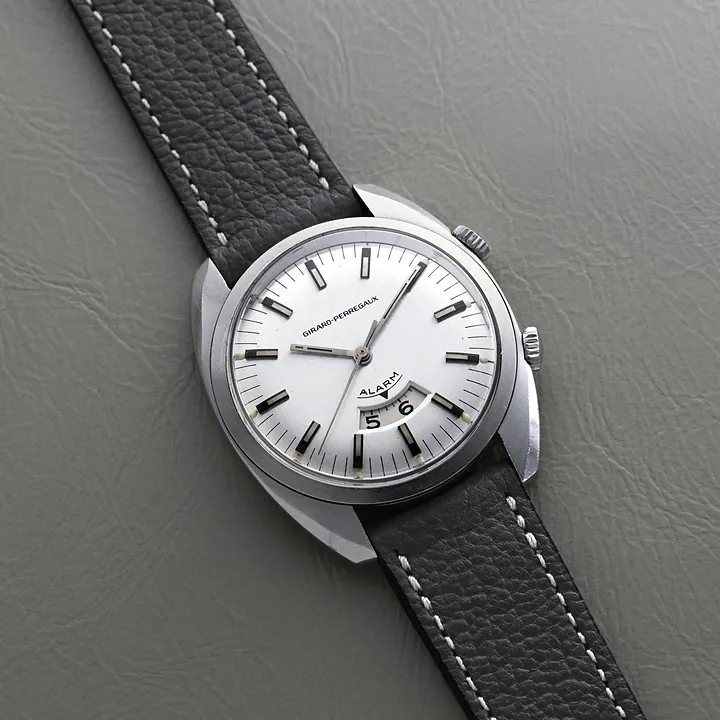
Girard Perregaux Alarm, 1970s
Analog/Shift (dealer), New York
Wristwatches · 1960s
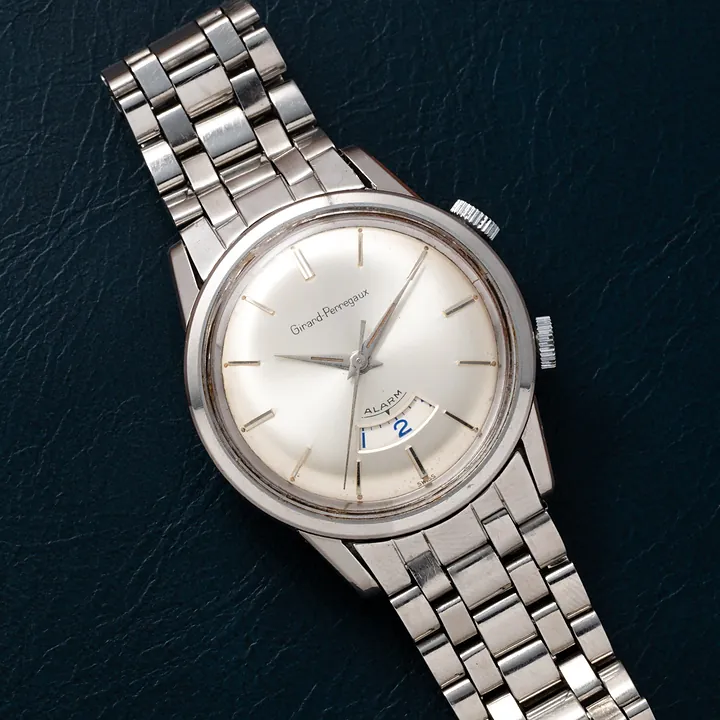
Girard Perregaux Alarm, 1960s
Analog/Shift (dealer), New York
Wristwatches · 1960
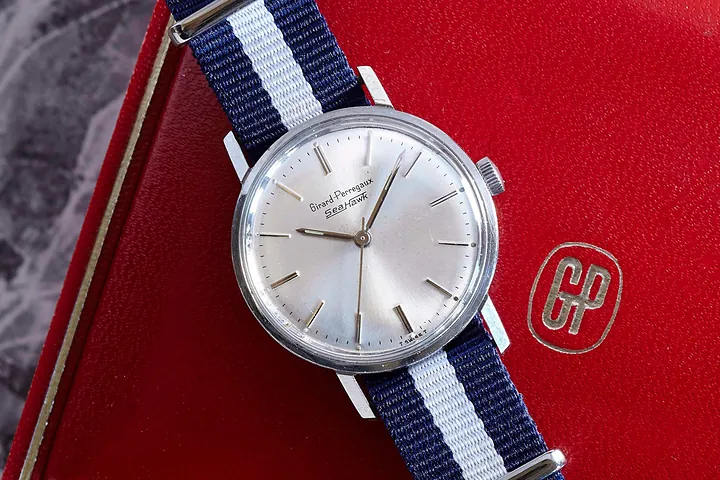
Girard-Perregaux Seahawk, 1960
Analog/Shift (dealer), New York
Wristwatches · 2024
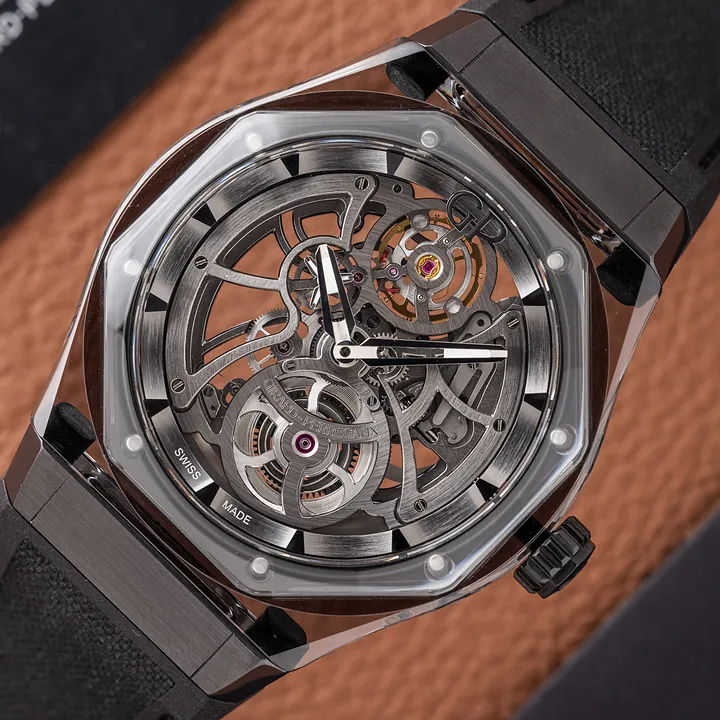
Girard-Perregaux Laureato Absolute Sapphire Case (Ref. 81071-43-2022-1CX ), 2024
Huntington Company (dealer)

Wristwatches · 1931
Rolex 'Oyster Perpetual' rotor self-winding wrist-watch, lever escapement, in steel case with glass in back, Montres Rolex SA, Geneva, Switzerland, 1931
Science Museum Group, London

Wristwatches · 1900–1999
Wristwatch by Certina, Switzerland, 1900–1999
Nordic Museum Foundation

Wristwatches · 1900–1999
Wristwatch by Omega, Västerås, 1900–1999
Nordic Museum Foundation

Wristwatches · 1900–1999
Wristwatch by Universal, Switzerland, 1900–1999
Nordic Museum Foundation