
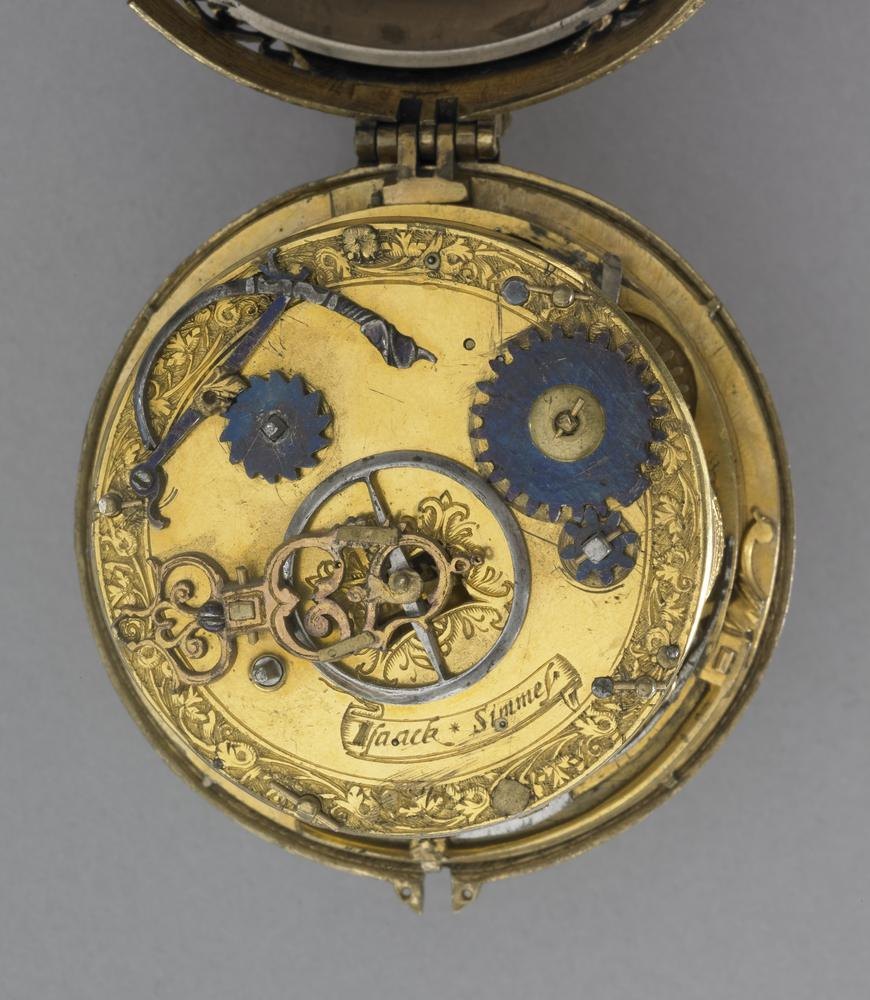
Pocket Watches · Alarm watch
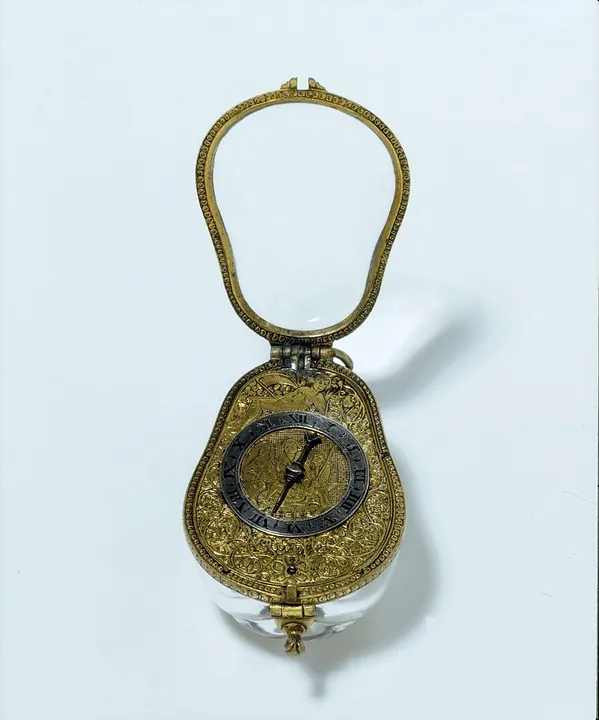
Gilt-Brass Cased Verge Clock-Watch with Alarm and One-at-the Hour Passing Strike
- Maker / attribution
- Isaac Simmes (Made by)
- Date
- 1600–1610
- Historical period
- Early Modern Horology (1600 – 1750)
- Country of origin
- England
- Place
- London (England) (Aldgate)
- Object type
- Alarm watch
- Materials / technique
- brass, gold
- Dimensions
- Diameter: 60 millimetres (case) Weight: 170.50 grammes (case and hand) Weight: 87 grammes (movement) Weight: 257.50 grammes
- Holding institution
- British Museum
- Accession / object no.
- 1894,0720.1
- Credit line
- British Museum, London
- Catalogue title (original)
- Gilt-Brass Cased Verge Clock-Watch with Alarm and One-at-the Hour Passing Strike (English)
View the source record ↗ (opens another website in a new tab)Suggest a correction
Record summary
Held and catalogued by British Museum (object number 1894,0720.1), this is an alarm watch by Isaac Simmes, made in London (England) (Aldgate), dated 1600–1610. The Atlas places it in the Early Modern Horology period (1600 – 1750) of its Pocket Watches collection. Materials and techniques recorded by the source: brass, gold. Recorded dimensions: Diameter: 60 millimetres (case) Weight: 170.50 grammes (case and hand) Weight: 87 grammes (movement) Weight: 257.50 grammes. The record is illustrated with 6 photographs.
Assembled from the source record's structured fields. Dates and attributions are given as the source states them; where a field is missing the Atlas leaves it blank rather than estimating.
Catalogue description
Description — British Museum
Gilt-Brass Cased Verge Clock-Watch with Alarm and One-at-the Hour Passing Strike. : Case: Gilt-brass case with hinged lid and integral back. The band is pierced and engraved with foliate scrolls between upper and lower hatched raised mouldings. On the back, within a foliate border with rabbits and mice, is an engraved depiction of Elija and the Priests of Baal. The outside of the lid has a similar border enclosing a depiction of The Sacrifice of Isaac. The inside of the lid is engraved with a coat of arms. Cast gilt-brass pendant with loose ring. Turned finial. : Dial & Hand: Gilt-brass dial with four lugs around the edge. An engraved foliate border surrounds an engraved chapter-ring with Roman hours I-XII and star half-hour marks within a circle of touch-pins. In the centre the alarm-setting disc has an outer border of roundels surrounding Arabic hours 1-12 for alarm setting. The disc has holes to aid rotation. The central area is engraved with a radiating geometric design. : Movement: Frame: Circular gilt-brass plates with four baluster pillars. Riveted potence and riveted counter-potence, the latter replaced. Engraved decoration around the verge aperture and an engraved foliate border around the back-plate. There is a separate riveted bridge for the recessed second wheel and the contrate pinion of the alarm train. : Mainspring & Set-up: Gilt-brass barrel with steel base and dovetailed brass cap, the latter not original. In the barrel wall, a riveted steel hook and two holes for gut-line attachment. Bow-and-arrow ratchet and click set-up, the steel click arm with a shaped gilt-brass cover where it engages with the ratchet wheel. The blued-steel ratchet wheel not original. The steel mainspring is a replacement, being far too small in height for the available space in the barrel. : Fusee & Stop-work: Gilt-brass fusee with gilt line and standard stop-work. The fusee may have been re-cut for gut-line after having been damage by a crude alteration to chain use or perhaps modified for use with the new mainspring. : Going train: Three wheel train of gilt-brass wheels, the second and contrate wheels each with three crossings, the contrate wheel probably not original. : Escapement & Balance: Verge escapement with steel two-arm balance. The pierced and engraved foliate balance cock is pinned to a stud on the back-plate. This original cock, at some time damaged, has been very poorly repaired with lead solder and is now also secured to the potence-plate with a screw in addition to the normal transverse pin through the stud. : Alarm Mechanism: Powered by a fixed barrel, pierced and engraved with foliate scrolls on the visible side. The train consists of three wheels, the contrate and crown wheels made from steel, each with a separate brazed-on rim. The semi-circular alarm hammer, mounted on the alarm verge, is operated by a crown wheel running in a riveted potence with engraved decoration on the visible side, and a screwed-on counter-potence. Steel semi-circular hammer mounted on the verge. : Striking Mechanism: A one-at-the-hour passing strike operated by a 12-point star-wheel mounted on the hour wheel. The hammer, release lever and buffer-spring are later replacements. There is also a later alarm stop lever of plain brass, pivoting on a stud on the inside of the back-plate, which intercepts the hammer. : Motion-Work/Duration: Pinion of report:6 Dial wheel:60 Turns on fusee:12.5 Duration: 15 hours : Train Count: Great wheel:60 Second wheel:48 pinion:6 Contrate wheel:42 pinion:6 Crown wheel:17 pinion:6 : Beats per hour:15,866.66 [nb. train not all original] : Alarm Train: Great wheel:40 Second wheel:27 pinion:8 Contrate wheel:24 pinion:6 Crown wheel:9 pinion:6.
Curator's comments — British Museum
Text from 'Watches', by David Thompson, London, 2008, p. 26-27. Isaac Simmes GILT-BRASS CASED VERGE WATCH WITH ALARM AND ONE-AT-THE-HOUR STRIKING LONDON, 1600-10 SIGNED: 'Isaack Simmes' By the beginning of the seventeenth century, there was a growing number of watchmakers in the City of London, and while many of them were members of the Blacksmiths' Company, a small number joined the Goldsmiths' Company. Isaac Simmes was one of them. He was born around 1580, the son of Roger Simmes, a clerk of London, and was apprenticed in the Company to John Humphrey in 1594. The Goldsmiths' Company records read: 'In that Isaac Symmes, the son of Roger Symes clarke of London have put myself prentis to John Harmfri for eight years. Beginning Michelmas 1594. By me Isaac Symmes.' Two years later another entry shows that his master changed: '1596 Memorandum that Isaac, the son of Roger Symes of London Clarke have put myself prentis to Richard Lytler for IX years at the birth of our Lord Ano 1596. By me Isaac Symes.' The story is complicated further by an entry in the records of his freedom, which reads: 'Isaac Symmes, Servant to John Humfrey for four years and the rest with Daniel Bennett, Friday 27th January 1603/4.' In March of that same year, now free of his apprenticeship and able to wed, the Archdeaconry Court of London records his marriage: 'March 12th 1603/4, Isaac Symmes of St Botolph Aldgate, London, Goldsmith and Emma Howe of St Bartholomew the Great, West Smithfield, widow of Henry Howe late of same, yeoman. At St Botolph Aldgate.' Simmes died in November 1622. One of the last references to him before his death is found in the famous 1622 petition of the clockmakers to King James I against the practices of a group of Huguenot watchmakers in Blackfriars and in quest of a new City livery company for clock- and watchmakers. Simmes's name appears alongside others as one of the established City makers. The petition failed, and it was not until 1631 that a charter was granted for the establishment of the Worshipful Company of Clockmakers. This is a fine example of an alarm watch of the period. It is unusual in having one-at-the-hour striking, in which a simple mechanism causes a hammer to strike the bell just once each hour. The case back and cover show scenes from the Bible: the Sacrifice of Isaac on the cover and Elijah and the priests of Baal on the back. Biblical scenes were quite popular as decoration on both English and French watches during this period. The dial, however, shows more of a Flemish or Dutch influence, with the design engraved on the alarm-setting disc. In keeping with a number of its contemporaries, this watch has engraved arms on the inside of the lid, showing evidence of its early owners. Here, in a well-executed shield, are the combined arms of the Weld, Greswold, Fitzhugh and Button families, used by John Weld and his wife Dorothy, née Greswold. The watch probably belonged to their son, also named John, who was later knighted and became Town Clerk of London and High Sheriff of Shropshire. View more about curator's comments The engraved illustrations on the outer faces of the lid are base on Elija and the Prophets of Baal, taken from Kings I Ch.18 verses 17-40, and The Sacrifice of Issaac from genesis, ch.22, verses 1-19. The engraved arms on the inside of the case are, "Quarterly, first, azure a fess nebulee betwwen three crescents ermine (for Weld). Fourth, argent, a fess gules between two grehounds courant sable (for Greswold) . Second, azure, three lions rampant or, two and one, and a chief argent (for Button). Third, azure, three chevronels sable, braced or (for Fitzhugh). In the centre a crescent for difference. Crest, a winged wyvern, wings expanded sable gutee d'or plain gorged and chained gold. For a discussion of the arms and the first ownership of the watch see, D.Thompson in Bibliography below. : The watch has undergone a number of alterations particularly to the going train and one-at-the-hour striking mechanism, the latter of which is mostly replacement : For a similar watch see cat.no 00 where a watch signed Nicholas Vallin shows characteristics in the design of a similar nature and also has a single-blow striking mechanism. : A third example of this one-at-the-hour striking system can be found in a watch, also by Nicholas Vallin, now in the Metropolitan Museum of Art, New York, and formerly in the John Pierpont Morgan collection presented to the Museum in 1917 by his son J. Pierpont Morgan Jnr. In his cartalogue of Pierpont Morgan's collection, C.G. Williamson describes the watch as a repeating watch, not recognising the alarm and striking mechanism in the watch. David Thompson, "A Verge Watch with Alarm and Passing Strike By Isaac Simmes", Antiquarian Horology, Vol.XVI (March 1987) pp.499-506.
Inscriptions & marks
signature; back plate; Isaack Simmes
Provenance
Purchased from:, Rev C R Manning; Acquired 1894
Historical context
Early Modern Horology (1600 – 1750)
Huygens' pendulum and balance spring transform accuracy; English makers develop the anchor and deadbeat escapements.
The balance spring (c. 1675) improved watches dramatically and introduced the minute hand. English pair-cased verge watches with pierced balance cocks and French oignons were typical; enamel painting at Blois and Geneva, and the repeating watch (1680s), made watches objects of great refinement.
Read the period in the timelineMore pocket watches from this periodEarlier: Renaissance Horology
Atlas type guide
Early spring-driven watches
Portable spring-driven timepieces appeared in southern Germany, France and Italy in the early sixteenth century; Peter Henlein of Nuremberg is traditionally credited, although the historical record is complex. These early watches were worn as pendants or carried, had iron or brass movements with a verge escapement and a foliot or small balance, and used a stackfreed or fusee to equalise spring force. They indicated hours only and were notoriously inaccurate.
From the later sixteenth century watches were made in Blois, Paris, Geneva, London and Augsburg in oval, octagonal, cruciform, skull and other 'form' cases of rock crystal, gilt brass, silver and enamel. They were jewellery and status objects as much as timekeepers.
What to look for
- A single hour hand and often a touch-pin hour ring for feeling the time.
- Stackfreed (a cam and spring) instead of a fusee on German watches.
- Pierced and engraved cocks over the balance, fine gut fusee lines.
- Rock-crystal, enamelled or engraved form cases.
Dating clues
- Drum-shaped German watches: c. 1530–1580.
- Oval and form watches: c. 1580–1650.
- Before c. 1675 there is no balance spring; watches can vary by many minutes a day.
General guidance written by the Atlas editors about this kind of object. It is not a statement about this particular piece; for that, rely on the source record above and on physical examination.
Read next:FoliotThe Melanchthon watch
Related records
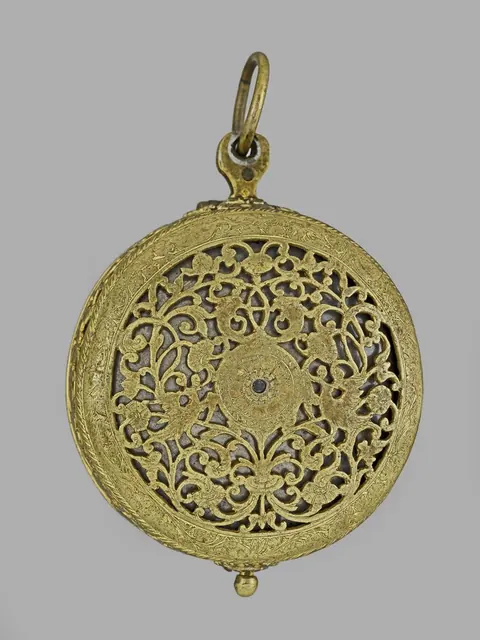
Pocket Watches · 1615–1620
Gilt-brass cased verge, hour-striking clock-watch
British Museum
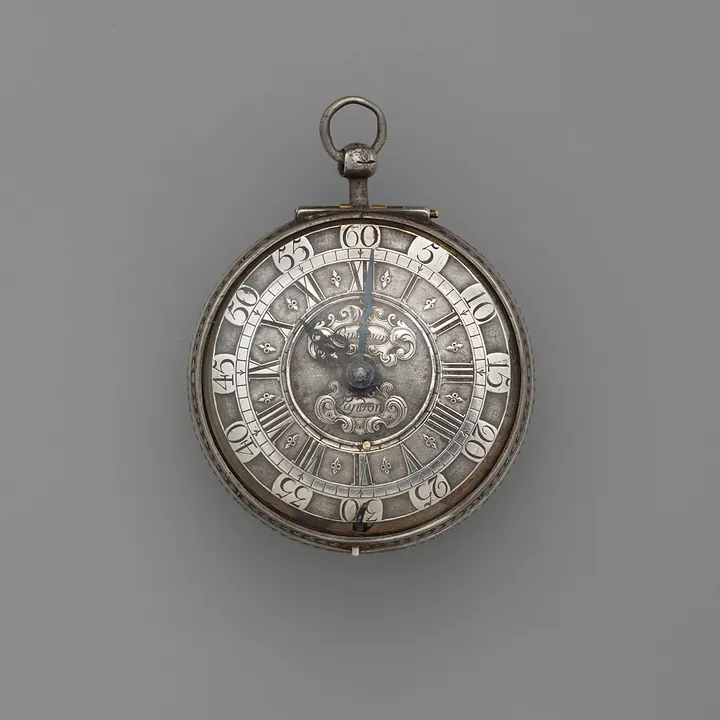
Pocket Watches · 17th century
Watch by John Bushman, England, 17th century
The Metropolitan Museum of Art, New York
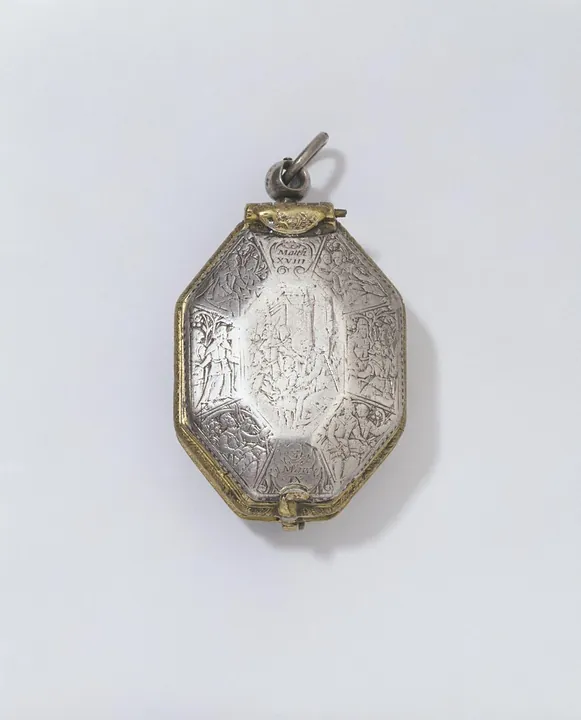
Pocket Watches · c. 1610-1620
Case and dial of engraved silver and gilt brass. English, about 1640.
Victoria and Albert Museum, London
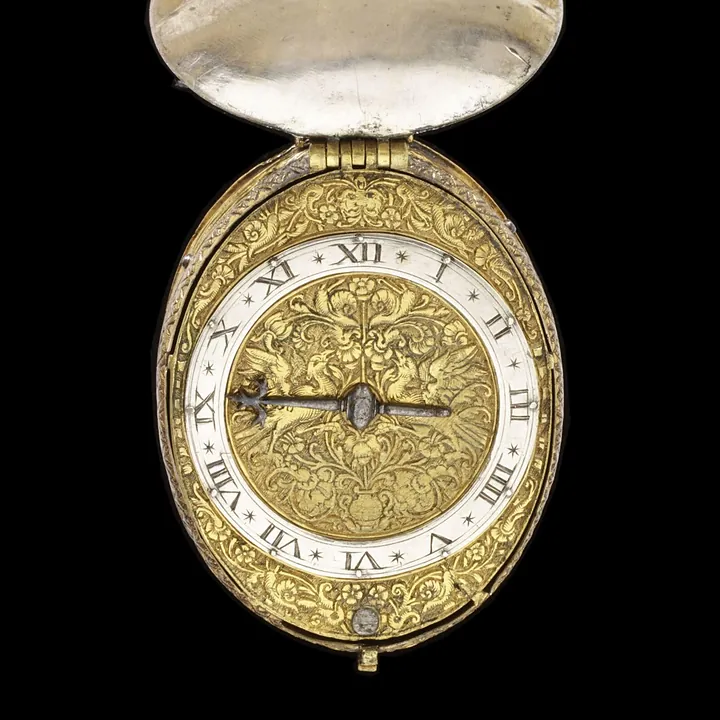
Pocket Watches · c. 1610
Watch by N. Ridgdale, England, c. 1610
Victoria and Albert Museum, London
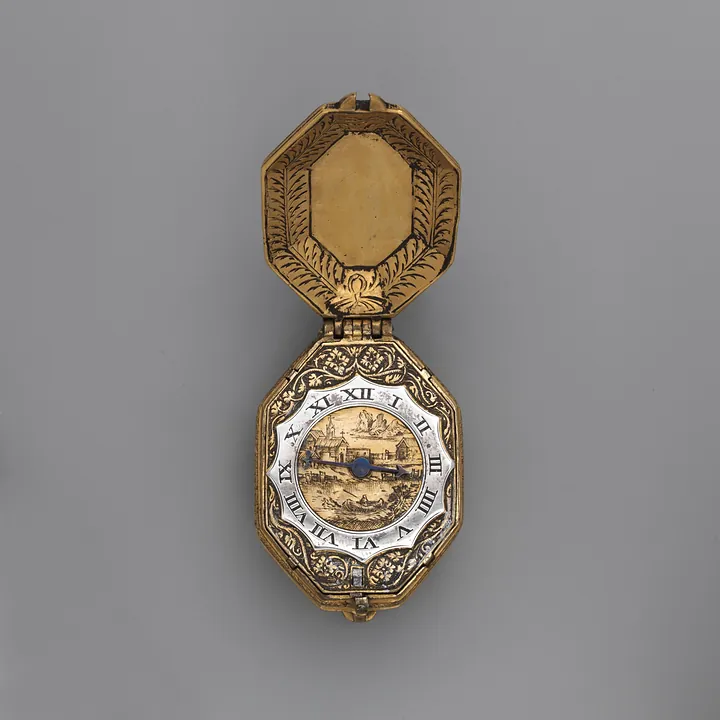
Pocket Watches · c. 1620–25
Watch by Isaac Symms, England, c. 1620–25
The Metropolitan Museum of Art, New York
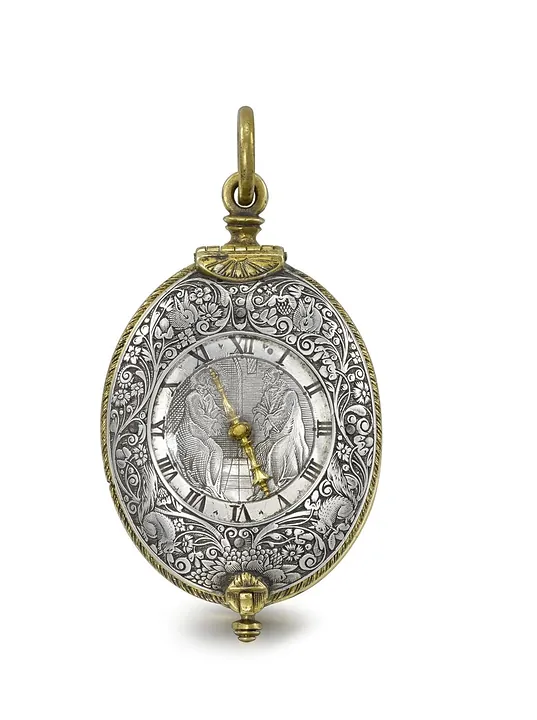
Pocket Watches · 1622–1628
Pocket watch by James Vautrollier, England, 1622–1628
Science Museum Group, London
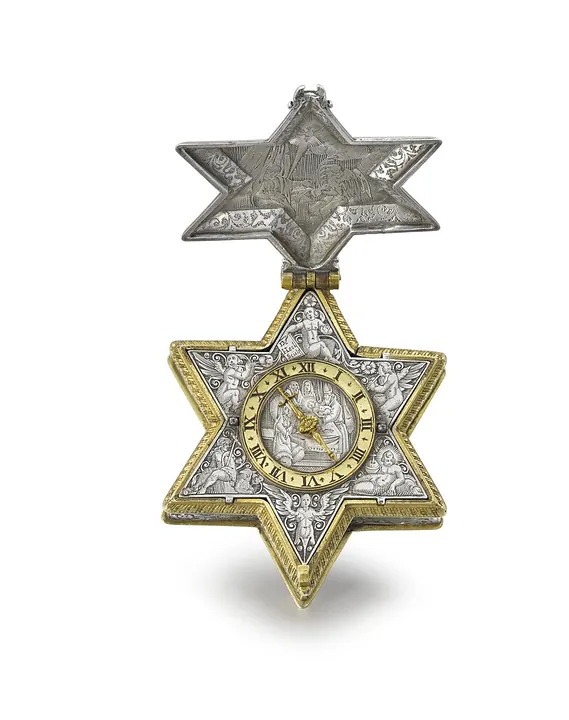
Pocket Watches · 1625
Pocket watch by David Ramsay, England, 1625
Science Museum Group, London
Pocket Watches · c. 1635
Jewellery, England
Victoria and Albert Museum, London