
Wristwatches · Wristwatch
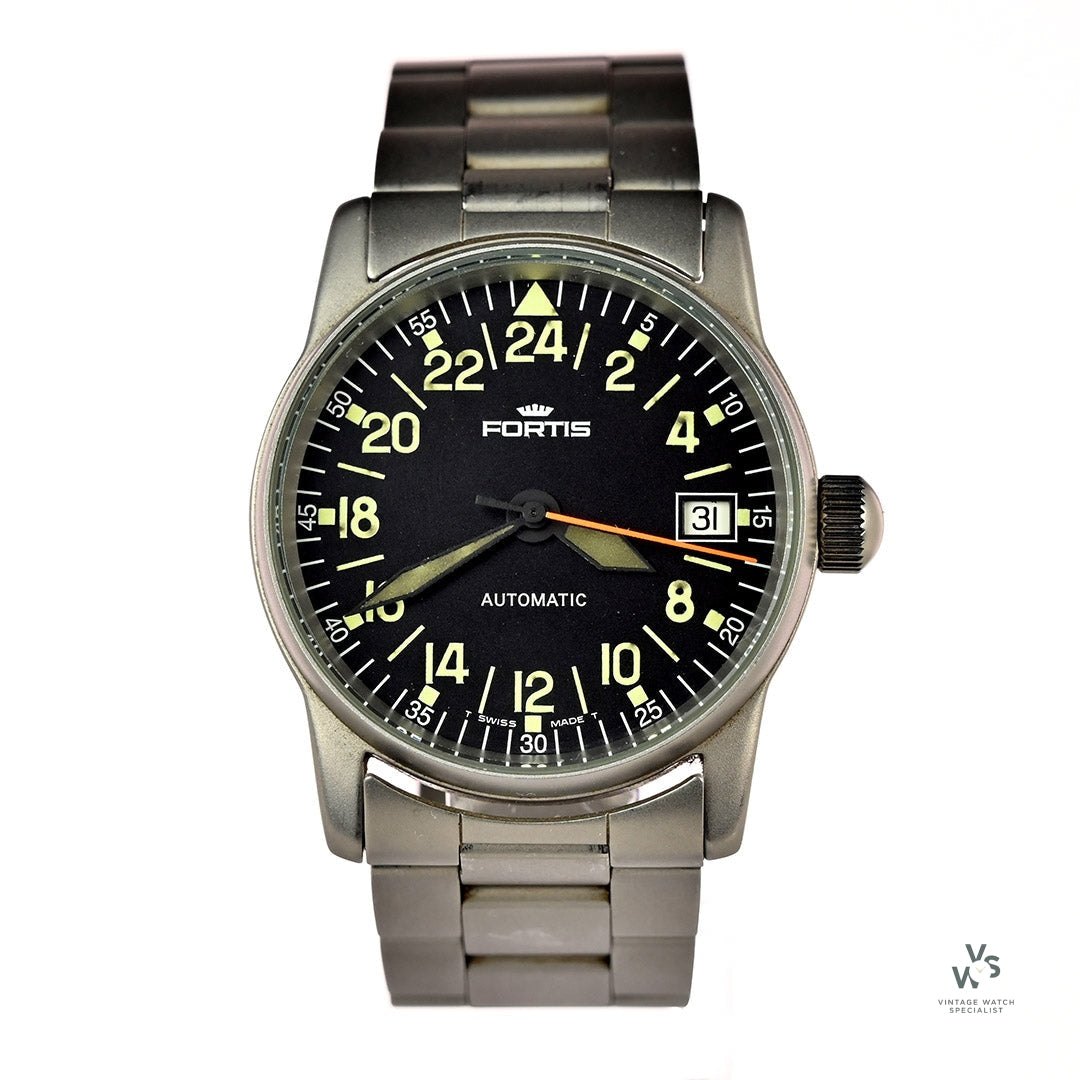
Fortis Automatic, 24Hr Dial, ref. 621.10.148, 34mm, circa 1995
- Maker / attribution
- Fortis (maker)
- Date
- c. 1995
- Historical period
- Mechanical Renaissance (1990 – 2010)
- Country of origin
- Unrecorded in source
- Object type
- Wristwatch
- Dimensions
- Case 34 mm
- Stock no.
- vws2905
- Credit line
- Dealer listing, Vintage Watch Specialist (vws2905)
- Catalogue title (original)
- Fortis Automatic - 24Hr Dial - Model Reference 621.10.148 - 34mm - c.1995 (English)
View the source record (dealer listing) ↗ (opens another website in a new tab)Suggest a correction
Record summary
Catalogued by Vintage Watch Specialist (dealer), United Kingdom (stock number vws2905), this is a wristwatch by Fortis, dated c. 1995. The Atlas places it in the Mechanical Renaissance period (1990 – 2010) of its Wristwatches collection. Recorded dimensions: Case 34 mm. The record is illustrated with 6 photographs.
Assembled from the source record's structured fields. Dates and attributions are given as the source states them; where a field is missing the Atlas leaves it blank rather than estimating.
Catalogue description
Dealer description — Vintage Watch Specialist
A Superb Fortis 24Hr Automatic Model Reference 621.10.148 34mm Circa 1995 in Excellent Condition Fortis is a Swiss watchmaker with a history dating back to 1912. Throughout its history, Fortis has maintained a reputation for quality craftsmanship and innovation, particularly in the realm of aviation and space-themed watches. The brand's connection to space missions, including its role as a supplier to the Russian space program, has contributed to its iconic status in the watch industry. Fortis was founded by Walter Vogt in Grenchen, Switzerland. Fortis has undergone changes in ownership over the years. In 1994, the Jupp Philipp era began, and then in 2018, the brand was acquired by the Schwarz Etienne group. The company initially focused on producing watch movements. However, it didn't take long for Fortis to become known for its quality timepieces. What’s On Offer This Fortis automatic model reference 621.10.148 is an excellent example of a modern field watch, robust yet comfortable with a bold 24hr dial design. The luminous Arabic numerals and hands are excellent for visibility in low light and really make the watch stand out. There is some light wear on the minute hand but nothing of real concern - the watch is nearly 30 years old after all! The sweep seconds hand is bright orange and contrasts nicely against the rich black dial. Crafted from brushed stainless steel, the 34mm case and bracelet are finished nicely in gunmetal grey. Very light signs of wear can be found on the case back and bracelet but overall the watch is in very good condition. The watch is powered by the Swiss ETA 2893-2 movement which has a power reserve of 42 hours and boasts 21 jewels. ETA movements are known for their outstanding quality and have a formidable reputation throughout the watch industry. This particular movement offers a 24h, quickset hack feature. This watch is a great buy and is the perfect everyday wearer.
Historical context
Mechanical Renaissance (1990 – 2010)
Mechanical watches return as cultural objects; independent watchmaking flourishes.
Mechanical watches returned as cultural and luxury objects. Complications, tourbillons and new materials proliferated; independent watchmakers such as George Daniels, F.P. Journe and Philippe Dufour revived artisanal watchmaking; collecting vintage watches became a major field.
Read the period in the timelineMore wristwatches from this periodEarlier: Quartz Revolution
Atlas type guide
Automatic (self-winding) watches
Self-winding watches use the wearer's motion to wind the mainspring. Abraham-Louis Perrelet and Breguet made 'perpétuelle' pocket watches with oscillating weights in the late eighteenth century, but the principle only became practical in the wristwatch. John Harwood patented a bumper automatic in 1923; Rolex's Perpetual rotor (1931) winding in one direction, and later bidirectional rotors (Eterna, Felsa Bidynator), established the modern form. Micro-rotors (Universal Genève, Buren) and peripheral rotors made automatic watches thinner.
What to look for
- A semicircular rotor turning 360° over the movement, or a 'bumper' weight that rebounds between springs.
- 'Automatic', 'Perpetual' or 'Self-winding' on the dial.
- A sealed screw-back case, since automatic watches are wound less often by the crown.
Dating clues
- Bumper automatics: 1923–c. 1955.
- Full rotors: from 1931 (Rolex); widespread after c. 1950.
- Micro-rotors: from 1954–1958.
General guidance written by the Atlas editors about this kind of object. It is not a statement about this particular piece; for that, rely on the source record above and on physical examination.
Related records
Wristwatches · c. 1997
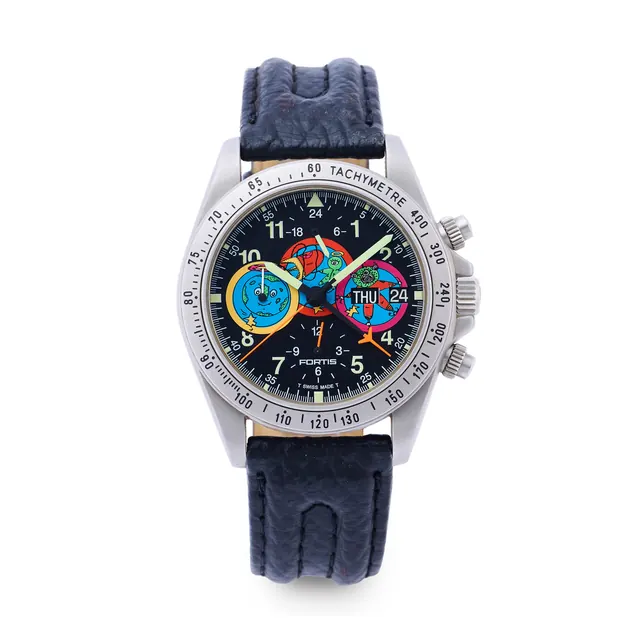
Fortis wristwatch, ref. 602.22.142, Andora Mir 97 Limited Edition 053/350, circa 1997
Antiquorum auction archive, Geneva
Wristwatches · c. early 2000s
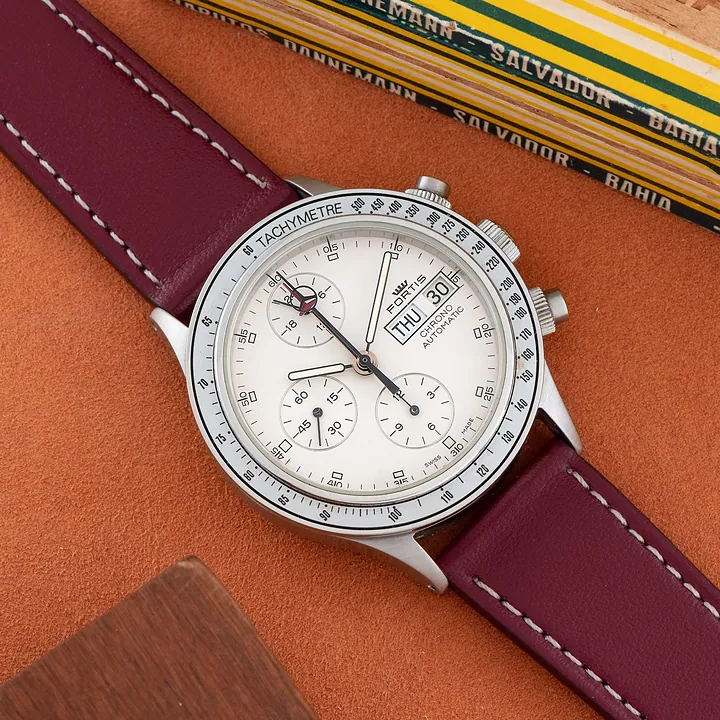
Fortis Stratoliner Mercedes-Benz Special Edition Chronograph, c. early 2000s
Analog/Shift (dealer), New York
Wristwatches · c. 1970
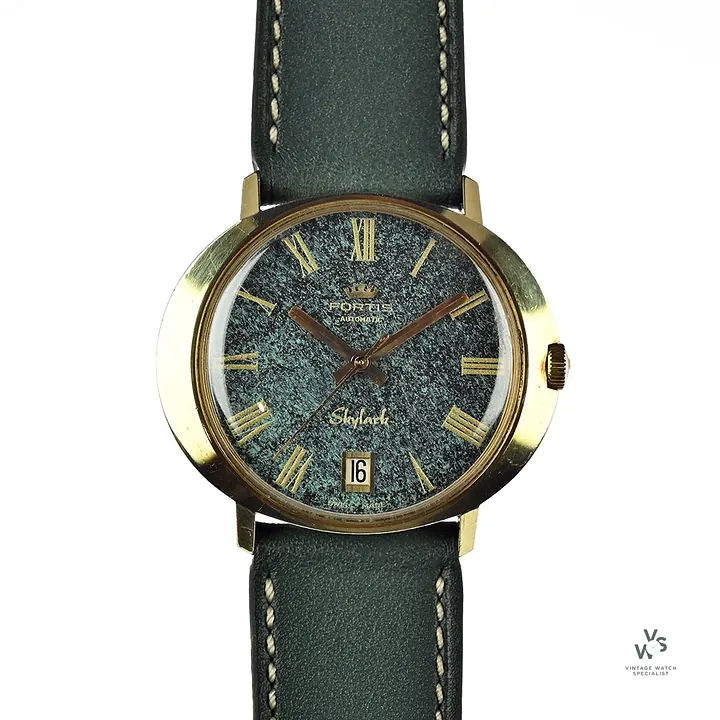
Fortis Skylark, Green 'Granite' Dial, ref. 6179, 20k Gold Plated, circa 1970
Vintage Watch Specialist (dealer), United Kingdom
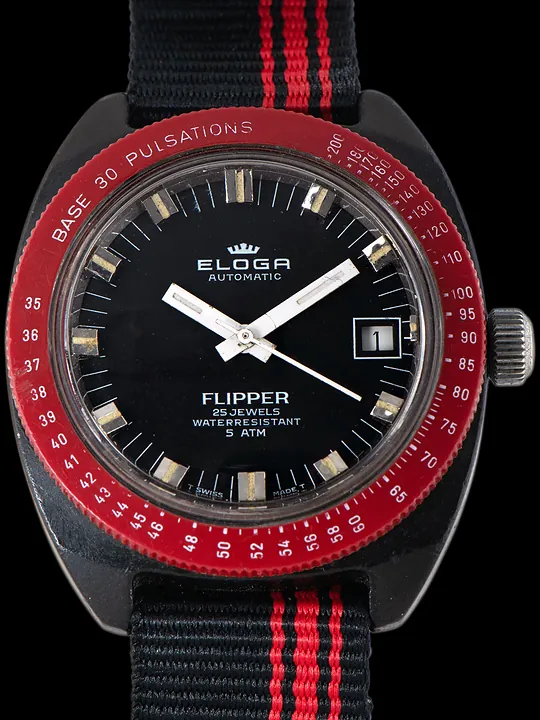
Wristwatches · 1960s
Fortis Eloga Flipper Plastic Sports Watch "Pulsations Bezel", 1960s
Craft & Tailored (dealer), Los Angeles
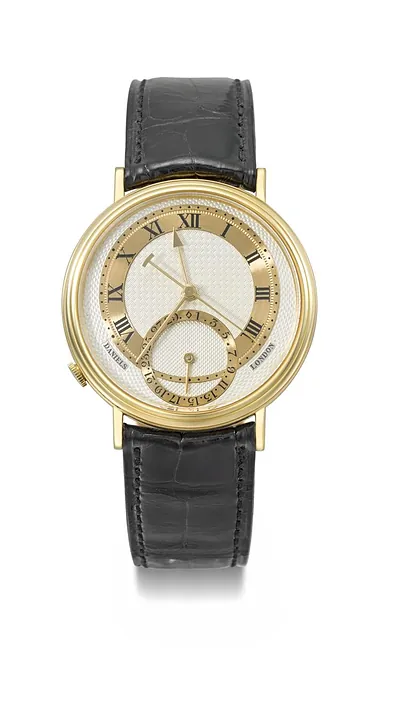
Wristwatches · 1999
'Millennium' co-axial wristwatch by George Daniels and Omega, England, 1999
Science Museum Group, London

Wristwatches · 2008
Wristwatch by Breitling?, 2008
Museum Rotterdam
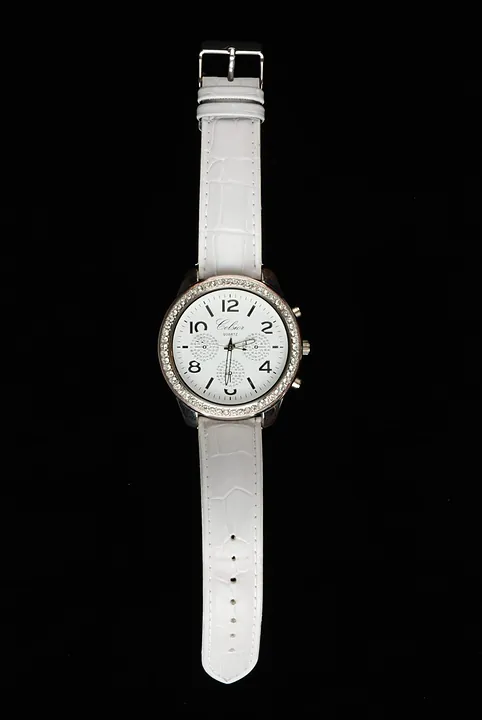
Wristwatches · 2008
Wristwatch by Celsior Quartz, 2008
Museum Rotterdam
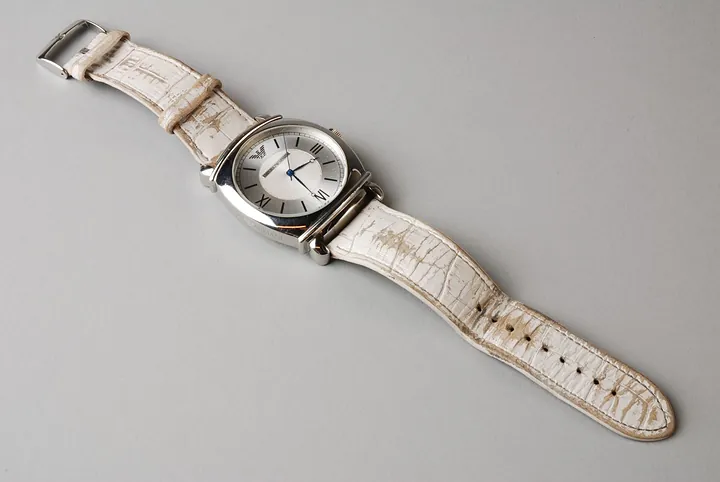
Wristwatches · 2008
Wristwatch possibly by Emporio Armani, 2008
Museum Rotterdam