
Wristwatches · Wristwatch
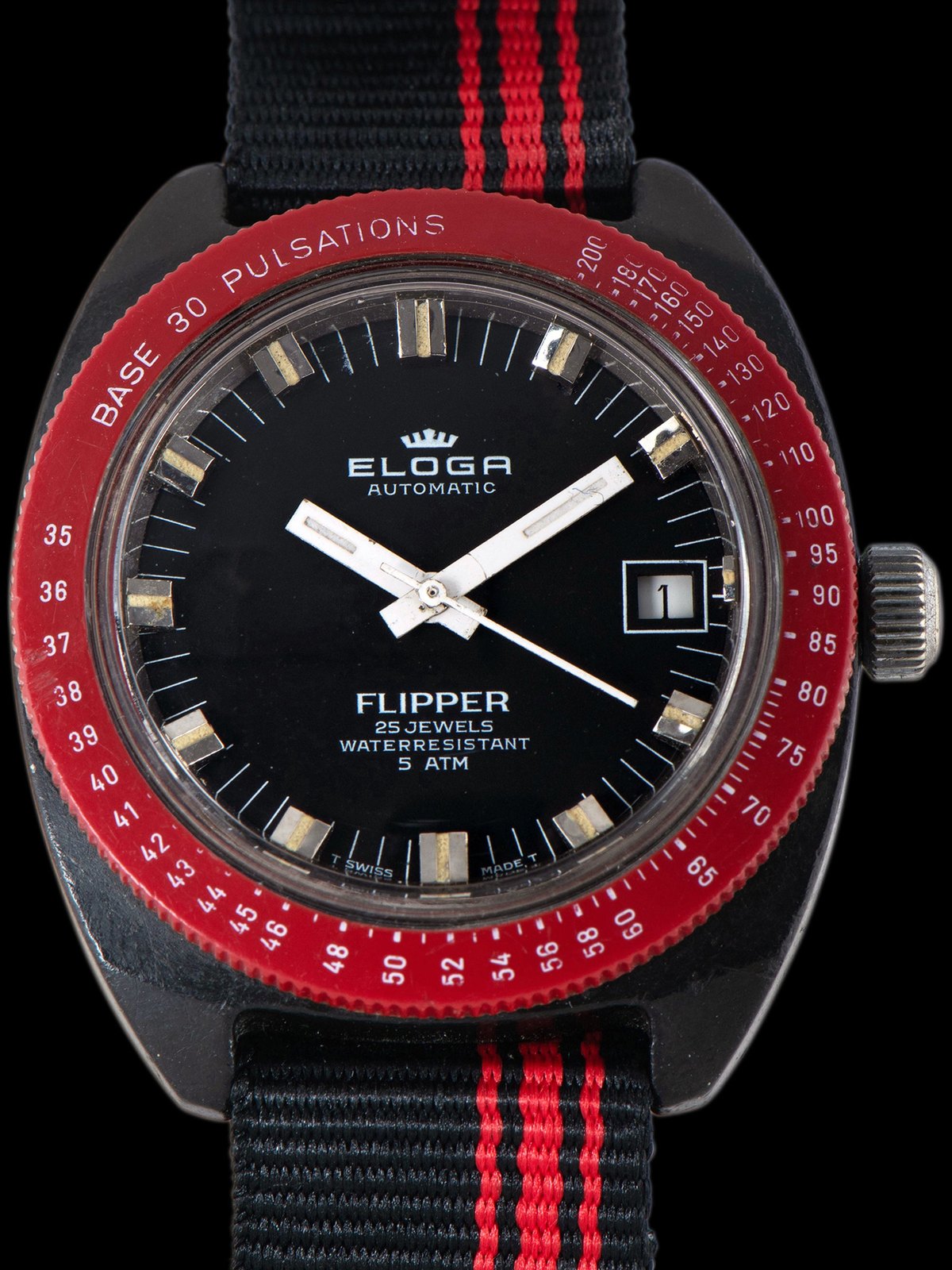
Fortis Eloga Flipper Plastic Sports Watch "Pulsations Bezel", 1960s
- Maker / attribution
- Fortis (maker)
- Date
- 1960s
- Historical period
- Modern Mechanical Horology (1945 – 1969)
- Country of origin
- Unrecorded in source
- Object type
- Wristwatch
- Dimensions
- Case 37 mm
- Stock no.
- FEFPW-MW
- Credit line
- Dealer listing, Craft & Tailored (FEFPW-MW)
- Catalogue title (original)
- 1960s Fortis Eloga Flipper Plastic Sports Watch "Pulsations Bezel" (English)
View the source record (dealer listing) ↗ (opens another website in a new tab)Suggest a correction
Record summary
Catalogued by Craft & Tailored (dealer), Los Angeles (stock number FEFPW-MW), this is a wristwatch by Fortis, dated 1960s. The Atlas places it in the Modern Mechanical Horology period (1945 – 1969) of its Wristwatches collection. Recorded dimensions: Case 37 mm. The record is illustrated with 6 photographs.
Assembled from the source record's structured fields. Dates and attributions are given as the source states them; where a field is missing the Atlas leaves it blank rather than estimating.
Catalogue description
Dealer description — Craft & Tailored
In the 1960s, the Swiss watch brand Fortis created a subsidiary company called Eloga to produce more experimental and, in some case, budget-friendly watches than those offered under the parent company. One of the most famous—and interesting—from that era was the Flipper, which was first released under the Eloga name but later also offered as a Fortis. The Flipper is actually heralded as one of the very first plastic, Swiss-made watches—a distinction that probably calls to mind Swatch watches. But unlike the latter, the early Flippers featured good-quality automatic movements, had a depth rating of 200m, and had interchangeable bezels so the wearer could personalize them. They were also popular among many celebrities and even politicians at the time. Roger Moore, Leonard Bernstein, and Whitney Houston wore them, as did Ronald Reagan, who even starred in his own Flipper ad that read, "Set your watch to Reagan Time!" This is a great example of the Flipper, featuring a black case with a red pulsations bezel and a black dial with large, white baton-style hands. In a world of Moonswatches, this is something that's a little left of the dial and with a much more unique history. SPECS Stock # FEFPW-MW Brand Fortis "Eloga" Style Flipper Model N/A Serial N/A Size Men's Material Black / Red Plastic Dial Black Millimeters 37 Strap NATO Strap CASE & BRACELET The black 37mm Noryl resin case is in excellent condition for its age, retaining sharp angles and dimensions throughout, with honest wear from use. The bidirectional red "pulsations" bezel is in good condition, with some signs of wear shown on some of the numerals. We believe the watch retains its original unsigned crown. The case back shows honest signs of wear and features the factory markings in easily legible condition. If you look closely, you can also see "Magnus Walker" lightly scratched into the finish. The watch comes supplied on a handmade, two-piece leather strap. DIAL & HANDS The black dial is in good vintage condition, showing some signs of age and patina throughout. The inlaid lume in the hour markers has aged to a light cream color. The white, oversized baton-style handset is in great condition, and the inlaid lume has aged to a lighter cream than the dial. ACCESSORIES None. The watch is running, previous service history is unknown.
Historical context
Modern Mechanical Horology (1945 – 1969)
Tool watches for divers, pilots and astronauts; electric watches anticipate the electronic age.
The classic era of the mechanical wristwatch: dive watches, chronographs for motor racing and space flight, GMT watches for jet travel, slim dress watches, automatic calendars, and the rise of Japanese manufacturers alongside Swiss, American, German and Soviet industries.
Read the period in the timelineMore wristwatches from this periodEarlier: Golden Age of Mechanical Watchmaking
Atlas type guide
Wristwatches
Bracelet watches were worn by women from the early nineteenth century — Breguet made one for Caroline Murat, Queen of Naples, in 1810–12 — but the wristwatch only became a man's instrument with military use and aviation in the early twentieth century. Between the World Wars it overtook the pocket watch; the 1920s and 1930s brought rectangular Art Deco cases, water-resistant cases and the first automatic winding systems.
After 1945 the wristwatch became a carrier of identity — dress watches, sports and dive watches, chronographs, calendars — produced by Swiss, American, Japanese, German, Soviet and Chinese industries. The quartz revolution after 1969 and the mechanical renaissance since the 1990s, including the rise of independent watchmakers, complete the story.
What to look for
- The reference number (between the lugs or inside the case back) and serial number, the starting point for dating.
- The calibre: its maker and number are often stamped under the dial or on the bridge.
- Originality of dial, hands and crown — refinished ('redial') dials are common.
- Case material marks: 18K/750, 14K/585, stainless steel, gold-filled, plated.
Dating clues
- Wire-lug cases: before c. 1925.
- Water-resistant screw-down cases: from 1926.
- Quartz movements: from 1969; sapphire crystals widespread after c. 1980.
General guidance written by the Atlas editors about this kind of object. It is not a statement about this particular piece; for that, rely on the source record above and on physical examination.
Related records
Wristwatches · c. 1997
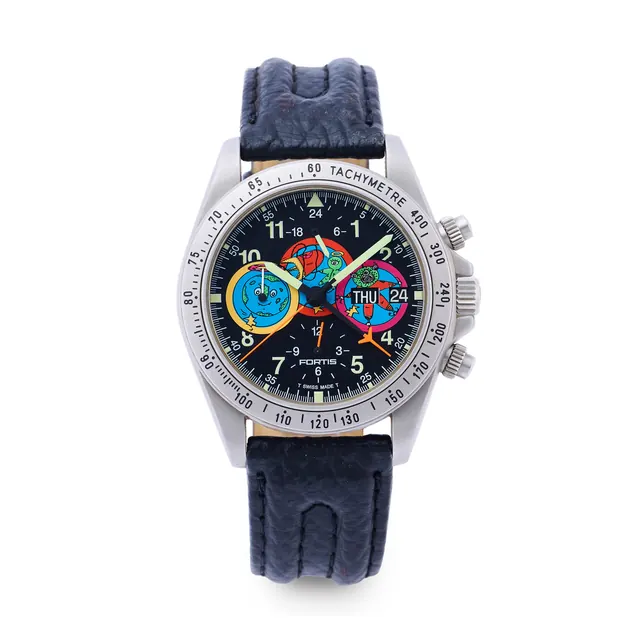
Fortis wristwatch, ref. 602.22.142, Andora Mir 97 Limited Edition 053/350, circa 1997
Antiquorum auction archive, Geneva
Wristwatches · c. early 2000s
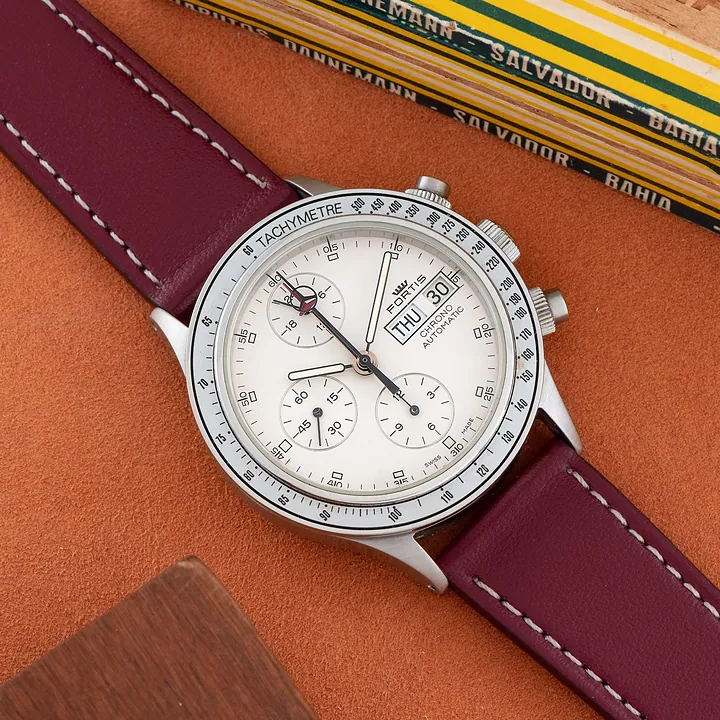
Fortis Stratoliner Mercedes-Benz Special Edition Chronograph, c. early 2000s
Analog/Shift (dealer), New York
Wristwatches · c. 1995
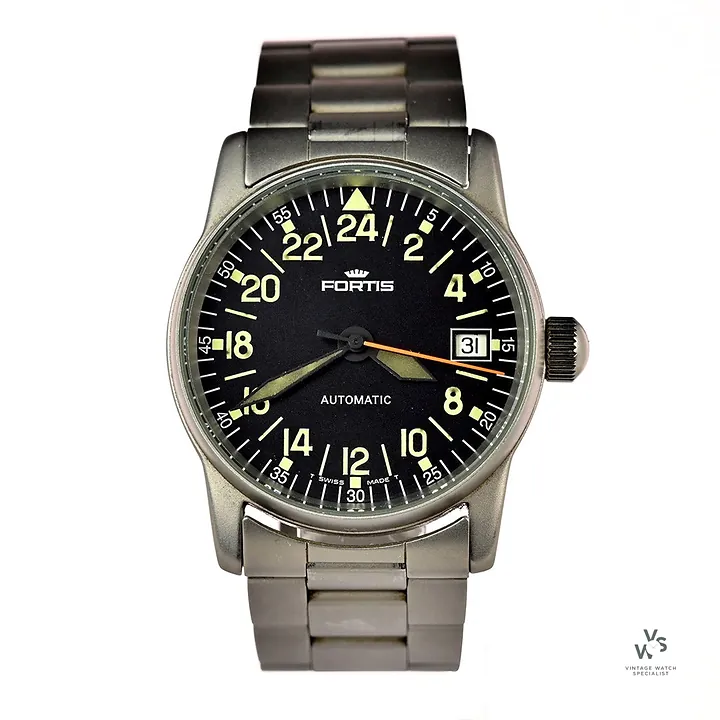
Fortis Automatic, 24Hr Dial, ref. 621.10.148, 34mm, circa 1995
Vintage Watch Specialist (dealer), United Kingdom
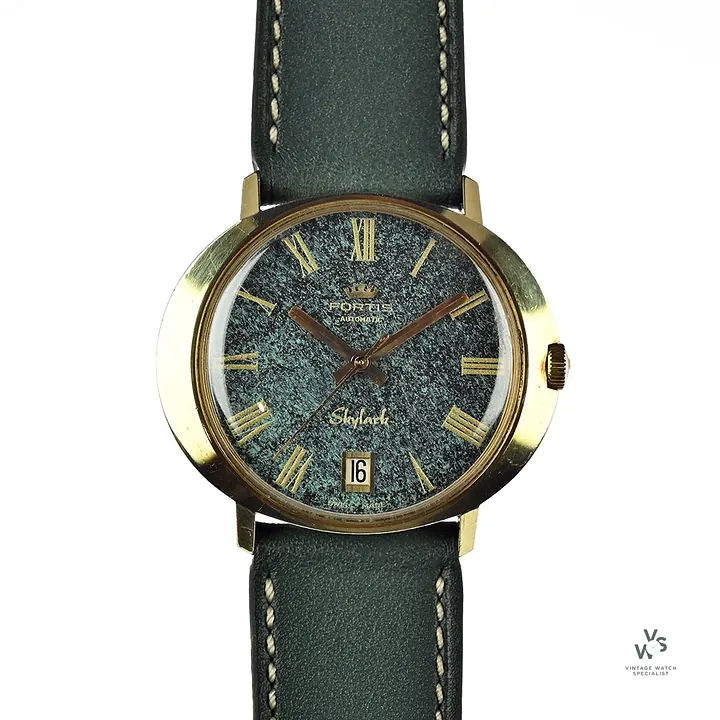
Wristwatches · c. 1970
Fortis Skylark, Green 'Granite' Dial, ref. 6179, 20k Gold Plated, circa 1970
Vintage Watch Specialist (dealer), United Kingdom

Wristwatches · 1945
Wristwatch by Eterna, 1945
Museum Rotterdam

Wristwatches · c. 1945
Breitling Premier, ref. 790, c. 1945
Antiquorum auction archive, Geneva

Wristwatches · c. 1945
Universal Genève Uni-Compax, ref. 22492, c. 1945
Antiquorum auction archive, Geneva
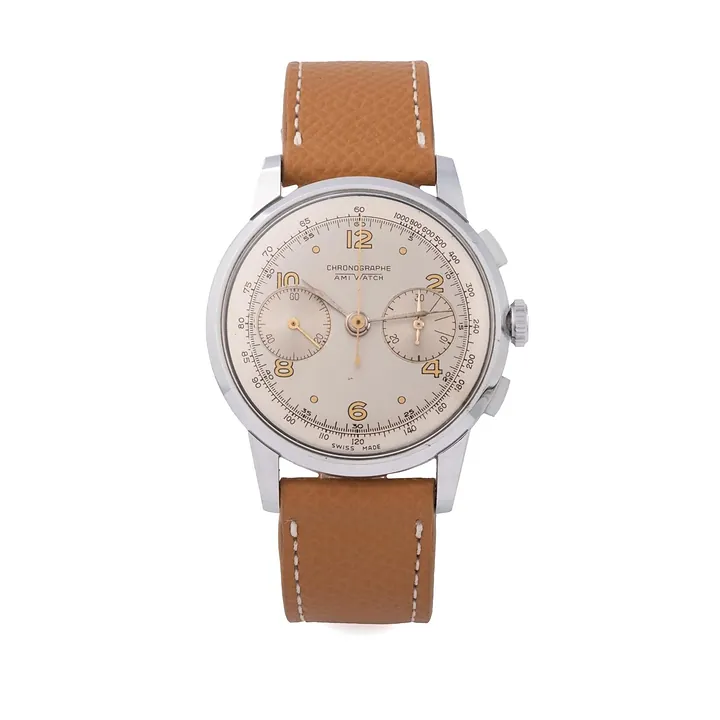
Wristwatches · c. 1950s
Ami Watch Chronographe, c. 1950s
Antiquorum auction archive, Geneva