
Wristwatches · Wristwatch
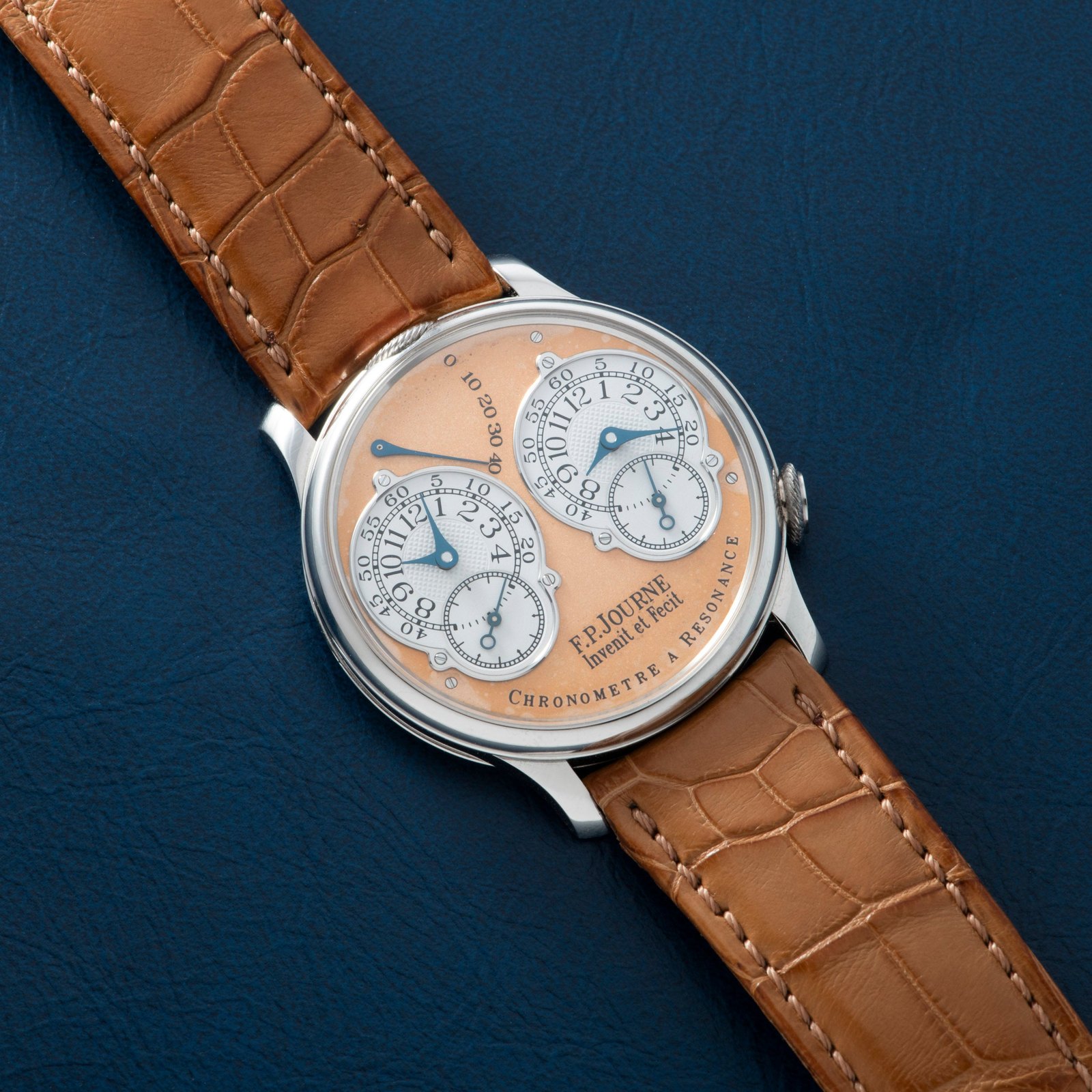
F.P. Journe Chronomètre à Résonance 'Brass Movement', 2003
- Maker / attribution
- F.P. Journe (maker)
- Date
- 2003
- Historical period
- Mechanical Renaissance (1990 – 2010)
- Country of origin
- Switzerland
- Object type
- Wristwatch
- Dimensions
- Case 38 mm
- Stock no.
- 40992308
- Credit line
- Dealer listing, Analog/Shift (40992308)
- Catalogue title (original)
- F.P. Journe Chronomètre à Résonance 'Brass Movement' (English)
View the source record (dealer listing) ↗ (opens another website in a new tab)Suggest a correction
Record summary
Catalogued by Analog/Shift (dealer), New York (stock number 40992308), this is a wristwatch by F.P. Journe, made in Switzerland, dated 2003. The Atlas places it in the Mechanical Renaissance period (1990 – 2010) of its Wristwatches collection. Recorded dimensions: Case 38 mm. The record is illustrated with 6 photographs.
Assembled from the source record's structured fields. Dates and attributions are given as the source states them; where a field is missing the Atlas leaves it blank rather than estimating.
Catalogue description
Dealer description — Analog/Shift
So you’ve bought a Patek, maybe an Audemars Piguet, a few Rolexes or a Vacheron. You think you’ve seen it all and are ready to move on to exotic spice collecting, and then you stumble on F.P. Journe. Arguably the father of the modern independent watchmaking renaissance, Journe has paved the road for countless other small manufacturers to make a name for themselves and share their creative eye with the industry. Leaving school early to study horology, and working in his uncle’s clock repair shop, Journe discovered his knack for all things horology at a young age. Studying the works of Breguet and George Daniels, Journe had an eye for complication and classicism. These influences heavily impacted the look of Journe’s later creations. After completing his studies and designing a number of commissioned pieces for private clients, Journe decided to set out on his own crafting wristwatches. Never slacking off, his earliest designs were tourbillons with constant force remontoirs , extremely mechanically sophisticated and difficult to execute. The ambitious young watchmaker was already punching above his weight, and by the time he started his own eponymous brand, collectors were already getting excited about Journe’s promise. If there’s one design that is most originally F.P. Journe, it’s undoubtedly the Resonance. Journe’s aspirational project for many years, the idea for a Resonance wristwatch came from pendulum clocks Journe had seen made by Breguet and Antide Janvier in the 18th century. The concept of resonance essentially suggests that by placing two escapement wheels in extremely close proximity, the two balances would synchronize, allowing the inaccuracies of one to counterbalance those of the other, and thus pulling both into a higher degree of accuracy. The calibration of these essentially two separate watch movements enclosed in one case is extremely difficult, and takes extensive training. This particular Resonance is one of the most significant for F.P Journe. The earliest and rarest Resonances were 38mm with brass movements. This piece falls under that extremely limited run. Dating to 2003 (just 3 years after the debut of the model), this model is fashioned from platinum and features a striking rose gold solid dial. It flaunts dual sub registers displaying two independently adjustable timezones with guilloché finishing. Details abound, with black polished dial frames and screws, blued-steel hands, a power reserve indication at 12 o'clock, and two separate crowns — one for winding and setting, and the other for synchronizing the subsidiary seconds with a zero reset flyback function. The crown features an engraved scroll motif — a signature characteristic of F.P. Journe. The beautiful 38mm Resonance is set on a signed, double sided alligator strap with a large rectangular scale alligator on the outside and smaller scale alligator on the underside of the strap. By using double-sided alligator instead of the more affordable and conventional calf skin on the inside, Journe has not only improved comfort, but also longevity. The strap is completed with a signed platinum pin buckle to match the case. On the reverse, Journe’s beautiful resonance movement is on full display, made from brass with both balances placed in close proximity. A true mechanical masterpiece, an argument can be made to wear this watch backwards so the whole world can appreciate watchmaking art at its finest! This watch played a significant role in the story of F.P. Journe and is sure to continue to be regarded as one of the most important watches in the expansion of the independent watchmaking industry. This particular example has aged to a gorgeous glow with a lightly patinaed dial. No need to visit the Louvre to see the Mona Lisa when you can come in to experience her equivalence in mechanical form!
Historical context
Mechanical Renaissance (1990 – 2010)
Mechanical watches return as cultural objects; independent watchmaking flourishes.
Mechanical watches returned as cultural and luxury objects. Complications, tourbillons and new materials proliferated; independent watchmakers such as George Daniels, F.P. Journe and Philippe Dufour revived artisanal watchmaking; collecting vintage watches became a major field.
Read the period in the timelineMore wristwatches from this periodEarlier: Quartz Revolution
Atlas type guide
Wristwatches
Bracelet watches were worn by women from the early nineteenth century — Breguet made one for Caroline Murat, Queen of Naples, in 1810–12 — but the wristwatch only became a man's instrument with military use and aviation in the early twentieth century. Between the World Wars it overtook the pocket watch; the 1920s and 1930s brought rectangular Art Deco cases, water-resistant cases and the first automatic winding systems.
After 1945 the wristwatch became a carrier of identity — dress watches, sports and dive watches, chronographs, calendars — produced by Swiss, American, Japanese, German, Soviet and Chinese industries. The quartz revolution after 1969 and the mechanical renaissance since the 1990s, including the rise of independent watchmakers, complete the story.
What to look for
- The reference number (between the lugs or inside the case back) and serial number, the starting point for dating.
- The calibre: its maker and number are often stamped under the dial or on the bridge.
- Originality of dial, hands and crown — refinished ('redial') dials are common.
- Case material marks: 18K/750, 14K/585, stainless steel, gold-filled, plated.
Dating clues
- Wire-lug cases: before c. 1925.
- Water-resistant screw-down cases: from 1926.
- Quartz movements: from 1969; sapphire crystals widespread after c. 1980.
General guidance written by the Atlas editors about this kind of object. It is not a statement about this particular piece; for that, rely on the source record above and on physical examination.
Related records
Wristwatches · 2012
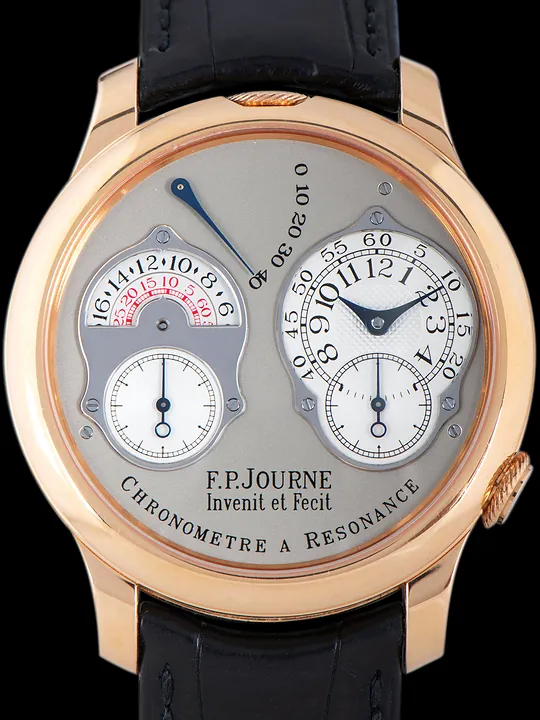
F.P. Journe Résonance "Parking Meter" 18K RG (Ref. RT) Grey Dial, 2012
Craft & Tailored (dealer), Los Angeles
Wristwatches · 2019
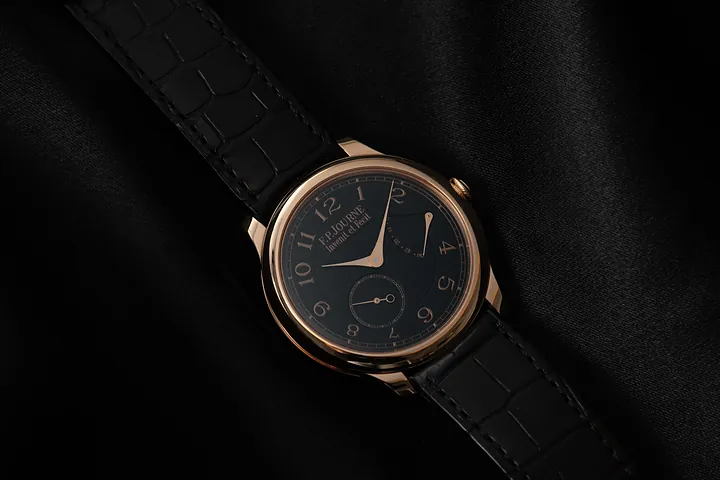
F.P. Journe Chronométre Souverain Boutique Edition, 2019
Analog/Shift (dealer), New York
Wristwatches · 2006
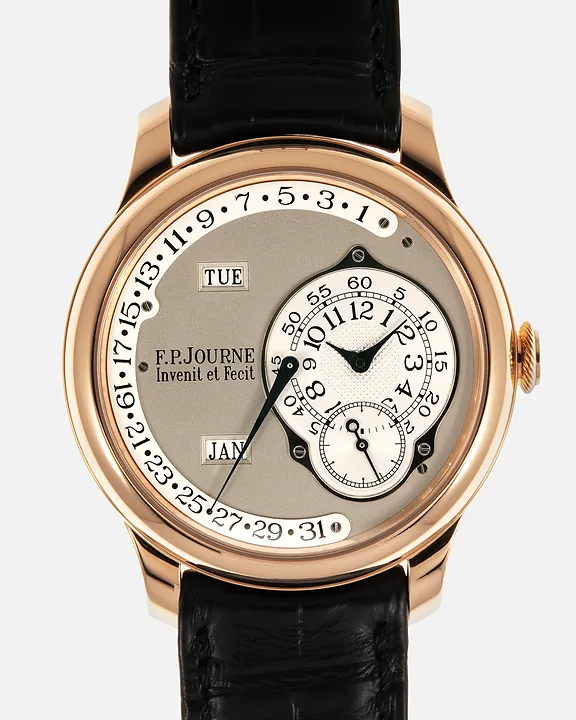
F.P. Journe Octa Calendrier RG Grey 40mm, 2006
S.Song Watches (dealer), Seattle
Wristwatches · 2003
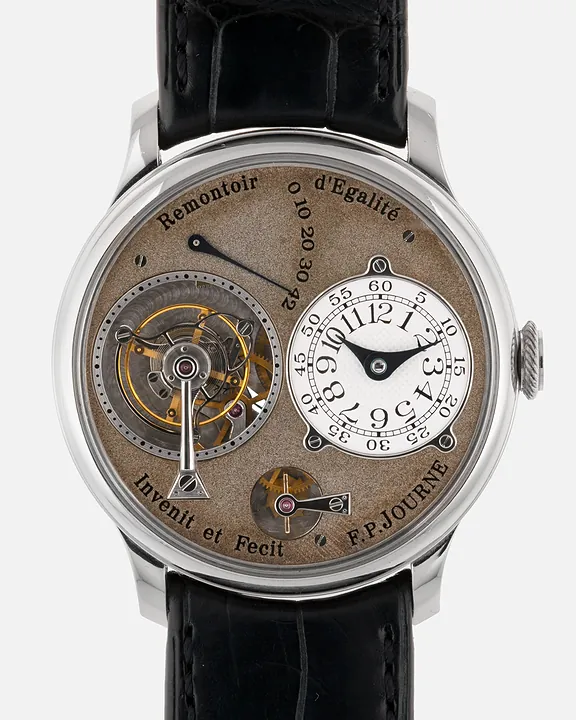
F.P. Journe Tourbillon Souverain Brass, 2003
S.Song Watches (dealer), Seattle

Wristwatches · 2008
Wristwatch by Breitling?, 2008
Museum Rotterdam

Wristwatches · c. 1990s
Audemars Piguet Bamboo, c. 1990s
Antiquorum auction archive, Geneva

Wristwatches · c. 1990
Audemars Piguet Huitieme Perpetual Calendar, ref. 25696PT, c. 1990
Antiquorum auction archive, Geneva

Wristwatches · c. 1990
Breitling Chronomat, ref. b13050.1, c. 1990
Antiquorum auction archive, Geneva