
Wristwatches · Wristwatch
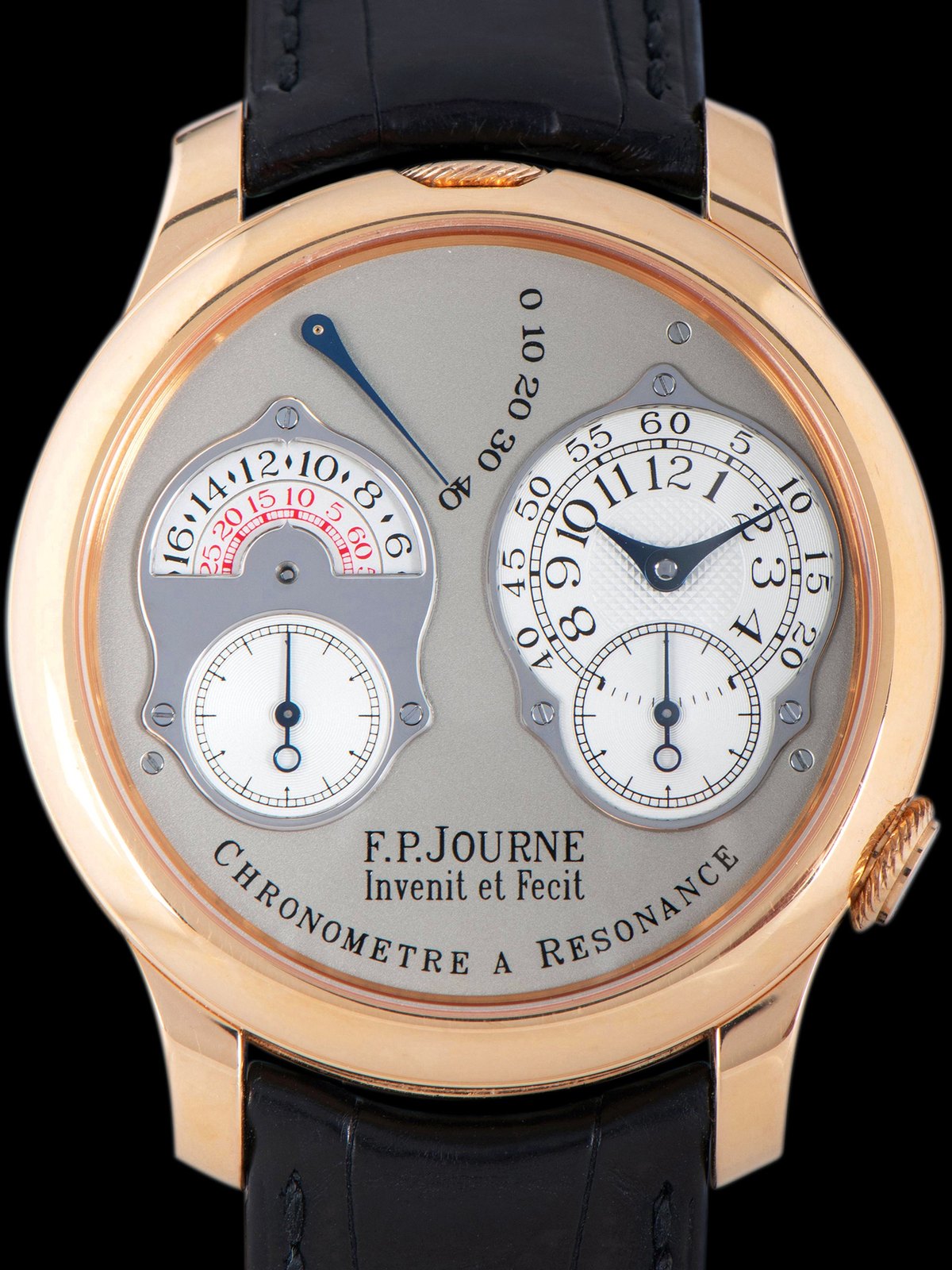
F.P. Journe Résonance "Parking Meter" 18K RG (Ref. RT) Grey Dial, 2012
- Maker / attribution
- F.P. Journe (maker)
- Date
- 2012
- Historical period
- Contemporary Horology (2010 – Present)
- Country of origin
- Switzerland
- Object type
- Wristwatch
- Stock no.
- FPJRPMRT
- Credit line
- Dealer listing, Craft & Tailored (FPJRPMRT)
- Catalogue title (original)
- 2012 F.P. Journe Résonance "Parking Meter" 18K RG (Ref. RT) Grey Dial W/ Box & Card (English)
View the source record (dealer listing) ↗ (opens another website in a new tab)Suggest a correction
Record summary
Catalogued by Craft & Tailored (dealer), Los Angeles (stock number FPJRPMRT), this is a wristwatch by F.P. Journe, made in Switzerland, dated 2012. The Atlas places it in the Contemporary Horology period (2010 – Present) of its Wristwatches collection. The record is illustrated with 6 photographs.
Assembled from the source record's structured fields. Dates and attributions are given as the source states them; where a field is missing the Atlas leaves it blank rather than estimating.
Catalogue description
Dealer description — Craft & Tailored
So few new watchmakers have captivated the entirety of the watch industry in the way F.P. Journe has, though most new watch brands lack the pedigree that warrants the popularity, in other words, F.P. Journe is not like most modern watch brands. François-Paul Journe, the founder of F.P. Journe, was only 14 years of age when he enrolled in technical college and graduated from the Paris Watchmaking School just 2-years later, this was in 1976. Shortly after his graduation, Journe began constructing his first Tourbillion pocket watch, from the ground up, and was brought under the wing of George Daniels, one of the most celebrated independent watchmakers of the last 100 years. In 1985, at the age of 28, Journe opened his own watchmaking workshop to create collector-commissioned bespoke timepieces, one of his most notable commissioned pieces was a planetary pocket watch. By 1989, Journe opened a movement manufacturer in Switzerland, and shortly after, he created his first wristwatch with a movement made entirely of 18K gold. In 1999, the company Montres Journe SA was formed, also known as F.P. Journe, with the launch of the Tourbillon Souverain, the brand's very first Model. Along with the success and numerous innovations introduced by F.P. Journe, many prestigious awards have followed, Including the prize by the Fondation Marcel Bleustein-Blanchet pour la Vocation, the Gaia Award of the Best Watchmaker from the Institut l’Homme et le Temps, the Balancier d’Or Prize at the Watchmakers Convention in Madrid, and the Prix Spécial du Jury. The second design to come from F.P. Journe was the Résonance. The concept of the Résonance dates back to the 1800s, with Abraham-Louis Breguet, who experimented with the idea of creating three pocket watches with two movements in a single mainplate and housing, which would also feature synchronized balance wheels. If that sounds complicated, that’s because it is. Inspired by Breguet’s early design, F.P. Journe conceptualized a way to scale this design into a wristwatch and was the first to ever do so. The caliber François-Paul created features two unregulated balances oscillating closely together. The idea is that one balance's inertia resonates through the shared mainplate, synchronizing the pair. However, to achieve this synchronization, the balances must stay within five seconds of each other. For the 10th anniversary of the Résonance, F.P. Journe updated his masterful design with the reference RT, also commonly referred to as the “Parking Meter”. As opposed to the symmetrical dual-time design of previous models, the ref. RT incorporates a new orbital 24-hour timing scale in the left “sub-dial”, which is where the “Parking Meter” nickname is derived. This new interpretation of the Résonance posed new challenges as well, as a new drive system was required to account for the different power required to run each of the two movements. SPECS Stock # FPJRPMRT Brand F.P. Journe Style Résonance "Parking Meter" Model RT Serial No. 09X Size Men's Material 18K Rose Gold Dial Grey Millimeters 40 Strap 2pc Black Alligator FPJ Strap W/ 18K RG FPJ Tang Buckle CASE & BRACELET The 18K rose gold case is in excellent condition, showing evidence of only minor polishing in the past and very gentle previous use. The sapphire crystal is in excellent condition and is free of blemishes. The crown located at 12 o'clock operates the setting of the hands for the two movements, and the crown located at 4 o'clock resonates the timekeeping of the watch. The sapphire case back is in excellent condition and displays the beautiful cal. 1499.3 movement constructed of 18K gold. The case retains all of its factory engravings and hallmarks in present condition. The watch comes supplied on an F.P. Journe black 2pc alligator leather strap with an 18K rose gold F.P. Journe tang buckle. DIAL & HANDS The satin grey dial is flawless, showing no age or damage whatsoever. Both subsidiary dials are also in flawless condition. The hands all remain in perfect condition as well. ACCESSORIES
Historical context
Contemporary Horology (2010 – Present)
Silicon components, connected watches, optical-lattice research clocks and a thriving independent scene.
Smartwatches became the world's best-selling watches, while mechanical watchmaking focuses on craft, innovation (silicon components, new escapements) and independent makers.
Read the period in the timelineMore wristwatches from this periodEarlier: Mechanical Renaissance
Atlas type guide
Wristwatches
Bracelet watches were worn by women from the early nineteenth century — Breguet made one for Caroline Murat, Queen of Naples, in 1810–12 — but the wristwatch only became a man's instrument with military use and aviation in the early twentieth century. Between the World Wars it overtook the pocket watch; the 1920s and 1930s brought rectangular Art Deco cases, water-resistant cases and the first automatic winding systems.
After 1945 the wristwatch became a carrier of identity — dress watches, sports and dive watches, chronographs, calendars — produced by Swiss, American, Japanese, German, Soviet and Chinese industries. The quartz revolution after 1969 and the mechanical renaissance since the 1990s, including the rise of independent watchmakers, complete the story.
What to look for
- The reference number (between the lugs or inside the case back) and serial number, the starting point for dating.
- The calibre: its maker and number are often stamped under the dial or on the bridge.
- Originality of dial, hands and crown — refinished ('redial') dials are common.
- Case material marks: 18K/750, 14K/585, stainless steel, gold-filled, plated.
Dating clues
- Wire-lug cases: before c. 1925.
- Water-resistant screw-down cases: from 1926.
- Quartz movements: from 1969; sapphire crystals widespread after c. 1980.
General guidance written by the Atlas editors about this kind of object. It is not a statement about this particular piece; for that, rely on the source record above and on physical examination.
Related records
Wristwatches · 2003
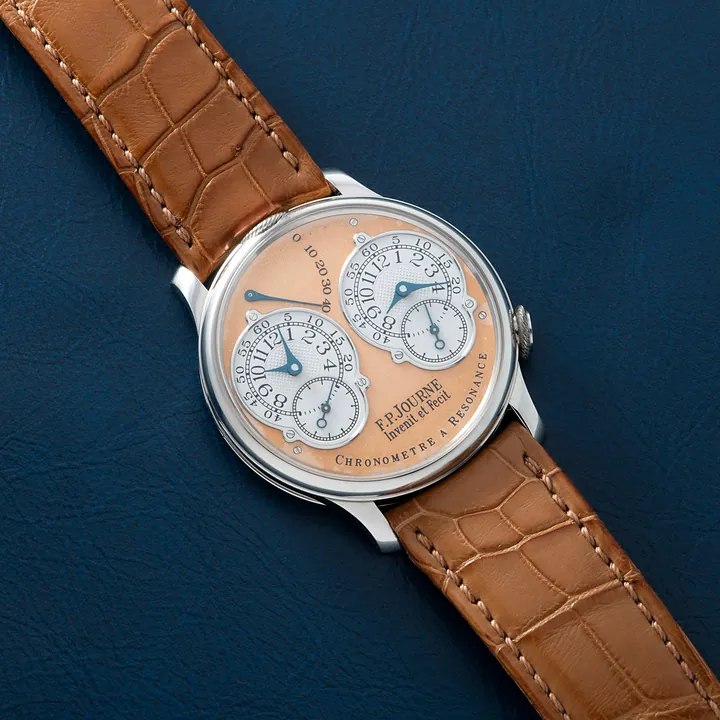
F.P. Journe Chronomètre à Résonance 'Brass Movement', 2003
Analog/Shift (dealer), New York
Wristwatches · 2019
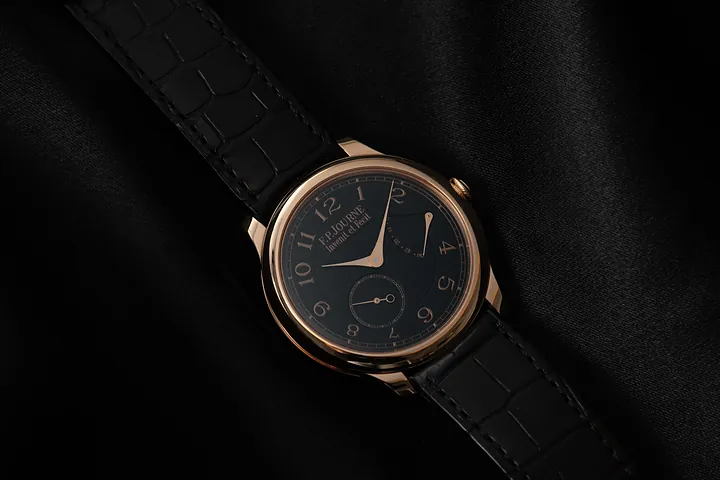
F.P. Journe Chronométre Souverain Boutique Edition, 2019
Analog/Shift (dealer), New York
Wristwatches · 2006
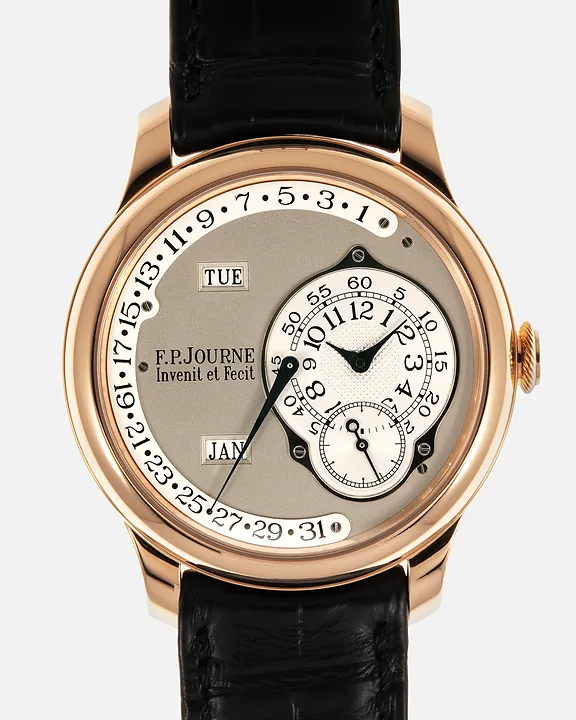
F.P. Journe Octa Calendrier RG Grey 40mm, 2006
S.Song Watches (dealer), Seattle
Wristwatches · 2003
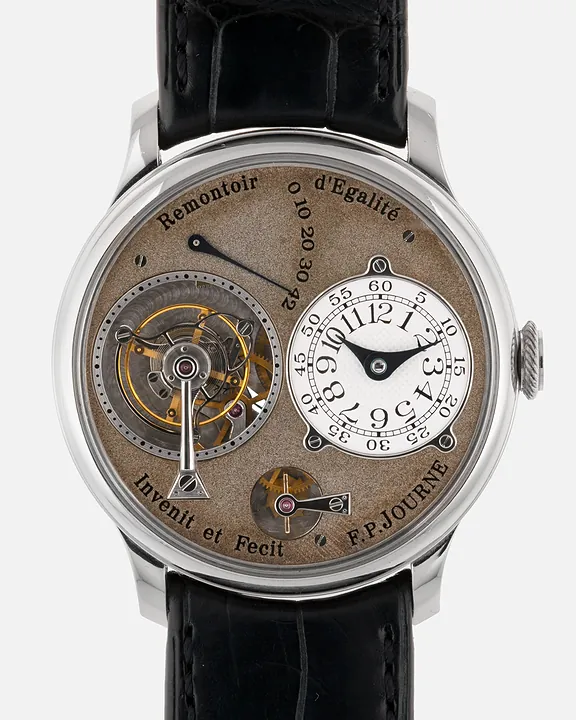
F.P. Journe Tourbillon Souverain Brass, 2003
S.Song Watches (dealer), Seattle

Wristwatches · c. 2010s
Breguet Type XXI, ref. 3810, c. 2010s (Antiquorum Lot 381-24)
Antiquorum auction archive, Geneva

Wristwatches · c. 2010s
Breguet Type XXI, ref. 3810, c. 2010s (Antiquorum Lot 386-229)
Antiquorum auction archive, Geneva

Wristwatches · Sold in September 2010
Breitling Cosmonaute, ref. A 22322, Sold in September 2010
Antiquorum auction archive, Geneva

Wristwatches · c. 2010
Corum Bubble Chrono, ref. 396.150.20, c. 2010
Antiquorum auction archive, Geneva