
Wristwatches · Wristwatch
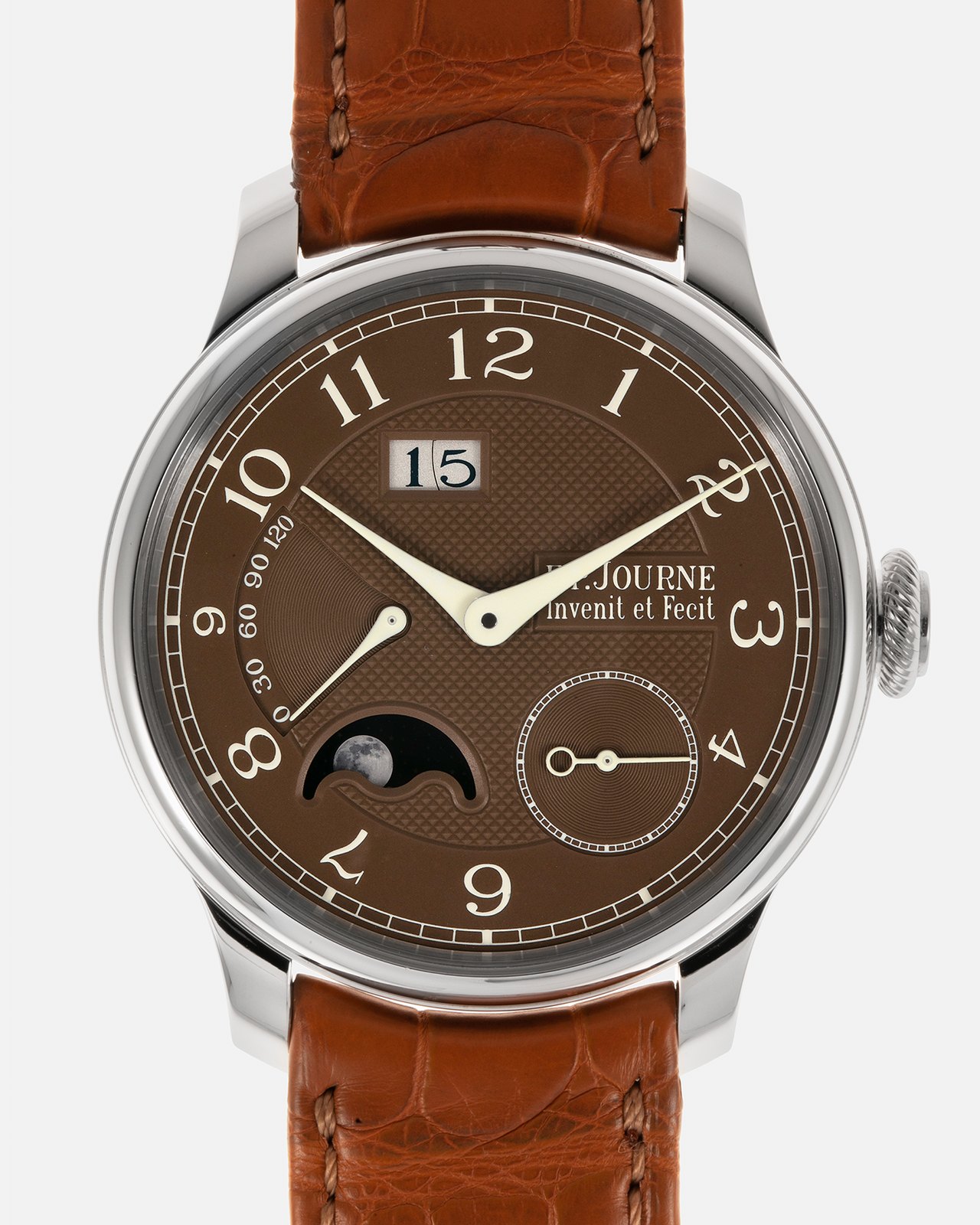
F.P. Journe Automatique Lune Havana PT 42mm, 2023
- Maker / attribution
- F.P. Journe (maker)
- Date
- 2023
- Historical period
- Contemporary Horology (2010 – Present)
- Country of origin
- Switzerland
- Object type
- Wristwatch
- Dimensions
- Case 42 mm
- Stock no.
- Product 7346420613207
- Credit line
- Dealer listing, S.Song Watches (product 7346420613207)
- Catalogue title (original)
- F.P. Journe Automatique Lune Havana PT 42mm (English)
View the source record (dealer listing) ↗ (opens another website in a new tab)Suggest a correction
Record summary
Catalogued by S.Song Watches (dealer), Seattle (stock number Product 7346420613207), this is a wristwatch by F.P. Journe, made in Switzerland, dated 2023. The Atlas places it in the Contemporary Horology period (2010 – Present) of its Wristwatches collection. Recorded dimensions: Case 42 mm. The record is illustrated with 6 photographs.
Assembled from the source record's structured fields. Dates and attributions are given as the source states them; where a field is missing the Atlas leaves it blank rather than estimating.
Catalogue description
Dealer description — S.Song Watches
Here, I have a highly desirable F.P Journe Automatique Octa Lune fitted with a ‘Havana’ dial in a platinum 950 case, named as such because of the stunning brown dial it is fitted with. Offered by F.P. Journe in several other precious metal cases, it can be said, that without a doubt, the ones fitted with Havana dials are some of the most attractive variants and as such, some of the most in-demand as well. While it might initially appear to be just another brown dial, it’s important to remember that F.P. Journe is an independent brand that loves pushing technical boundaries. The Havana dial is crafted by combining ruthenium and gold, creating a rich, reflective brown tone with remarkable color depth. This technique results in a dial that shifts from dark to light brown—almost tropical-brown / milk chocolate in hue—depending on the lighting conditions. Encircling the dial at the periphery is a contrasting Chermin de Fer minute track in white, complementing the highly sober Arabic numerals used as hour markers. At its center, a hobnail Clous de Paris pattern also adds some much-needed texture. The dial also features F.P. Journe’s signature asymmetrical layout, with a power reserve indicator at 9:00, a moon phase at 7:00, a running-seconds sub-dial at 4:30, and a large off-centered date window aperture at 11:30. All of these elements are tastefully arranged in a way that showcases F.P. Journe’s exceptional mastery of asymmetry and negative space, resulting in a dial design that is both visually balanced and elegant. Beyond the dial, encased within its sleek platinum 950 case and visible through the sapphire caseback lies the impressive in-house, self-winding Cal. 1300.3. Like all F.P. Journe watches produced since 2004, this movement is crafted entirely from 18-carat solid rose gold. True to F.P. Journe’s high standards, the Cal. 1300.3 features a massive 120-hour power reserve on a full wind and is also exquisitely decorated, showcasing a partially circular-grained baseplate, perlage on the main plate, Côtes de Genève on the bridges, and meticulous hand-finishing throughout, including hand-polished chamfers and screw-heads. As shown in the listing photos, the off-centered winding rotor in 22-carat rose gold stands out with its flawless guilloché work, further emphasizing F.P. Journe’s exceptional craftsmanship and artisanal mastery. With all that being said, the Automatique Octa Lune, with its contemporary 42mm case size, is very wearable by modern standards. While it may be widely regarded as one of F.P. Journe's more understated designs compared to some of his earlier works, its execution is quintessentially Journe—elegant, refined with very clean lines and curves. It’s a design that’s simple and balanced, yet crafted with just the right amount of flair to keep things interesting.
Historical context
Contemporary Horology (2010 – Present)
Silicon components, connected watches, optical-lattice research clocks and a thriving independent scene.
Smartwatches became the world's best-selling watches, while mechanical watchmaking focuses on craft, innovation (silicon components, new escapements) and independent makers.
Read the period in the timelineMore wristwatches from this periodEarlier: Mechanical Renaissance
Atlas type guide
Automatic (self-winding) watches
Self-winding watches use the wearer's motion to wind the mainspring. Abraham-Louis Perrelet and Breguet made 'perpétuelle' pocket watches with oscillating weights in the late eighteenth century, but the principle only became practical in the wristwatch. John Harwood patented a bumper automatic in 1923; Rolex's Perpetual rotor (1931) winding in one direction, and later bidirectional rotors (Eterna, Felsa Bidynator), established the modern form. Micro-rotors (Universal Genève, Buren) and peripheral rotors made automatic watches thinner.
What to look for
- A semicircular rotor turning 360° over the movement, or a 'bumper' weight that rebounds between springs.
- 'Automatic', 'Perpetual' or 'Self-winding' on the dial.
- A sealed screw-back case, since automatic watches are wound less often by the crown.
Dating clues
- Bumper automatics: 1923–c. 1955.
- Full rotors: from 1931 (Rolex); widespread after c. 1950.
- Micro-rotors: from 1954–1958.
General guidance written by the Atlas editors about this kind of object. It is not a statement about this particular piece; for that, rely on the source record above and on physical examination.
Related records
Wristwatches · 2012
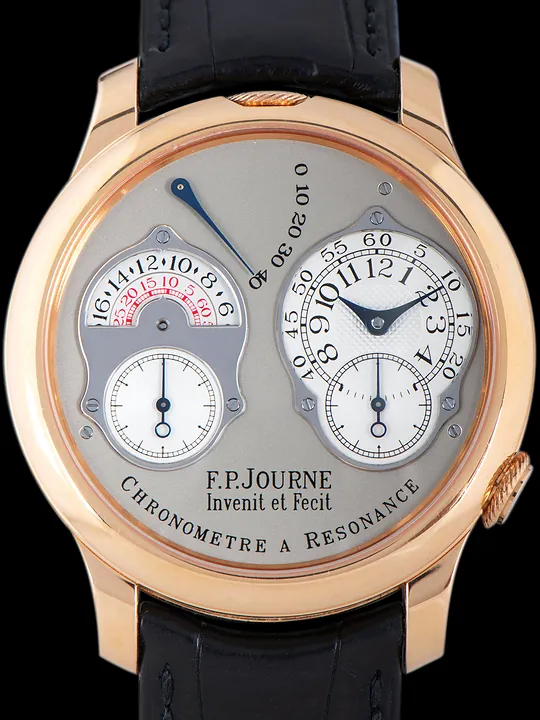
F.P. Journe Résonance "Parking Meter" 18K RG (Ref. RT) Grey Dial, 2012
Craft & Tailored (dealer), Los Angeles
Wristwatches · 2003
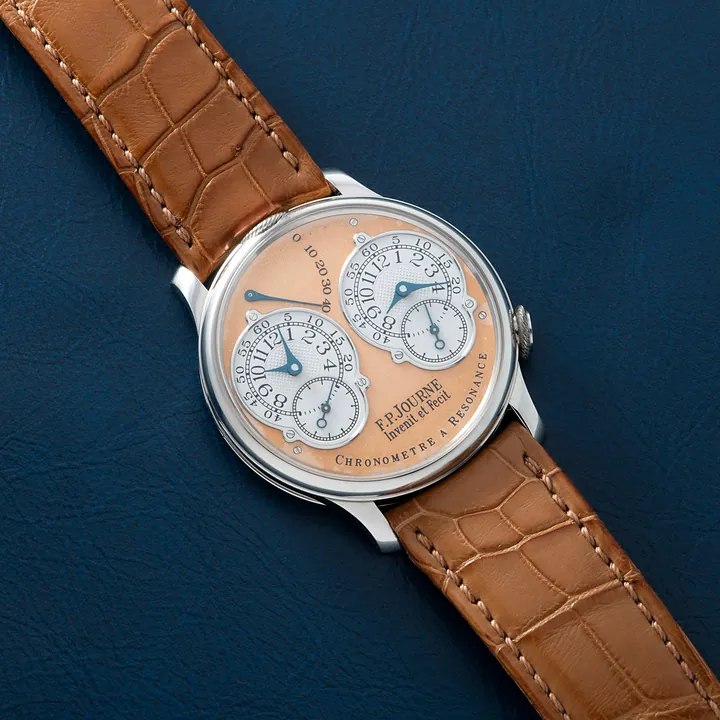
F.P. Journe Chronomètre à Résonance 'Brass Movement', 2003
Analog/Shift (dealer), New York
Wristwatches · 2019
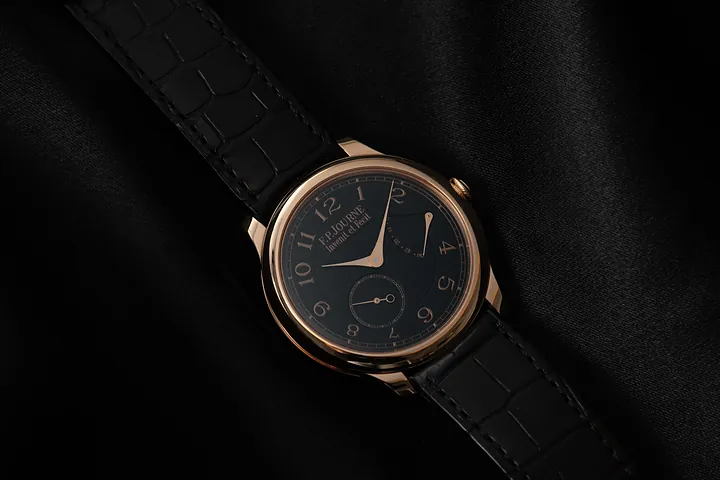
F.P. Journe Chronométre Souverain Boutique Edition, 2019
Analog/Shift (dealer), New York
Wristwatches · 2006
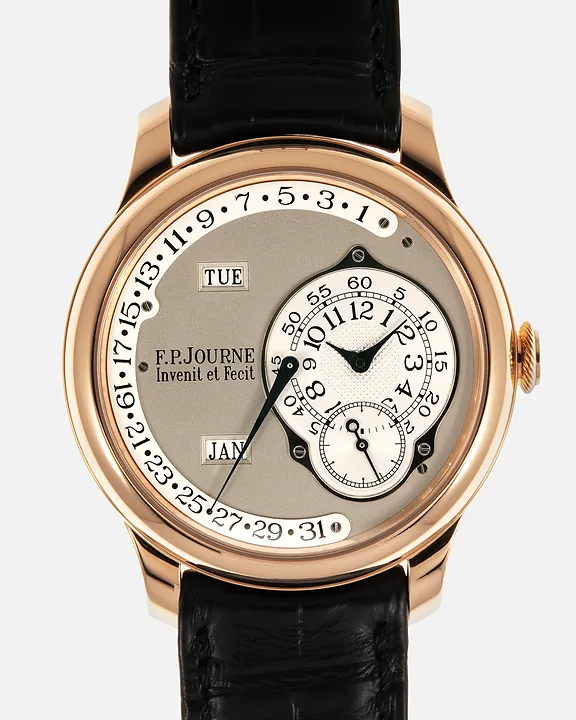
F.P. Journe Octa Calendrier RG Grey 40mm, 2006
S.Song Watches (dealer), Seattle

Wristwatches · c. 2010s
Breguet Type XXI, ref. 3810, c. 2010s (Antiquorum Lot 381-24)
Antiquorum auction archive, Geneva

Wristwatches · c. 2010s
Breguet Type XXI, ref. 3810, c. 2010s (Antiquorum Lot 386-229)
Antiquorum auction archive, Geneva

Wristwatches · Sold in September 2010
Breitling Cosmonaute, ref. A 22322, Sold in September 2010
Antiquorum auction archive, Geneva

Wristwatches · c. 2010
Corum Bubble Chrono, ref. 396.150.20, c. 2010
Antiquorum auction archive, Geneva