
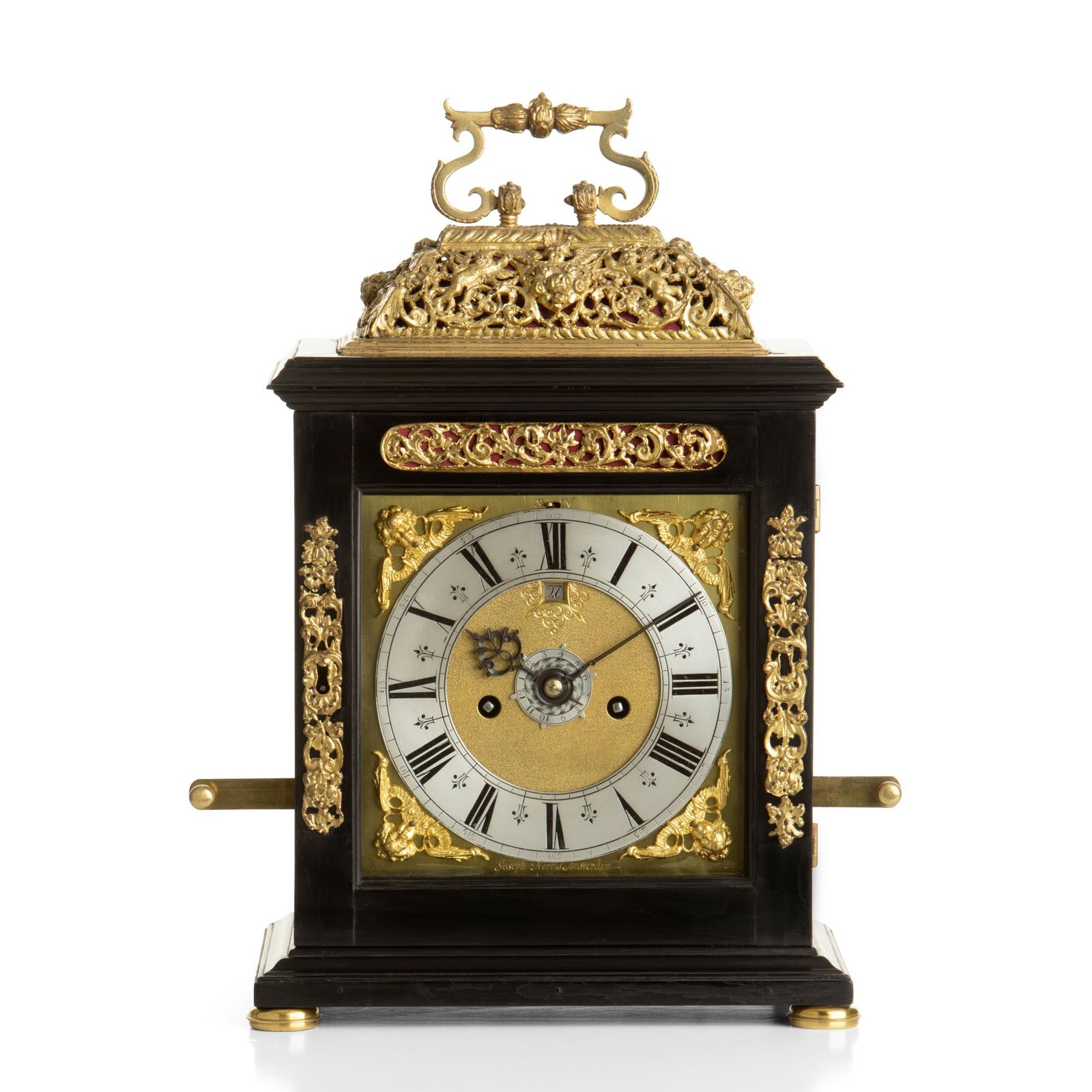
Clocks · Bracket clock
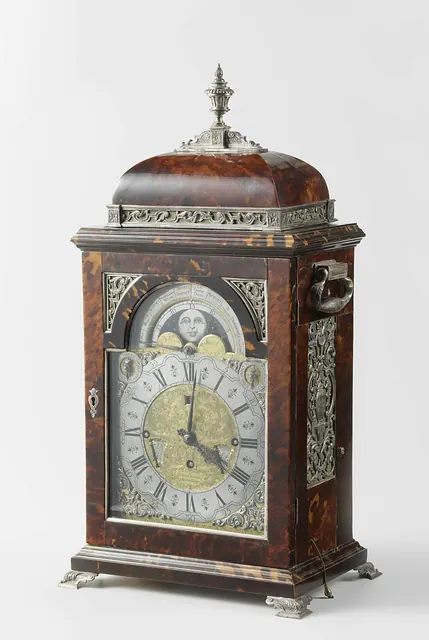
Ebonised “basket top” table clock by Joseph Norris, Amsterdam
- Maker / attribution
- Joseph Norris (maker)
- Date
- c. 1680
- Historical period
- Early Modern Horology (1600 – 1750)
- Country of origin
- Netherlands
- Place
- Amsterdam
- Object type
- Bracket clock
- Materials / technique
- ebonised
- Dimensions
- Height 38 cm
- Stock no.
- Product 2467
- Credit line
- Dealer listing, The Antique Clock Company (product 2467)
- Catalogue title (original)
- A VERY FINE EBONISED “BASKET TOP” TABLE CLOCK – JOSEPH NORRIS OF AMSTERDAM (English)
View the source record (dealer listing) ↗ (opens another website in a new tab)Suggest a correction
Record summary
Catalogued by The Antique Clock Company (dealer), Dorset (stock number Product 2467), this is a bracket clock by Joseph Norris, made in Amsterdam, Netherlands, dated c. 1680. The Atlas places it in the Early Modern Horology period (1600 – 1750) of its Clocks collection. Materials and techniques recorded by the source: ebonised. Recorded dimensions: Height 38 cm. The record is illustrated with 3 photographs.
Assembled from the source record's structured fields. Dates and attributions are given as the source states them; where a field is missing the Atlas leaves it blank rather than estimating.
Catalogue description
Dealer description — The Antique Clock Company
An outstanding quality Ebonised, 8-day striking table clock with alarm by the renowned Joseph Norris of Amsterdam, who famously worked alongside the prestigious Fromanteel family. This particular clock dates from the late 17th Century. The case is ebony veneered onto an oak carcass with an over-elaborate gilt-brass repoussé basket top, side panels, and mounts decorated with flowers, cherubs, and fruits with a gilt-brass carrying handle and gilt-brass bun feet. Extending from each side of the case is the pull/push quarter repeat lever to sound the quarters and the hour last struck. A high-quality 6” square gilt-brass dial with four winged cherub spandrels, strike/silent above XII of the silvered, engraved chapter ring, featuring Roman numerals, half-hour markers, and Arabic numerals outside of the division ring. The centre of the dial being matted, a decorated date aperture under XII, complimented with finely pierced blued steel hands and the centre alarm setting disc to the centre. The movement of 8-day duration with original verge escapement and short bob pendulum is rack striking, sounding the hours to a bell with a repeat system connected to the strike train, striking both the hours and quarters along with an independent alarm. The stunning tulip and floral engraved backplate within a line border and is signed Joseph Norris, Amsterdam . A stunning, collectable and truly breath-taking clock from the golden age of clock making. Joseph Norris: Joseph Norris was born in Abingdon near Oxford in 1650, the brother of Edward Norris (1637-1726), who was twelve years his senior. At the age of 12, Joseph was apprenticed to his brother for eight years. He survived ‘The Plague’ and ‘The Great London Fire’, respectively, in 1665 and 1666. Because of the fire, the two brothers had to leave The Crossed Keys in Lothbury and move to Dove Court in London. After the peace treaty between England and the Netherlands in 1674, Joseph went to Amsterdam and settled there. It may have been because his former mentor Ahasuerus Fromanteel had been there since 1667; Norris did not return to England until 1692. Several authorities think that during his Dutch period Fromanteel did not produce longcase clocks with a long pendulum and anchor escapement in Holland but that he imported them ready-made from London. He, therefore, concludes that Joseph Norris was the first to make such clocks with a ’Royal Pendulum’ in Holland, starting in or immediately after 1675. Norris lived near the Beurs (the Exchange) on Damrak in Amsterdam, where he also had his workshop. In 1677 he married Alicia Arnold (from Tonstell, probably Tunstall, Kent, England) in the English Reformed Church. He quickly became one of the city’s leading clockmakers. In 1692 he returned to Abingdon, where he held numerous prominent public and clerical life positions until he died in 1726. During this period, he made clocks in London in his brother’s workshop in Dove Court. It will be clear from the preceding description that clocks signed ’Joseph Norris London’ must date from either the pre-Amsterdam years 1670-1675 or from the post-Amsterdam years 1692-1696, the last year of his membership of the Clockmakers Company; clocks signed ‘Joseph Norris Amsterdam’ are to be dated between 1675 and 1692. Comparative Literature: Dr R. Plomp – Spring-driven Dutch pendulum clocks 1657-1710, p. 66, 174-175. Height: 15 ” or 38cm (Handle up) *Pictures taken prior to restoration*
Provenance
Private collection U.K.
Historical context
Early Modern Horology (1600 – 1750)
Huygens' pendulum and balance spring transform accuracy; English makers develop the anchor and deadbeat escapements.
Huygens's pendulum (1656–57) improved clock accuracy from about a quarter of an hour to under a minute a day. The anchor escapement (c. 1670) and the long seconds pendulum created the longcase clock; London makers such as Fromanteel, Knibb, Tompion and Quare led European clockmaking, and French makers created the Boulle pendule.
Read the period in the timelineMore clocks from this periodEarlier: Renaissance Horology
Atlas type guide
Bracket, table and spring-driven clocks
Spring-driven clocks freed timekeeping from the hanging weight. The coiled mainspring, documented from the fifteenth century, made portable table clocks possible; to even out its declining force, makers used the fusee, a conical pulley connected to the barrel by a gut line or chain. Renaissance table clocks from Augsburg and Nuremberg — drum-shaped, square or tower-shaped in gilt brass — were luxury scientific objects, often with astronomical dials and alarms.
After the pendulum, English makers developed the bracket clock: a wooden case with a carrying handle, a short pendulum with a verge escapement, and often repeating work to sound the hours on demand at night. Later examples use the anchor escapement. In the nineteenth century, 'table clock' became a broad term for spring clocks of every nationality.
What to look for
- A fusee in the movement (cone-shaped pulley) and the type of line — gut or chain.
- Verge escapement with a short bob pendulum, often with a decoratively engraved backplate.
- Repeat cords or buttons that make the clock strike again on demand.
- Gilt-brass engraved cases and horizontal dials on Renaissance pieces.
- Case shapes: inverted bell, bell top, break-arch, lancet or balloon.
Dating clues
- Drum and tower table clocks: c. 1520–1650.
- Ebony veneered English bracket clocks with verge escapements: c. 1670–1800.
- Engraved backplates were usual on English clocks until c. 1800, then generally plain.
General guidance written by the Atlas editors about this kind of object. It is not a statement about this particular piece; for that, rely on the source record above and on physical examination.
Read next:Fusee
Related records
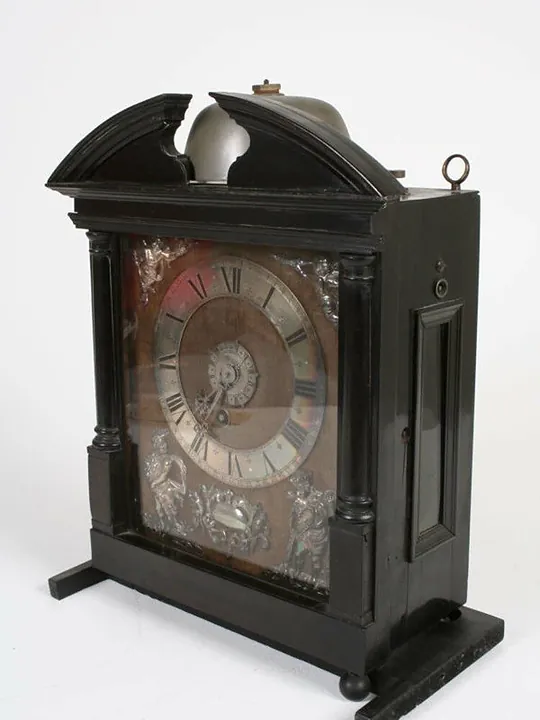
Clocks · 1650
Clock by J.J. van Leeuwaarden, Netherlands, 1650
City Museum Zutphen
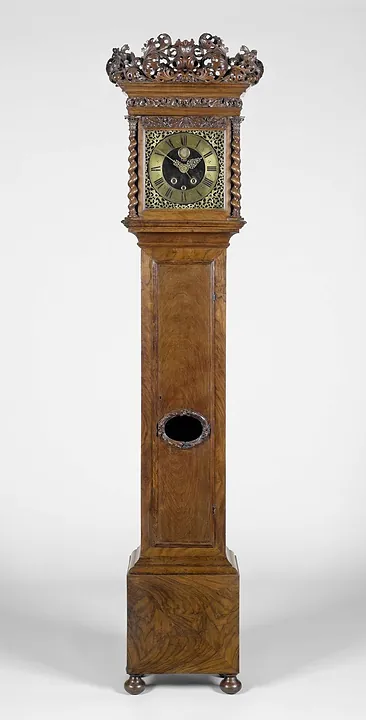
Clocks · 1680
Longcase clock, Netherlands, 1680
Rijksmuseum
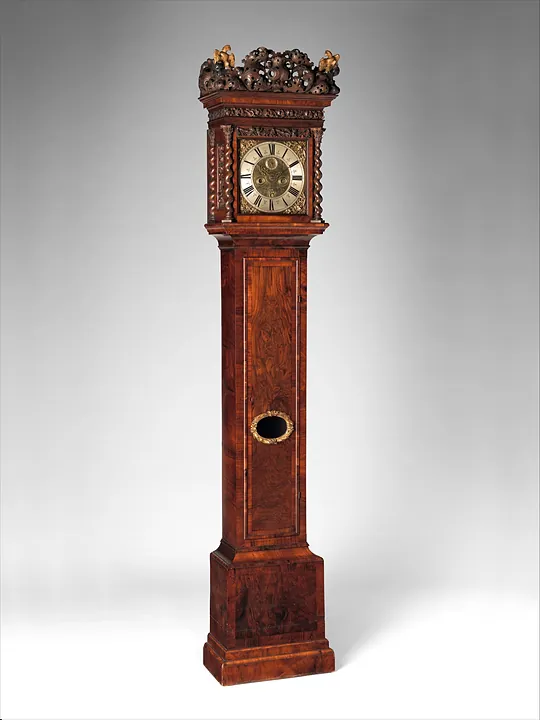
Clocks · c. 1690–94
Longcase clock, movement by Ahasuerus II Fromanteel, Netherlands, c. 1690–94
The Metropolitan Museum of Art, New York
Clocks · 1715
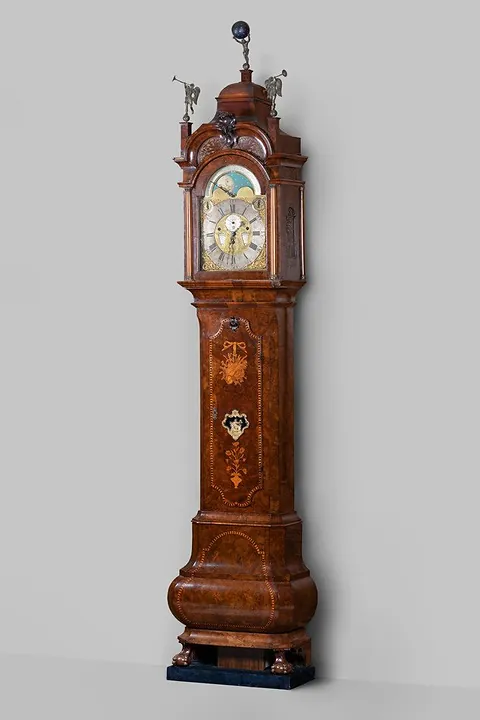
Longcase clock by Paulus Bramer, Netherlands, 1715
Geldersch Landschap & Kasteelen
Clocks · 1715–1725
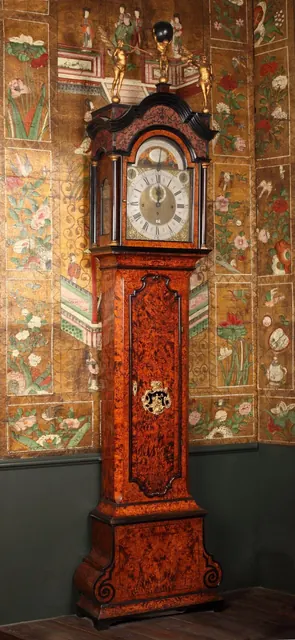
Longcase clock by Roger Dunster, Netherlands, 1715–1725
Victoria and Albert Museum, London
Clocks · c.1715 - c.1725
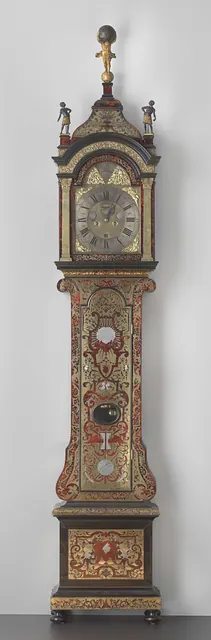
Longcase clock
Rijksmuseum
Clocks · c.1730 - c.1750
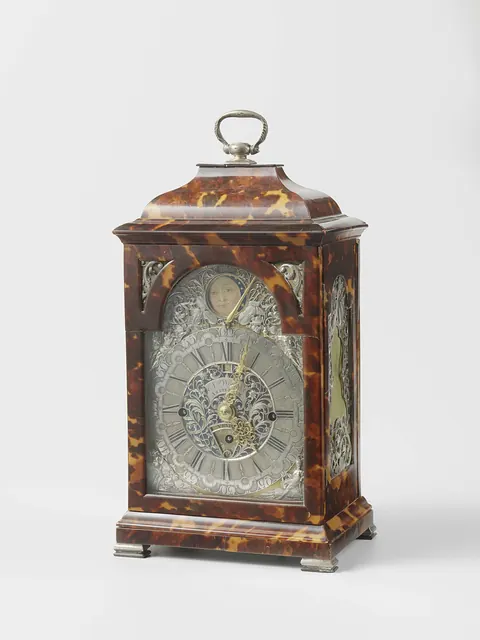
Mechanical clock, Netherlands, c.1730 - c.1750
Rijksmuseum
Clocks · c.1700 - c.1725
Furniture, Netherlands, c.1700 - c.1725
Rijksmuseum