
Wristwatches · Wristwatch
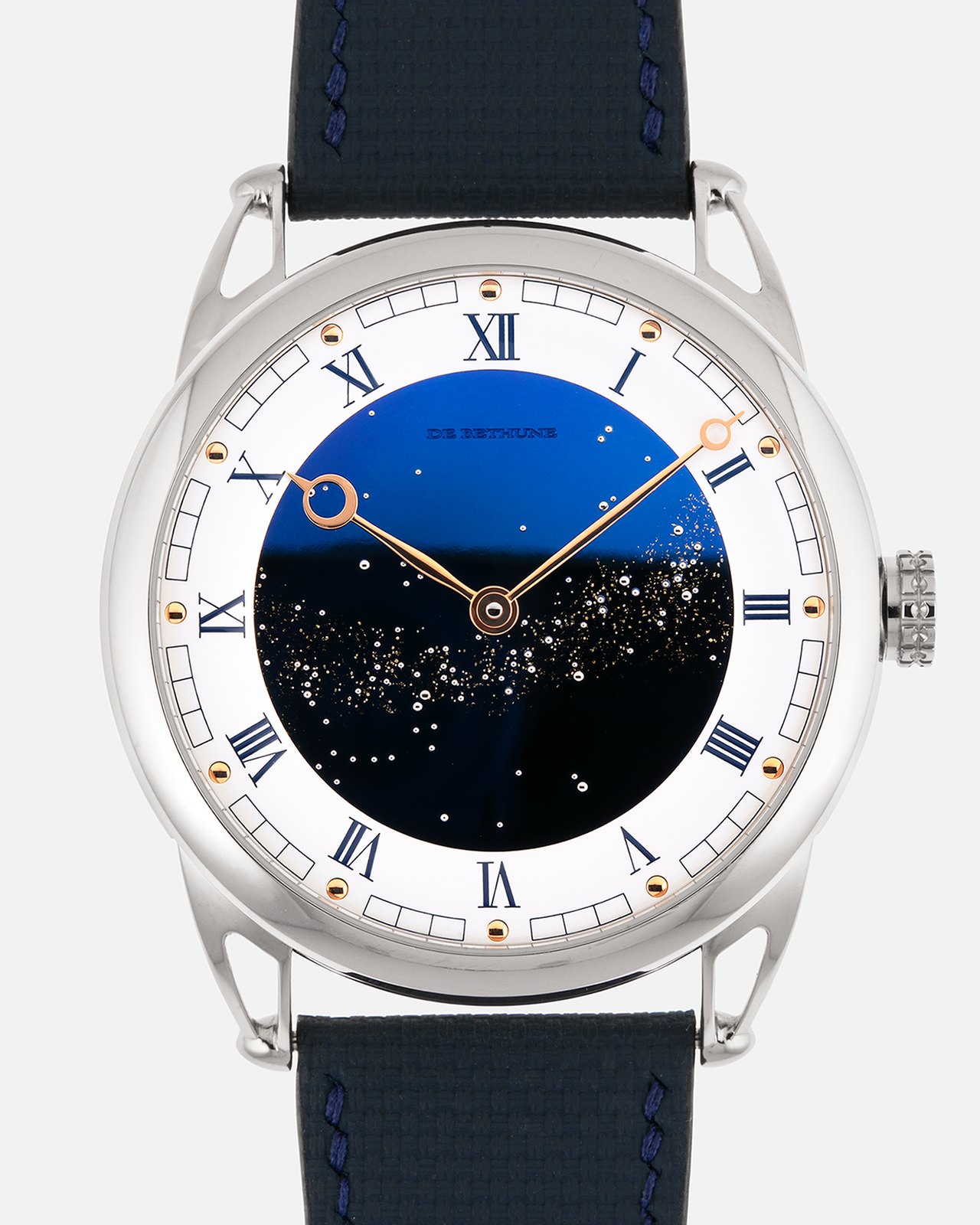
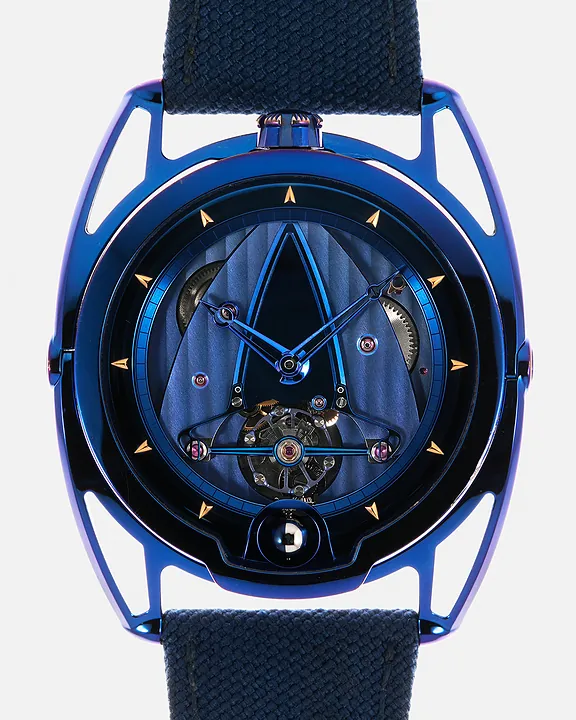
De Bethune DB25VTIS3 Starry Varius Titanium, 2022
- Maker / attribution
- De Bethune (maker)
- Date
- 2022
- Historical period
- Contemporary Horology (2010 – Present)
- Country of origin
- Switzerland
- Object type
- Wristwatch
- Materials / technique
- titanium
- Dimensions
- Case 42 mm
- Stock no.
- Product 7791943155799
- Credit line
- Dealer listing, S.Song Watches (product 7791943155799)
- Catalogue title (original)
- De Bethune DB25VTIS3 Starry Varius Titanium (English)
View the source record (dealer listing) ↗ (opens another website in a new tab)Suggest a correction
Record summary
Catalogued by S.Song Watches (dealer), Seattle (stock number Product 7791943155799), this is a wristwatch by De Bethune, made in Switzerland, dated 2022. The Atlas places it in the Contemporary Horology period (2010 – Present) of its Wristwatches collection. Materials and techniques recorded by the source: titanium. Recorded dimensions: Case 42 mm. The record is illustrated with 6 photographs.
Assembled from the source record's structured fields. Dates and attributions are given as the source states them; where a field is missing the Atlas leaves it blank rather than estimating.
Catalogue description
Dealer description — S.Song Watches
Founded in 2002 by Denis Flageollet and David Zanetta, De Bethune has established a remarkably distinct identity within independent watchmaking. While much of the manufacture's work is defined by highly technical movements and futuristic case designs, the DB25 represents its more classical side, combining traditional round watchmaking with the materials, finishing and technical innovations that have come to define the brand. Introduced in 2018, the DB25 Starry Varius is perhaps one of the purest expressions of this approach. At first glance it is an exceptionally simple watch displaying only the hours and minutes, yet almost every element of its construction is unmistakably De Bethune. At the centre is the manufacture's signature starry sky dial. Rather than conventional paint or lacquer, the deep blue surface is made from polished titanium, its colour achieved through the controlled oxidation of the metal. Individual white gold pins are then hand fitted into the dial to form the stars, while the Milky Way is created through laser micro-milling before being gilded with 24-carat gold leaf. The result has considerably more depth than a conventional blue dial, changing from an almost black navy to an intense electric blue depending on the light. Surrounding this is a silver-toned chapter ring with polished rose gold hour markers, matched by a pair of hand-polished rose gold hands. It is an unusual combination of colours and materials, but one that works particularly well. The warmth of the rose gold provides contrast against the cold blue titanium without distracting from the starry dial itself. The case is equally considered. Measuring 42mm across but just 8.8mm thick, it is made entirely from highly polished Grade 5 titanium. The hollowed ogival lugs curve sharply downwards towards the wrist, helping disguise the relatively large diameter, while the extremely low weight of titanium makes the watch considerably easier to wear than its dimensions would suggest. Visible through the sapphire caseback is the manually wound Calibre DB2005. Despite the simplicity of the display, the movement incorporates much of De Bethune's technical watchmaking, including a titanium balance wheel with white gold inserts, the manufacture's balance spring with flat terminal curve, a silicon escape wheel and its triple pare-chute shock absorption system. Twin self-regulating barrels provide an impressive six-day power reserve. The movement is also unmistakably De Bethune in its finishing. Broad bridges are decorated with Côtes De Bethune, the twin barrels are hand snailed and the steel components are individually polished and chamfered. The architecture is modern and almost industrial, but the level of hand finishing remains firmly rooted in traditional haute horlogerie. What makes the DB25 Starry Varius particularly successful is its restraint. De Bethune is best known for watches that can be visually and mechanically extreme, yet here many of the manufacture's signatures - heat-blued titanium, unusual materials, proprietary movement technology and its fascination with the night sky - are distilled into a simple two-hand watch. The result is unmistakably De Bethune, but in a form that is considerably more understated and wearable than much of the manufacture's work.
Historical context
Contemporary Horology (2010 – Present)
Silicon components, connected watches, optical-lattice research clocks and a thriving independent scene.
Smartwatches became the world's best-selling watches, while mechanical watchmaking focuses on craft, innovation (silicon components, new escapements) and independent makers.
Read the period in the timelineMore wristwatches from this periodEarlier: Mechanical Renaissance
Atlas type guide
Wristwatches
Bracelet watches were worn by women from the early nineteenth century — Breguet made one for Caroline Murat, Queen of Naples, in 1810–12 — but the wristwatch only became a man's instrument with military use and aviation in the early twentieth century. Between the World Wars it overtook the pocket watch; the 1920s and 1930s brought rectangular Art Deco cases, water-resistant cases and the first automatic winding systems.
After 1945 the wristwatch became a carrier of identity — dress watches, sports and dive watches, chronographs, calendars — produced by Swiss, American, Japanese, German, Soviet and Chinese industries. The quartz revolution after 1969 and the mechanical renaissance since the 1990s, including the rise of independent watchmakers, complete the story.
What to look for
- The reference number (between the lugs or inside the case back) and serial number, the starting point for dating.
- The calibre: its maker and number are often stamped under the dial or on the bridge.
- Originality of dial, hands and crown — refinished ('redial') dials are common.
- Case material marks: 18K/750, 14K/585, stainless steel, gold-filled, plated.
Dating clues
- Wire-lug cases: before c. 1925.
- Water-resistant screw-down cases: from 1926.
- Quartz movements: from 1969; sapphire crystals widespread after c. 1980.
General guidance written by the Atlas editors about this kind of object. It is not a statement about this particular piece; for that, rely on the source record above and on physical examination.
Related records
Wristwatches · c. 2015
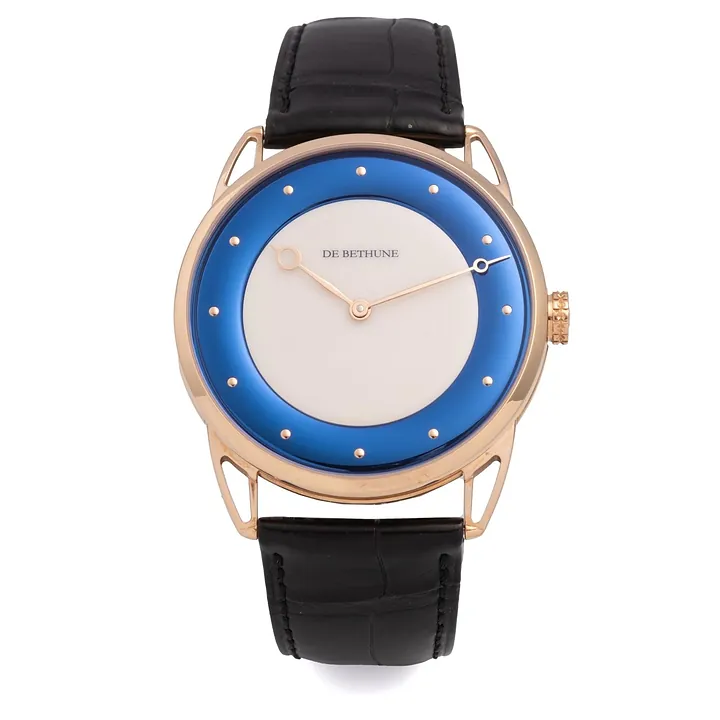
De Bethune White Night, ref. DB 25 XPA Rv3, c. 2015
Antiquorum auction archive, Geneva
Wristwatches · c. 2002
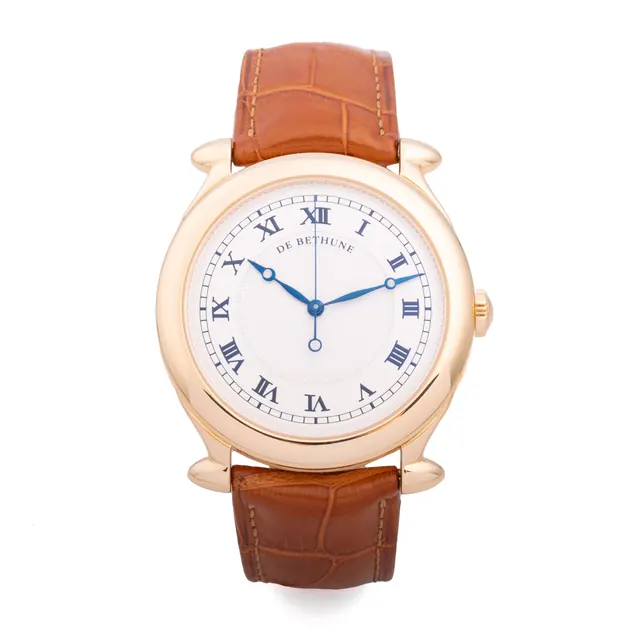
De Bethune wristwatch, ref. DB5RT, No. 007, circa 2002
Antiquorum auction archive, Geneva
Wristwatches · 2008
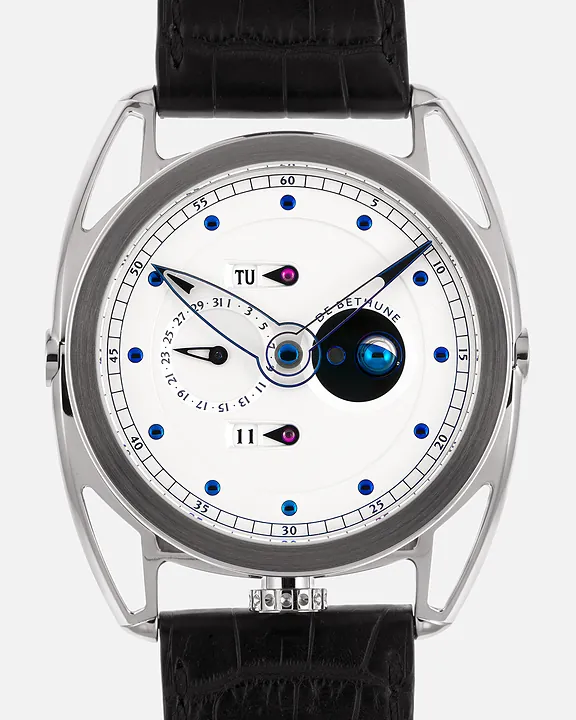
De Bethune DB26 Perpetual Calendar Moonphase DB26WS1, 2008
S.Song Watches (dealer), Seattle
Wristwatches · 2019
De Bethune DB28 Kind Of Blue, 2019
S.Song Watches (dealer), Seattle

Wristwatches · c. 2010s
Breguet Type XXI, ref. 3810, c. 2010s (Antiquorum Lot 381-24)
Antiquorum auction archive, Geneva

Wristwatches · c. 2010s
Breguet Type XXI, ref. 3810, c. 2010s (Antiquorum Lot 386-229)
Antiquorum auction archive, Geneva

Wristwatches · Sold in September 2010
Breitling Cosmonaute, ref. A 22322, Sold in September 2010
Antiquorum auction archive, Geneva

Wristwatches · c. 2010
Corum Bubble Chrono, ref. 396.150.20, c. 2010
Antiquorum auction archive, Geneva