
Wristwatches · Perpetual calendar wristwatch
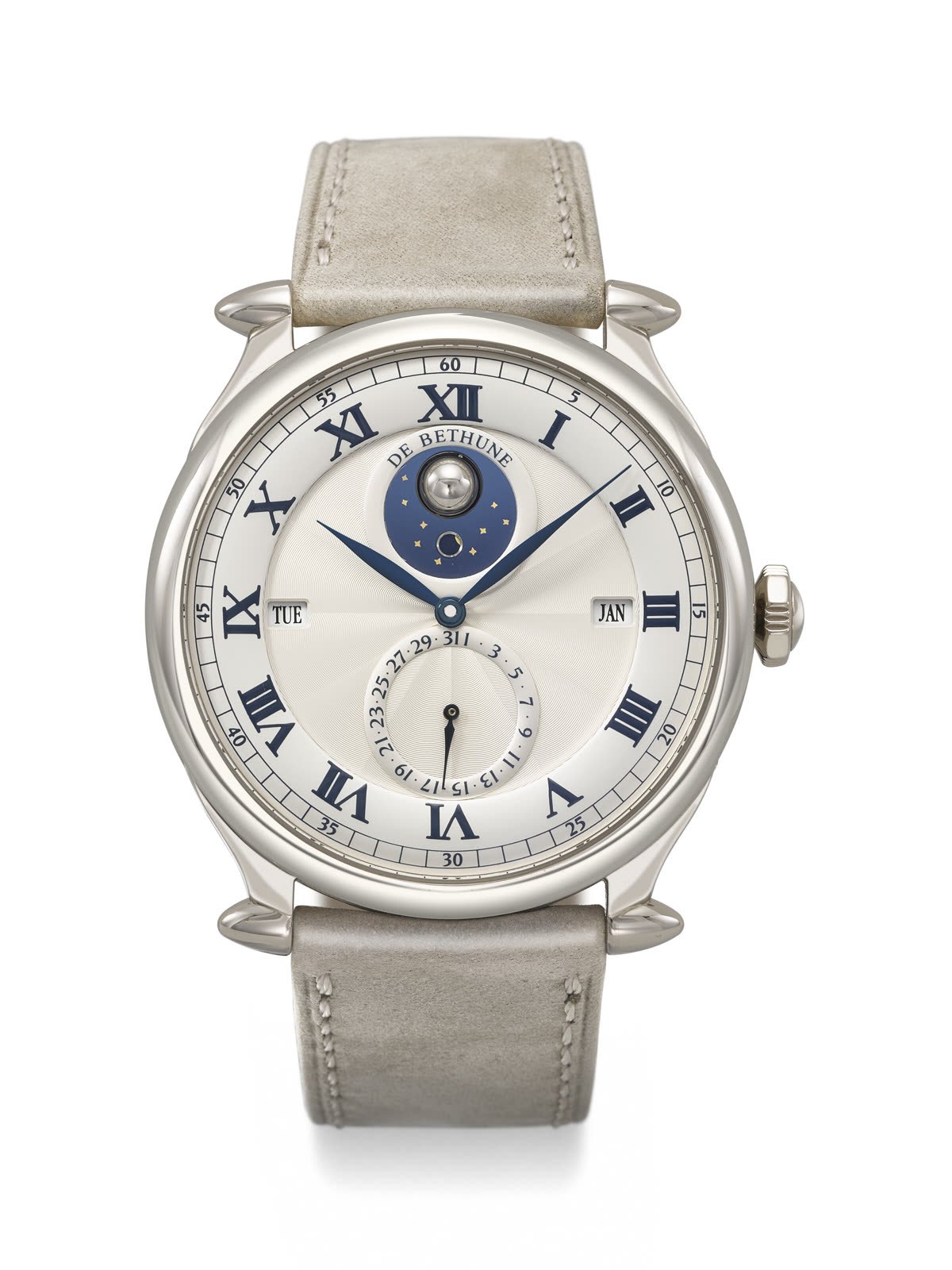
De Bethune DB15WT 18k White Gold Perpetual Calendar Wristwatch, No. 002
- Maker / attribution
- De Bethune (source attribution)
- Date
- c. 2014
- Historical period
- Contemporary Horology (2010 – Present)
- Country of origin
- Switzerland
- Object type
- Perpetual calendar wristwatch
- Materials / technique
- 18k white gold
- Dimensions
- 43 mm
- Auction house
- Christie's
- Lot
- 124
- Credit line
- Christie's
- Catalogue title (original)
- DE BETHUNE. AN ELEGANT 18K WHITE GOLD PERPETUAL CALENDAR WRISTWATCH WITH THREE-DIMENSIONAL SPHERICAL MOON PHASES AND LEAP YEAR INDICATION, REF. DB15WT, NO. 002, CIRCA 2014 | Christie's (English)
View the source record (auction lot) ↗ (opens another website in a new tab)Suggest a correction
Record summary
Catalogued by Christie's (lot 124), this is a perpetual calendar wristwatch attributed to De Bethune, made in Switzerland, dated c. 2014. The Atlas places it in the Contemporary Horology period (2010 – Present) of its Wristwatches collection. Materials and techniques recorded by the source: 18k white gold. Recorded dimensions: 43 mm. The record is illustrated with 1 photograph.
Assembled from the source record's structured fields. Dates and attributions are given as the source states them; where a field is missing the Atlas leaves it blank rather than estimating.
Catalogue description
Original object description
Catalogued as Lot 124 at Christie's, this 18k white gold perpetual calendar wristwatch by De Bethune carries reference DB15WT and individual number 002, with an estimated date of circa 2014. The circular case spans 43 mm across and incorporates the manufacture's characteristic teardrop ogival lugs. On the silvered guilloché dial, blued hands indicate time over Roman numerals, supported by apertures for the day at 9 o'clock and the month at 3 o'clock, an analog date subdial at 6 o'clock, and a spherical three-dimensional moon phase set into a blued, star-decorated opening beneath 12 o'clock, which also includes a subtle leap-year indication.
Original object description
Bearing model reference DB15WT and number 002, this wristwatch is executed in 18k white gold with a stated diameter of 43 mm. Its polished case incorporates teardrop-shaped ogival lugs and is mounted on a light grey leather strap. Accompanying ephemera and accessories cited in the auction entry comprise a De Bethune 18k white gold buckle, a certificate of origin, an inner case, a slip cover, and an outer storage pouch. Neither the caliber nor the case reverse can be viewed in the catalog image.
Original object description
The dial exhibits an engine-turned silvered guilloché center framed by an outer minutes ring and Roman hour markers. The calendar indications include day and month windows at 9 and 3 o'clock (reading 'TUE' and 'JAN' in the catalog photograph) and a pointer-date dial at 6 o'clock. Positioned below 12 o'clock is a three-dimensional spherical moon set against a blued starry backdrop, which incorporates a leap-year indicator represented by an eclipsed star.
Original object description
The auction catalogue provides conflicting descriptions regarding the internal movement: the formal technical specifications describe it as manual wind, whereas the prose narrative cites an automatic caliber DB2004 with a five-day power reserve. In the absence of direct inspection or movement photographs, the mechanical condition, caliber markings, and winding method remain unconfirmed, and the circa 2014 date is an auction estimate.
Inscriptions & marks
002
Historical context
Contemporary Horology (2010 – Present)
Silicon components, connected watches, optical-lattice research clocks and a thriving independent scene.
Smartwatches became the world's best-selling watches, while mechanical watchmaking focuses on craft, innovation (silicon components, new escapements) and independent makers.
Read the period in the timelineMore wristwatches from this periodEarlier: Mechanical Renaissance
Atlas type guide
Calendar, moon-phase and perpetual calendar watches
Calendar complications range from a simple date to the perpetual calendar, which automatically allows for months of different lengths and leap years until 2100. Pocket watches with perpetual calendars were made in the eighteenth and nineteenth centuries; Patek Philippe made the first perpetual calendar wristwatch in 1925, and series production followed in 1941. The annual calendar (Patek Philippe, 1996) needs correction only once a year.
Moon-phase displays use a disc with two moons and 59 teeth advanced daily, approximating the 29.5-day lunation; more precise trains reduce the error to one day in over a century.
What to look for
- Apertures or subsidiary dials for day, date, month and leap year.
- Moon disc under a 'bosom' shaped aperture.
- Recessed correctors on the case band for setting the calendar.
Dating clues
- Triple-date wristwatches: popular c. 1940–1955.
- Perpetual calendar wristwatches: from 1925 (unique) and 1941 (series).
General guidance written by the Atlas editors about this kind of object. It is not a statement about this particular piece; for that, rely on the source record above and on physical examination.
Related records
Wristwatches · c. 2015
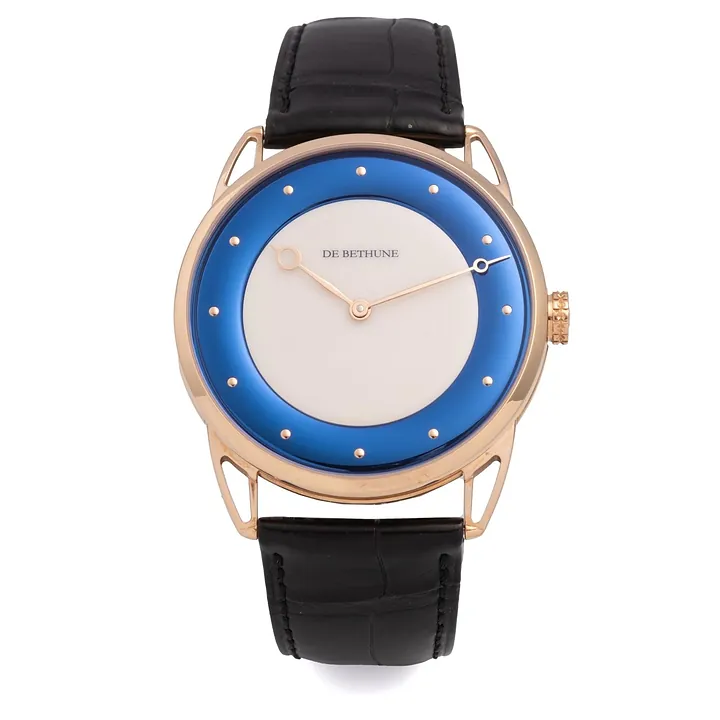
De Bethune White Night, ref. DB 25 XPA Rv3, c. 2015
Antiquorum auction archive, Geneva
Wristwatches · c. 2002
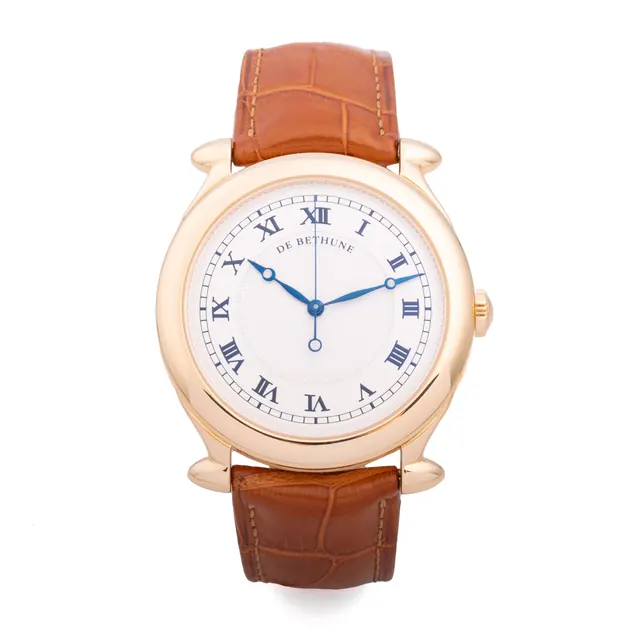
De Bethune wristwatch, ref. DB5RT, No. 007, circa 2002
Antiquorum auction archive, Geneva
Wristwatches · 2008
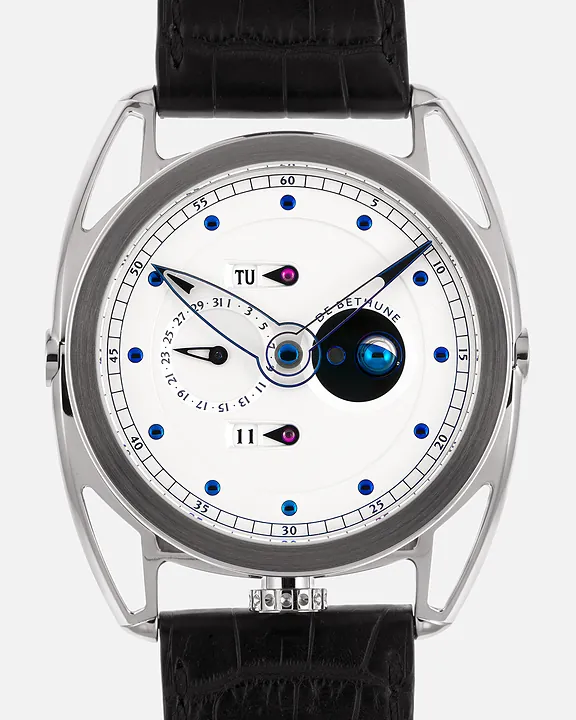
De Bethune DB26 Perpetual Calendar Moonphase DB26WS1, 2008
S.Song Watches (dealer), Seattle
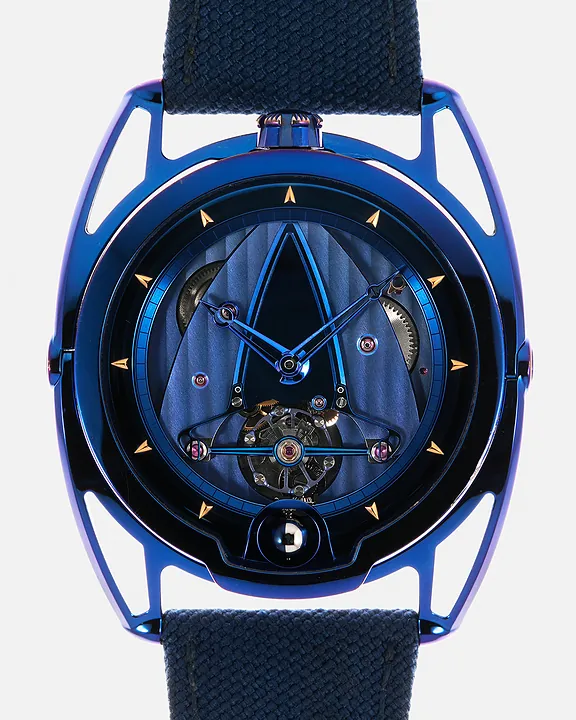
Wristwatches · 2019
De Bethune DB28 Kind Of Blue, 2019
S.Song Watches (dealer), Seattle

Wristwatches · c. 2010s
Breguet Type XXI, ref. 3810, c. 2010s (Antiquorum Lot 381-24)
Antiquorum auction archive, Geneva

Wristwatches · c. 2010s
Breguet Type XXI, ref. 3810, c. 2010s (Antiquorum Lot 386-229)
Antiquorum auction archive, Geneva

Wristwatches · Sold in September 2010
Breitling Cosmonaute, ref. A 22322, Sold in September 2010
Antiquorum auction archive, Geneva

Wristwatches · c. 2010
Corum Bubble Chrono, ref. 396.150.20, c. 2010
Antiquorum auction archive, Geneva