
Wristwatches · Wristwatch
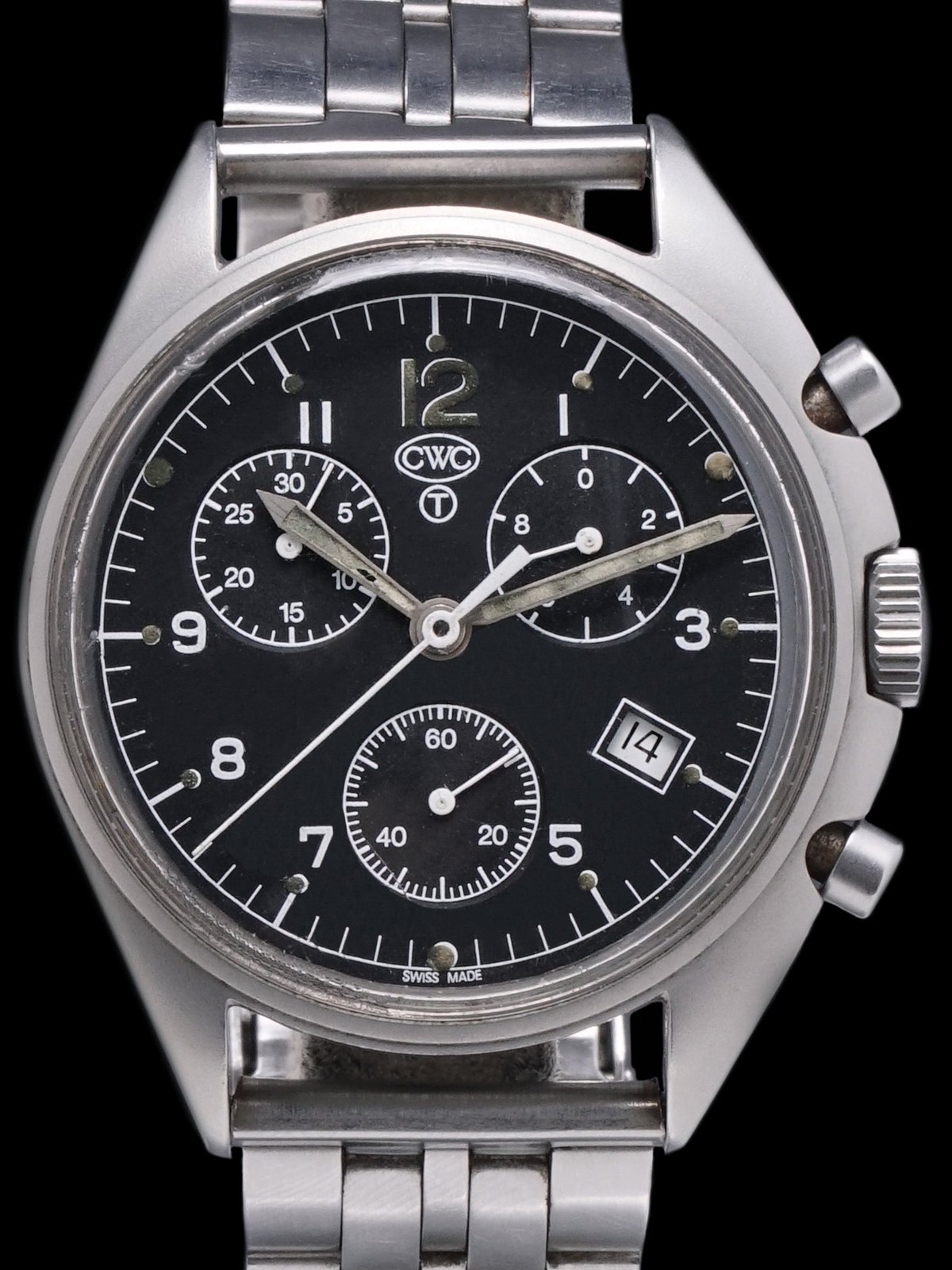
CWC Quartz Military Pilots Chronograph "Belgian Air Force", 1990s
- Maker / attribution
- CWC (maker)
- Date
- 1990s
- Historical period
- Mechanical Renaissance (1990 – 2010)
- Country of origin
- Belgium
- Object type
- Wristwatch
- Dimensions
- Case 39 mm
- Stock no.
- CWCQCHRBAF
- Credit line
- Dealer listing, Craft & Tailored (CWCQCHRBAF)
- Catalogue title (original)
- 1990s CWC Quartz Military Pilots Chronograph "Belgian Air Force" (English)
View the source record (dealer listing) ↗ (opens another website in a new tab)Suggest a correction
Record summary
Catalogued by Craft & Tailored (dealer), Los Angeles (stock number CWCQCHRBAF), this is a wristwatch by CWC, made in Belgium, dated 1990s. The Atlas places it in the Mechanical Renaissance period (1990 – 2010) of its Wristwatches collection. Recorded dimensions: Case 39 mm. The record is illustrated with 6 photographs.
Assembled from the source record's structured fields. Dates and attributions are given as the source states them; where a field is missing the Atlas leaves it blank rather than estimating.
Catalogue description
Dealer description — Craft & Tailored
Cabot Watch Company or CWC was founded in 1972 with a clear focus in mind, to win MOD wristwatch contracts, often utilizing quartz movements for accuracy and affordability. CWC is most known for creating the military diving watch that replaced the Rolex 5517 or Rolex Milsub for the British military and continued to supply military spec wristwatches to different branches of the British and European Militaries until the 1990s. The CWC quartz-powered pilots chronograph were issued to the Belgian Air Force in the 1990s, featuring both a date and jumping hour hand complication along with the classic "circle T" dial, which is the military designation for the use of tritium. These fixed spring bar chronographs are mostly seen equipped with a NATO strap, however, some CWC chronographs were issued with a Rowi stainless steel bracelets, which creates both a unique and tasteful appearance to this rugged military timepiece. SPECS Stock # CWCQCHRBAF Brand CWC Style Chronograph Model Military Pilots Watch Serial N/A Size Men's Material SS Dial Matte Black "T" Millimeters 39mm Bracelet Rowi Stainless Steel Bracelet CASE & BRACELET The excellent case retains its original bead blast finishing and fixed spring bars, showing light signs of use. The case retains its original unsigned crown and pushers with bead blast finishing. The case back clearly displays its original engravings for its military classification, showing some light tool marks from a previous service. The original stainless steel Rowi bracelet remains in excellent condition showing very light stretch form use. DIAL & HANDS The matte black "T" dial with white text and Arabic numerals is in wonderful vintage condition. The original tritium lume plots have taken on a charming dark patina and show very minor degradation throughout under U.V. light inspection. The original tritium hands match the dial nicely, under U.V. light inspection the hour hand exhibits some lume loss, the minute hand remains fully intact. ACCESSORIES None. The watch is functioning and keeping time perfectly, previous service history is unknown.
Historical context
Mechanical Renaissance (1990 – 2010)
Mechanical watches return as cultural objects; independent watchmaking flourishes.
Mechanical watches returned as cultural and luxury objects. Complications, tourbillons and new materials proliferated; independent watchmakers such as George Daniels, F.P. Journe and Philippe Dufour revived artisanal watchmaking; collecting vintage watches became a major field.
Read the period in the timelineMore wristwatches from this periodEarlier: Quartz Revolution
Atlas type guide
Chronographs and split-seconds watches
A chronograph is a watch with an additional seconds hand that can be started, stopped and returned to zero independently of the timekeeping. Louis Moinet built an early example in 1816 and Nicolas Rieussec a recording 'chronographe' in 1821; Adolphe Nicole's heart-shaped reset cam (patented 1862) made the modern return-to-zero possible. Split-seconds (rattrapante) chronographs add a second hand that can be stopped for intermediate times; flyback chronographs restart instantly.
Chronographs were essential tools for doctors (pulsometer scales), artillery (telemeter), engineers and sport. In wristwatches, Valjoux, Venus, Lemania and later the automatic chronographs of 1969 (Zenith El Primero, the Chronomatic Calibre 11 group and Seiko 6139) are milestones.
What to look for
- Push-pieces on the case band or a single button in the crown (monopusher).
- Subsidiary registers for minutes and hours; tachymeter, telemeter or pulsometer scales.
- Column wheel versus cam control visible in the movement.
- Calibre markings of specialist makers (Valjoux, Lemania, Venus, Landeron).
Dating clues
- Pocket chronographs with heart cam reset: after 1862.
- Wrist chronographs: from c. 1910; two-button designs from the 1930s.
- Automatic chronographs: from 1969.
General guidance written by the Atlas editors about this kind of object. It is not a statement about this particular piece; for that, rely on the source record above and on physical examination.
Read next:Flyback chronographChronograph
Related records
Wristwatches · c. 1985
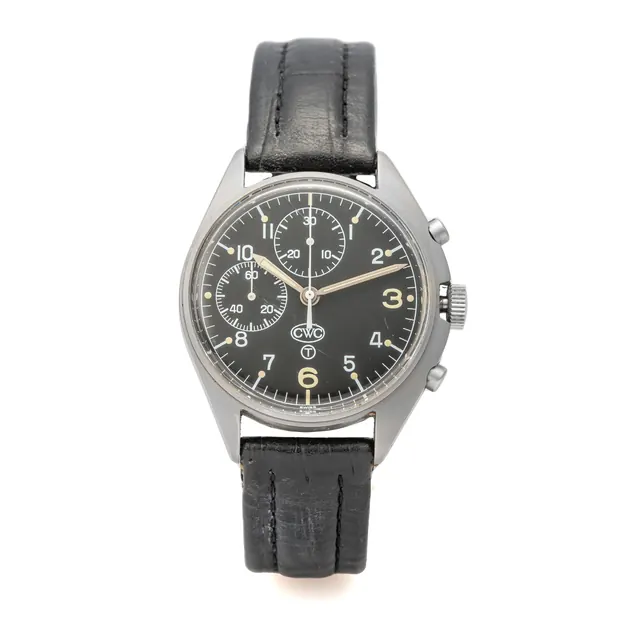
Cwc wristwatch, Military Chronograph, circa 1985
Antiquorum auction archive, Geneva
Wristwatches · 1986
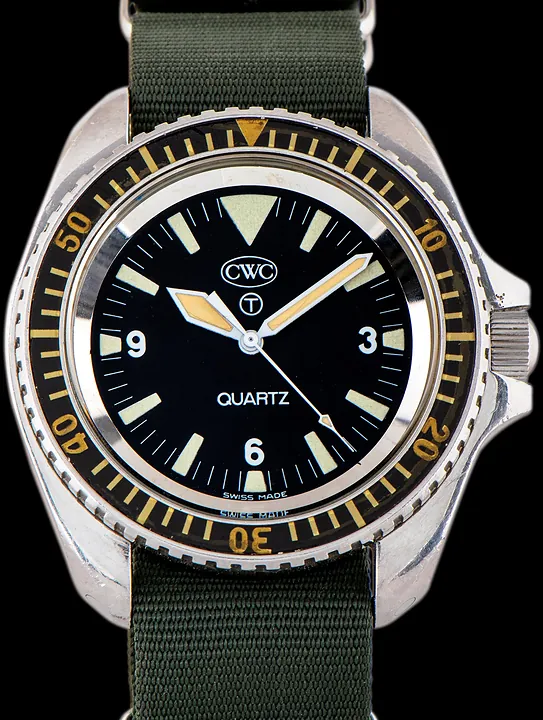
CWC Royal Navy Diver 0552/6645-99-7573314, 1986
Craft & Tailored (dealer), Los Angeles
Wristwatches · 2005
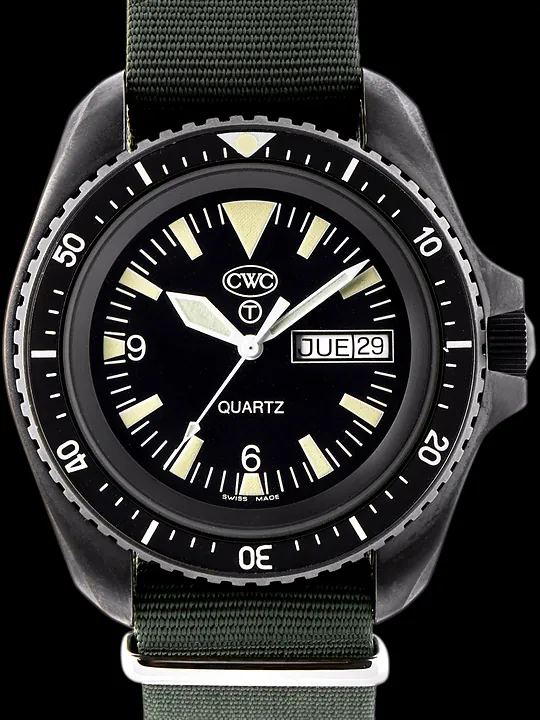
CWC Royal Navy SBS Diver W10/6645-99-7995443, 2005
Craft & Tailored (dealer), Los Angeles
Wristwatches · 1993
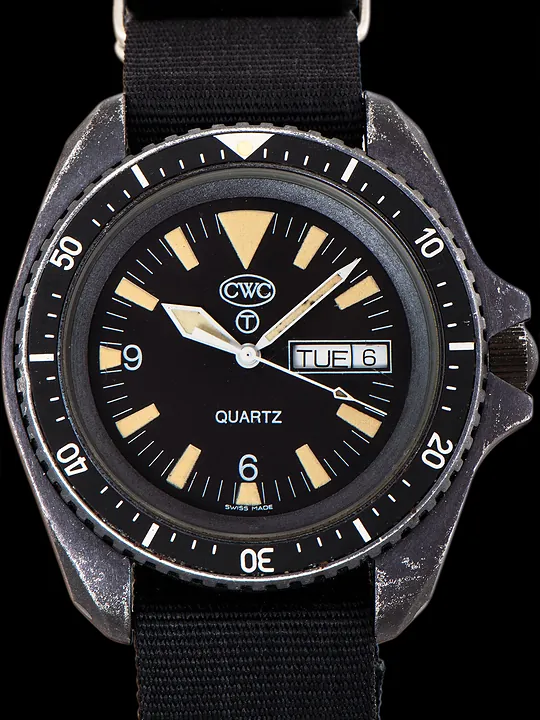
CWC Royal Navy SBS Diver 0555/6645-99-7995443, 1993
Craft & Tailored (dealer), Los Angeles
Wristwatches · 1999
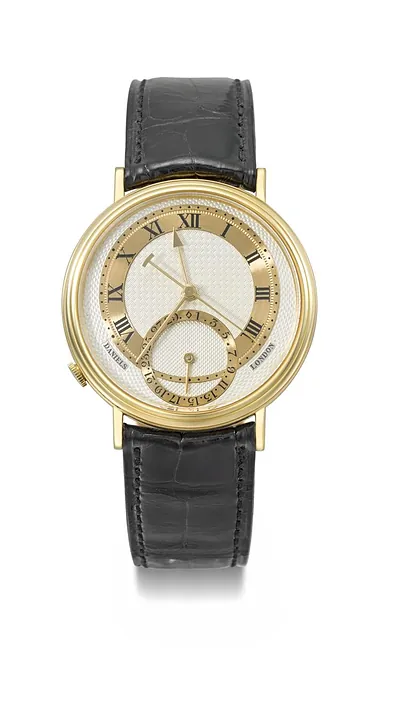
'Millennium' co-axial wristwatch by George Daniels and Omega, England, 1999
Science Museum Group, London

Wristwatches · 2008
Wristwatch by Breitling?, 2008
Museum Rotterdam
Wristwatches · 2008
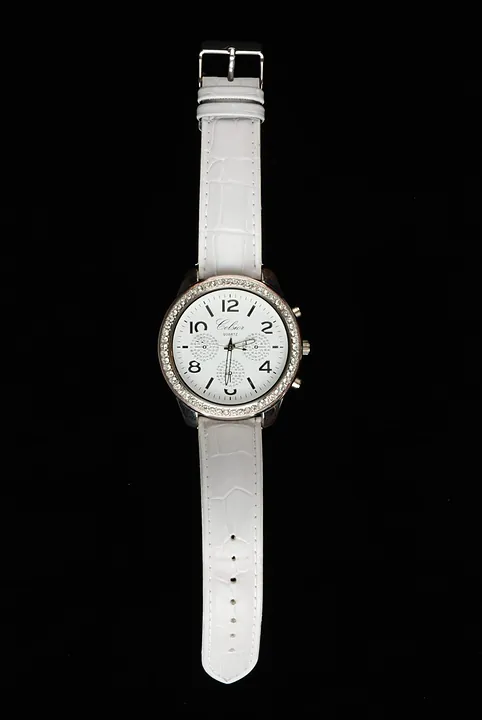
Wristwatch by Celsior Quartz, 2008
Museum Rotterdam
Wristwatches · 2008
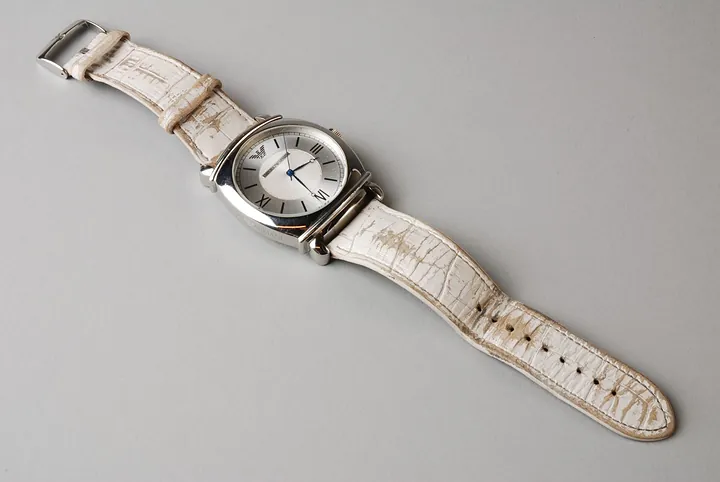
Wristwatch possibly by Emporio Armani, 2008
Museum Rotterdam