
Clocks · Clock
Clock, Netherlands, 1770–1830
- Maker / attribution
- Unrecorded in source
- Date
- 1770–1830
- Historical period
- Precision & Scientific Horology (1750 – 1850)
- Country of origin
- Netherlands
- Place
- Friesland
- Object type
- Clock
- Materials / technique
- Wooden frame with painted dial and surround supporting gilded metal cresting, and iron movement
- Dimensions
- Height: 17 1/4 in; Width: 11.5 in; Height: 22 7/8 in; Depth: 9.5 in
- Holding institution
- Victoria and Albert Museum, London
- Accession / object no.
- M.16:1 to 7 -1965
- Credit line
- Given by Miss Frances M Rivers
View the source record ↗ (opens another website in a new tab)Suggest a correction
Record summary
Held and catalogued by Victoria and Albert Museum, London (object number M.16:1 to 7 -1965), this is a clock, made in Friesland, Netherlands, dated 1770–1830. The Atlas places it in the Precision & Scientific Horology period (1750 – 1850) of its Clocks collection. Materials and techniques recorded by the source: Wooden frame with painted dial and surround supporting gilded metal cresting, and iron movement. Recorded dimensions: Height: 17 1/4 in; Width: 11.5 in; Height: 22 7/8 in; Depth: 9.5 in. The record is illustrated with 2 photographs.
Assembled from the source record's structured fields. Dates and attributions are given as the source states them; where a field is missing the Atlas leaves it blank rather than estimating.
Catalogue description
Summary — Victoria and Albert Museum
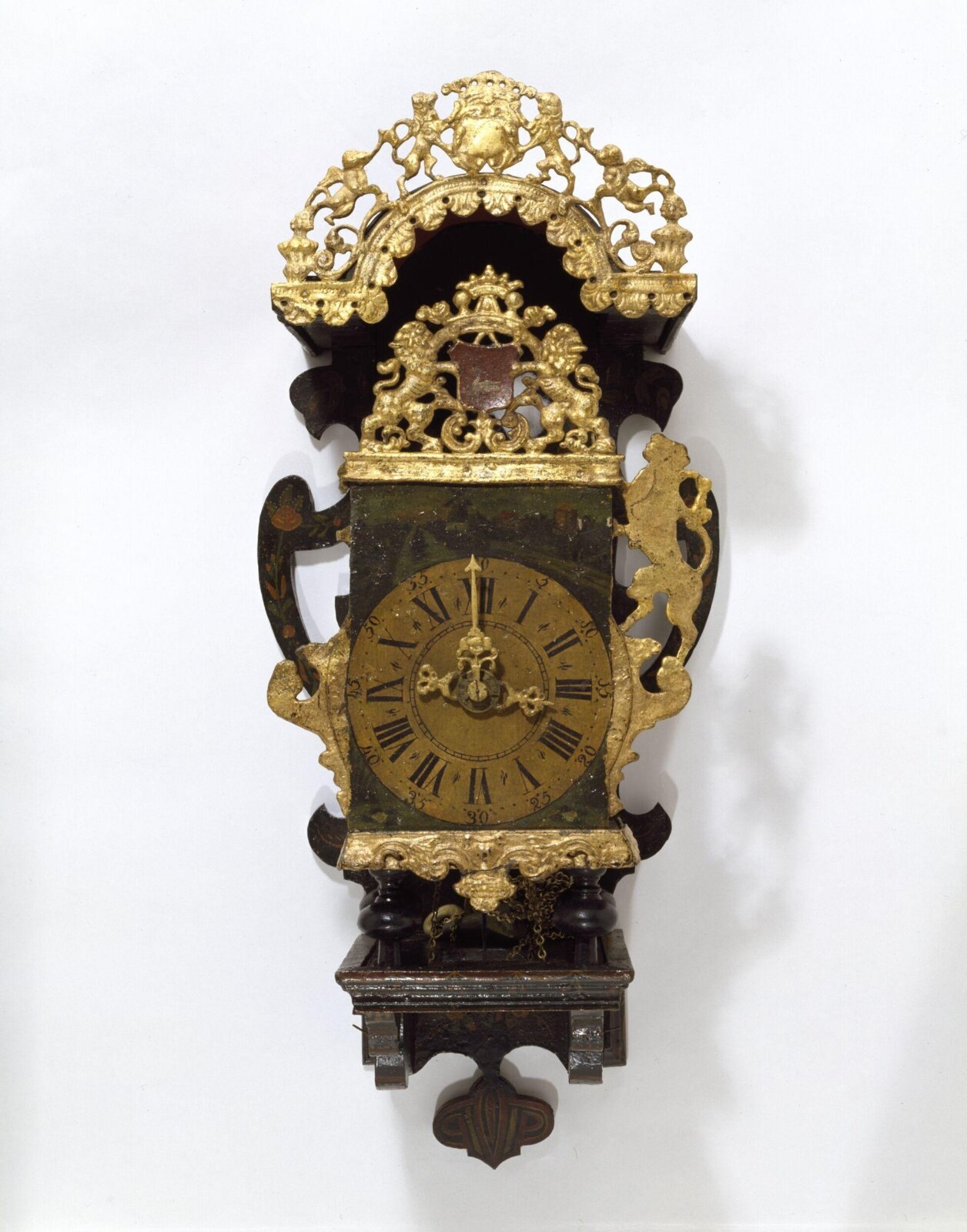
This clock on its wooden bracket with arched canopy is decorated with gilded lead heraldic ornament and of a type known as a Stohl Klok (chair clock) associated with Friesland and the city of Leeuwarden. This architectural form, painted with scenes from daily life and flowers, provided a focal point in the domestic interior. This example dates from the late 18th or early 19th century.
Physical description — Victoria and Albert Museum
A rectangular case with side doors (now separate, but originally hinged and glazed) enclosing an iron movement with a bell at the top. With ornamental pierced cresting at the front and the sides, cast in lead, that at the front with a crowned coat of arms, a white swan on a red field, and those at the sides with an unidentified monogram. The dial plate is painted with a Dutch canal scene above and flowers (water lilies?) below. It is flanked by rampant lions cast in gilt lead (one is broken). All parts of the case are painted or gilt. The dial has a Roman chapter ring, and outer Arabic minute ring and brass hands, the hour hand with a brass pointer attached to the central alarm dial. Also rivetted to the case are further cast and gilded lead ornaments consisting of the armorial cresting above the arched wooden painted canopy and a pierced apron ornament attached to the dial plate below. The brackets which attach the clock to the wall are, like the frames to the side doors, painted with roses against an olive green ground. The movement is supported by four balusters. The brass chain and pulleys with four weights (two cylindrical, two conical, one of lead the other of brass) are listed in the original registered description but have not yet been identified or correctly numbered. The registered description has been annotated at a later date as follows 'Lead decoration broken partly repaired in museum when gilding was also partly renewed'.
Brief description — Victoria and Albert Museum
Clock, wood, iron, lead and brass with painted decoration and gilded cast ornament, Dutch, late 18th- early 19th century
Provenance
In the sixteenth century, the wall-mounted, weight-driven chamber clock became a relatively common type in the Low Countries (Holland and Flanders). By the early eighteenth century, particularly in Friesland, the brass dial and movement were sometimes set in a decorative case with cresting that included coats of arms and heraldic supporters indicating the status of the owner. Such clocks were known as 'Stoel Klok' (chair clock). The imposing Stoelklok is distinguished by its elaborate cast fretwork crown adorned with a "jewel". The Dutch Stoelklok means "Stool Clock" or "Seat Clock" as the elaborately pillared movement sits firmly upon a chair-like wooden platform with a backboard and arched hood. There are two armorial shields both with lion supporters on the cresting of the hood and the cresting above the dial; the lower painted coat of arms shows a swan on a red ground and may identify an earlier owner. The clock was given to the V&A in 1965 by Miss Frances M Rivers.
Historical context
Precision & Scientific Horology (1750 – 1850)
Harrison solves longitude; Mudge invents the lever; Breguet's Paris workshop defines the modern watch.
The age of the deadbeat escapement, compensated pendulums and observatory regulators. Domestic clocks spread through the middle classes: English longcase and bracket clocks, French gilt-bronze mantel clocks, Viennese Biedermeier wall clocks, Black Forest painted-shield clocks, and the first American shelf clocks.
Read the period in the timelineMore clocks from this periodEarlier: Early Modern Horology
Atlas type guide
Domestic clocks
A clock combines four systems: a source of power (falling weight, coiled spring, or later electricity), a gear train that divides time, an escapement and oscillator that regulate it (foliot, pendulum or balance), and an indicating system of dial and hands or a bell. Its history runs from the large iron weight-driven clocks of the late thirteenth century to Renaissance spring-driven table clocks, the pendulum revolution of 1656, the factory clocks of the nineteenth century and electric and quartz clocks of the twentieth.
Domestic clocks also reflect regional furniture and decorative traditions — English longcase and bracket clocks, French pendules, Viennese regulators, Black Forest and American shelf clocks — and therefore record changing tastes as much as technical progress.
What to look for
- How the clock is powered: weights, spring barrel, fusee, electric coil.
- The oscillator: foliot, short pendulum, long seconds pendulum or balance.
- Whether it strikes: hour only (count wheel) or hours and quarters (rack striking).
- The maker or retailer's name on dial and movement, and any factory trademarks.
- Signs of alteration — replaced dials, converted escapements, 'married' cases.
Dating clues
- Before 1656 clocks used foliots or balances; after, most domestic clocks have pendulums.
- Anchor escapements spread after c. 1670; minute hands became common at the same time.
- Factory production in America and Germany transformed prices after c. 1840.
General guidance written by the Atlas editors about this kind of object. It is not a statement about this particular piece; for that, rely on the source record above and on physical examination.
Related records
Clocks · 1799
Longcase clock by Jan Hermelink, Netherlands, 1799
Geldersch Landschap & Kasteelen
Clocks · c.1755 - c.1765
Longcase clock
Rijksmuseum
Clocks · 1792
Mechanical clock, Netherlands, 1792
Rijksmuseum
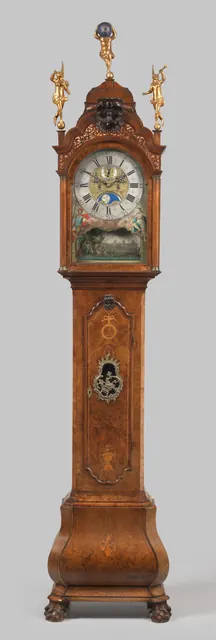
Clocks · c. 1750 - before 1799
Longcase clock by Jan Hermelinck, Netherlands, c. 1750 - before 1799
Rijksmuseum
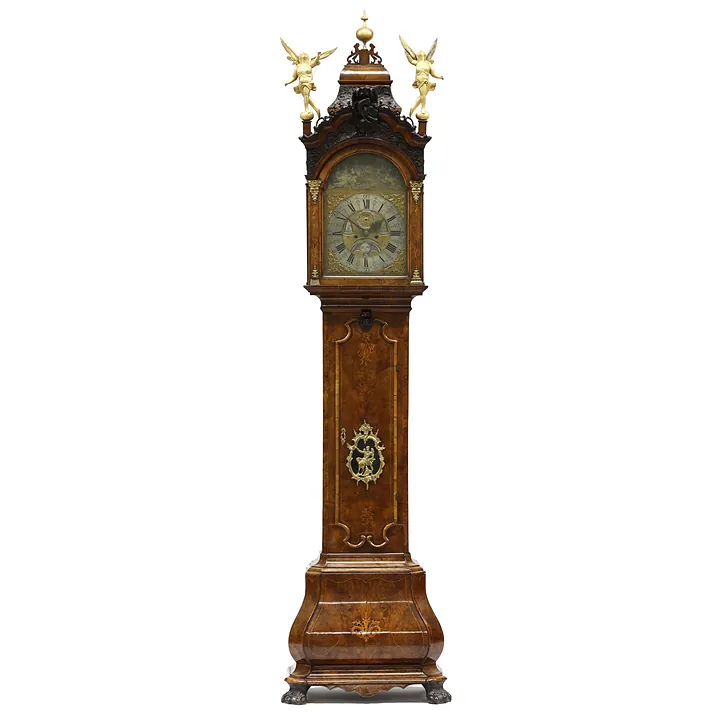
Clocks · c. 1770
A Fine Dutch Marquetry Inlaid Burl Wood Tall Case Clock, Johannes du Chesne, c. 1770
LiveAuctioneers auction archive
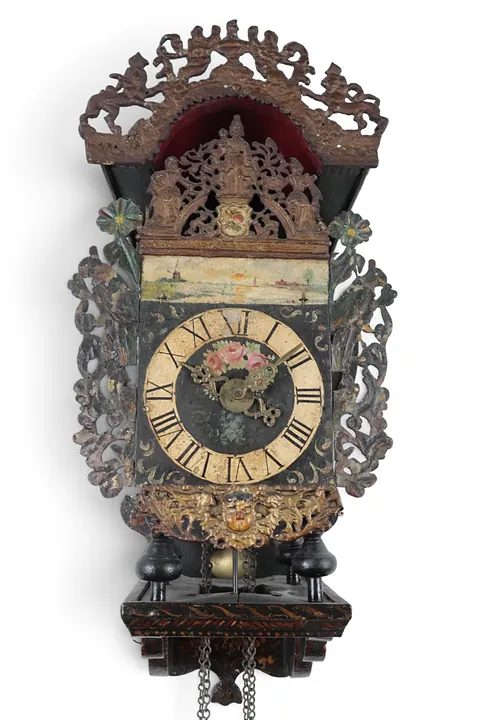
Clocks · c. 1800
Frisian 'stoelklok' wall clock, Netherlands, circa 1800
Invaluable auction listings
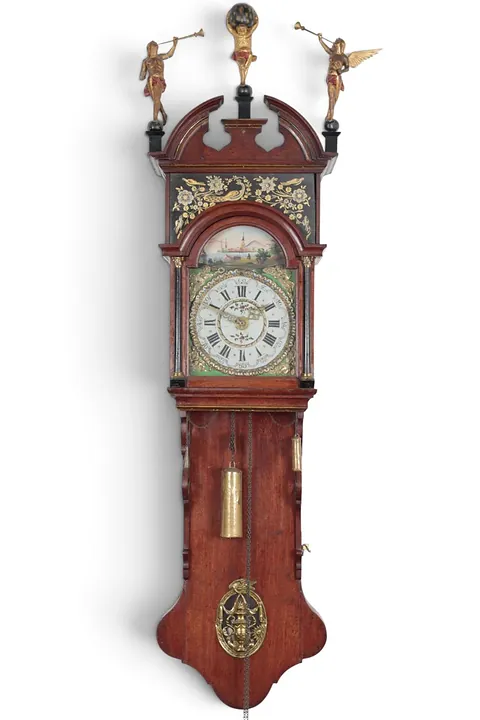
Clocks · 19th century
Groningen 'staartklok' (tail clock), Netherlands, 19th century
Invaluable auction listings
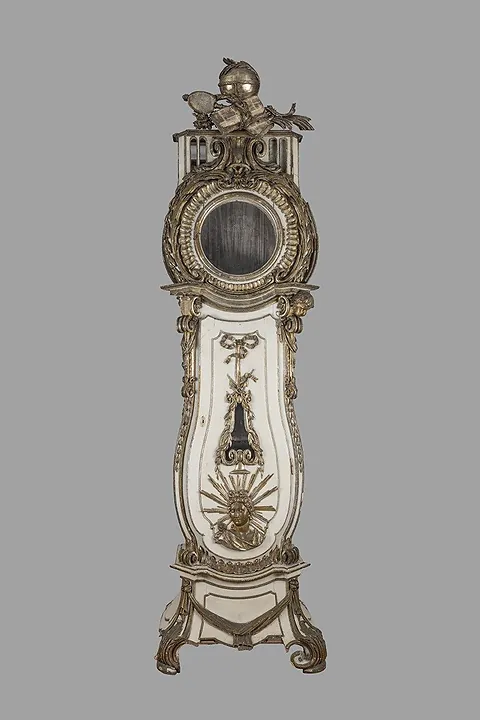
Clocks · c. 1780
Longcase clock by Louis George, Eberswalde, c. 1780
Museum Eberswalde