
Wristwatches · Wristwatch
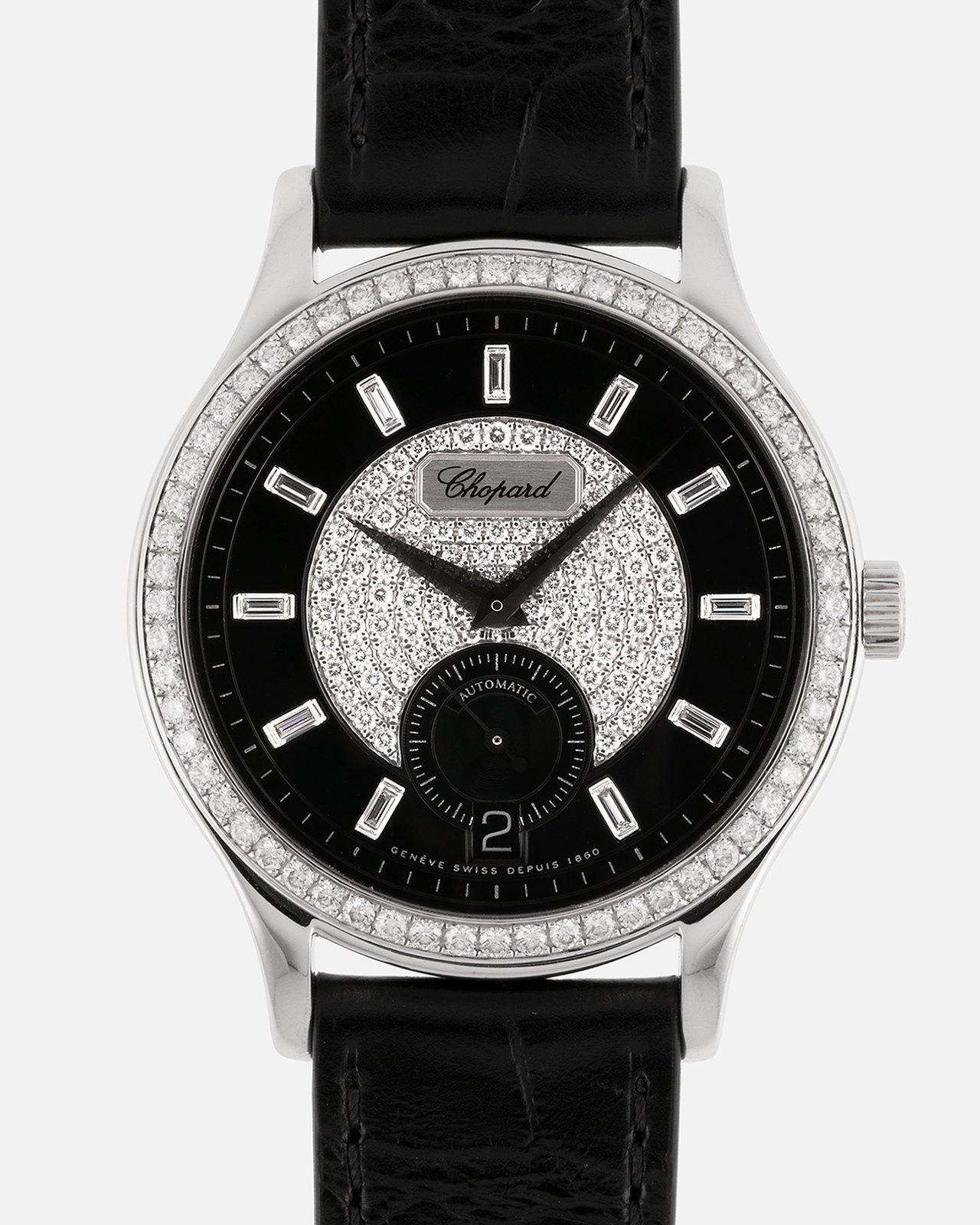
Chopard LUC 1860 17/1873/2 WG Black Pave Baguette Markers, 2000s
- Maker / attribution
- Chopard (maker)
- Date
- 2000s
- Historical period
- Mechanical Renaissance (1990 – 2010)
- Country of origin
- Switzerland
- Object type
- Wristwatch
- Dimensions
- Case 37 mm
- Stock no.
- Product 7834256310359
- Credit line
- Dealer listing, S.Song Watches (product 7834256310359)
- Catalogue title (original)
- Chopard LUC 1860 17/1873/2 WG Black Pave Baguette Markers (English)
View the source record (dealer listing) ↗ (opens another website in a new tab)Suggest a correction
Record summary
Catalogued by S.Song Watches (dealer), Seattle (stock number Product 7834256310359), this is a wristwatch by Chopard, made in Switzerland, dated 2000s. The Atlas places it in the Mechanical Renaissance period (1990 – 2010) of its Wristwatches collection. Recorded dimensions: Case 37 mm. The record is illustrated with 6 photographs.
Assembled from the source record's structured fields. Dates and attributions are given as the source states them; where a field is missing the Atlas leaves it blank rather than estimating.
Catalogue description
Dealer description — S.Song Watches
While Chopard is predominantly recognised for its jewellery and more commercially oriented watches, its involvement in high-end mechanical watchmaking is considerably more significant than many realise. Under the direction of Karl-Friedrich Scheufele, Chopard established its manufacture in Fleurier in 1996, with the ambition of producing movements capable of competing with the very best of traditional Swiss watchmaking. At a time when much of the industry remained reliant on movements supplied by external manufacturers, the decision to develop an entirely new in-house calibre was both ambitious and remarkably forward-thinking. The result was the calibre 1.96, developed with the involvement of Michel Parmigiani and introduced in 1996. Featuring a beautifully finished micro-rotor movement, twin stacked mainspring barrels and an impressive 65-hour power reserve, the calibre combined technical sophistication with traditional haute horlogerie finishing. It was awarded both COSC chronometer certification and the prestigious Geneva Seal, an extraordinary achievement for a manufacture's inaugural movement. Even today, the calibre 1.96 is widely regarded as one of the finest automatic movements of its generation. The first watch to house this movement was the L.U.C. 16/1860, introduced in 1997. Measuring approximately 37mm in diameter, it featured a beautifully proportioned case and an engine-turned solid gold dial produced by Metalem, the same specialist dial manufacturer that would later become associated with Philippe Dufour's Simplicity. With its restrained design, exceptional movement and relatively modest dimensions, the 16/1860 has since become one of the most appreciated neo-vintage dress watches among collectors. However, what makes the early L.U.C. collection particularly fascinating is the existence of a small number of highly unusual variations, many of which appear to have been produced outside the regular catalogue. These watches retained the fundamental architecture and exceptional movement of the original 16/1860, but incorporated elaborate decorative treatments that reflected Chopard's considerable expertise as a jewellery house. Here, we have an extraordinarily unusual example, the reference 17/1873/2 in 18-carat white gold. Based on the original 16/1860/2, this particular watch features a black dial with baguette diamond hour markers, a diamond-set bezel and, most unusually, a central section entirely set with pavé diamonds in place of the traditional engine-turned guilloché. It is a configuration that I have rarely encountered, and one that appears to belong to the small group of special-order or off-catalogue variations produced during Chopard's early L.U.C. years. The case retains the classical proportions and familiar design of the original 1860, with its gently stepped bezel, relatively slender lugs and understated profile. However, the addition of diamonds around the bezel transforms its appearance considerably, introducing a more elaborate decorative element without fundamentally changing the proportions that made the original design so successful. The dial is undoubtedly the most remarkable aspect of this particular example. While the regular 16/1860 is celebrated for its beautifully executed guilloché centre, here that entire section has been replaced by an intricate arrangement of pavé-set diamonds. Surrounding it is a contrasting black chapter ring, punctuated by baguette diamond hour markers that introduce a distinctly geometric quality to the design. The contrast between the dark dial, brilliant-cut pavé diamonds and more structured baguette markers is particularly attractive, with the different diamond cuts creating an unusual interplay of light and texture. Turning the watch over reveals the calibre 1.96, one of the defining movements of modern Chopard watchmaking. Its 22-carat gold micro-rotor, beautifully decorated bridges, polished bevels and Geneva Seal finishing are a reminder that beneath the elaborate exterior lies exactly the same exceptional mechanical foundation that made the original 16/1860 so important. The precise production numbers of the 17/1873/2 are not publicly documented, and very little information exists regarding this particular configuration. Given the unusual reference designation and the elaborate combination of diamond-setting techniques, it would appear to be an exceptionally rare variation, quite possibly produced as a special order rather than as part of the regular catalogue. What I find particularly appealing about this watch is how successfully it brings together two very different aspects of Chopard's identity. On one hand, it retains the exceptional movement, classical proportions and historical significance of the original L.U.C. 1860. On the other, its elaborate diamond-set dial and bezel demonstrate the Maison's considerable expertise in high jewellery. The black dial provides a particularly effective contrast against the diamonds, while the restrained proportions of the original case prevent the design from becoming excessive. For collectors familiar with the regular 16/1860, this is an extraordinarily unusual interpretation of one of the most important watches in Chopard's modern history.
Historical context
Mechanical Renaissance (1990 – 2010)
Mechanical watches return as cultural objects; independent watchmaking flourishes.
Mechanical watches returned as cultural and luxury objects. Complications, tourbillons and new materials proliferated; independent watchmakers such as George Daniels, F.P. Journe and Philippe Dufour revived artisanal watchmaking; collecting vintage watches became a major field.
Read the period in the timelineMore wristwatches from this periodEarlier: Quartz Revolution
Atlas type guide
Wristwatches
Bracelet watches were worn by women from the early nineteenth century — Breguet made one for Caroline Murat, Queen of Naples, in 1810–12 — but the wristwatch only became a man's instrument with military use and aviation in the early twentieth century. Between the World Wars it overtook the pocket watch; the 1920s and 1930s brought rectangular Art Deco cases, water-resistant cases and the first automatic winding systems.
After 1945 the wristwatch became a carrier of identity — dress watches, sports and dive watches, chronographs, calendars — produced by Swiss, American, Japanese, German, Soviet and Chinese industries. The quartz revolution after 1969 and the mechanical renaissance since the 1990s, including the rise of independent watchmakers, complete the story.
What to look for
- The reference number (between the lugs or inside the case back) and serial number, the starting point for dating.
- The calibre: its maker and number are often stamped under the dial or on the bridge.
- Originality of dial, hands and crown — refinished ('redial') dials are common.
- Case material marks: 18K/750, 14K/585, stainless steel, gold-filled, plated.
Dating clues
- Wire-lug cases: before c. 1925.
- Water-resistant screw-down cases: from 1926.
- Quartz movements: from 1969; sapphire crystals widespread after c. 1980.
General guidance written by the Atlas editors about this kind of object. It is not a statement about this particular piece; for that, rely on the source record above and on physical examination.
Related records
Wristwatches · Sold on 23 Jun 1998
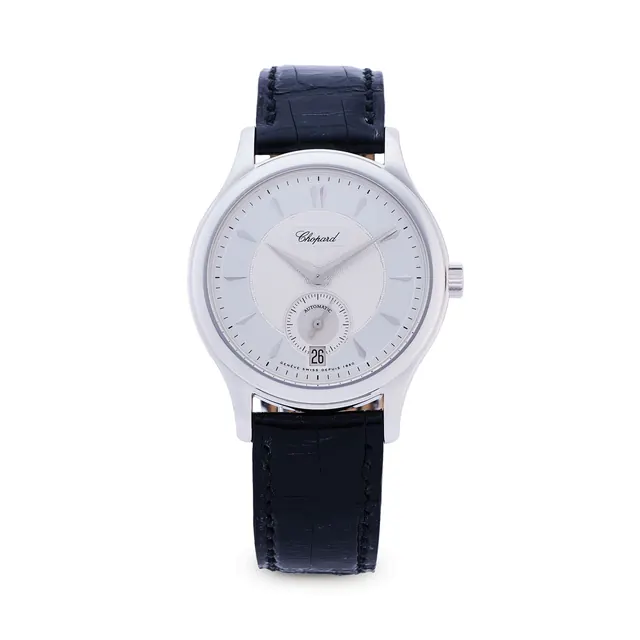
Chopard wristwatch, ref. 16/91860/2, L.U.c. 1860 Guilloche Dial, Sold on 23 Jun 1998
Antiquorum auction archive, Geneva
Wristwatches · c. 2000s
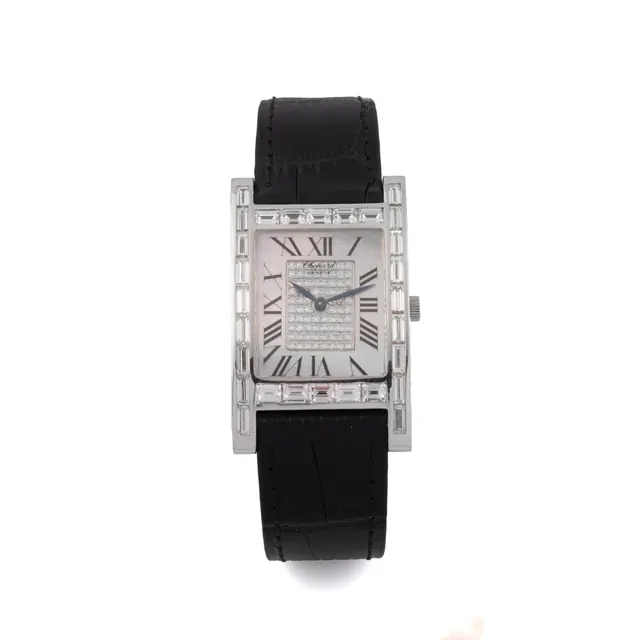
Chopard wristwatch, ref. 471, Your Hour Mop Dial, circa 2000's
Antiquorum auction archive, Geneva
Wristwatches · 2017
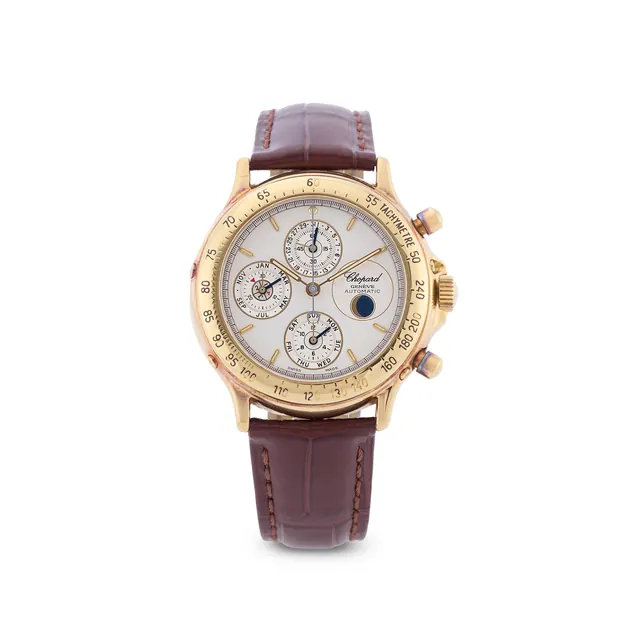
Chopard wristwatch, ref. 36/1208, Classic Perpetual Calendar Limited 12/50, Sold in June, 2017
Antiquorum auction archive, Geneva
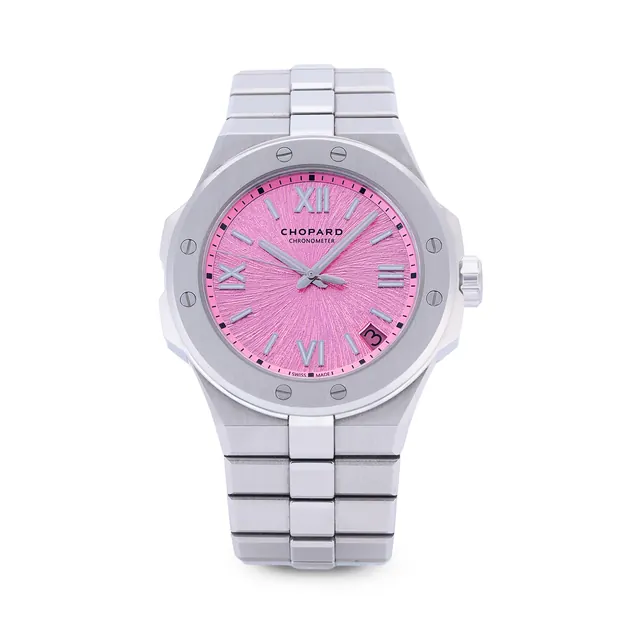
Wristwatches · c. 2024
Chopard wristwatch, ref. 298600-3022, Alpine Eagle, circa 2024
Antiquorum auction archive, Geneva

Wristwatches · 2008
Wristwatch by Breitling?, 2008
Museum Rotterdam

Wristwatches · c. 1990s
Audemars Piguet Bamboo, c. 1990s
Antiquorum auction archive, Geneva

Wristwatches · c. 1990
Audemars Piguet Huitieme Perpetual Calendar, ref. 25696PT, c. 1990
Antiquorum auction archive, Geneva

Wristwatches · c. 1990
Breitling Chronomat, ref. b13050.1, c. 1990
Antiquorum auction archive, Geneva