
Clocks · Longcase clock
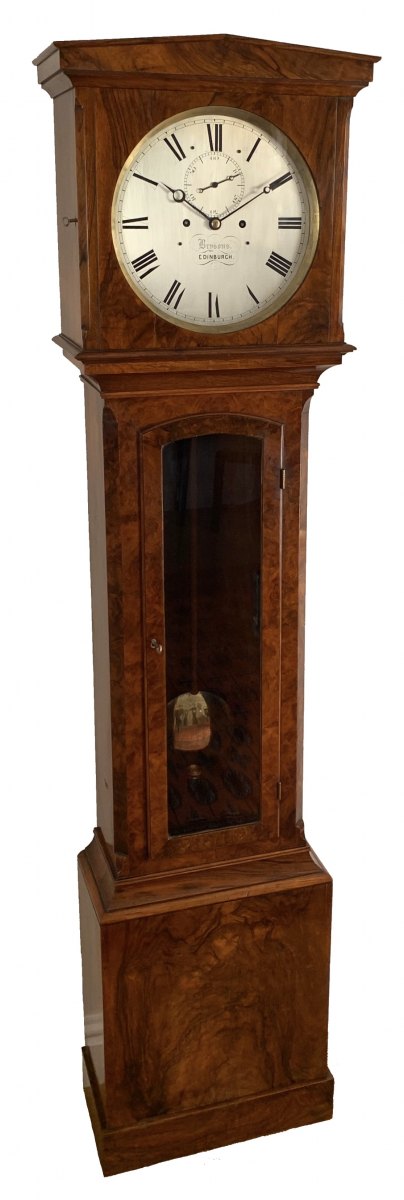
Burr walnut regulator longcase clock by Brysons, Edinburgh, c. 1850
- Maker / attribution
- Brysons (maker)
- Date
- c. 1850
- Historical period
- Industrial Revolution (1850 – 1900)
- Country of origin
- Scotland
- Place
- Edinburgh
- Object type
- Longcase clock
- Materials / technique
- burr walnut
- Dimensions
- Height 6 ft 2 in (188 cm)
- Stock no.
- Product 512
- Credit line
- Dealer listing, P A Oxley (product 512)
- Catalogue title (original)
- Rare burr walnut Regulator longcase clock by Brysons of Edinburgh (English)
View the source record (dealer listing) ↗ (opens another website in a new tab)Suggest a correction
Record summary
Catalogued by P A Oxley (dealer), Wiltshire (stock number Product 512), this is a longcase clock by Brysons, made in Edinburgh, Scotland, dated c. 1850. The Atlas places it in the Industrial Revolution period (1850 – 1900) of its Clocks collection. Materials and techniques recorded by the source: burr walnut. Recorded dimensions: Height 6 ft 2 in (188 cm). The record is illustrated with 6 photographs.
Assembled from the source record's structured fields. Dates and attributions are given as the source states them; where a field is missing the Atlas leaves it blank rather than estimating.
Catalogue description
Dealer description — P A Oxley
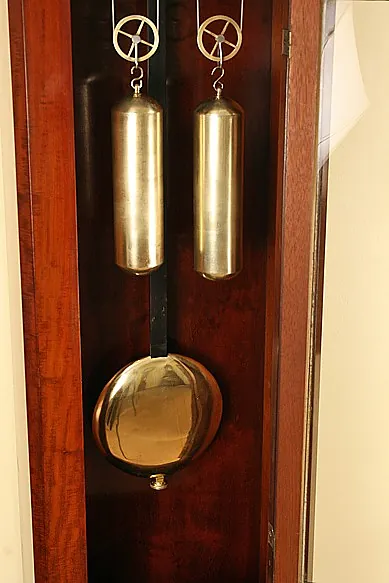
A very small high quality Domestic Regulator by these Clockmakers to the Royal family. The 8 day duration movement striking the hours unusually on a gong with Deadbeat Escapement and Harrison Maintaining Power. The round silvered brass dial showing seconds and set within a circular gilt wooden sight ring. Also with matching blued steel hands and signed by the maker to the centre of the dial - Brysons, Edinburgh. The wooden pendulum rod is hung from the rear of the case from a substantial cast iron bracket. The large pendulum bob is held in place with two regulation nuts. The movement also features an unusual weight driving mechanism that positions the square lead weights to the internal sides of the case which hides them from view This gives the impression that the clock is running with no visible form of power as only the pendulum can be seen through the glazed trunk door The very rare burr walnut case features a glazed trunk door with a walnut veneered backboard and canted corners. The burr walnut is displayed virtually throughout the whole of the front elevation of the case. The base stands on a single plinth. The hood also with canted corners and a lockable door to gain access to the dial. The hood finishes with a very elegant architectural top. A very rare and collectable Regulator longcase clock. NOTE: The Brysons were not only famous in the Clockmaking world but also the Scientific establishment. They were also Clockmakers to the Royal family. The business began in the early 19th century with Robert Bryson, a very competent and inventive maker. Alexander and Robert, his two sons had joined him in business by the 1841 Census. The business then became known as Bryson & Sons or just simply Brysons. Alexander was not just a Clockmaker but also an Inventor of all types of apparatus from a device that detected Icebergs to an Improved Aneriod Barometer. The business carried on through the 19th century with Robert Snr passing away in 1852, Alexander in 1866 and then Robert Jnr in 1886. The business then passed in to the hands of Hamilton & Inches which is still in existence today. Maker Brysons of Edinburgh
Historical context
Industrial Revolution (1850 – 1900)
American interchangeable-parts manufacture; railroad time standards; Swiss and German factory systems.
Factory production transformed the clock into an everyday object. American makers (Seth Thomas, Ansonia, Waterbury) and German factories (Junghans, Gustav Becker, Lenzkirch) sold millions of shelf, wall and alarm clocks worldwide; France produced standardised Paris movements and carriage clocks; electric time distribution began.
Read the period in the timelineMore clocks from this periodEarlier: Precision & Scientific Horology
Atlas type guide
Longcase (tall-case or grandfather) clocks
The longcase clock was born from two seventeenth-century innovations: Christiaan Huygens's pendulum (1656–57) and the anchor escapement (c. 1670). A long seconds pendulum, nearly a metre long, swings with a small arc, and enclosing it together with the driving weights in a tall wooden case protected the mechanism and created a new piece of furniture. London makers such as Ahasuerus Fromanteel, Thomas Tompion and Joseph Knibb set the pattern.
By the eighteenth century longcase clocks were made throughout Britain, the Netherlands, Scandinavia (the Swedish Mora clock), France (the Comtoise from the Franche-Comté), Germany and colonial America. Eight-day movements with two weights became standard in better clocks; thirty-hour clocks with one weight and a rope or chain were cheaper alternatives.
What to look for
- Winding holes in the dial: two (eight-day, going and striking) or none (thirty-hour, pulled up by a chain).
- Brass dials with applied chapter rings (earlier) versus painted iron 'white' dials (after c. 1770 in Britain).
- Moon-phase arches, date apertures, seconds dials and maker's name on the dial.
- Case woods and style: ebonised, walnut marquetry, lacquer, oak or mahogany; regional styles from London, Lancashire, Scotland or America.
- Whether the movement and dial match the case — 'marriages' are common.
Dating clues
- Square brass dials suggest c. 1670–1720; arched brass dials c. 1715–1790.
- Painted (white) dials were made by Birmingham dial-makers from about 1772.
- Comtoise clocks with repoussé pendulums are mostly nineteenth century.
General guidance written by the Atlas editors about this kind of object. It is not a statement about this particular piece; for that, rely on the source record above and on physical examination.
Related records
Clocks · c. 1845
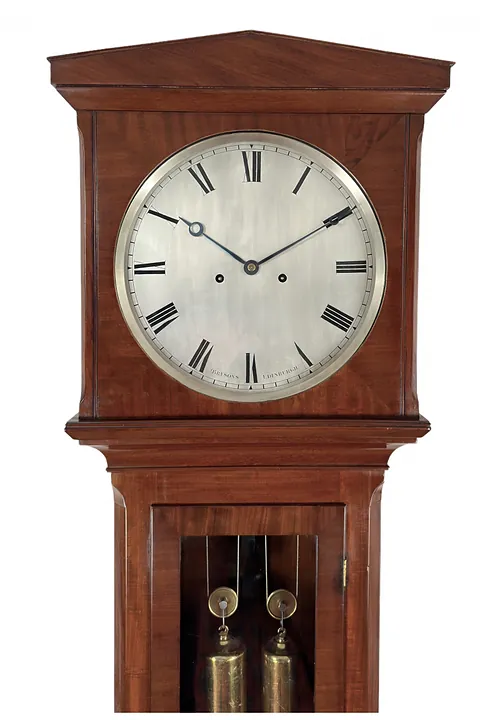
Regulator style longcase clock by Brysons, Edinburgh, c. 1845
P A Oxley (dealer), Wiltshire
Clocks · c. 1845
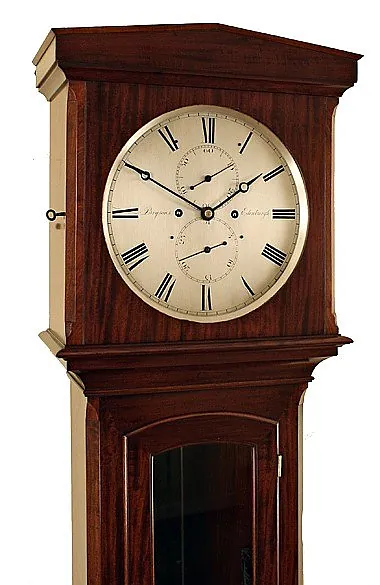
Domestic regulator by Brysons, Edinburgh, c. 1845
P A Oxley (dealer), Wiltshire
Clocks · c. 1850
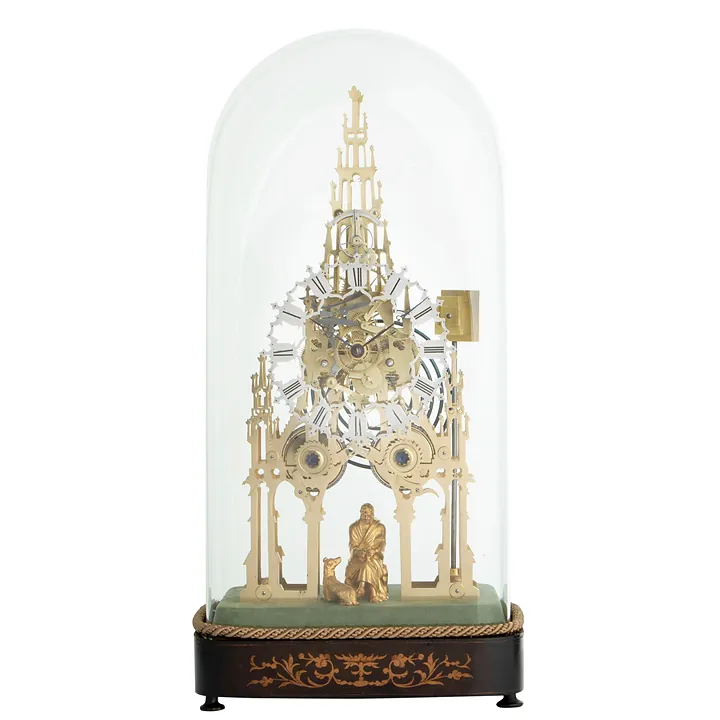
Scott Memorial striking skeleton clock with balance escapement
The Antique Clock Company (dealer), Dorset
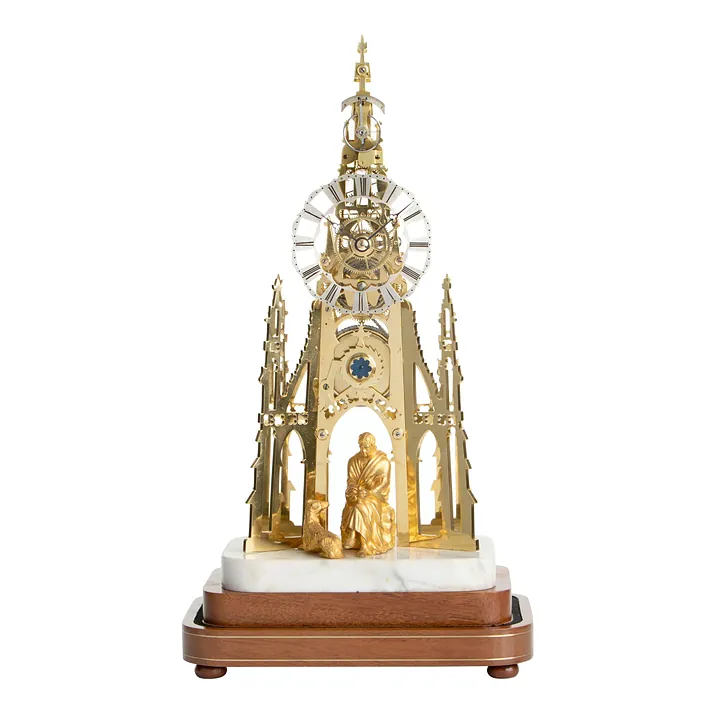
Clocks · c. 1850
Scott Memorial skeleton clock timepiece with balance escapement
The Antique Clock Company (dealer), Dorset
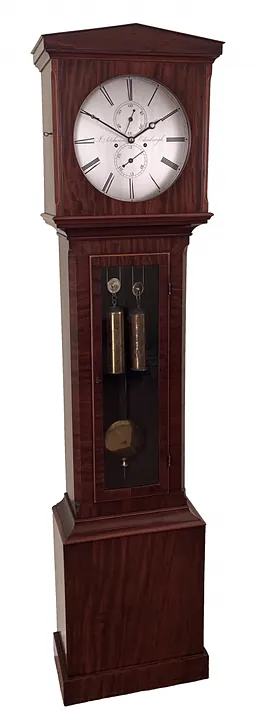
Clocks · c. 1850
Scottish longcase clock by Aitchison, Edinburgh, c. 1850
P A Oxley (dealer), Wiltshire
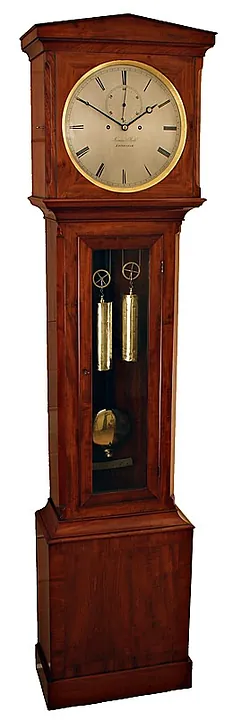
Clocks · c. 1850
Domestic regulator longcase clock by James Bell, Edinburgh, c. 1850
P A Oxley (dealer), Wiltshire
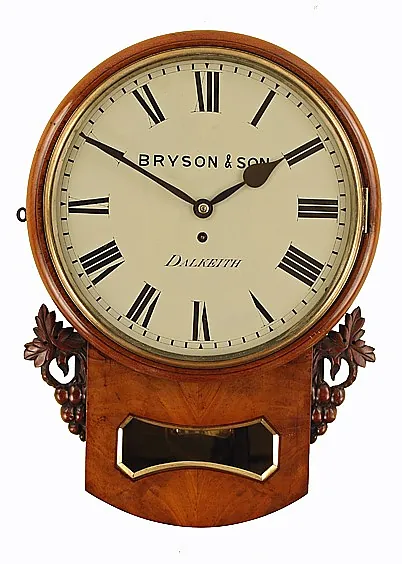
Clocks · c. 1885
Drop dial wall clock by Bryson & Son, Dalkeith, c. 1885
P A Oxley (dealer), Wiltshire
Clocks · c. 1860
Regulator grandfather clock by Barrie, Edinburgh, c. 1860
P A Oxley (dealer), Wiltshire