
Wristwatches · Wristwatch
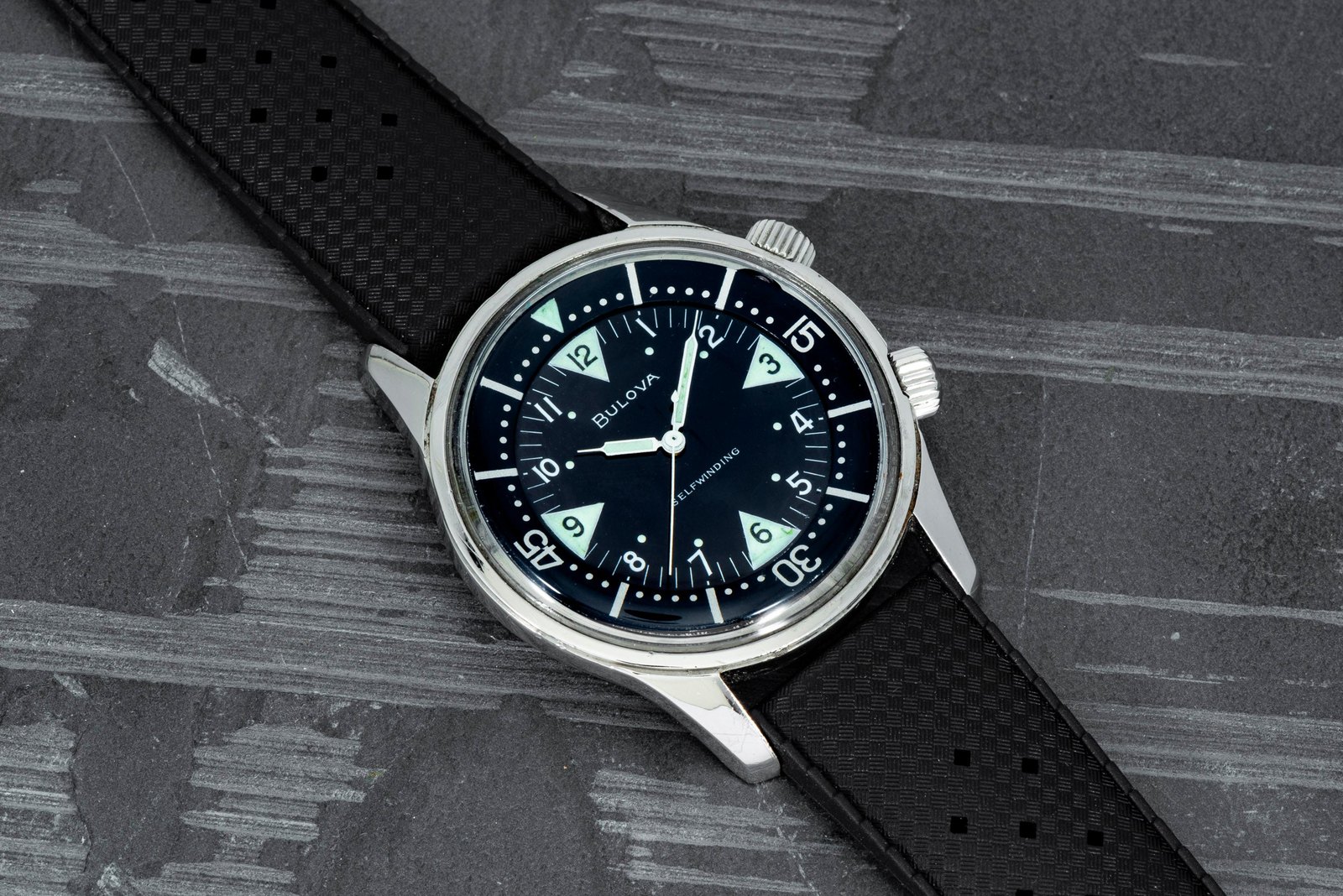
Bulova Super Compressor 'Jumbo', c. 1971
- Maker / attribution
- Bulova (maker)
- Date
- c. 1971
- Historical period
- Quartz Revolution (1969 – 1990)
- Country of origin
- United States
- Object type
- Wristwatch
- Dimensions
- Case 36 mm
- Stock no.
- 40990434
- Credit line
- Dealer listing, Analog/Shift (40990434)
- Catalogue title (original)
- Bulova Super Compressor 'Jumbo' (English)
View the source record (dealer listing) ↗ (opens another website in a new tab)Suggest a correction
Record summary
Catalogued by Analog/Shift (dealer), New York (stock number 40990434), this is a wristwatch by Bulova, made in United States, dated c. 1971. The Atlas places it in the Quartz Revolution period (1969 – 1990) of its Wristwatches collection. Recorded dimensions: Case 36 mm. The record is illustrated with 6 photographs.
Assembled from the source record's structured fields. Dates and attributions are given as the source states them; where a field is missing the Atlas leaves it blank rather than estimating.
Catalogue description
Dealer description — Analog/Shift
There are lots of Super Compressors out there, but few are truly exceptional. The JLC Deep Sea Alarm is one. The Universal Geneve Polerouter Sub is another. While Bulova's take on the distinctive dual-crown diver doesn't command the same kind of value, it manages to stand head and shoulders above other Super Compressors from other brands. The Super Compressor name refers to the innovative case design which utilizes a ‘compressor’ system designed to increase watertightness the deeper the watch dives under the water. As the atmospheric pressure increases, the case back compresses, pushing on the gaskets and creating a tighter seal. Despite the logic of the design, the compressor case wasn’t any better at preventing water intrusion than the garden variety screw-down crown — in fact, it was less effective in many models — but due to their good looks, compressor cases proved to be wildly popular during the 1960s. Eager to get into the burgeoning dive watch market, many of the best Swiss brands turned to EPSA (Ervin Piquerez, S.A.), the leading manufacturer of compressor cases at the time, for cases upon which to build their divers. So what’s so special about this Bulova? We’ve sold other Super Compressors,, but like 99% of examples out there, they were 36mm, the typical size for the era. Bulova produced a very small number of Jumbo Super Compressors, and they’re extremely rare (and sought after) today. The Jumbo's 42mm case feels appropriately hefty compared with the 36mm models, giving the watch the tool-like aspect it was always meant to have. This particular example features an aforementioned 42mm stainless steel Super Compressor case with an acrylic crystal, dual crowns, a gloss black Tritium dial with printed ‘Arabic’ indices, a matching ‘syringe’ handset, and an internal rotating dive timing bezel. Powered by the automatic Bulova Caliber 11ALAC movement and dating to circa 1971, it’s an awesome piece of horological history that doesn’t often surface. Nab this one before somebody else gets a similar idea!
Historical context
Quartz Revolution (1969 – 1990)
Seiko's Astron begins mass quartz timekeeping; traditional industries contract sharply.
Quartz and digital watches transformed the market after 1969. Swiss employment collapsed, Japanese and Hong Kong production soared, and the Swatch (1983) helped the Swiss industry recover; mechanical watches survived as luxury goods.
Read the period in the timelineMore wristwatches from this periodEarlier: Modern Mechanical Horology
Atlas type guide
Wristwatches
Bracelet watches were worn by women from the early nineteenth century — Breguet made one for Caroline Murat, Queen of Naples, in 1810–12 — but the wristwatch only became a man's instrument with military use and aviation in the early twentieth century. Between the World Wars it overtook the pocket watch; the 1920s and 1930s brought rectangular Art Deco cases, water-resistant cases and the first automatic winding systems.
After 1945 the wristwatch became a carrier of identity — dress watches, sports and dive watches, chronographs, calendars — produced by Swiss, American, Japanese, German, Soviet and Chinese industries. The quartz revolution after 1969 and the mechanical renaissance since the 1990s, including the rise of independent watchmakers, complete the story.
What to look for
- The reference number (between the lugs or inside the case back) and serial number, the starting point for dating.
- The calibre: its maker and number are often stamped under the dial or on the bridge.
- Originality of dial, hands and crown — refinished ('redial') dials are common.
- Case material marks: 18K/750, 14K/585, stainless steel, gold-filled, plated.
Dating clues
- Wire-lug cases: before c. 1925.
- Water-resistant screw-down cases: from 1926.
- Quartz movements: from 1969; sapphire crystals widespread after c. 1980.
General guidance written by the Atlas editors about this kind of object. It is not a statement about this particular piece; for that, rely on the source record above and on physical examination.
Related records
Wristwatches · c. 1969
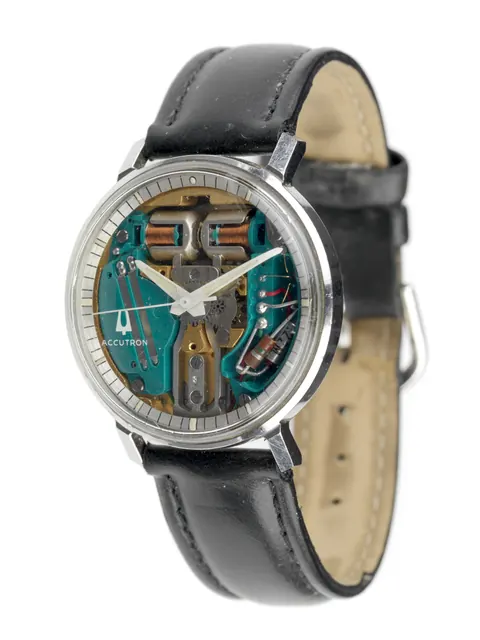
Bulova 'Accutron' tuning-fork wristwatch by Bulova
Royal Museums Greenwich
Wristwatches · c. 1965
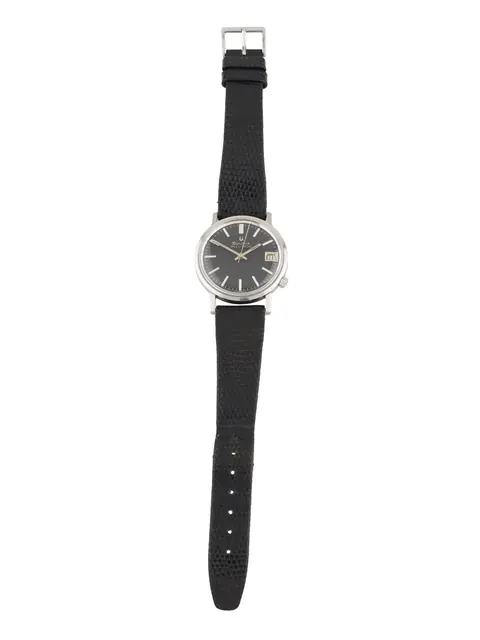
Wristwatch Accutron by Knud Geelmuyden Bull
Royal Museums Greenwich
Clocks · c. 1960s
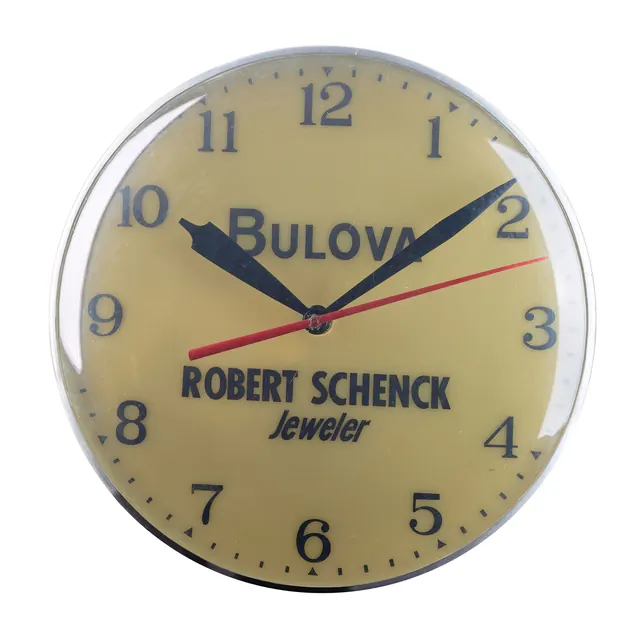
Bulova wall clock, Lighted Advertising Wall Clock for Robert Schenck Jeweler, circa 1960s
Antiquorum auction archive, Geneva
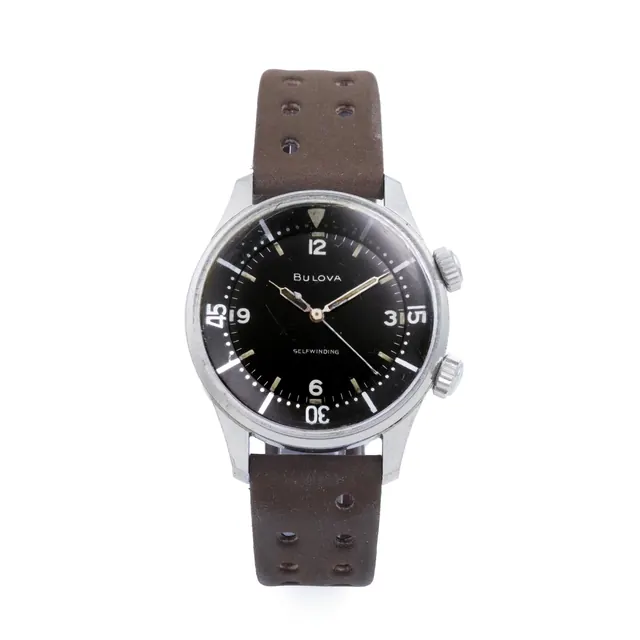
Wristwatches · 1963
Bulova wristwatch, ref. 314, Diver Super Compressor, 1963
Antiquorum auction archive, Geneva
Wristwatches · 1949–1992
Timex `Electric' wristwatch, with electrically operated balance wheel mechanism, United States, 1949–1992
Science Museum Group, London
Wristwatches · 1972
Wristwatch by Hamilton Watch Company and Electro-Data Inc, United States, 1972
Science Museum Group, London
Wristwatches · 1973–1974
Quartz watch with liquid crystal digital display, made by American Microsystems Inc. (AMI) . 1973/74
Science Museum Group, London
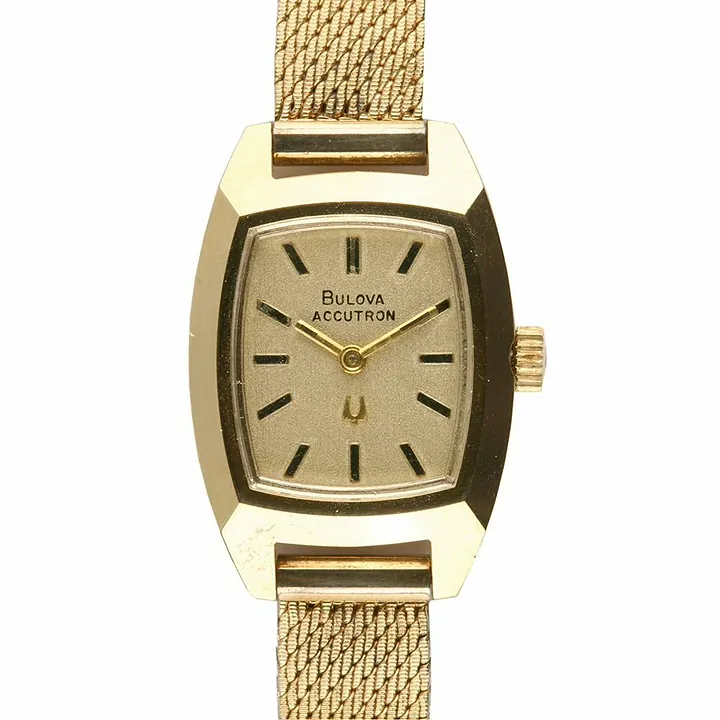
Wristwatches · c. 1973
Wristwatch by Josef Bulova, United States, c. 1973
German Clock Museum