
Wristwatches · Wristwatch
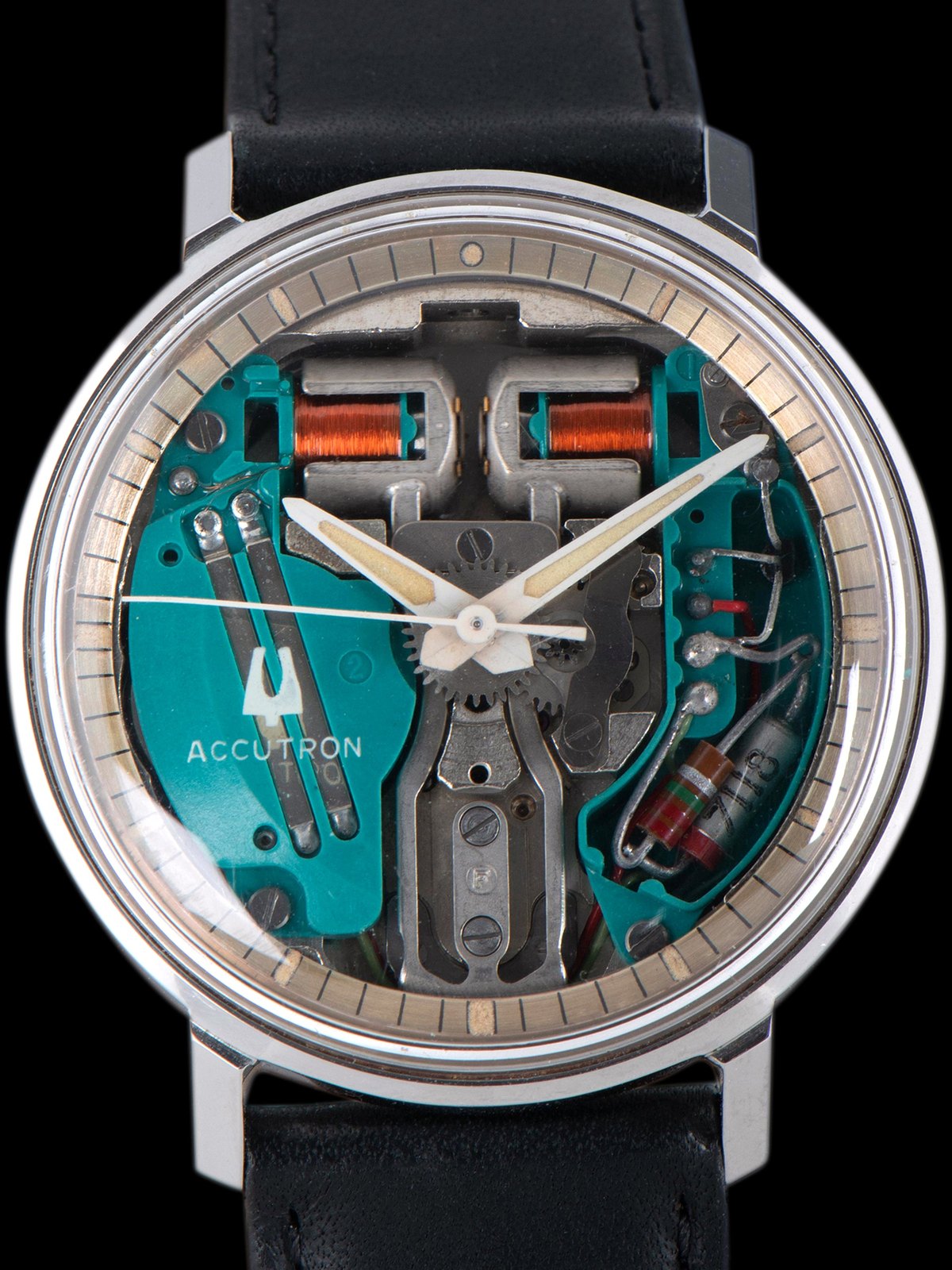
Bulova Accutron Spaceview "G" (Ref. 2528), 1968
- Maker / attribution
- Bulova (maker)
- Date
- 1968
- Historical period
- Modern Mechanical Horology (1945 – 1969)
- Country of origin
- United States
- Object type
- Wristwatch
- Stock no.
- BLVAATRNSV
- Credit line
- Dealer listing, Craft & Tailored (BLVAATRNSV)
- Catalogue title (original)
- 1968 Bulova Accutron Spaceview "G" (Ref. 2528) (English)
View the source record (dealer listing) ↗ (opens another website in a new tab)Suggest a correction
Record summary
Catalogued by Craft & Tailored (dealer), Los Angeles (stock number BLVAATRNSV), this is a wristwatch by Bulova, made in United States, dated 1968. The Atlas places it in the Modern Mechanical Horology period (1945 – 1969) of its Wristwatches collection. The record is illustrated with 6 photographs.
Assembled from the source record's structured fields. Dates and attributions are given as the source states them; where a field is missing the Atlas leaves it blank rather than estimating.
Catalogue description
Dealer description — Craft & Tailored
Founded in New York by Czech immigrant, Joseph Bulova, in 1875, Bulova began as a jewelry and clock repair store before moving into the manufacturing of watch components and jeweled movements in the early 1900s. Over time, the brand would come to be known for its unique and funky watches that were made from the '60s into the '80s. Ranging from colorful diving chronographs to eccentric electric watches, like this incredible Accutron Spaceview. The Accutron line was initially a product of Bulova's view of the future – one that replaced analog movements with battery-powered ones, and predated the quartz crisis by a decade or so. But this isn't just any electric movement. This is one uses a steel tuning fork powered by electromagnets to keep incredibly precise time. And it does it while humming (if you put your ear to the watch, you'll be able to hear the tuning fork working away). Of course, with a movement this innovative, it'd be a shame to hide it inside a watch case. So, Bulova stripped away all the usual design and opted for a clear view right into the inner workings, with only an outer minute track, a handset and a small Accutron logo lockup to distract from the space-aged visage. SPECS Stock # BLVAATRNSV Brand Bulova Style Accutron Spaceview "G" Model 2528 Serial M8 Size Men's Material Stainless Steel Dial Skeleton Millimeters 34 Strap 2pc Leather Strap CASE & BRACELET he stainless steel case is in exceptional condition, showing no notable evidence of major polishing in the past and crisp factory-brushing throughout with only minimal signs of previous use. The case back is very crisp with all of its factory markings in deep and defined condition. The watch is supplied on a two-piece leather strap. DIAL & HANDS Aside from the view into the inner mechanics of the watch movement, the outer minute track is the only real 'dial' portion to the watch and features a champagne-hued with lume plots at the hour markers, each of which have aged to a lovely cream color. The white dauphine handset is in fantastic condition with inset lume that matches the dial perfectly. Under UV light inspection the dial and hands display no notable degradation. ACCESSORIES
Historical context
Modern Mechanical Horology (1945 – 1969)
Tool watches for divers, pilots and astronauts; electric watches anticipate the electronic age.
The classic era of the mechanical wristwatch: dive watches, chronographs for motor racing and space flight, GMT watches for jet travel, slim dress watches, automatic calendars, and the rise of Japanese manufacturers alongside Swiss, American, German and Soviet industries.
Read the period in the timelineMore wristwatches from this periodEarlier: Golden Age of Mechanical Watchmaking
Atlas type guide
Quartz, digital and electronic watches
Electronic watches arrived in three steps. The Hamilton Electric 500 (1957) was the first battery-powered wristwatch, still with a balance; Bulova's Accutron (1960) used a tuning fork. On 25 December 1969 Seiko released the Astron 35SQ, the first quartz wristwatch, closely followed by the Swiss Beta 21 group. In 1972 Hamilton's Pulsar introduced the LED digital watch, and LCD displays soon made digital watches cheap.
The 'Quartz Crisis' that followed devastated the Swiss mechanical industry, which lost two-thirds of its workforce between 1970 and 1984 before recovering with the Swatch (1983) and the luxury mechanical revival. Solar, radio-controlled, kinetic and connected smartwatches continue the electronic line.
What to look for
- Battery hatch in the case back and calibre markings with 'Quartz' or a crystal frequency.
- Display technology: LED (red, push-button) versus LCD (always-on).
- Tuning-fork hum and a smoothly sweeping seconds hand on Accutrons.
- Model and reference numbers, often printed on the back.
Dating clues
- Electric balance watches: from 1957.
- Tuning-fork watches: 1960–c. 1977.
- Quartz analogue: from December 1969; LED digital: 1972–c. 1978; LCD from 1973.
General guidance written by the Atlas editors about this kind of object. It is not a statement about this particular piece; for that, rely on the source record above and on physical examination.
Read next:Seiko calibre 35A (Astron)
Related records
Wristwatches · c. 1969
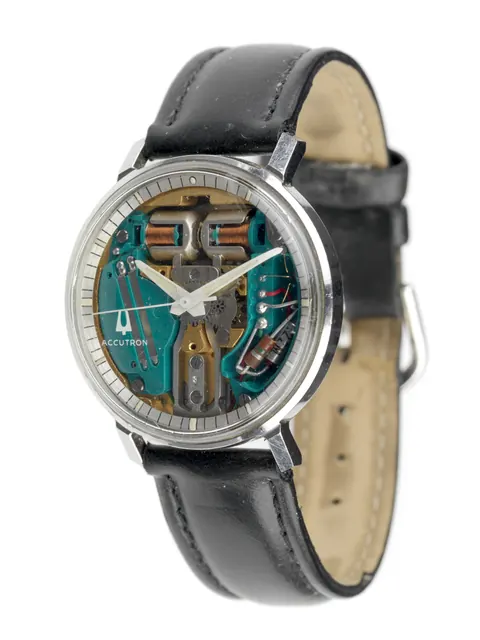
Bulova 'Accutron' tuning-fork wristwatch by Bulova
Royal Museums Greenwich
Wristwatches · c. 1965
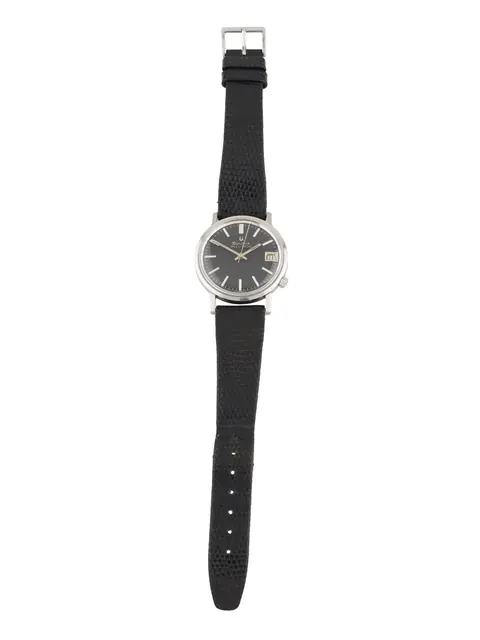
Wristwatch Accutron by Knud Geelmuyden Bull
Royal Museums Greenwich
Clocks · c. 1960s
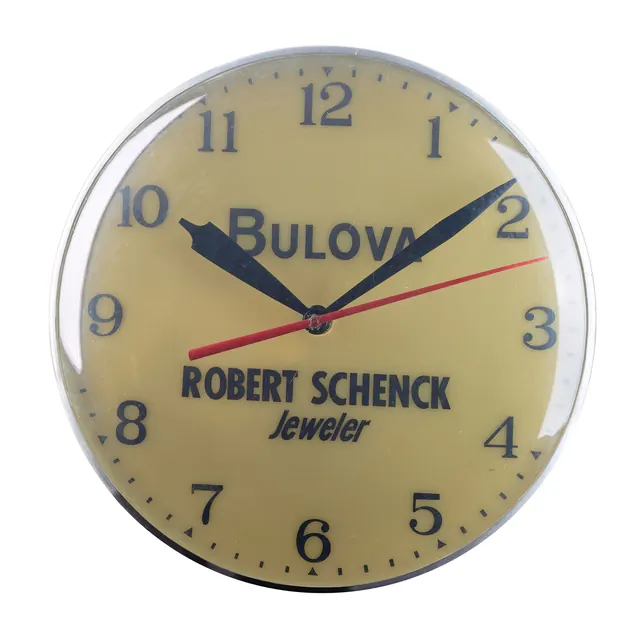
Bulova wall clock, Lighted Advertising Wall Clock for Robert Schenck Jeweler, circa 1960s
Antiquorum auction archive, Geneva
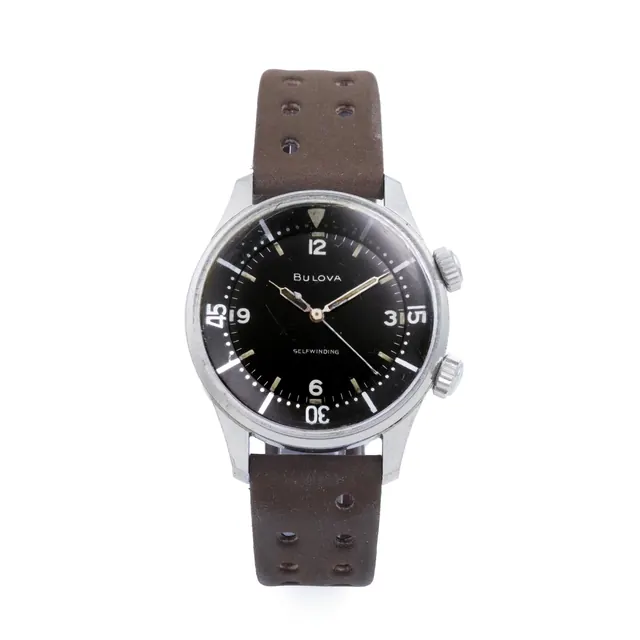
Wristwatches · 1963
Bulova wristwatch, ref. 314, Diver Super Compressor, 1963
Antiquorum auction archive, Geneva
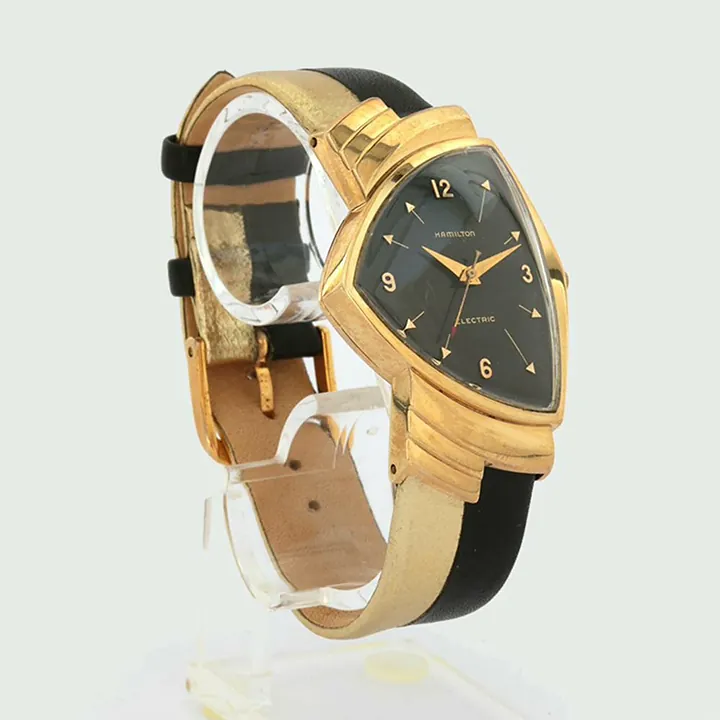
Wristwatches · c. 1957
Wristwatch by Richard H. Arbib, United States, c. 1957
German Clock Museum
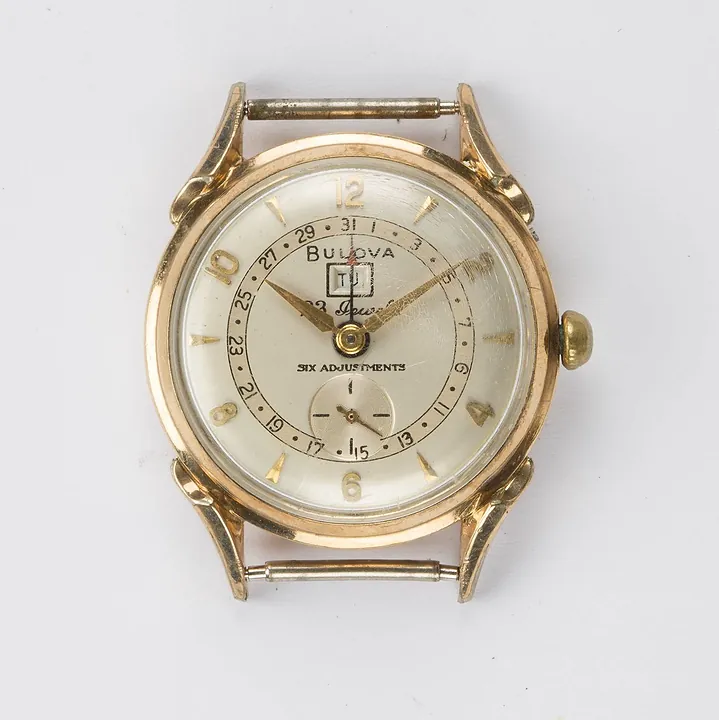
Wristwatches · 1959
Wristwatch by Josef Bulova, United States, 1959
German Clock Museum
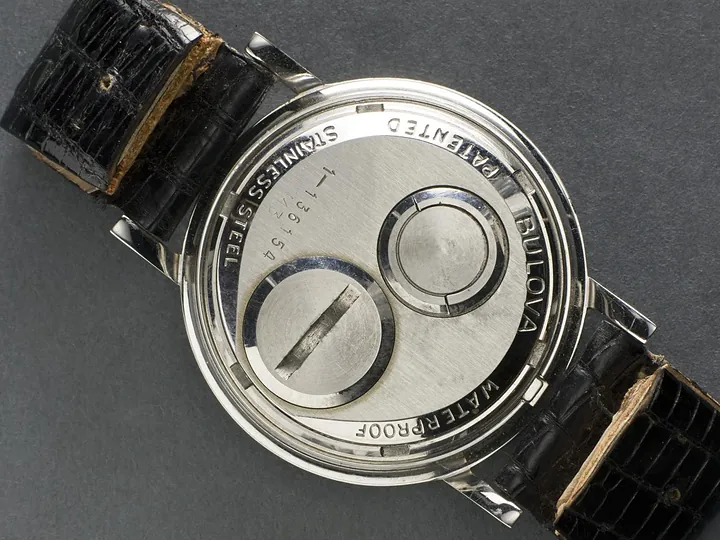
Wristwatches · 1960–1963
Bulova Accutron tuning-fork wristwatch on a demonstration stand, designed by Max Hetzel, United States, 1960–1963
Science Museum Group, London
Wristwatches · 1964
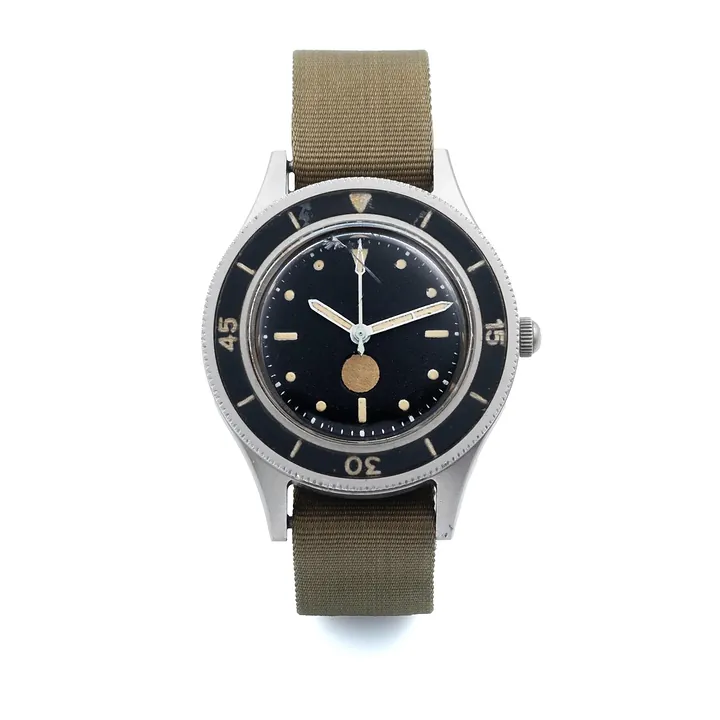
Tornek-Rayville wristwatch, ref. TR 900, 1964
Antiquorum auction archive, Geneva