
Wristwatches · Wristwatch
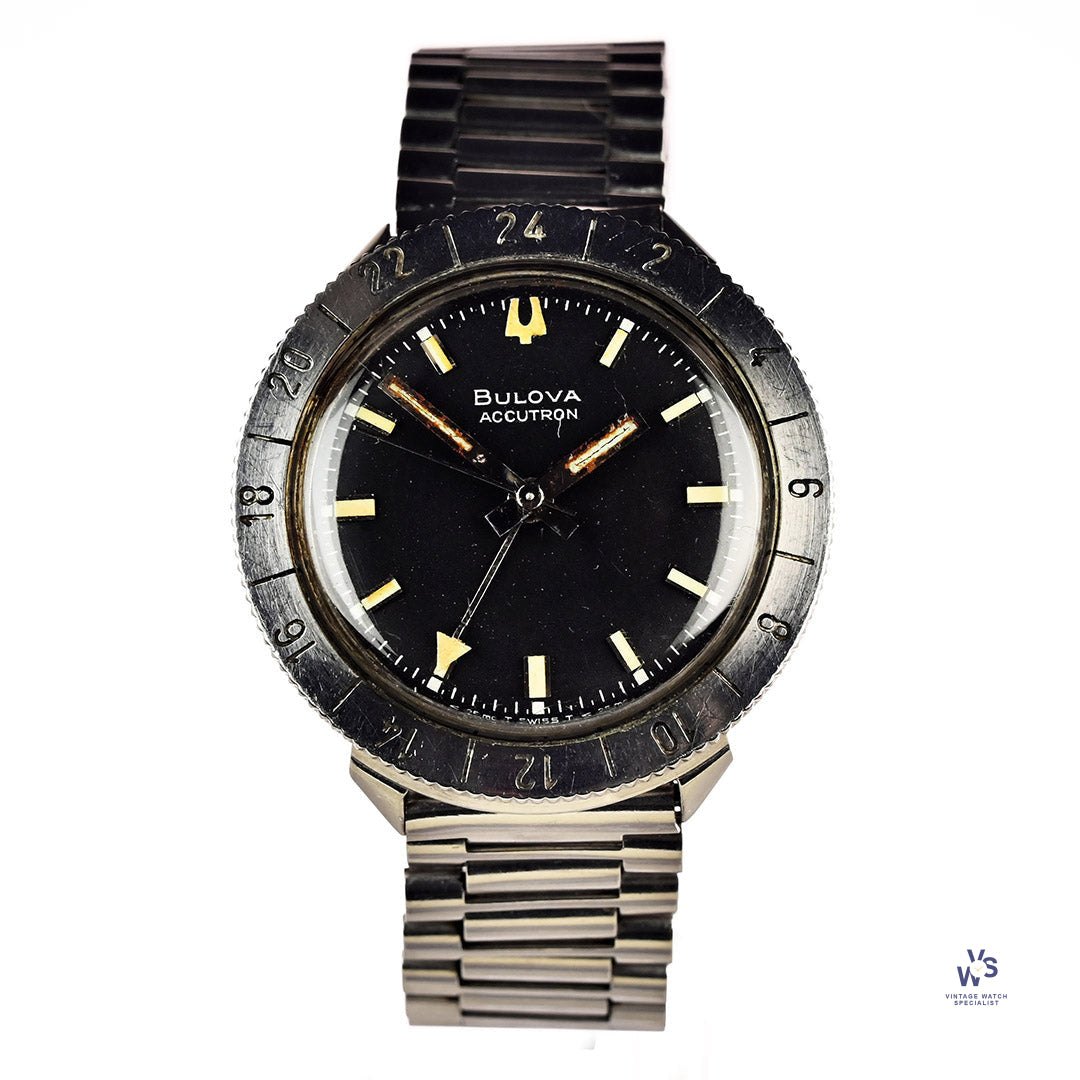
Bulova Accutron Astronaut GMT, With Pre Astronaut Dial, circa 1962
- Maker / attribution
- Bulova (maker)
- Date
- c. 1962
- Historical period
- Modern Mechanical Horology (1945 – 1969)
- Country of origin
- United States
- Object type
- Wristwatch
- Stock no.
- vws3110cs
- Credit line
- Dealer listing, Vintage Watch Specialist (vws3110cs)
- Catalogue title (original)
- Bulova Accutron Astronaut GMT - With Pre Astronaut Dial - c.1962 (English)
View the source record (dealer listing) ↗ (opens another website in a new tab)Suggest a correction
Record summary
Catalogued by Vintage Watch Specialist (dealer), United Kingdom (stock number vws3110cs), this is a wristwatch by Bulova, made in United States, dated c. 1962. The Atlas places it in the Modern Mechanical Horology period (1945 – 1969) of its Wristwatches collection. The record is illustrated with 6 photographs.
Assembled from the source record's structured fields. Dates and attributions are given as the source states them; where a field is missing the Atlas leaves it blank rather than estimating.
Catalogue description
Dealer description — Vintage Watch Specialist
A Very Rare Bulova Accutron GMT Pre Astronaut Dial in Original Condition with Calibre 214 HN Tuning Fork Movement and Nicely Aged Lume, c.1962 In 1962 Bulova produced the Astronaut, a 214-based GMT timepiece with a 24-hour rotating bezel, secondary 24-hour hand, and hack function. The Astronaut was initially developed by Bulova for the US space program, but ultimately found its greatest success in the consumer market. The handset first used on the new all-stainless steel Accutron GMT watch (which had yet to be named Astronaut) was lifted from the Bulova Timer Labs and had already been used on all their aerospace clocks and timers. What's on Offer Bulova released numerous cosmetic variants of the Accutron Astronaut and it seems that each Astronaut variant is designated with a single letter or what Bulova calls it's "Style Name". We can see from the case back that this watch has been engraved with a M. From the designation scheme seen in actual Bulova ads, they confirm the existence of an Astronaut "C", "H", "J", "L", " M ", "N", "O" and "T" all of which are cosmetically unique. The watch offered here for sale has been classified as a 'type 2' ( enhanced applied markers and a standard bare-metal bezel.) The movement is a 360-Herz tuning fork, powered by a one-transistor electronic oscillator, to drive the timekeeping functions rather than a traditional balance wheel. This watch has been well preserved given its age of well over 60 years old. The rich black dial boasts applied hour markers with luminous inserts and chunky stick hands with corresponding lume. There is also a GMT hand which similarly boasts lume, it is to be noted that the lume across the dial has aged evenly to beautiful vanilla colour. As this is a 'pre-astronaut' dial, it is simply signed Bulova Accutron at 12 and the hour plot is the Bulova fork. There is a little pitting on the hands that can be noted in the photographs, however, this watch is in original condition and it is simply part of the ageing process on this particular piece. The case back number is 1-297671 and you will also note the letter M, the style name denoted by Bulova.
Historical context
Modern Mechanical Horology (1945 – 1969)
Tool watches for divers, pilots and astronauts; electric watches anticipate the electronic age.
The classic era of the mechanical wristwatch: dive watches, chronographs for motor racing and space flight, GMT watches for jet travel, slim dress watches, automatic calendars, and the rise of Japanese manufacturers alongside Swiss, American, German and Soviet industries.
Read the period in the timelineMore wristwatches from this periodEarlier: Golden Age of Mechanical Watchmaking
Atlas type guide
Military, pilot and travel watches
The wristwatch owes much of its adoption by men to warfare and aviation. Wristlets — small pocket watches soldered with lugs and worn on a strap — were used in colonial campaigns and became standard equipment in the First World War, with protective grilles over the crystal ('shrapnel guards'). Louis Cartier's Santos (1904), designed for the aviator Alberto Santos-Dumont, is often cited as an early purpose-made pilot's watch.
In the Second World War governments specified watches in detail: the German B-Uhr observation watches, the American A-11, and the British 'W.W.W.' (the 'Dirty Dozen' set of 1945). After the war, jet travel brought GMT and world-time watches, which show two or more time zones at once — Louis Cottier's world-time mechanism and the Rolex GMT-Master (1955) are examples.
What to look for
- Military markings on the case back: broad arrow, issue numbers, 'W.W.W.', 'A.T.P.'
- High-legibility black dials with luminous Arabic numerals; oversized crowns for gloved hands.
- 24-hour hands and rotating 24-hour bezels or city rings on GMT/world-time watches.
- Wire lugs on early wristlets converted from pocket watches.
Dating clues
- Wire-lug wristlets: c. 1900–1925.
- Military specifications of the Second World War: 1939–1945.
- GMT and world-time wristwatches: mainly after 1950.
General guidance written by the Atlas editors about this kind of object. It is not a statement about this particular piece; for that, rely on the source record above and on physical examination.
Related records
Wristwatches · c. 1969
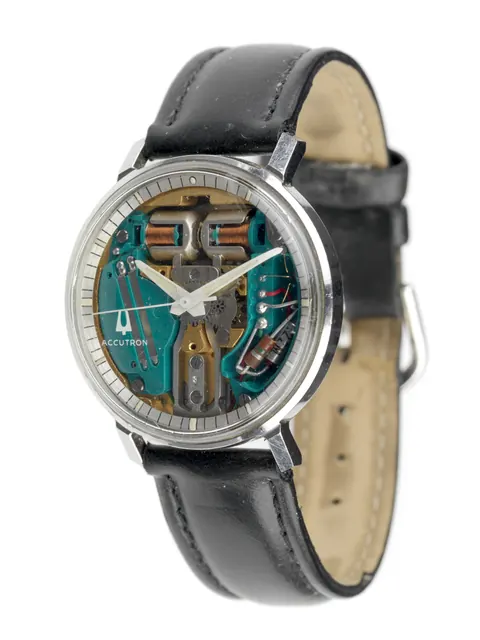
Bulova 'Accutron' tuning-fork wristwatch by Bulova
Royal Museums Greenwich
Wristwatches · c. 1965
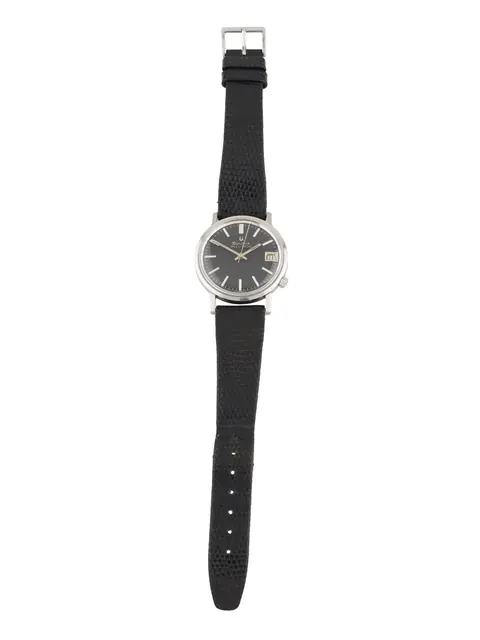
Wristwatch Accutron by Knud Geelmuyden Bull
Royal Museums Greenwich
Clocks · c. 1960s
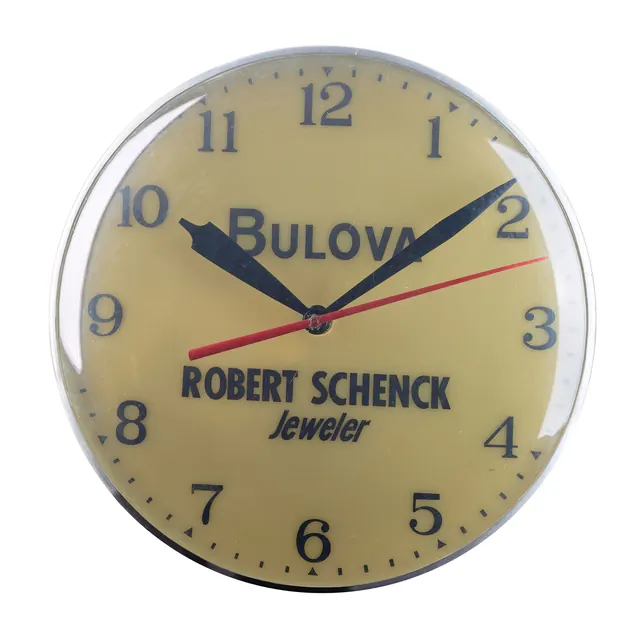
Bulova wall clock, Lighted Advertising Wall Clock for Robert Schenck Jeweler, circa 1960s
Antiquorum auction archive, Geneva
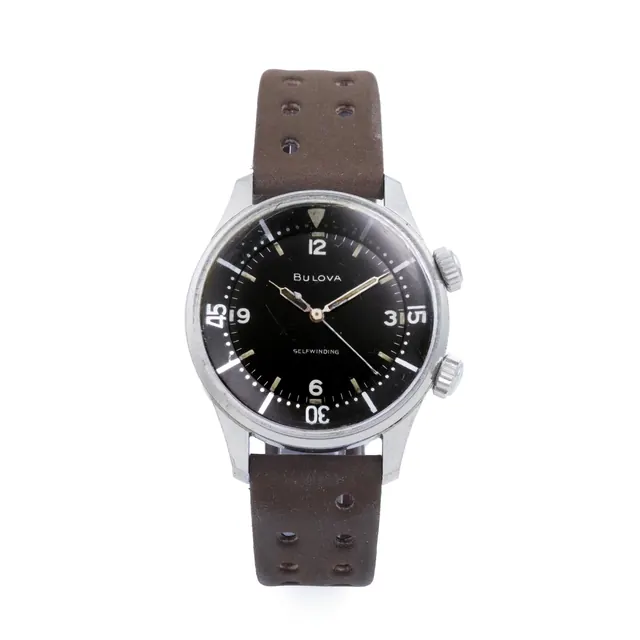
Wristwatches · 1963
Bulova wristwatch, ref. 314, Diver Super Compressor, 1963
Antiquorum auction archive, Geneva
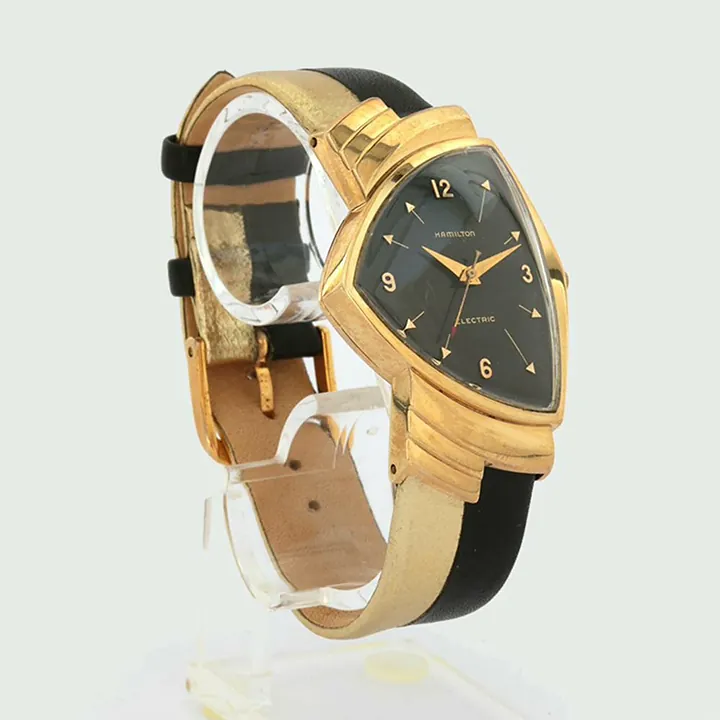
Wristwatches · c. 1957
Wristwatch by Richard H. Arbib, United States, c. 1957
German Clock Museum
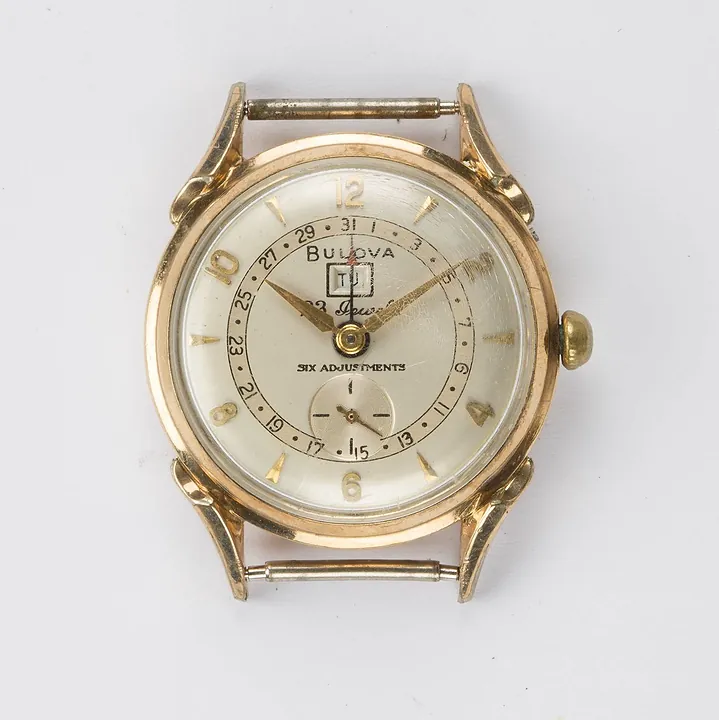
Wristwatches · 1959
Wristwatch by Josef Bulova, United States, 1959
German Clock Museum
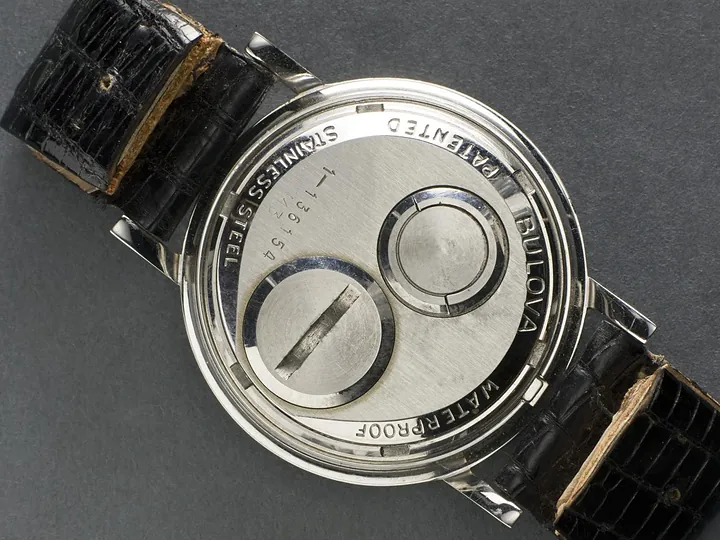
Wristwatches · 1960–1963
Bulova Accutron tuning-fork wristwatch on a demonstration stand, designed by Max Hetzel, United States, 1960–1963
Science Museum Group, London
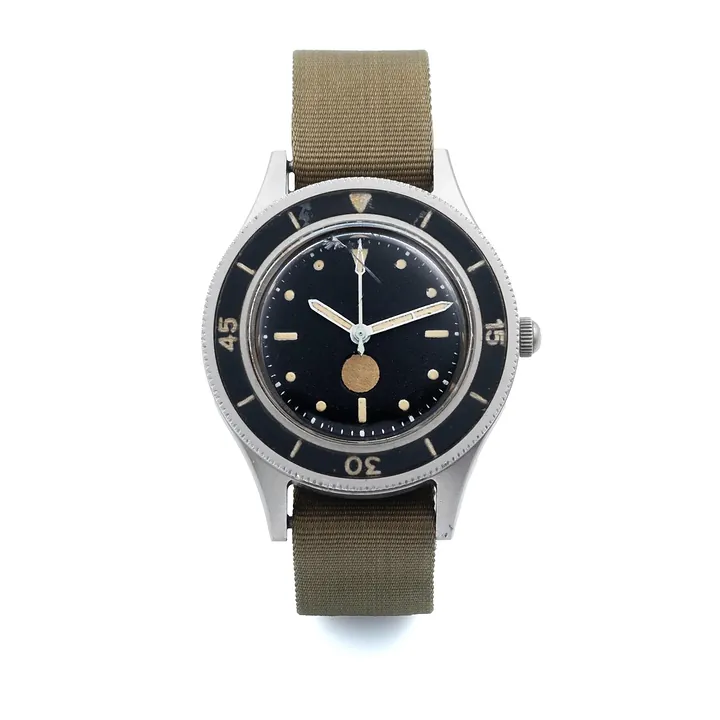
Wristwatches · 1964
Tornek-Rayville wristwatch, ref. TR 900, 1964
Antiquorum auction archive, Geneva