
Wristwatches · Quartz wristwatch
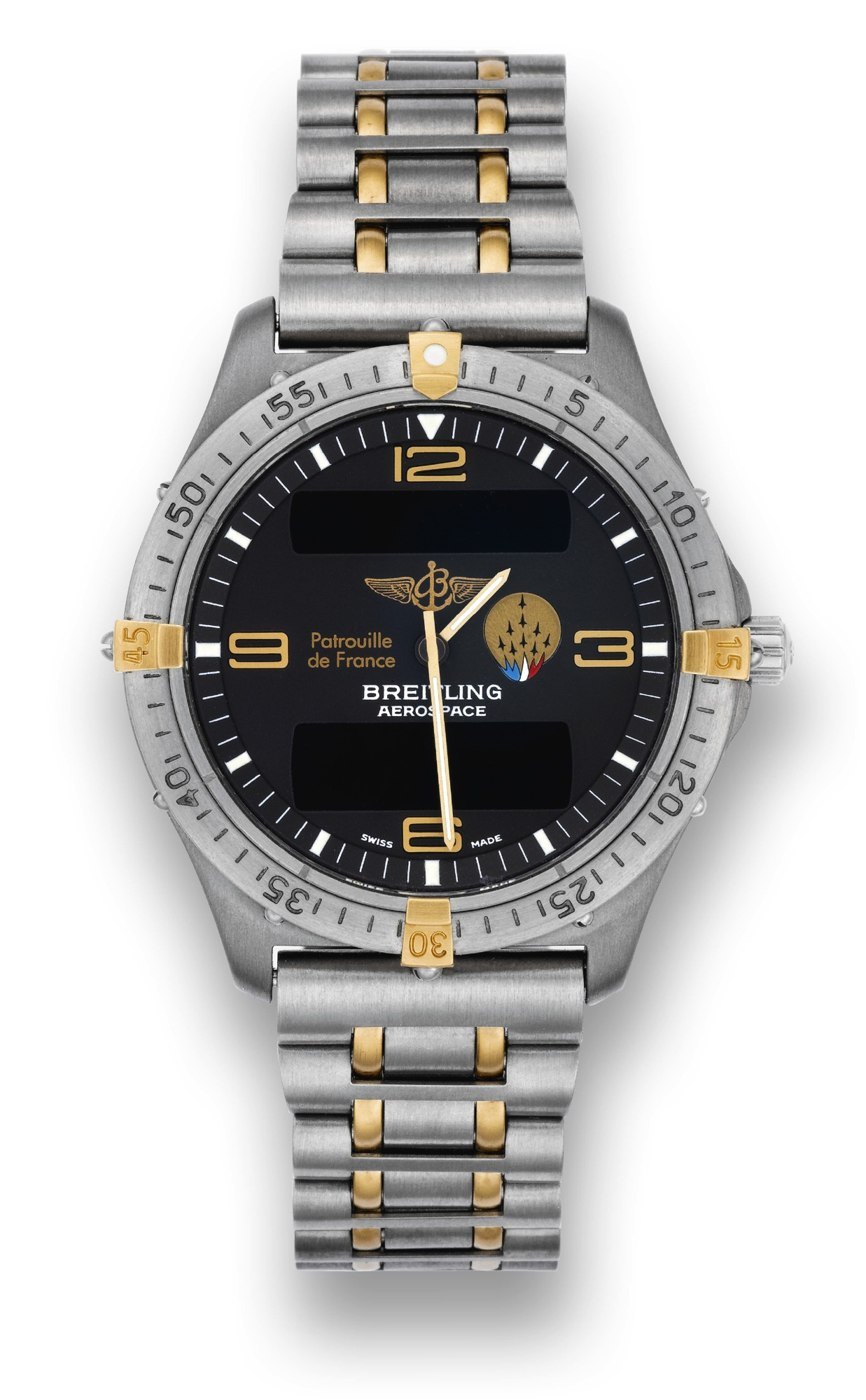
Breitling Aerospace Patrouille de France
- Maker / attribution
- Breitling (source attribution)
- Date
- 1990s
- Historical period
- Mechanical Renaissance (1990 – 2010)
- Country of origin
- Switzerland
- Object type
- Quartz wristwatch
- Materials / technique
- Titanium and gold
- Dimensions
- 40 mm diameter, 9 mm thickness
- Holding institution
- Antiquorum
- Accession / object no.
- 349
- Credit line
- Antiquorum
- Catalogue title (original)
- Breitling Aerospace\nPatrouille de France\nAerospace Breitling, Genève, \"Aerospace\",\nNo. 03627, Ref. F 56062. Made\nin the 1990's.\nFine, two time zone, water-resistant,\ntitanium and gold quartz w (English)
View the source record ↗ (opens another website in a new tab)Suggest a correction
Record summary
Held and catalogued by Antiquorum (object number 349), this is a quartz wristwatch attributed to Breitling, made in Switzerland, dated 1990s. The Atlas places it in the Mechanical Renaissance period (1990 – 2010) of its Wristwatches collection. Materials and techniques recorded by the source: Titanium and gold. Recorded dimensions: 40 mm diameter, 9 mm thickness. The record is illustrated with 1 photograph.
Assembled from the source record's structured fields. Dates and attributions are given as the source states them; where a field is missing the Atlas leaves it blank rather than estimating.
Catalogue description
Original object description
Offered as Lot 349 without reserve, this 1990s Breitling Aerospace Patrouille de France (reference F 56062, serial 03627) combines titanium and gold in a three-body case measuring 40 mm in diameter and 9 mm in depth. The exterior features concave lugs, a sapphire crystal, a relief-decorated threaded case back, and a unidirectional rotating bezel accented with graduated quarter-hour rider tabs in gold, paired with an integrated titanium and gold bracelet secured by a folding clasp. Graded 2-01, the anthracite dial displays luminous markers, luminous gold baton hands, gilt Arabic numerals, the insignia of the Patrouille de France, and twin LCD displays. Internal functions are driven by the multi-feature Breitling Calibre 75 quartz movement, incorporating a second time zone, a countdown timer, an alarm, a 1/100th-second chronograph, and an end-of-life battery indicator, with mechanical maintenance noted as due at the buyer's cost. Case, movement, and dial are all signed by the manufacturer, with specific condition ranks recorded per component.
Inscriptions & marks
03627
Historical context
Mechanical Renaissance (1990 – 2010)
Mechanical watches return as cultural objects; independent watchmaking flourishes.
Mechanical watches returned as cultural and luxury objects. Complications, tourbillons and new materials proliferated; independent watchmakers such as George Daniels, F.P. Journe and Philippe Dufour revived artisanal watchmaking; collecting vintage watches became a major field.
Read the period in the timelineMore wristwatches from this periodEarlier: Quartz Revolution
Atlas type guide
Quartz, digital and electronic watches
Electronic watches arrived in three steps. The Hamilton Electric 500 (1957) was the first battery-powered wristwatch, still with a balance; Bulova's Accutron (1960) used a tuning fork. On 25 December 1969 Seiko released the Astron 35SQ, the first quartz wristwatch, closely followed by the Swiss Beta 21 group. In 1972 Hamilton's Pulsar introduced the LED digital watch, and LCD displays soon made digital watches cheap.
The 'Quartz Crisis' that followed devastated the Swiss mechanical industry, which lost two-thirds of its workforce between 1970 and 1984 before recovering with the Swatch (1983) and the luxury mechanical revival. Solar, radio-controlled, kinetic and connected smartwatches continue the electronic line.
What to look for
- Battery hatch in the case back and calibre markings with 'Quartz' or a crystal frequency.
- Display technology: LED (red, push-button) versus LCD (always-on).
- Tuning-fork hum and a smoothly sweeping seconds hand on Accutrons.
- Model and reference numbers, often printed on the back.
Dating clues
- Electric balance watches: from 1957.
- Tuning-fork watches: 1960–c. 1977.
- Quartz analogue: from December 1969; LED digital: 1972–c. 1978; LCD from 1973.
General guidance written by the Atlas editors about this kind of object. It is not a statement about this particular piece; for that, rely on the source record above and on physical examination.
Read next:Seiko calibre 35A (Astron)
Related records
Clocks · c. 1990s
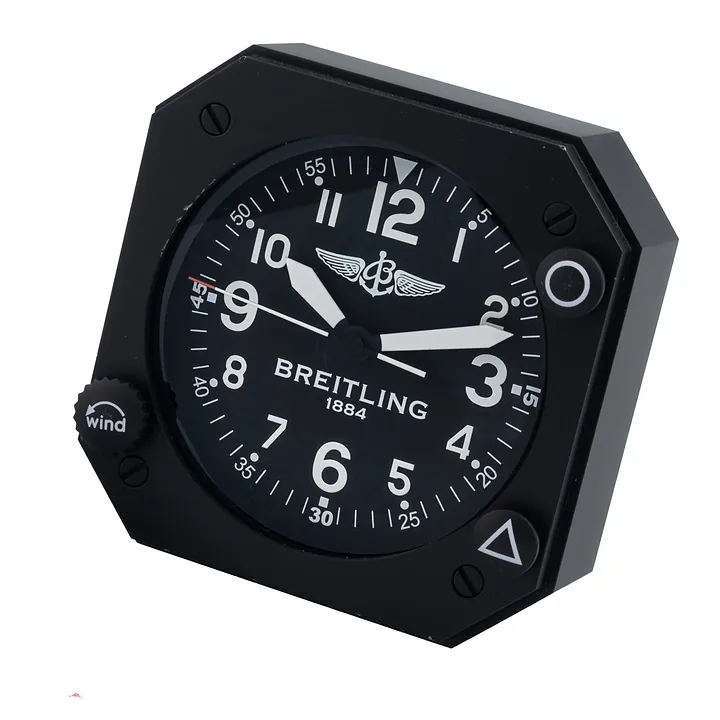
Breitling clock, c. 1990s (Antiquorum Lot 389-18)
Antiquorum auction archive, Geneva
Clocks · c. 1990s
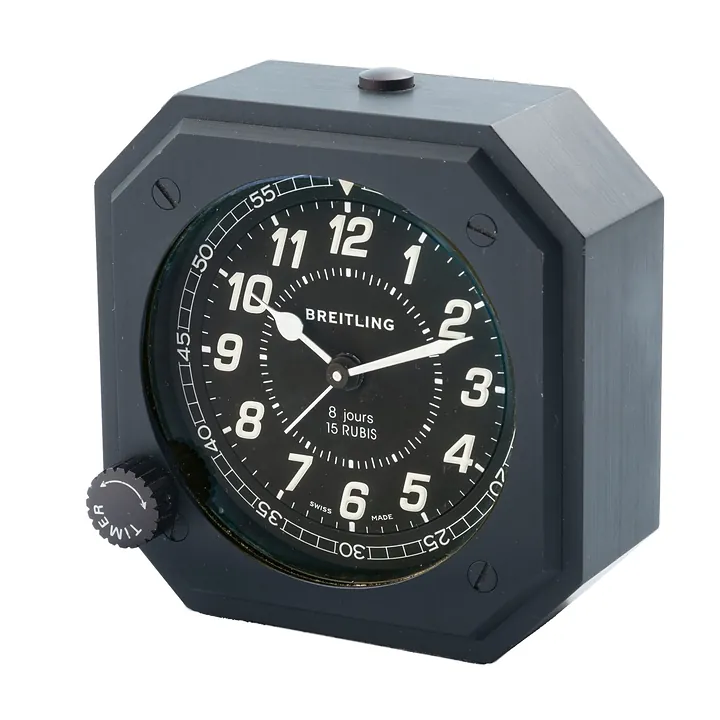
Breitling clock, c. 1990s (Antiquorum Lot 389-20)
Antiquorum auction archive, Geneva
Wristwatches · c. 1940s
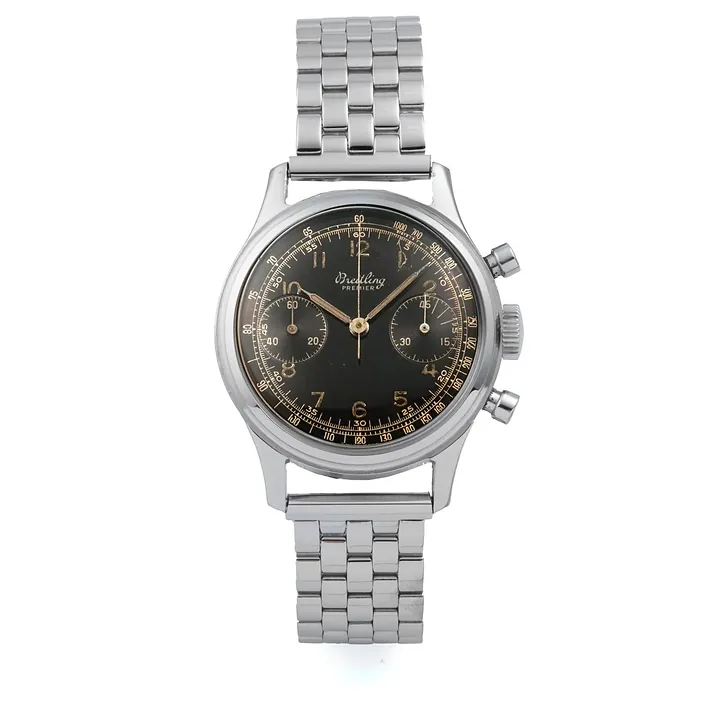
Breitling Premier, ref. 790, c. 1940s
Antiquorum auction archive, Geneva

Wristwatches · c. 1945
Breitling Premier, ref. 790, c. 1945
Antiquorum auction archive, Geneva
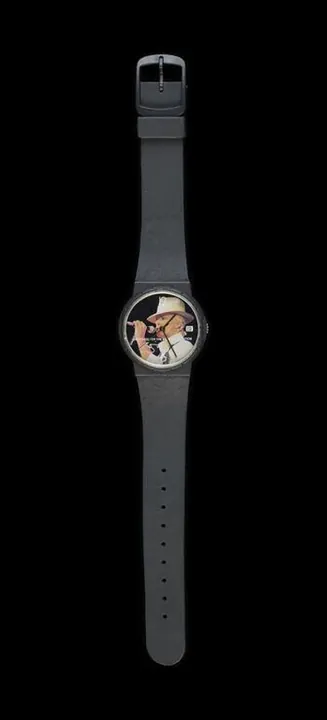
Wristwatches · 1991
Limited edition watch designed by Eta relating to David Bowie's Serious Moonlight live tour, 1991
Victoria and Albert Museum, London

Wristwatches · 2008
Wristwatch by Breitling?, 2008
Museum Rotterdam

Wristwatches · c. 1990s
Audemars Piguet Bamboo, c. 1990s
Antiquorum auction archive, Geneva

Wristwatches · c. 1990
Audemars Piguet Huitieme Perpetual Calendar, ref. 25696PT, c. 1990
Antiquorum auction archive, Geneva