
Wristwatches · Wristwatch
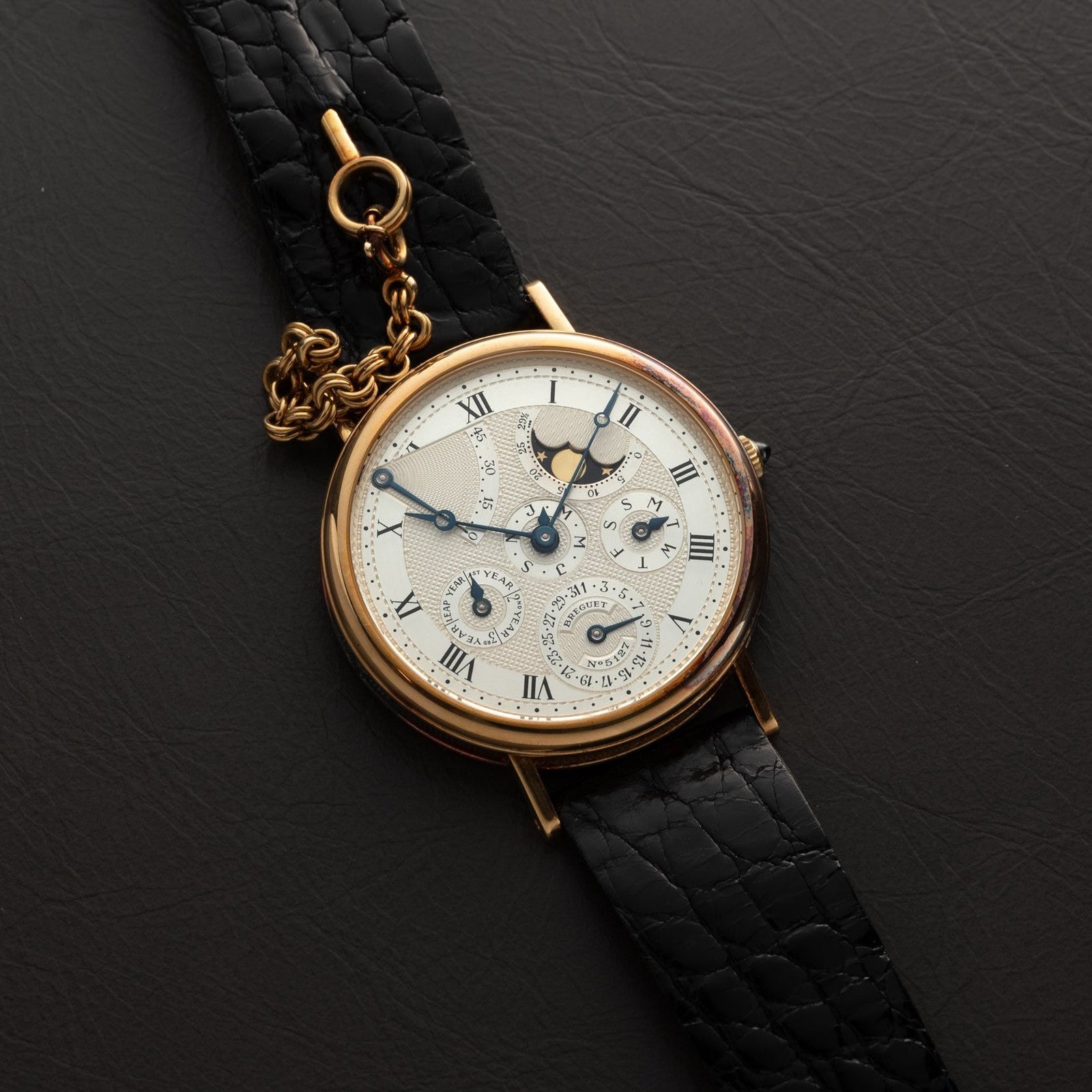
Breguet Classique Perpetual Calender, 2000s
- Maker / attribution
- Breguet (maker)
- Date
- 2000s
- Historical period
- Mechanical Renaissance (1990 – 2010)
- Country of origin
- Switzerland
- Object type
- Wristwatch
- Dimensions
- Case 37 mm
- Stock no.
- 40992162
- Credit line
- Dealer listing, Analog/Shift (40992162)
- Catalogue title (original)
- Breguet Classique Perpetual Calender (English)
View the source record (dealer listing) ↗ (opens another website in a new tab)Suggest a correction
Record summary
Catalogued by Analog/Shift (dealer), New York (stock number 40992162), this is a wristwatch by Breguet, made in Switzerland, dated 2000s. The Atlas places it in the Mechanical Renaissance period (1990 – 2010) of its Wristwatches collection. Recorded dimensions: Case 37 mm. The record is illustrated with 6 photographs.
Assembled from the source record's structured fields. Dates and attributions are given as the source states them; where a field is missing the Atlas leaves it blank rather than estimating.
Catalogue description
Dealer description — Analog/Shift
The more sophisticated, intricate, and elaborate a movement is, the higher up the monetary ladder a watch will climb. Only the most respected high-horology names even venture to attempt the most complicated movements. Today’s watch is an anomaly in this convention. No, this piece isn’t made by a little-known boutique manufacturer — it’s made by Breguet, one of the most revered brands in horological history. No, this piece isn’t a simple time-only dress watch — it’s a perpetual calendar executed in an extra-slim package. And yet, this watch trades for significantly less than many watches with a similar complication. In short, it’s proof positive that if you know where to look, you can still find outsized value in the watch world. A Breguet Classique Perpetual Calendar dating to the 2000s, its 37mm diameter makes it perfect for both men and women. Housed in an 18K yellow gold case with a stepped bezel, a cabochon-style crown, straight lugs, and a sapphire crystal, it features a white guilloché dial with an outer minute track in black, a blued steel ‘Breguet’ handset, a power reserve indicator between 10 and 11 o’clock, a moonphase display between 1 and 2 o’clock, a central month display, a day indicator at 4 o’clock, a date indicator at 6 o’clock, and a leap year indicator at 8 o’clock. Powered by a self-winding movement, it comes paired to a unique signed, factory-issued black leather strap with an 18K yellow gold pin buckle that includes space for a small calendar adjustment tool. This way, you can handily adjust your watch no matter where you are. (Not that you’d have much need to — a perpetual calendar rarely needs manual adjustment, which is the entire point of the complication!) If you’re on the hunt for an elegant, complicated calendar watch from a company with several hundred years of watchmaking history, look no further than this beautiful Classique Reference 3310BA!
Historical context
Mechanical Renaissance (1990 – 2010)
Mechanical watches return as cultural objects; independent watchmaking flourishes.
Mechanical watches returned as cultural and luxury objects. Complications, tourbillons and new materials proliferated; independent watchmakers such as George Daniels, F.P. Journe and Philippe Dufour revived artisanal watchmaking; collecting vintage watches became a major field.
Read the period in the timelineMore wristwatches from this periodEarlier: Quartz Revolution
Atlas type guide
Calendar, moon-phase and perpetual calendar watches
Calendar complications range from a simple date to the perpetual calendar, which automatically allows for months of different lengths and leap years until 2100. Pocket watches with perpetual calendars were made in the eighteenth and nineteenth centuries; Patek Philippe made the first perpetual calendar wristwatch in 1925, and series production followed in 1941. The annual calendar (Patek Philippe, 1996) needs correction only once a year.
Moon-phase displays use a disc with two moons and 59 teeth advanced daily, approximating the 29.5-day lunation; more precise trains reduce the error to one day in over a century.
What to look for
- Apertures or subsidiary dials for day, date, month and leap year.
- Moon disc under a 'bosom' shaped aperture.
- Recessed correctors on the case band for setting the calendar.
Dating clues
- Triple-date wristwatches: popular c. 1940–1955.
- Perpetual calendar wristwatches: from 1925 (unique) and 1941 (series).
General guidance written by the Atlas editors about this kind of object. It is not a statement about this particular piece; for that, rely on the source record above and on physical examination.
Related records
Pocket Watches · 1700–1799
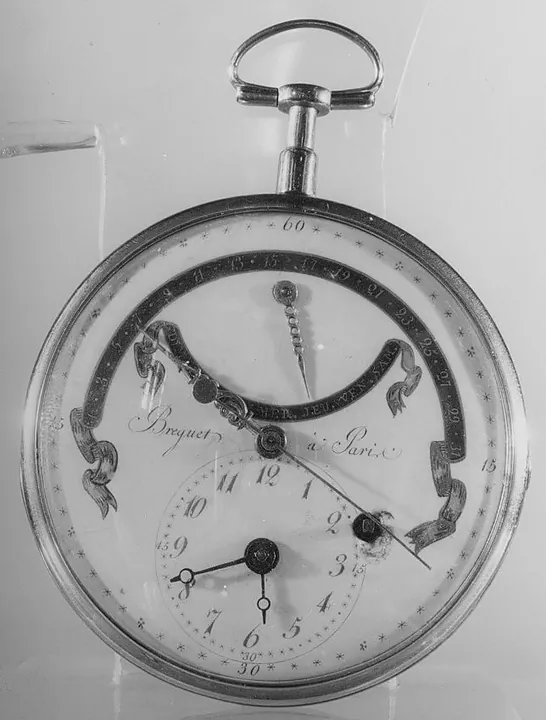
Pocket watch by Breguet, Belgium, 1700–1799
Royal Institute for Cultural Heritage
Pocket Watches · 1700–1799
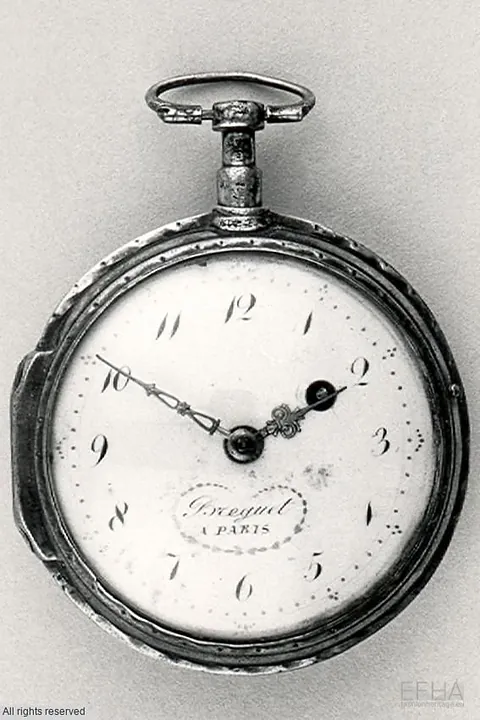
Pocket watch by Breguet, France, 1700–1799
Fashion Museum of Antwerp
Pocket Watches · c. 1790
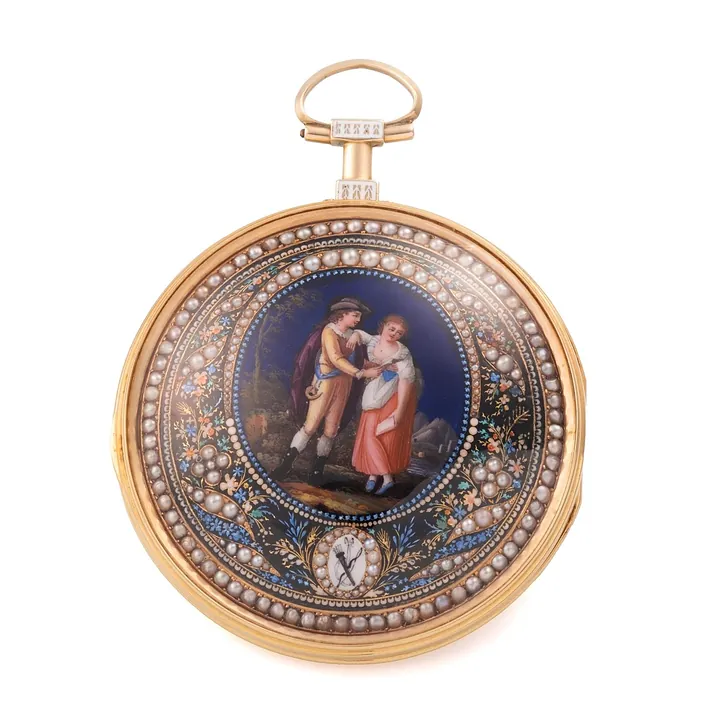
Breguet Love Letter, c. 1790
Antiquorum auction archive, Geneva
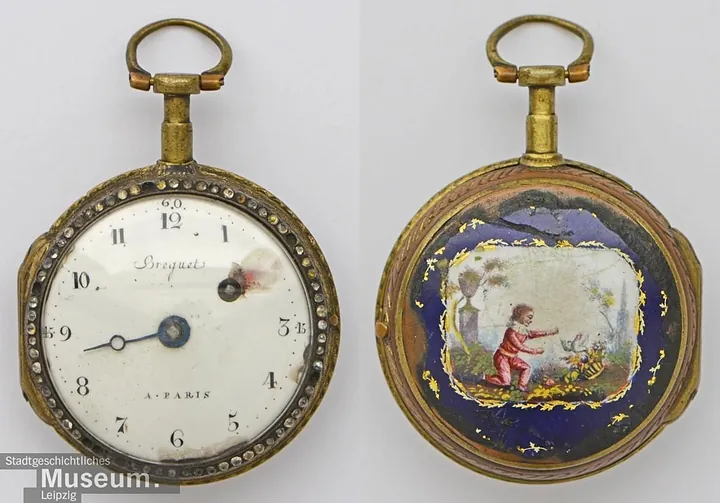
Pocket Watches · 1790
Pocket watch possibly by Breguet, France, 1790
Museum of City History Leipzig

Wristwatches · 2008
Wristwatch by Breitling?, 2008
Museum Rotterdam

Wristwatches · c. 1990s
Audemars Piguet Bamboo, c. 1990s
Antiquorum auction archive, Geneva

Wristwatches · c. 1990
Audemars Piguet Huitieme Perpetual Calendar, ref. 25696PT, c. 1990
Antiquorum auction archive, Geneva

Wristwatches · c. 1990
Breitling Chronomat, ref. b13050.1, c. 1990
Antiquorum auction archive, Geneva