
Wristwatches · Wristwatch
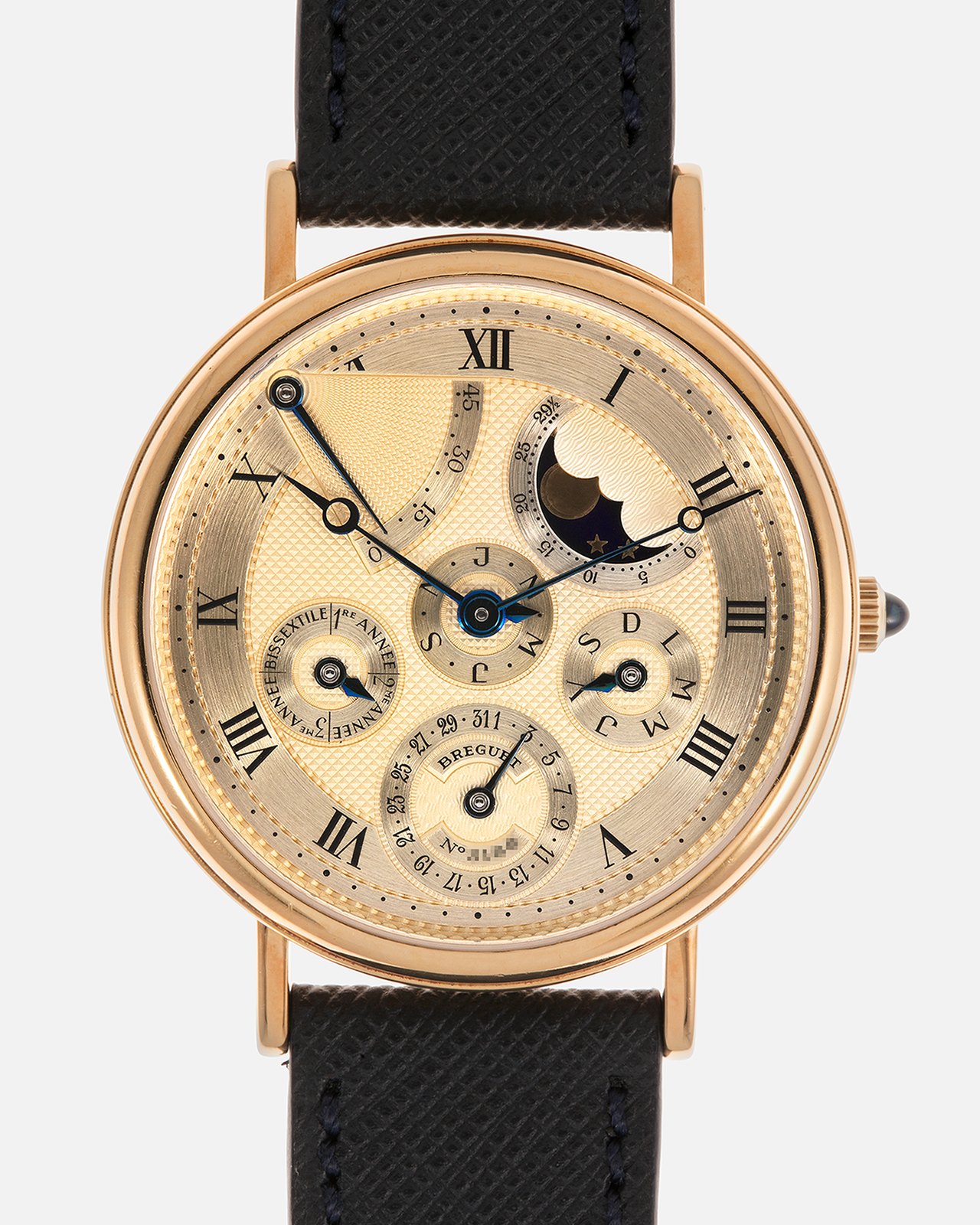
Breguet Classique Perpetual Calendar 3310 'Champagne', 1994
- Maker / attribution
- Breguet (maker)
- Date
- 1994
- Historical period
- Mechanical Renaissance (1990 – 2010)
- Country of origin
- Switzerland
- Object type
- Wristwatch
- Dimensions
- Case 36 mm
- Stock no.
- Product 7710271668311
- Credit line
- Dealer listing, S.Song Watches (product 7710271668311)
- Catalogue title (original)
- Breguet Classique Perpetual Calendar 3310 'Champagne' (English)
View the source record (dealer listing) ↗ (opens another website in a new tab)Suggest a correction
Record summary
Catalogued by S.Song Watches (dealer), Seattle (stock number Product 7710271668311), this is a wristwatch by Breguet, made in Switzerland, dated 1994. The Atlas places it in the Mechanical Renaissance period (1990 – 2010) of its Wristwatches collection. Recorded dimensions: Case 36 mm. The record is illustrated with 6 photographs.
Assembled from the source record's structured fields. Dates and attributions are given as the source states them; where a field is missing the Atlas leaves it blank rather than estimating.
Catalogue description
Dealer description — S.Song Watches
Few watches capture Breguet's revival under Daniel Roth as completely as the 3310. Today, it is almost impossible to imagine a Breguet without a hand-guilloché dial, fluted mid-caseband, welded straight lugs or blued pomme hands. These elements have become so closely associated with the manufacture that many collectors assume they have always formed part of its identity. In reality, much of what we now recognise as the modern Breguet aesthetic was carefully re-established during Daniel Roth's tenure in the 1980s. When the Chaumet brothers acquired Breguet in 1976, they recruited the young Daniel Roth to rebuild the manufacture around the principles established by Abraham-Louis Breguet. Rather than modernising the collection, Roth looked to the surviving work of its founder, reviving the visual language that continues to shape the Classique collection today: hand-guilloché dials, fluted casebands, welded straight lugs, restrained proportions and mechanical sophistication. Introduced in 1986, the 3310 was Daniel Roth's second perpetual calendar for Breguet, following the earlier 3050. Rather than simply revising its predecessor, the 3310 adopted an entirely new dial architecture inspired by the asymmetrical layout of the Classique 3130. It combined a power-reserve indicator, a pointer-date display and a revised arrangement of the calendar indications while remaining unmistakably Breguet in both appearance and execution. In doing so, it delivered the sophistication of a perpetual calendar without sacrificing the clarity that became a hallmark of Roth's work. The dial is where this approach becomes most apparent. A broad power-reserve indicator arcs across the top, while the month is displayed in a compact central register. The day of the week and leap-year indicator balance one another on either side, with the moon phase occupying the upper-right quadrant and the pointer-date display anchoring the dial at 6 o'clock. Despite presenting seven individual indications, the composition remains remarkably coherent. Rather than pursuing perfect symmetry, Roth prioritised legibility and visual flow, allowing each display to occupy its own space without overwhelming the dial. The dial itself is cut from solid gold before being individually engine-turned on traditional rose engines. Distinct guilloché motifs differentiate each indication, allowing texture rather than colour to separate the various functions without relying on printed borders or contrasting tones. Together, these details demonstrate that guilloché serves not merely as decoration, but as a functional element that contributes as much to legibility as it does to aesthetics. The case reflects the same restrained thinking. Measuring 36 mm in diameter, it embodies the proportions Daniel Roth consistently favoured throughout his time at Breguet. The relatively slim bezel gives the dial generous presence, while the coin-edge mid-caseband, welded straight lugs and sapphire-set crown immediately identify it as a Breguet. Each element draws directly from the design vocabulary established by Abraham-Louis Breguet himself. What makes this particular example especially compelling is its dial. Rather than the more commonly encountered silver finish, this example has a distinctively champagne dial that recalls the celebrated doré dials found on certain vintage Patek Philippe references. The difference is immediately apparent in person, lending the watch a richness and warmth that beautifully complements the yellow gold case. Powering the 3310 is the automatic Cal. 502 DRP, developed around the ultra-thin Frédéric Piguet Cal. 71. Its slim architecture allowed the watch to retain the proportions of a classical dress watch despite the complexity of its perpetual calendar. The 3310 arrived at a pivotal moment in the manufacture's renaissance. By the mid-1980s, Daniel Roth had firmly re-established the visual language that continues to define the Classique collection today. Rather than reproducing historical pocket watches, the 3310 demonstrated how Abraham-Louis Breguet's principles could be translated into a contemporary perpetual calendar without sacrificing their integrity. Although Breguet has never published official production figures for the 3310, contemporary research into the Chaumet era suggests that perpetual calendars were produced only in very small numbers. Well-preserved examples such as this one surface relatively infrequently. As collectors have increasingly rediscovered the Chaumet era, the 3310 has quietly established itself as one of the defining complicated watches of the period and one of the purest expressions of Daniel Roth's vision for modern Breguet.
Historical context
Mechanical Renaissance (1990 – 2010)
Mechanical watches return as cultural objects; independent watchmaking flourishes.
Mechanical watches returned as cultural and luxury objects. Complications, tourbillons and new materials proliferated; independent watchmakers such as George Daniels, F.P. Journe and Philippe Dufour revived artisanal watchmaking; collecting vintage watches became a major field.
Read the period in the timelineMore wristwatches from this periodEarlier: Quartz Revolution
Atlas type guide
Calendar, moon-phase and perpetual calendar watches
Calendar complications range from a simple date to the perpetual calendar, which automatically allows for months of different lengths and leap years until 2100. Pocket watches with perpetual calendars were made in the eighteenth and nineteenth centuries; Patek Philippe made the first perpetual calendar wristwatch in 1925, and series production followed in 1941. The annual calendar (Patek Philippe, 1996) needs correction only once a year.
Moon-phase displays use a disc with two moons and 59 teeth advanced daily, approximating the 29.5-day lunation; more precise trains reduce the error to one day in over a century.
What to look for
- Apertures or subsidiary dials for day, date, month and leap year.
- Moon disc under a 'bosom' shaped aperture.
- Recessed correctors on the case band for setting the calendar.
Dating clues
- Triple-date wristwatches: popular c. 1940–1955.
- Perpetual calendar wristwatches: from 1925 (unique) and 1941 (series).
General guidance written by the Atlas editors about this kind of object. It is not a statement about this particular piece; for that, rely on the source record above and on physical examination.
Related records
Pocket Watches · 1700–1799
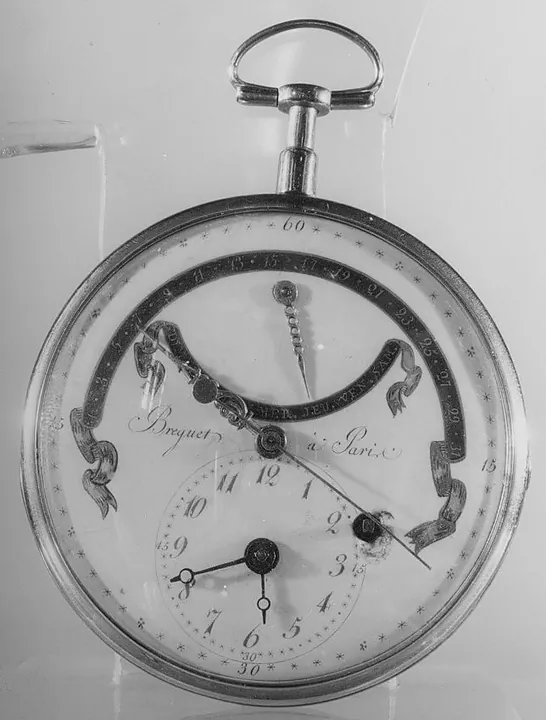
Pocket watch by Breguet, Belgium, 1700–1799
Royal Institute for Cultural Heritage
Pocket Watches · 1700–1799
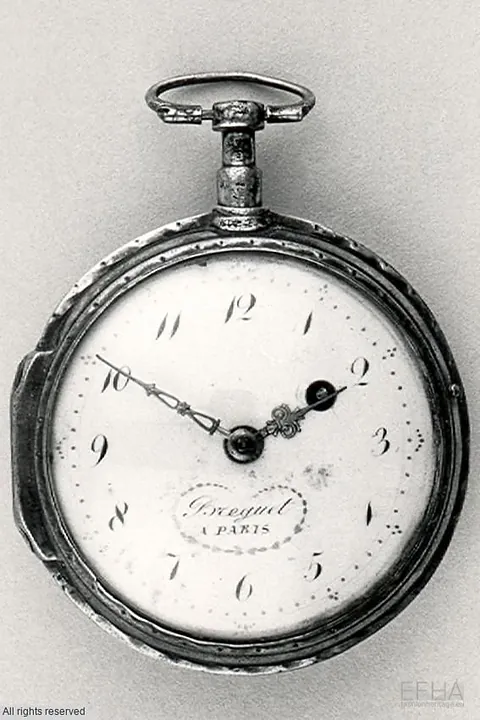
Pocket watch by Breguet, France, 1700–1799
Fashion Museum of Antwerp
Pocket Watches · c. 1790
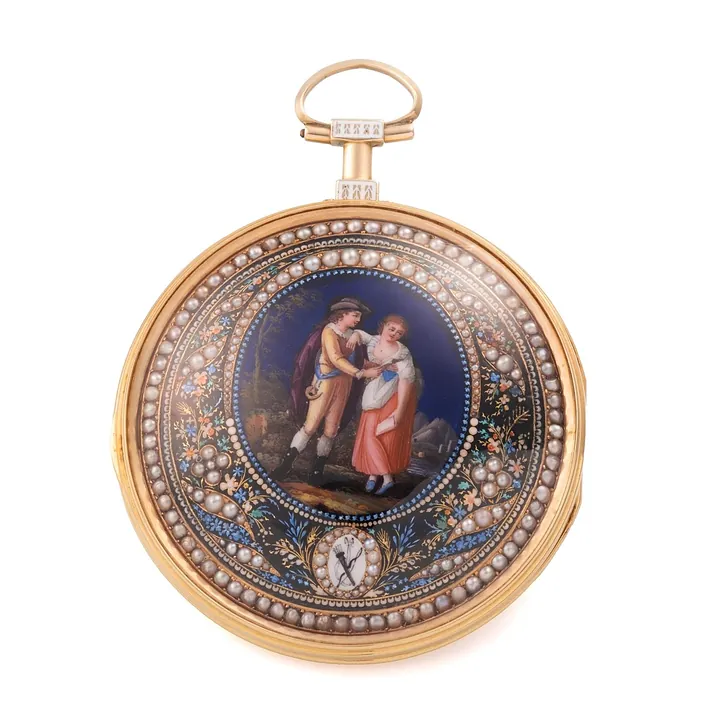
Breguet Love Letter, c. 1790
Antiquorum auction archive, Geneva
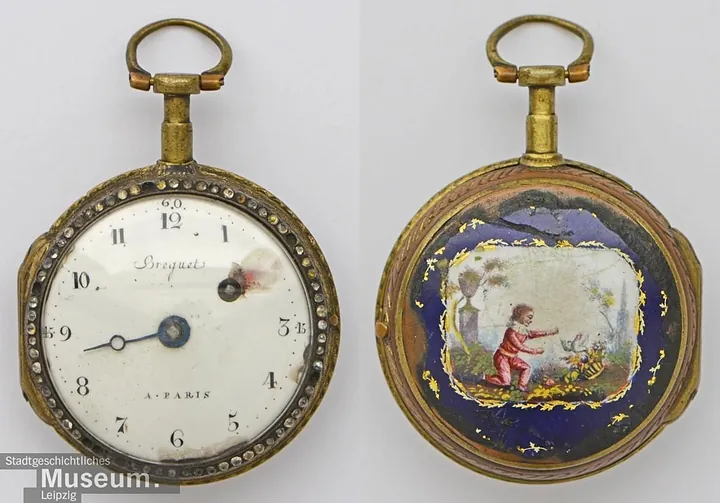
Pocket Watches · 1790
Pocket watch possibly by Breguet, France, 1790
Museum of City History Leipzig

Wristwatches · 2008
Wristwatch by Breitling?, 2008
Museum Rotterdam

Wristwatches · c. 1990s
Audemars Piguet Bamboo, c. 1990s
Antiquorum auction archive, Geneva

Wristwatches · c. 1990
Audemars Piguet Huitieme Perpetual Calendar, ref. 25696PT, c. 1990
Antiquorum auction archive, Geneva

Wristwatches · c. 1990
Breitling Chronomat, ref. b13050.1, c. 1990
Antiquorum auction archive, Geneva