
Clocks · Flute clock
Black Forest Flute Clock
- Maker / attribution
- Unrecorded in source
- Date
- late 18th century
- Historical period
- Precision & Scientific Horology (1750 – 1850)
- Country of origin
- Germany
- Object type
- Flute clock
- Dimensions
- 100 x 60 cm
- Auction house
- Nagel Auction (via Invaluable)
- Lot
- 853
- Credit line
- Nagel Auction (via Invaluable)
- Catalogue title (original)
- A LARGE BLACK FOREST FLUTE CLOCK (English)
View the source record (auction lot) ↗ (opens another website in a new tab)Suggest a correction
Record summary
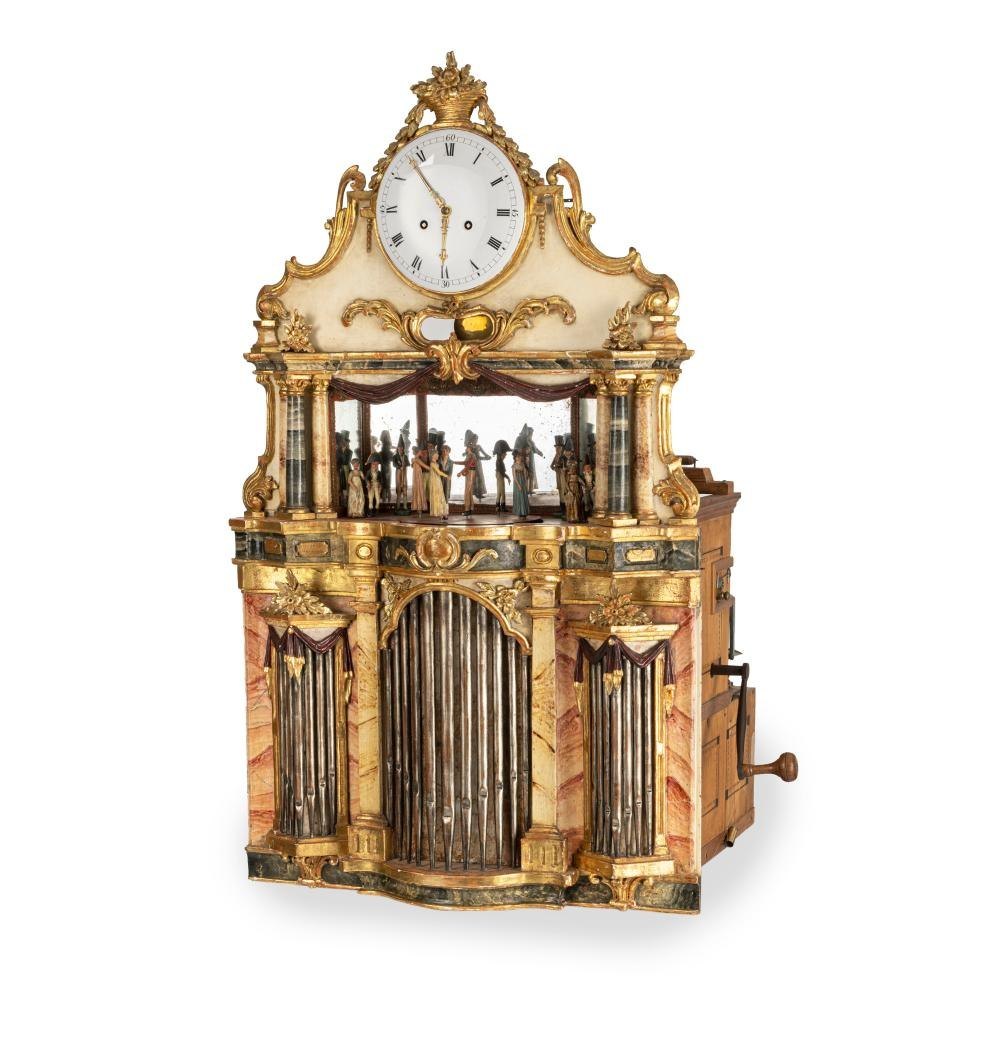
Catalogued by Nagel Auction (via Invaluable) (lot 853), this is a flute clock, made in Germany, dated late 18th century. The Atlas places it in the Precision & Scientific Horology period (1750 – 1850) of its Clocks collection. Recorded dimensions: 100 x 60 cm. The record is illustrated with 1 photograph.
Assembled from the source record's structured fields. Dates and attributions are given as the source states them; where a field is missing the Atlas leaves it blank rather than estimating.
Catalogue description
Original object description
Dating from the late eighteenth century, this musical flute clock from the Black Forest region is set within a poliment-gilt architectural wooden case replicating a church organ, supported by a wooden base in the form of a commode. A white enamel dial, featuring ornate hands, Roman hours, and Arabic numerals for minutes, is driven by a replacement eight-day movement with a thread-suspended pendulum that strikes the half-hours on a bell. Sixty-four wooden pipes, 21 claverns, and three registers constitute the built-in pipe organ, which operates via two interchangeable pinned wooden cylinders playing eight tunes apiece. Acquired in 1991 from Cologne dealer Antiquitäten Rust, the clock was subsequently held in Stuttgart's Sapper Collection; it includes correspondence mentioning an unconfirmed attribution linking the figures and shield to Matthias Faller for the court of France.
Historical context
Precision & Scientific Horology (1750 – 1850)
Harrison solves longitude; Mudge invents the lever; Breguet's Paris workshop defines the modern watch.
The age of the deadbeat escapement, compensated pendulums and observatory regulators. Domestic clocks spread through the middle classes: English longcase and bracket clocks, French gilt-bronze mantel clocks, Viennese Biedermeier wall clocks, Black Forest painted-shield clocks, and the first American shelf clocks.
Read the period in the timelineMore clocks from this periodEarlier: Early Modern Horology
Atlas type guide
Black Forest and cuckoo clocks
Clockmaking spread through the Black Forest in south-west Germany in the late seventeenth century as a winter occupation for farming families. Early clocks had wooden plates and wheels and a foliot ('Waaguhr') or short pendulum, with a painted wooden shield dial; pedlars (Uhrenträger) carried them across Europe. The cuckoo clock, which imitates the bird's call with two small bellows-driven pipes, appeared in the mid-eighteenth century.
The industry was organised around Furtwangen, Triberg, Schwenningen and Lenzkirch. The Furtwangen clockmaking school (1850) introduced the railway-house cuckoo clock design, and from the late nineteenth century factories such as Junghans, Kienzle and Hamburg-Amerikanische Uhrenfabrik produced clocks by the million. The German Clock Museum in Furtwangen preserves the region's history.
What to look for
- Wooden plates and wheels (earlier) versus brass movements (later).
- Painted shield dials (Lackschilduhr) with floral or figurative decoration.
- Cuckoo bellows and pipes, the carved 'railway house' or hunting-scene case.
- Trademarks and movement stamps of Black Forest factories.
Dating clues
- Wooden-wheeled foliot clocks: c. 1680–1750.
- Painted shield clocks: c. 1780–1880.
- Railway-house cuckoo clocks: after 1850; carved hunting-style cases after c. 1860.
General guidance written by the Atlas editors about this kind of object. It is not a statement about this particular piece; for that, rely on the source record above and on physical examination.
Read next:FoliotAnchor (recoil) escapement
Related records
Clocks · 1780s (inferred: the museum dates the style to the 1780s and the music includes Gluck's Iphigénie en Tauride of 1779)
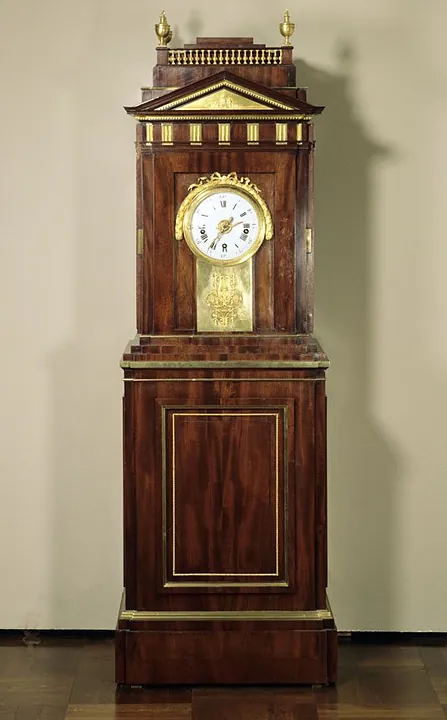
Musical longcase clock, Roentgen workshop, Neuwied, 1780s
Badisches Landesmuseum Karlsruhe
Clocks · c. 1750
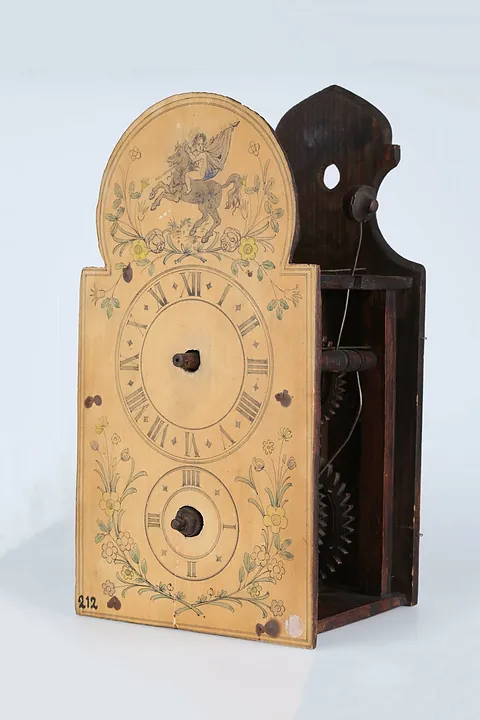
Clock by Georg Gfell, Germany, c. 1750
German Clock Museum
Clocks · 1750–1799
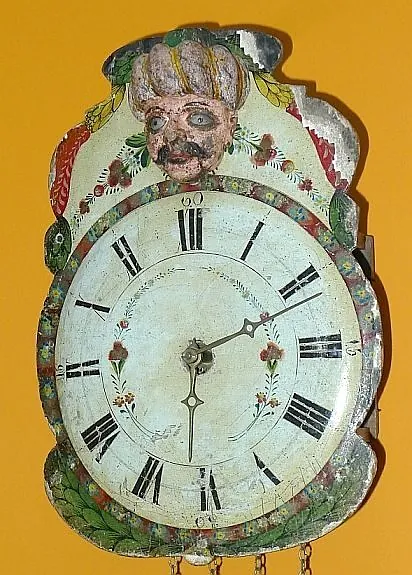
Cuckoo / black forest clock, Germany, 1750–1799
Badisches Landesmuseum Karlsruhe
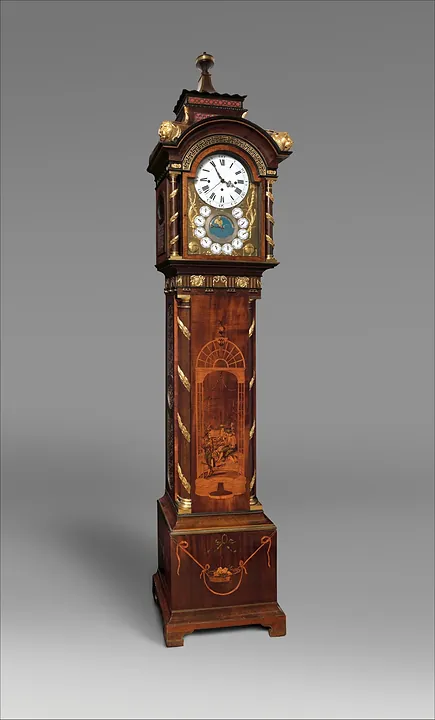
Clocks · c. 1774–75
Longcase clock by Hermann Achenbach, Germany, c. 1774–75
The Metropolitan Museum of Art, New York
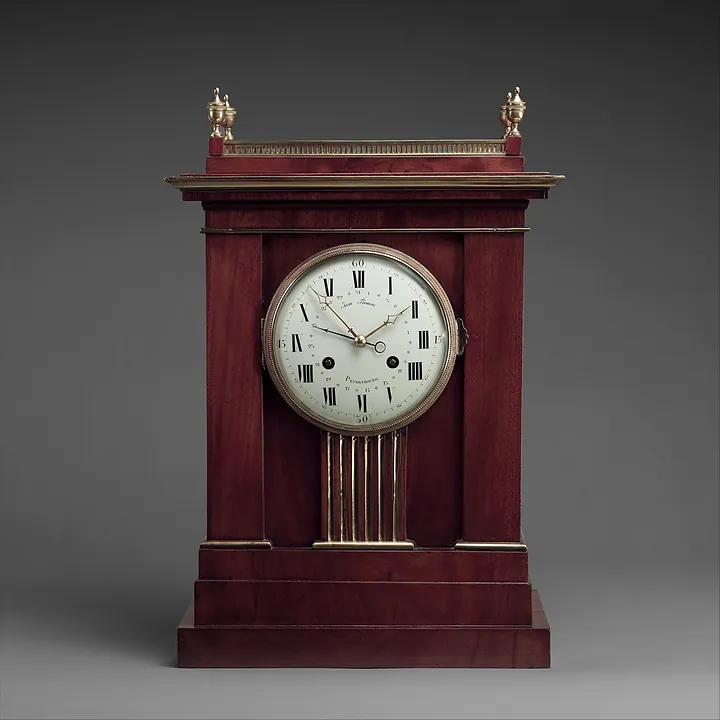
Clocks · c. 1780–90
Clock, workshop of David Roentgen, Germany, c. 1780–90
The Metropolitan Museum of Art, New York
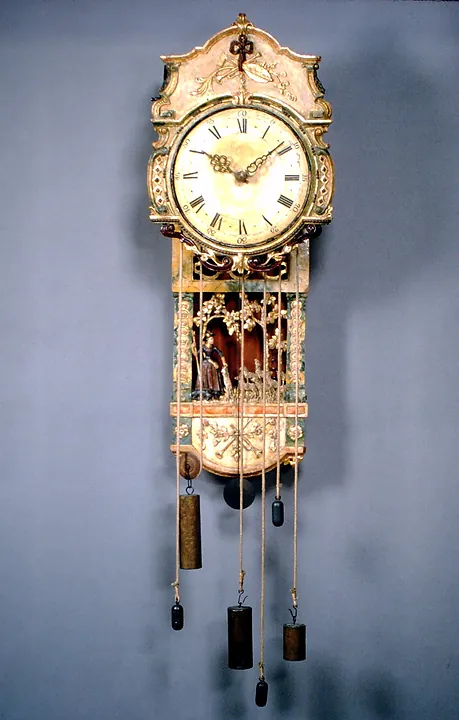
Clocks · c. 1800
Musical clock by Martin Vanlo?, Germany, c. 1800
The Metropolitan Museum of Art, New York
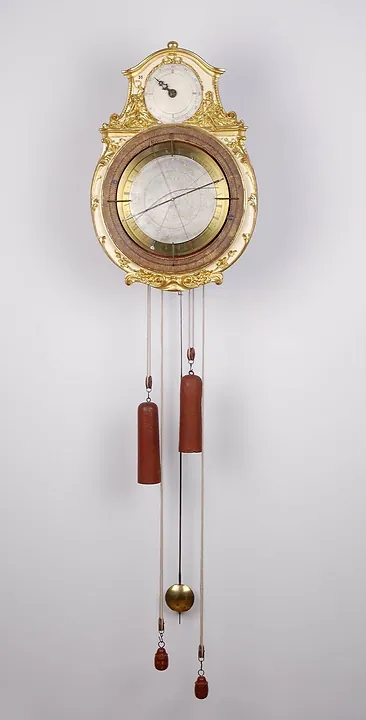
Clocks · 1787
Astronomical clock, Germany, 1787
German Clock Museum
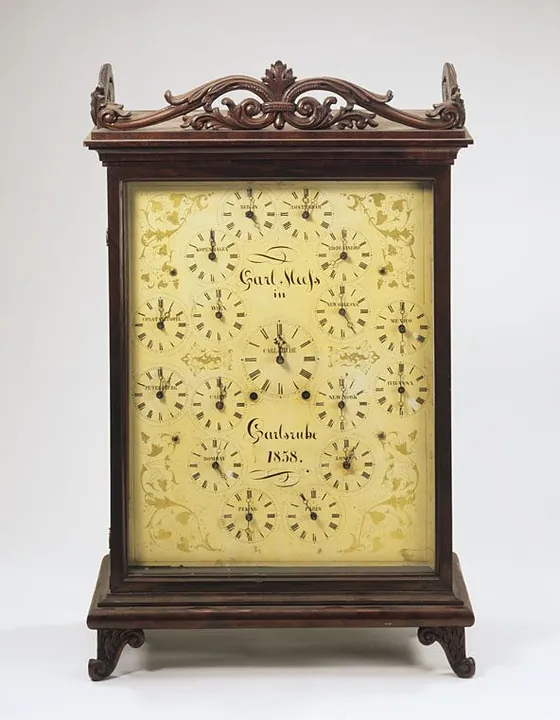
Clocks · 1800–1899
Clock by Carl Meeß, Germany, 1800–1899
Badisches Landesmuseum Karlsruhe