
Wristwatches · Wristwatch
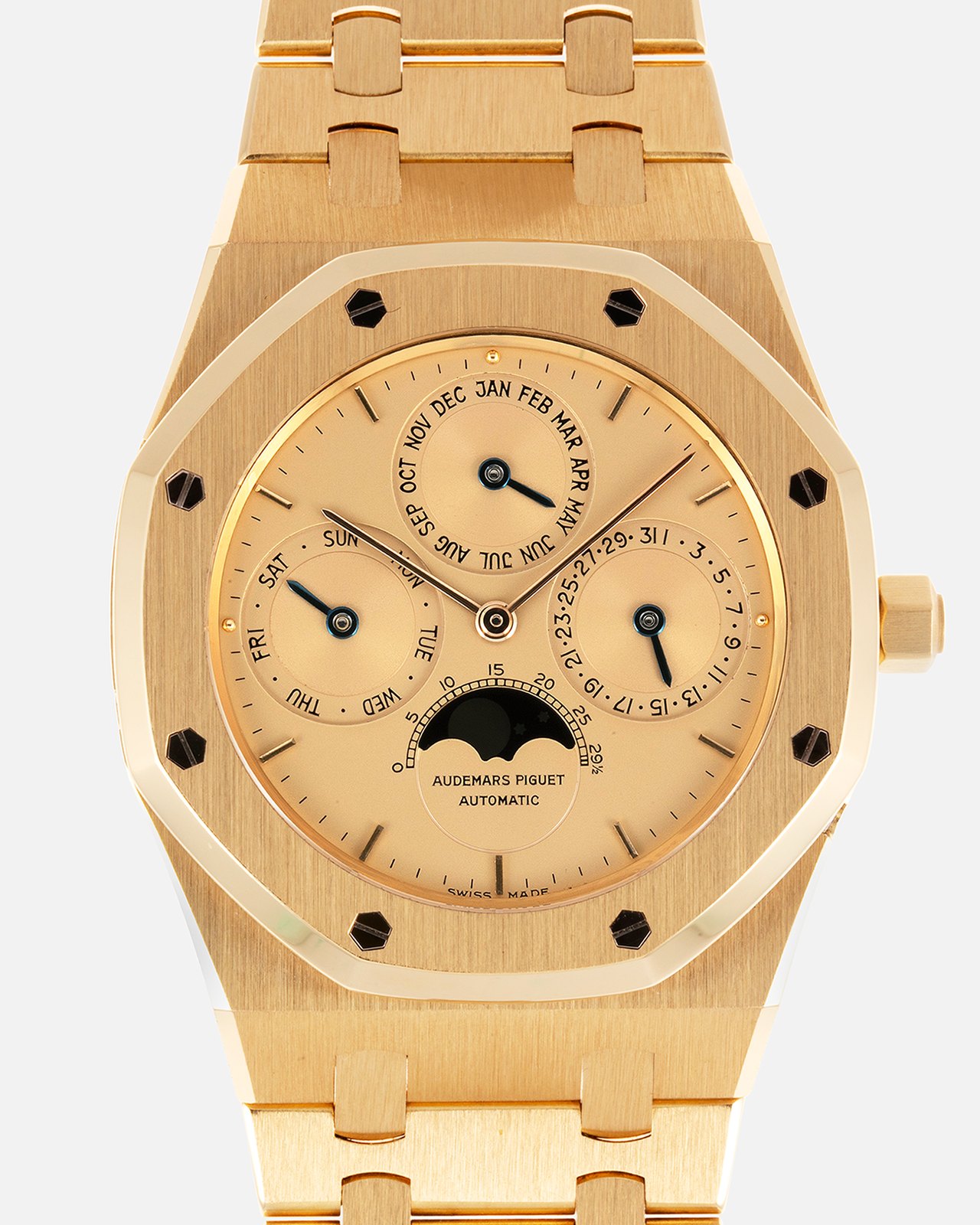
Audemars Piguet Royal Oak Perpetual Calendar 25654BA, 1980s
- Maker / attribution
- Audemars Piguet (maker)
- Date
- 1980s
- Historical period
- Quartz Revolution (1969 – 1990)
- Country of origin
- Switzerland
- Object type
- Wristwatch
- Dimensions
- Case 39 mm
- Stock no.
- Product 6785312751703
- Credit line
- Dealer listing, S.Song Watches (product 6785312751703)
- Catalogue title (original)
- Audemars Piguet Royal Oak Perpetual Calendar 25654BA (English)
View the source record (dealer listing) ↗ (opens another website in a new tab)Suggest a correction
Record summary
Catalogued by S.Song Watches (dealer), Seattle (stock number Product 6785312751703), this is a wristwatch by Audemars Piguet, made in Switzerland, dated 1980s. The Atlas places it in the Quartz Revolution period (1969 – 1990) of its Wristwatches collection. Recorded dimensions: Case 39 mm. The record is illustrated with 6 photographs.
Assembled from the source record's structured fields. Dates and attributions are given as the source states them; where a field is missing the Atlas leaves it blank rather than estimating.
Catalogue description
Dealer description — S.Song Watches
The Royal Oak, with its masculine octagonal case, exposed screws, and integrated bracelet is one of the most distinctive watches in the market today. It is imposing and recognizable, and in my opinion, one of the best statement watches money can buy. While the Royal Oaks was initially made famous by the use of stainless steel, it was always a natural progression to also produce examples in precious metals, and that is exactly what Audemars Piguet did. Furthermore, it also made sense to add complications to the initial time-only Royal Oak. What we have here today is the culmination of just that- the 18k Yellow Gold Audemars Piguet Royal Oak Perpetual Calendar 25654BA. First released in 1982, the Ref. 25654 came at a time when the Swiss industry was reeling from the Quartz Crisis. With declining sales and extinction in sight, it would seem like absolute madness for Audemars Piguet to release a complicated mechanical watch in a yellow gold sports case, but that is exactly what they did. Featuring a perpetual calendar complication and a four sub-dial layout to display the day, date, month, and moon phase, there is a certain beautiful symmetry in the sub-dials that contrasts with the octagonal shape of the case, giving off a very balanced, proportionate aesthetic. Combining this with the solid 18k yellow gold case and the matching champagne dial, what you get is a truly impressive watch. While Royal Oaks are most iconic in stainless steel, I have to say that there is a certain inexplicable aura when it is made in yellow gold. You kind of start to understand it when you put it on your wrist. I think it has something to do with the perfectly finished and reflective brushed, beveled, and polished gold surfaces combined with the immense weight of the watch- it really is like no other. Furthermore, the 39mm case sits much better on the wrist than the newer 41mms as it has better proportions and is more faithful to the original Genta-designed Royal Oak. In fact, the movement inside this watch is the same you will find on the Jumbo models as it is the legendary JLC Cal. 2120 with a perpetual calendar module built on top. As a result, this watch shares the same thickness as the modern 15202’s with a slightly thicker bezel to accommodate the perpetual calendar module. For such a complicated watch that takes into account how many days each month has, this is truly impressive. The discontinued Royal Oak Perpetual Calendars have become immensely popular in the last few years and it's easy to see why. For a long time, they were under-appreciated and I am glad to see that finally collectors are taking this reference seriously. In fact, part of the reason why there is a renewed interest in perpetual calendar Royal Oaks is that AP themselves have been releasing many of their iconic new models with this collection, from the black and white ceramic models, including the most recent open-worked version, and of course the insane RD2 ultra, ultra-thin. The perpetual calendar complication and the Royal Oak is seen today as an iconic pairing and one that is synonymous with the brand. With this early, historically important reference paving the way, it is no doubt a must-have for connoisseurs of the brand. With only 422 examples produced between 1982 and 1993, the Ref. 25654BA is not a watch you will see every day.
Historical context
Quartz Revolution (1969 – 1990)
Seiko's Astron begins mass quartz timekeeping; traditional industries contract sharply.
Quartz and digital watches transformed the market after 1969. Swiss employment collapsed, Japanese and Hong Kong production soared, and the Swatch (1983) helped the Swiss industry recover; mechanical watches survived as luxury goods.
Read the period in the timelineMore wristwatches from this periodEarlier: Modern Mechanical Horology
Atlas type guide
Calendar, moon-phase and perpetual calendar watches
Calendar complications range from a simple date to the perpetual calendar, which automatically allows for months of different lengths and leap years until 2100. Pocket watches with perpetual calendars were made in the eighteenth and nineteenth centuries; Patek Philippe made the first perpetual calendar wristwatch in 1925, and series production followed in 1941. The annual calendar (Patek Philippe, 1996) needs correction only once a year.
Moon-phase displays use a disc with two moons and 59 teeth advanced daily, approximating the 29.5-day lunation; more precise trains reduce the error to one day in over a century.
What to look for
- Apertures or subsidiary dials for day, date, month and leap year.
- Moon disc under a 'bosom' shaped aperture.
- Recessed correctors on the case band for setting the calendar.
Dating clues
- Triple-date wristwatches: popular c. 1940–1955.
- Perpetual calendar wristwatches: from 1925 (unique) and 1941 (series).
General guidance written by the Atlas editors about this kind of object. It is not a statement about this particular piece; for that, rely on the source record above and on physical examination.
Related records

Clocks · c. 1990s
Audemars Piguet Royal Oak, c. 1990s
Antiquorum auction archive, Geneva

Pocket Watches · c. 1960
Audemars Piguet ''couteau'', c. 1960
Antiquorum auction archive, Geneva
Pocket Watches · originally sold in November 1961 (per the lot record)
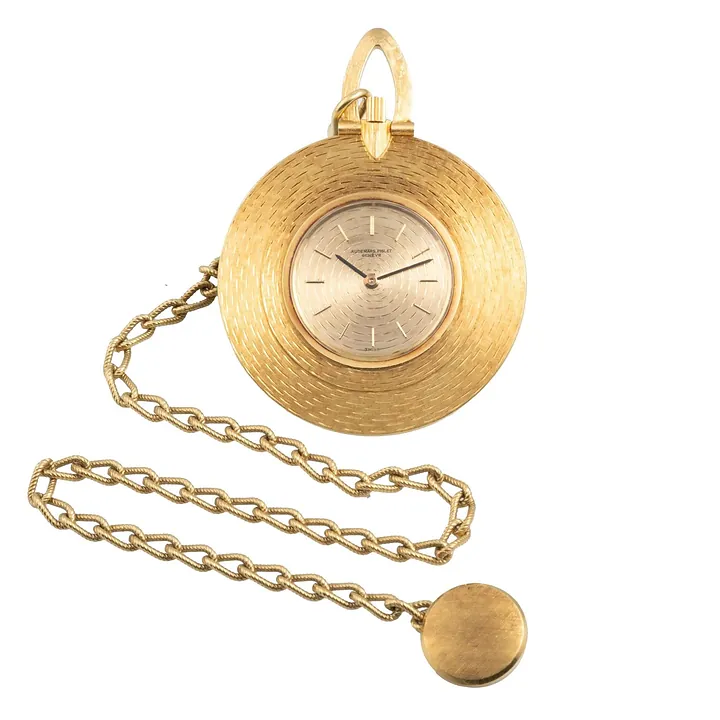
Audemars Piguet "extra Plate", ref. 5633 BA, originally sold in November 1961
Antiquorum auction archive, Geneva

Pocket Watches · c. 1980
Audemars Piguet pocket watch, c. 1980
Antiquorum auction archive, Geneva

Wristwatches · 1970
Wristwatch by Heno, Switzerland, 1970
Museum Rotterdam

Wristwatches · 1960–1986
'Tri-Compax' calendar chronograph wristwatch in gold case, by Universal, Geneva, Switzerland, 1960–1986.
Science Museum Group, London

Wristwatches · 1969–1970
Beta 21 Quartz wristwatch movement, made in Switzerland, 1970.
Science Museum Group, London

Wristwatches · c. 1969
Omega Speedmaster Moonwatch, ref. 145022-69st, c. 1969
Antiquorum auction archive, Geneva