
Wristwatches · Wristwatch
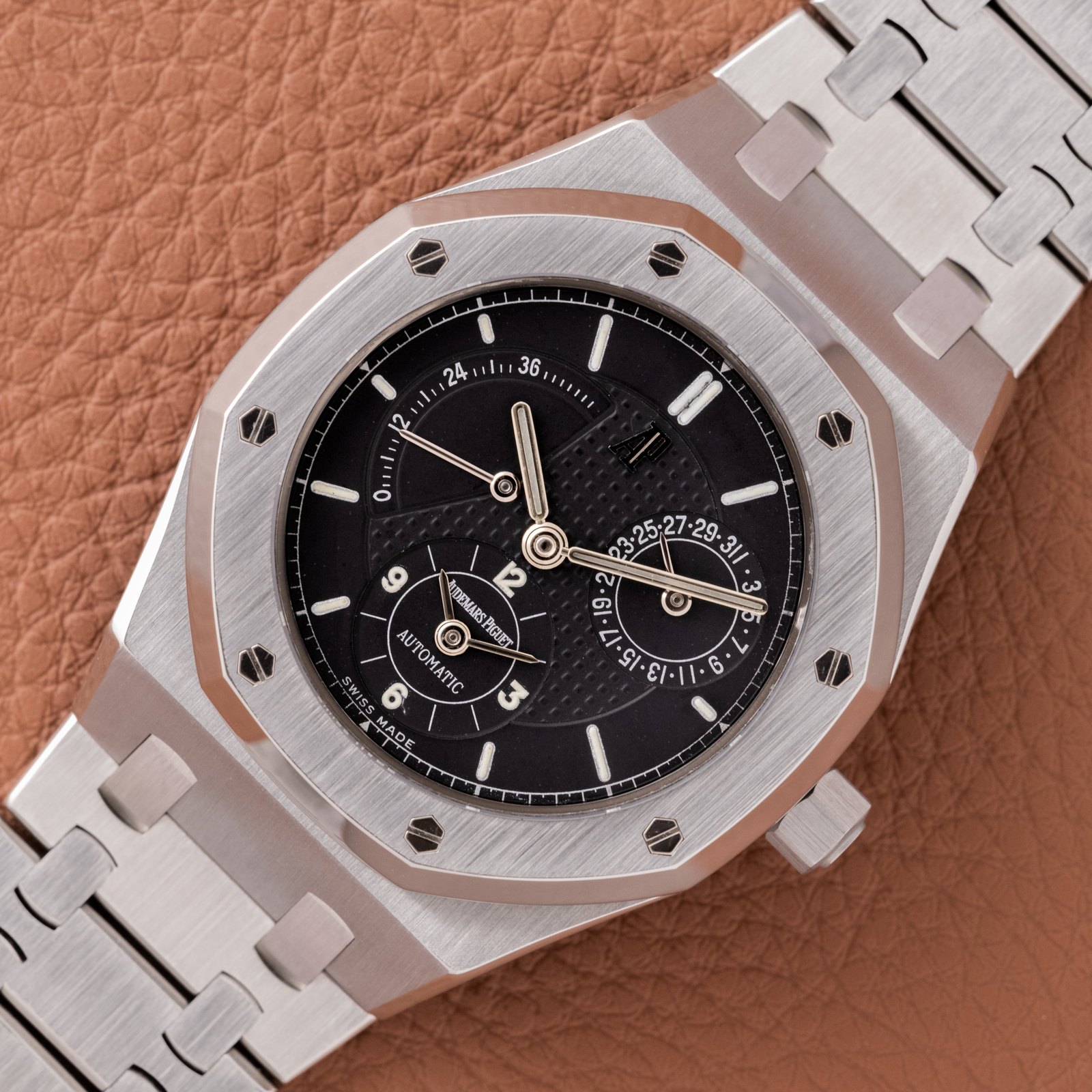
Audemars Piguet Royal Oak Black Dual Time (Ref. 25730ST), 1990s
- Maker / attribution
- Audemars Piguet (maker)
- Date
- 1990s
- Historical period
- Mechanical Renaissance (1990 – 2010)
- Country of origin
- Switzerland
- Object type
- Wristwatch
- Dimensions
- Case 36 mm
- Stock no.
- Product 8743994097847
- Credit line
- Dealer listing, Huntington Company (product 8743994097847)
- Catalogue title (original)
- 1990s Audemars Piguet Royal Oak Black Dual Time (Ref. 25730ST) (English)
View the source record (dealer listing) ↗ (opens another website in a new tab)Suggest a correction
Record summary
Catalogued by Huntington Company (dealer) (stock number Product 8743994097847), this is a wristwatch by Audemars Piguet, made in Switzerland, dated 1990s. The Atlas places it in the Mechanical Renaissance period (1990 – 2010) of its Wristwatches collection. Recorded dimensions: Case 36 mm. The record is illustrated with 6 photographs.
Assembled from the source record's structured fields. Dates and attributions are given as the source states them; where a field is missing the Atlas leaves it blank rather than estimating.
Catalogue description
Dealer description — Huntington Company
History and Significance The Royal Oak Dual Time is one of the more interesting complications found in the neo-vintage Audemars Piguet catalog. The reference 25730ST takes the familiar architecture of the Royal Oak and fits considerably more information into the same compact format without turning the watch into an oversized sports piece. At 36mm, the stainless steel case retains the proportions that make Royal Oaks from this period particularly elegant. The integrated bracelet, octagonal bezel, exposed screws, and alternating brushed and polished surfaces remain unmistakably Royal Oak, but the dial gives the watch an entirely different personality. The black dial combines a second time-zone display, date indication, power-reserve display, and small seconds within a surprisingly balanced layout. Each complication has its own defined area, creating an asymmetrical design that still feels deliberate rather than crowded. The tapisserie texture through the center provides a recognizable connection to the broader Royal Oak family, while the surrounding displays make the reference 25730ST immediately distinguishable from the simpler time-and-date models. There is a level of mechanical information here that rewards closer examination without sacrificing the fundamental geometry of the original design. Age has also begun to show in the luminous material on the dial. The lume displays visible signs of aging, giving the otherwise dark and monochromatic dial a warmer appearance in certain areas. Those changes are consistent with the age of the watch and add character to a Royal Oak that has now entered genuine neo-vintage territory. The dial remains attractive overall, with the complications, printing, and textured center retaining strong visual definition. The case has recently been polished and presents in very good overall condition. The brushing across the case and bracelet works particularly well against the polished bevels and bezel edges, preserving the contrast that is so important to the Royal Oak design. Combined with the black dial and compact 36mm dimensions, the watch feels substantially more restrained than many later complicated Royal Oaks. The reference 25730ST offers the functionality of a complicated travel watch in proportions that remain remarkably close to the elegant character of earlier Royal Oak models. Writer's Thoughts Complicated Royal Oaks became considerably larger over time, which makes the reference 25730ST especially appealing in retrospect. Fitting a second time zone, power reserve, date, and small seconds into a 36mm Royal Oak creates a watch with genuine mechanical interest without requiring additional wrist presence. The black dial is busy in the best possible way, with the tapisserie center anchoring several displays that reveal themselves gradually rather than all at once. The aging luminous material adds another layer of character and makes the watch feel appropriately connected to its 1990s production period. The recently polished case gives the exterior a very clean appearance, while the dial retains the signs of age expected of a watch from this era. That contrast works particularly well on a Royal Oak because the case architecture depends so heavily on crisp brushed and polished surfaces. At 36mm, the integrated construction also gives the watch more presence than the diameter suggests while remaining exceptionally comfortable and restrained. Reference 25730ST represents a period when Audemars Piguet could add substantial complications to the Royal Oak without altering the proportions that made the original design so successful. Our Promise Every watch is thoroughly vetted, carefully described with complete transparency, and guaranteed authentic. Each piece is offered in honest condition, ensuring collectors receive a timepiece that reflects both originality and integrity. Specifications Brand: Audemars Piguet Model: Royal Oak Dual Time Reference: 25730ST Year: Circa 1990s Case Material: Stainless steel Case Size: 36mm Dial: Black dial with tapisserie center Movement: Automatic Functions: Hours, minutes, second time zone, date, power reserve, small seconds Strap/Bracelet: Audemars Piguet integrated stainless steel bracelet Buckle/Clasp: Audemars Piguet folding clasp Contents: Watch only Condition Case: The stainless steel case has recently been polished and presents in very good overall condition. The brushed and polished surfaces remain well defined, with the characteristic Royal Oak architecture presenting attractively throughout. Dial: The black dial presents well overall, with clean printing and clearly defined displays. The luminous material shows visible signs of aging consistent with the watch's age. Hands: The hands present well and remain highly legible against the black dial, with age visible in the luminous material. Crystal: The crystal presents well overall with minor signs of wear consistent with use. Strap/Bracelet: The integrated stainless steel bracelet has recently been polished and presents in very good overall condition with light signs of handling. Buckle/Clasp: The Audemars Piguet folding clasp presents well with light surface wear consistent with use.
Historical context
Mechanical Renaissance (1990 – 2010)
Mechanical watches return as cultural objects; independent watchmaking flourishes.
Mechanical watches returned as cultural and luxury objects. Complications, tourbillons and new materials proliferated; independent watchmakers such as George Daniels, F.P. Journe and Philippe Dufour revived artisanal watchmaking; collecting vintage watches became a major field.
Read the period in the timelineMore wristwatches from this periodEarlier: Quartz Revolution
Atlas type guide
Military, pilot and travel watches
The wristwatch owes much of its adoption by men to warfare and aviation. Wristlets — small pocket watches soldered with lugs and worn on a strap — were used in colonial campaigns and became standard equipment in the First World War, with protective grilles over the crystal ('shrapnel guards'). Louis Cartier's Santos (1904), designed for the aviator Alberto Santos-Dumont, is often cited as an early purpose-made pilot's watch.
In the Second World War governments specified watches in detail: the German B-Uhr observation watches, the American A-11, and the British 'W.W.W.' (the 'Dirty Dozen' set of 1945). After the war, jet travel brought GMT and world-time watches, which show two or more time zones at once — Louis Cottier's world-time mechanism and the Rolex GMT-Master (1955) are examples.
What to look for
- Military markings on the case back: broad arrow, issue numbers, 'W.W.W.', 'A.T.P.'
- High-legibility black dials with luminous Arabic numerals; oversized crowns for gloved hands.
- 24-hour hands and rotating 24-hour bezels or city rings on GMT/world-time watches.
- Wire lugs on early wristlets converted from pocket watches.
Dating clues
- Wire-lug wristlets: c. 1900–1925.
- Military specifications of the Second World War: 1939–1945.
- GMT and world-time wristwatches: mainly after 1950.
General guidance written by the Atlas editors about this kind of object. It is not a statement about this particular piece; for that, rely on the source record above and on physical examination.
Related records

Clocks · c. 1990s
Audemars Piguet Royal Oak, c. 1990s
Antiquorum auction archive, Geneva

Pocket Watches · c. 1960
Audemars Piguet ''couteau'', c. 1960
Antiquorum auction archive, Geneva
Pocket Watches · originally sold in November 1961 (per the lot record)
Audemars Piguet "extra Plate", ref. 5633 BA, originally sold in November 1961
Antiquorum auction archive, Geneva

Pocket Watches · c. 1980
Audemars Piguet pocket watch, c. 1980
Antiquorum auction archive, Geneva

Wristwatches · 2008
Wristwatch by Breitling?, 2008
Museum Rotterdam

Wristwatches · c. 1990s
Audemars Piguet Bamboo, c. 1990s
Antiquorum auction archive, Geneva

Wristwatches · c. 1990
Audemars Piguet Huitieme Perpetual Calendar, ref. 25696PT, c. 1990
Antiquorum auction archive, Geneva

Wristwatches · c. 1990
Breitling Chronomat, ref. b13050.1, c. 1990
Antiquorum auction archive, Geneva