
Wristwatches · Wristwatch
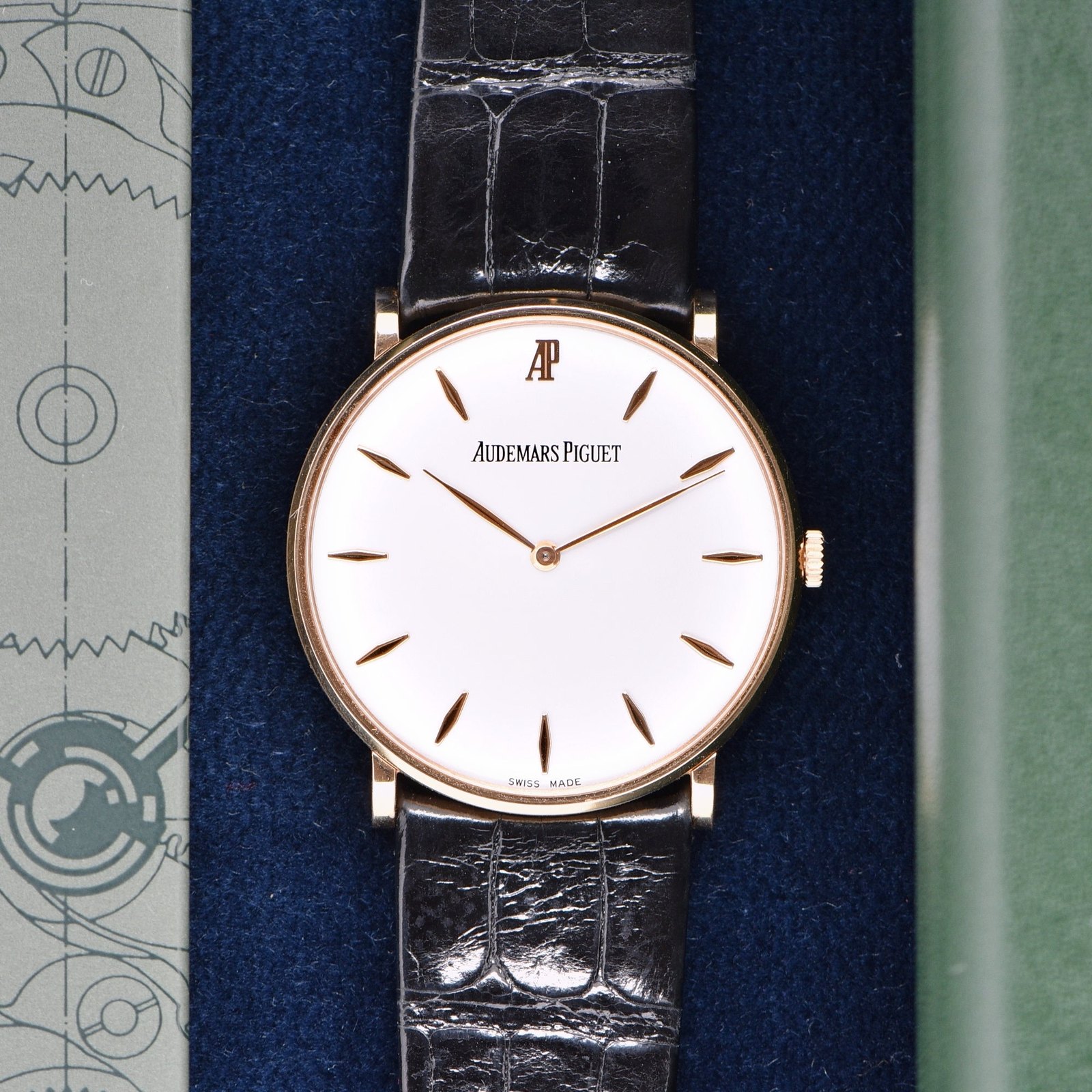
Audemars Piguet Rose Gold Ultra Thin, 2000
- Maker / attribution
- Audemars Piguet (maker)
- Date
- 2000
- Historical period
- Mechanical Renaissance (1990 – 2010)
- Country of origin
- Switzerland
- Object type
- Wristwatch
- Materials / technique
- rose gold
- Dimensions
- Case 32 mm
- Stock no.
- Product 7595857150135
- Credit line
- Dealer listing, Huntington Company (product 7595857150135)
- Catalogue title (original)
- 2000 Audemars Piguet Rose Gold Ultra Thin - Complete Set (English)
View the source record (dealer listing) ↗ (opens another website in a new tab)Suggest a correction
Record summary
Catalogued by Huntington Company (dealer) (stock number Product 7595857150135), this is a wristwatch by Audemars Piguet, made in Switzerland, dated 2000. The Atlas places it in the Mechanical Renaissance period (1990 – 2010) of its Wristwatches collection. Materials and techniques recorded by the source: rose gold. Recorded dimensions: Case 32 mm. The record is illustrated with 6 photographs.
Assembled from the source record's structured fields. Dates and attributions are given as the source states them; where a field is missing the Atlas leaves it blank rather than estimating.
Catalogue description
Dealer description — Huntington Company
Reference 14539OR Specifications Year: 2000 Model: Ultra Slim Case Diameter: 32mm Lug to Lug: 35mm Case: Rose Gold Dial: White Movement: Manual Condition This Ultra Slim is in phenomenal condition and comes as a complete set form 2000. The case on this AP is in very nice condition. The crystal has no nicks or dents. The beautiful white dial is in great shape with rose gold hour markers. The Story Audemars Piguet as a brand is one of the top players in the watch world and that's mainly thanks to the Royal Oak. That's not to say Audemars Piguet is only good at one thing. The brand has a vast history that includes much more than the Royal Oak. Before their popular sports dress watch, Audemars Piguet was at their top, making some of the most beautiful dress watches. Ultra slim manual movements, perpetual calander, and so much more. The brand is so much more than just their sports watches and a lot of people forget about that these days. The Brand Audemars Piguet and Piguet were working separately in the 1870s, with Audemars creating complicated watch movements for different manufacturers. After starting to work together in 1875, they continued this split function, with Audemars overseeing production and technical aspects and Piguet focusing on sales and management. The name Audemars Piguet & Cie was first used in 1881. In 1892, the brand created the first-minute repeater wristwatch, followed by the Grand Complication pocket watch in 1899. Tragically, Audemars and Piguet passed away in 1918 and 1919, but the company continued to grow. The next generation of Audemars and Piguet, sons Paul Louis Audemars and Paul Edward Piguet, continued the legacy. During the early-mid 1900s, the brand continued to push for innovation within the watch community. The thinnest pocket watch caliber was released in 1925, while the first skeletonized pocket watch was released in 1934. In 1946, the world's thinnest wristwatch was launched, and the first perpetual calendar wristwatch was released in 1957. The brand also holds the record for the first thinnest self-winding automatic caliber featuring a central rotor of 2.45mm in 1967. In the 1970s, the quartz crisis affected traditional mechanical watchmakers, leading Audemars Piguet to partner with Swiss watch designer Gerald Genta to develop a new category of watches. The Royal Oak steel watch, introduced at the 1972 Swiss Watch Show, was made of stainless steel and had an integrated bracelet. The daring design of the case, featuring a round dial within an octagon bezel with 8 screws set inside a tonneau-shaped case, has become one of the most iconic and highly sought-after pieces.
Historical context
Mechanical Renaissance (1990 – 2010)
Mechanical watches return as cultural objects; independent watchmaking flourishes.
Mechanical watches returned as cultural and luxury objects. Complications, tourbillons and new materials proliferated; independent watchmakers such as George Daniels, F.P. Journe and Philippe Dufour revived artisanal watchmaking; collecting vintage watches became a major field.
Read the period in the timelineMore wristwatches from this periodEarlier: Quartz Revolution
Atlas type guide
Wristwatches
Bracelet watches were worn by women from the early nineteenth century — Breguet made one for Caroline Murat, Queen of Naples, in 1810–12 — but the wristwatch only became a man's instrument with military use and aviation in the early twentieth century. Between the World Wars it overtook the pocket watch; the 1920s and 1930s brought rectangular Art Deco cases, water-resistant cases and the first automatic winding systems.
After 1945 the wristwatch became a carrier of identity — dress watches, sports and dive watches, chronographs, calendars — produced by Swiss, American, Japanese, German, Soviet and Chinese industries. The quartz revolution after 1969 and the mechanical renaissance since the 1990s, including the rise of independent watchmakers, complete the story.
What to look for
- The reference number (between the lugs or inside the case back) and serial number, the starting point for dating.
- The calibre: its maker and number are often stamped under the dial or on the bridge.
- Originality of dial, hands and crown — refinished ('redial') dials are common.
- Case material marks: 18K/750, 14K/585, stainless steel, gold-filled, plated.
Dating clues
- Wire-lug cases: before c. 1925.
- Water-resistant screw-down cases: from 1926.
- Quartz movements: from 1969; sapphire crystals widespread after c. 1980.
General guidance written by the Atlas editors about this kind of object. It is not a statement about this particular piece; for that, rely on the source record above and on physical examination.
Related records
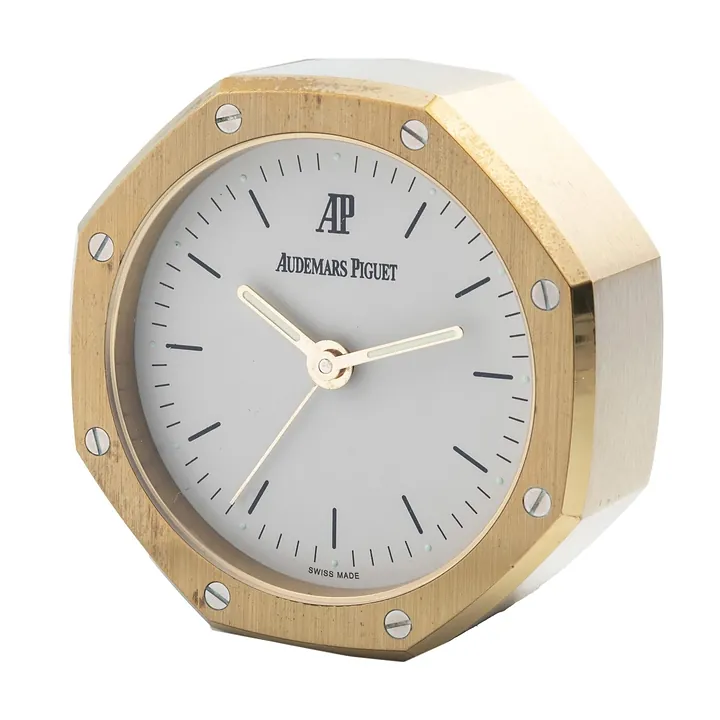
Clocks · c. 1990s
Audemars Piguet Royal Oak, c. 1990s
Antiquorum auction archive, Geneva
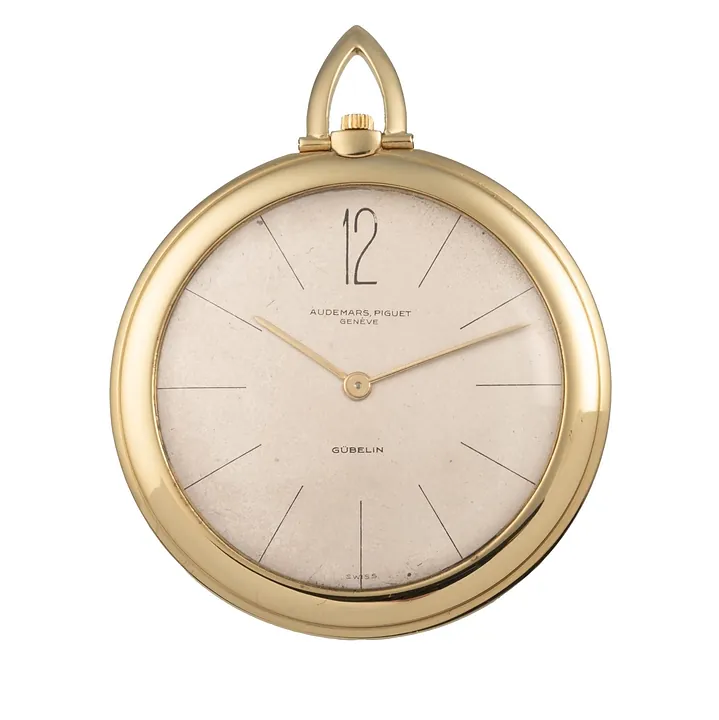
Pocket Watches · c. 1960
Audemars Piguet ''couteau'', c. 1960
Antiquorum auction archive, Geneva
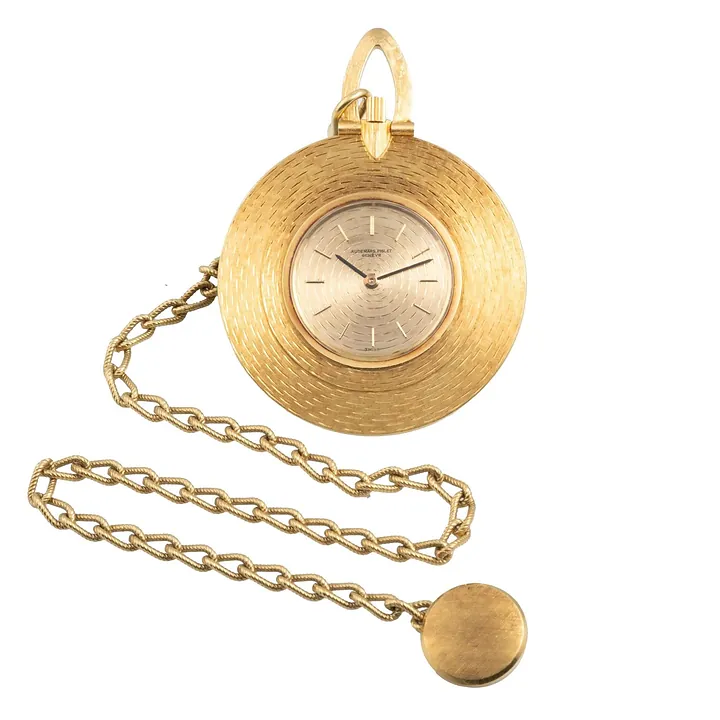
Pocket Watches · originally sold in November 1961 (per the lot record)
Audemars Piguet "extra Plate", ref. 5633 BA, originally sold in November 1961
Antiquorum auction archive, Geneva
Pocket Watches · c. 1980
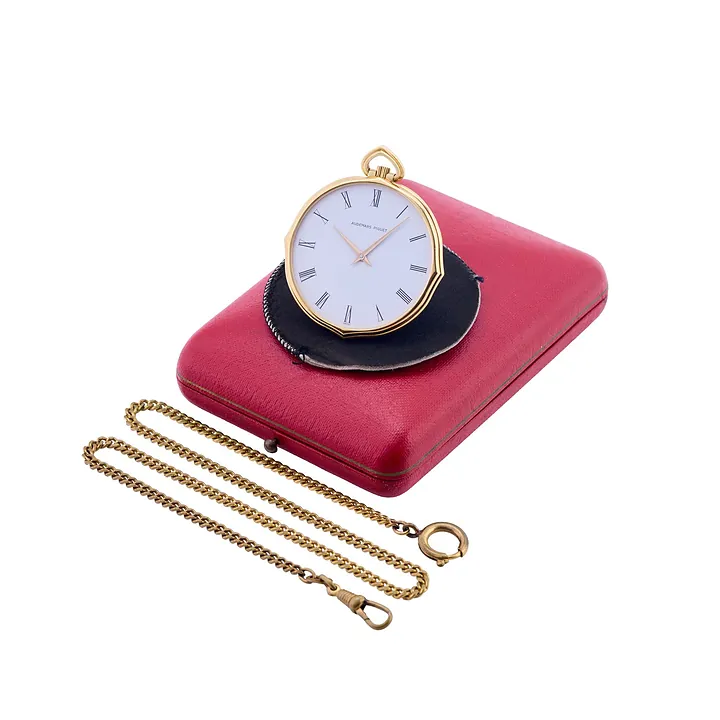
Audemars Piguet pocket watch, c. 1980
Antiquorum auction archive, Geneva

Wristwatches · 2008
Wristwatch by Breitling?, 2008
Museum Rotterdam

Wristwatches · c. 1990s
Audemars Piguet Bamboo, c. 1990s
Antiquorum auction archive, Geneva

Wristwatches · c. 1990
Audemars Piguet Huitieme Perpetual Calendar, ref. 25696PT, c. 1990
Antiquorum auction archive, Geneva

Wristwatches · c. 1990
Breitling Chronomat, ref. b13050.1, c. 1990
Antiquorum auction archive, Geneva