
Wristwatches · Wristwatch
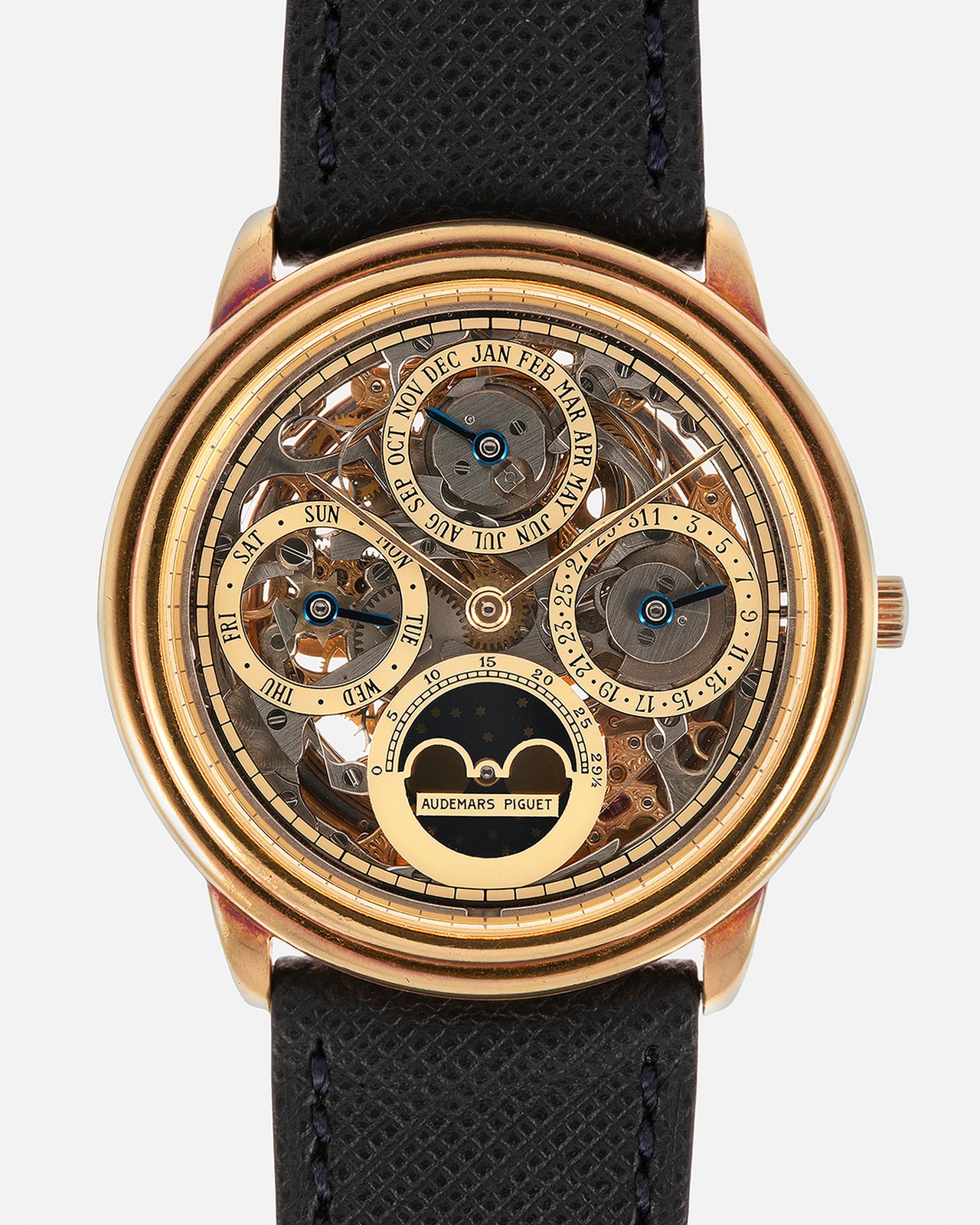
Audemars Piguet Quantieme Perpetual Openworked 25668BA, 1980s
- Maker / attribution
- Audemars Piguet (maker)
- Date
- 1980s
- Historical period
- Quartz Revolution (1969 – 1990)
- Country of origin
- Switzerland
- Object type
- Wristwatch
- Dimensions
- Case 36 mm
- Stock no.
- Product 7679762202711
- Credit line
- Dealer listing, S.Song Watches (product 7679762202711)
- Catalogue title (original)
- Audemars Piguet Quantieme Perpetual Openworked 25668BA (English)
View the source record (dealer listing) ↗ (opens another website in a new tab)Suggest a correction
Record summary
Catalogued by S.Song Watches (dealer), Seattle (stock number Product 7679762202711), this is a wristwatch by Audemars Piguet, made in Switzerland, dated 1980s. The Atlas places it in the Quartz Revolution period (1969 – 1990) of its Wristwatches collection. Recorded dimensions: Case 36 mm. The record is illustrated with 6 photographs.
Assembled from the source record's structured fields. Dates and attributions are given as the source states them; where a field is missing the Atlas leaves it blank rather than estimating.
Catalogue description
Dealer description — S.Song Watches
Famed for its legendary avant-garde designs and uncanny ability to chart its own course, Audemars Piguet has long been established as one of watchmaking's most influential manufactures. With a long list of industry firsts to its name, innovation has always been central to the brand's identity. When Audemars Piguet introduced the Perpetual Calendar Openworked Ref. 25668BA in 1988, it further reinforced that reputation. Produced until 1993, the Ref. 25668 was made in just 205 examples, of which only 94 were cased in 18-carat yellow gold, like the example offered here. This reference combines two disciplines that Audemars Piguet has long championed: the perpetual calendar and the art of open-working. Given the immense technical precision, craftsmanship and hand-finishing required to produce each watch, it is no surprise that the Ref. 25668BA remains as rare and desirable as it is today. At the heart of the watch lies its beautifully open-worked dial, which showcases the perpetual calendar mechanism in full view. Blued steel hands indicate the calendar functions, while a striking moon phase display occupies the 6 o'clock position. The hours and minutes are displayed via matching yellow gold hands, creating a pleasing contrast against the intricately skeletonised movement beneath. Despite the complexity of its construction, the watch remains remarkably legible. Powering the Ref. 25668BA is the automatic Cal. 2120, one of Audemars Piguet's most historically significant movements. Renowned for its exceptionally thin profile, the Cal. 2120 remained in production until 2022 and formed the foundation of many of the brand's most important references. As an early example from the late 1980s, this watch predates the introduction of the leap-year indicator. While this may make the perpetual calendar slightly less convenient in practical terms, collectors often favour these earlier references for their historical significance and rarity. The movement's open-worked architecture reveals an intricate network of gears, bridges, springs and plates, all meticulously hand-finished to the standards expected of a member of watchmaking's Holy Trinity. Viewed through the sapphire crystal caseback, the watch reveals another highlight: an elaborately engraved 18-carat yellow gold rotor suspended above equally ornate open-worked bridges, demonstrating the extraordinary level of attention devoted to even the smallest visible surfaces. Housed within a 36mm 18-carat yellow gold case, the Ref. 25668BA remains remarkably wearable. Its slim profile, elegant proportions and short downturned lugs allow it to sit comfortably on the wrist, while the stepped bezel adds visual depth and refinement. Combined with the endlessly fascinating open-worked movement, the result is a watch that rewards prolonged observation, continually revealing new details with every glance.
Historical context
Quartz Revolution (1969 – 1990)
Seiko's Astron begins mass quartz timekeeping; traditional industries contract sharply.
Quartz and digital watches transformed the market after 1969. Swiss employment collapsed, Japanese and Hong Kong production soared, and the Swatch (1983) helped the Swiss industry recover; mechanical watches survived as luxury goods.
Read the period in the timelineMore wristwatches from this periodEarlier: Modern Mechanical Horology
Atlas type guide
Calendar, moon-phase and perpetual calendar watches
Calendar complications range from a simple date to the perpetual calendar, which automatically allows for months of different lengths and leap years until 2100. Pocket watches with perpetual calendars were made in the eighteenth and nineteenth centuries; Patek Philippe made the first perpetual calendar wristwatch in 1925, and series production followed in 1941. The annual calendar (Patek Philippe, 1996) needs correction only once a year.
Moon-phase displays use a disc with two moons and 59 teeth advanced daily, approximating the 29.5-day lunation; more precise trains reduce the error to one day in over a century.
What to look for
- Apertures or subsidiary dials for day, date, month and leap year.
- Moon disc under a 'bosom' shaped aperture.
- Recessed correctors on the case band for setting the calendar.
Dating clues
- Triple-date wristwatches: popular c. 1940–1955.
- Perpetual calendar wristwatches: from 1925 (unique) and 1941 (series).
General guidance written by the Atlas editors about this kind of object. It is not a statement about this particular piece; for that, rely on the source record above and on physical examination.
Related records

Clocks · c. 1990s
Audemars Piguet Royal Oak, c. 1990s
Antiquorum auction archive, Geneva

Pocket Watches · c. 1960
Audemars Piguet ''couteau'', c. 1960
Antiquorum auction archive, Geneva
Pocket Watches · originally sold in November 1961 (per the lot record)
Audemars Piguet "extra Plate", ref. 5633 BA, originally sold in November 1961
Antiquorum auction archive, Geneva

Pocket Watches · c. 1980
Audemars Piguet pocket watch, c. 1980
Antiquorum auction archive, Geneva

Wristwatches · 1970
Wristwatch by Heno, Switzerland, 1970
Museum Rotterdam

Wristwatches · 1960–1986
'Tri-Compax' calendar chronograph wristwatch in gold case, by Universal, Geneva, Switzerland, 1960–1986.
Science Museum Group, London

Wristwatches · 1969–1970
Beta 21 Quartz wristwatch movement, made in Switzerland, 1970.
Science Museum Group, London

Wristwatches · c. 1969
Omega Speedmaster Moonwatch, ref. 145022-69st, c. 1969
Antiquorum auction archive, Geneva