
Wristwatches · Wristwatch
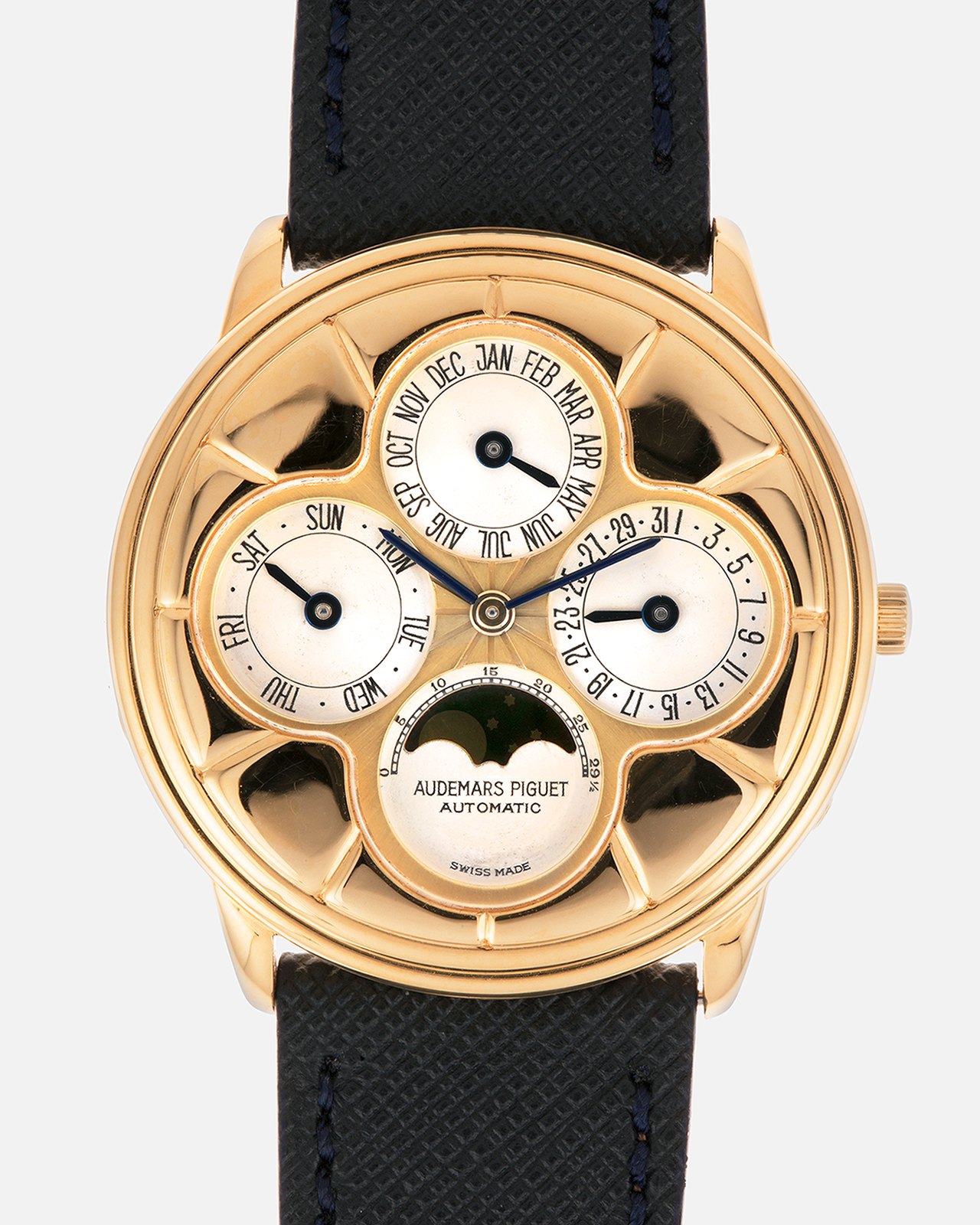
Audemars Piguet Quantieme Perpetual Calendar 25681BA ‘Clover’, 1980s
- Maker / attribution
- Audemars Piguet (maker)
- Date
- 1980s
- Historical period
- Quartz Revolution (1969 – 1990)
- Country of origin
- Switzerland
- Object type
- Wristwatch
- Dimensions
- Case 36 mm
- Stock no.
- Product 7692531499095
- Credit line
- Dealer listing, S.Song Watches (product 7692531499095)
- Catalogue title (original)
- Audemars Piguet Quantieme Perpetual Calendar 25681BA ‘Clover’ (English)
View the source record (dealer listing) ↗ (opens another website in a new tab)Suggest a correction
Record summary
Catalogued by S.Song Watches (dealer), Seattle (stock number Product 7692531499095), this is a wristwatch by Audemars Piguet, made in Switzerland, dated 1980s. The Atlas places it in the Quartz Revolution period (1969 – 1990) of its Wristwatches collection. Recorded dimensions: Case 36 mm. The record is illustrated with 6 photographs.
Assembled from the source record's structured fields. Dates and attributions are given as the source states them; where a field is missing the Atlas leaves it blank rather than estimating.
Catalogue description
Dealer description — S.Song Watches
Over the following decade, the Quantième Perpétuel became a platform for experimentation, giving rise to approximately 70 different references and more than 200 documented variations. Among them, few are as memorable as the Ref. 25681. Better known among collectors as the "Clover", or sometimes Quadrifoglio (Italian for "four-leaf clover"), current research suggests that only 123 examples were produced between 1988 and 1991 across all metals, with just 82 cased in 18-carat yellow gold like the example presented here. Like every other example, it is individually numbered on its caseback. It doesn't take long to understand how the 25681 earned its "Clover" nickname. Building upon the Quantième Perpétuel aesthetic first developed by Jacqueline Dimier, one of Audemars Piguet's most influential designers of the period, who worked closely with Gérald Genta early in her career, the 25681 arranges its oversized calendar registers into a symmetrical four-leaf formation that immediately draws the eye. With the dial almost entirely concealed beneath a solid gold plate, only the four calendar subdials and the hour and minute hands remain visible. Fine engraved lines radiating across the gold surface serve as discreet hour markers, ensuring legibility without disrupting the purity of the composition. While this is undoubtedly a highly complicated watch, it is the design surrounding the complication that defines the beauty of the 25681BA. Many four-register calendar watches have been made, but arguably none possesses quite the same visual identity. The month display sits at 12 o'clock, the date at 3, the moon phase at 6, and the day at 9, creating an intuitive layout that feels every bit as balanced as it is practical. Delicate engraved lines radiate from the central pinion, forming an almost floral composition before flowing seamlessly into the surrounding case and reinforcing the distinctive clover-shaped motif. Blued sword-style hands provide a striking contrast against the gold dial, while the circular-grained sub-registers introduce welcome depth and texture. Unlike many perpetual calendars of the era, which favoured restraint above all else, the 25681 proved that decoration and legibility need not be mutually exclusive. Beneath that distinctive dial sits the automatic Cal. 2120/2, a perpetual calendar movement built upon Audemars Piguet's legendary ultra-thin Cal. 2120. Renowned for its slim construction, reliability, and refined finishing, it remains one of the manufacture's finest automatic movements of the period. As this reference predates the introduction of a leap-year indicator, it also preserves the clean four-register layout that many collectors continue to favour for its exceptional balance and symmetry. Housed within an elegant 36mm by 8mm 18-carat yellow gold case, the 25681 wears every bit as gracefully as its proportions suggest. Its slim profile, stepped bezel, and gently curved lugs allow the dial to remain the centre of attention, while the warmth of the aged yellow gold beautifully complements the display beneath its distinctive clover-shaped crystal. More than three decades after its introduction, the Clover remains a reminder that some of Audemars Piguet's most memorable watches are not necessarily those with the longest list of complications, but those with the confidence to present them differently. While its perpetual calendar is every bit as technically accomplished as its contemporaries, it is the watch's unmistakable character that continues to leave the strongest impression. For collectors willing to look beyond the Royal Oak, the Ref. 25681 remains one of the manufacture's most intriguing and charming creations.
Historical context
Quartz Revolution (1969 – 1990)
Seiko's Astron begins mass quartz timekeeping; traditional industries contract sharply.
Quartz and digital watches transformed the market after 1969. Swiss employment collapsed, Japanese and Hong Kong production soared, and the Swatch (1983) helped the Swiss industry recover; mechanical watches survived as luxury goods.
Read the period in the timelineMore wristwatches from this periodEarlier: Modern Mechanical Horology
Atlas type guide
Calendar, moon-phase and perpetual calendar watches
Calendar complications range from a simple date to the perpetual calendar, which automatically allows for months of different lengths and leap years until 2100. Pocket watches with perpetual calendars were made in the eighteenth and nineteenth centuries; Patek Philippe made the first perpetual calendar wristwatch in 1925, and series production followed in 1941. The annual calendar (Patek Philippe, 1996) needs correction only once a year.
Moon-phase displays use a disc with two moons and 59 teeth advanced daily, approximating the 29.5-day lunation; more precise trains reduce the error to one day in over a century.
What to look for
- Apertures or subsidiary dials for day, date, month and leap year.
- Moon disc under a 'bosom' shaped aperture.
- Recessed correctors on the case band for setting the calendar.
Dating clues
- Triple-date wristwatches: popular c. 1940–1955.
- Perpetual calendar wristwatches: from 1925 (unique) and 1941 (series).
General guidance written by the Atlas editors about this kind of object. It is not a statement about this particular piece; for that, rely on the source record above and on physical examination.
Related records

Clocks · c. 1990s
Audemars Piguet Royal Oak, c. 1990s
Antiquorum auction archive, Geneva

Pocket Watches · c. 1960
Audemars Piguet ''couteau'', c. 1960
Antiquorum auction archive, Geneva
Pocket Watches · originally sold in November 1961 (per the lot record)
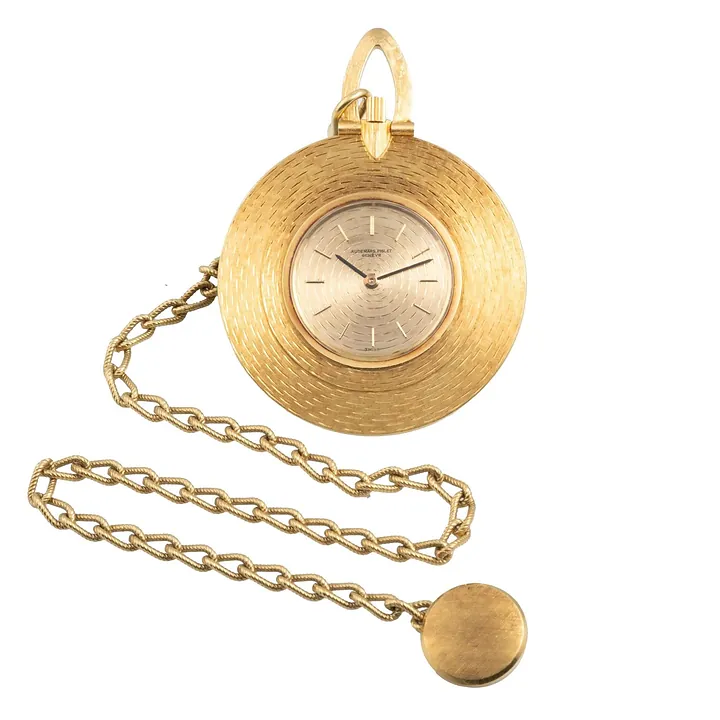
Audemars Piguet "extra Plate", ref. 5633 BA, originally sold in November 1961
Antiquorum auction archive, Geneva

Pocket Watches · c. 1980
Audemars Piguet pocket watch, c. 1980
Antiquorum auction archive, Geneva

Wristwatches · 1970
Wristwatch by Heno, Switzerland, 1970
Museum Rotterdam

Wristwatches · 1960–1986
'Tri-Compax' calendar chronograph wristwatch in gold case, by Universal, Geneva, Switzerland, 1960–1986.
Science Museum Group, London

Wristwatches · 1969–1970
Beta 21 Quartz wristwatch movement, made in Switzerland, 1970.
Science Museum Group, London

Wristwatches · c. 1969
Omega Speedmaster Moonwatch, ref. 145022-69st, c. 1969
Antiquorum auction archive, Geneva