
Wristwatches · Wristwatch
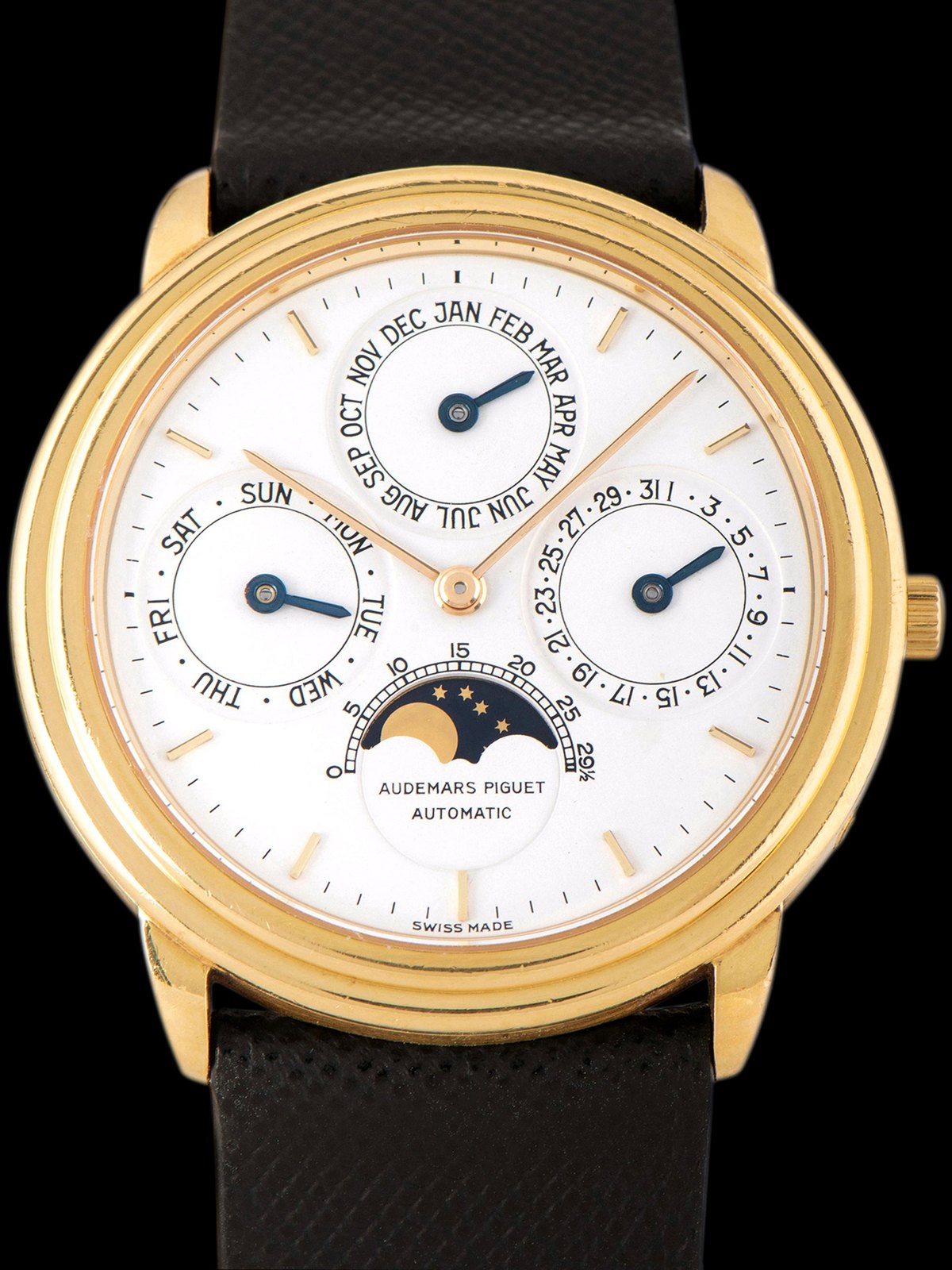
Audemars Piguet Quantième Perpetual Calendar 18K YG (Ref. 25661BA) "Cal. 2120/2800", 1990s
- Maker / attribution
- Audemars Piguet (maker)
- Date
- 1990s
- Historical period
- Mechanical Renaissance (1990 – 2010)
- Country of origin
- Switzerland
- Object type
- Wristwatch
- Dimensions
- Case 95 mm
- Stock no.
- APQP25661BA
- Credit line
- Dealer listing, Craft & Tailored (APQP25661BA)
- Catalogue title (original)
- 1990s Audemars Piguet Quantième Perpetual Calendar 18K YG (Ref. 25661BA) "Cal. 2120/2800" (English)
View the source record (dealer listing) ↗ (opens another website in a new tab)Suggest a correction
Record summary
Catalogued by Craft & Tailored (dealer), Los Angeles (stock number APQP25661BA), this is a wristwatch by Audemars Piguet, made in Switzerland, dated 1990s. The Atlas places it in the Mechanical Renaissance period (1990 – 2010) of its Wristwatches collection. Recorded dimensions: Case 95 mm. The record is illustrated with 6 photographs.
Assembled from the source record's structured fields. Dates and attributions are given as the source states them; where a field is missing the Atlas leaves it blank rather than estimating.
Catalogue description
Dealer description — Craft & Tailored
Although Audemars Piguet may be best known for their Royal Oak series, notably designed by Gerald Genta, Audemars Piguet has a long lineage of interesting timepieces both before the conceptualization of the Royal Oak and after. Primarily consisting of unique chronographs, complex calendars, and charming dress models that were both stylistically and mechanically very ahead of their time. Considering the climate of wristwatches in the late 1970s, at the height of the quartz crisis, the concept of designing and manufacturing a mechanically innovative watch was all but lost for most watch brands. Amidst this turmoil, Audemars Piguet seized an opportunity to create, in secret, one of the greatest achievements in horological history. Enter the Caliber 2120/2800 — an automatic winding, ultra-thin, perpetual calendar movement, measuring only a mere 3.95mm in height. This movement was based on the ultra-thin caliber 2120 created in 1967 and utilized in several iconic models such as the Royal Oak, Nautilus, and the 222, but was heavily modified to incorporate the perpetual calendar complication. This caliber was initially introduced in 1978 with the model 5548, the original Quantième Perpetual model, and was designed by the protege of Gerald Genta, Jaqulin Dimmer. The Quantième Perpetual quickly evolved through the 80s and 90s, however each model was produced in very limited quantities. It’s known that 7219 cal. 2120/2800 movements were created over the 15-year production period of the movement. The Audemars Piguet Quantième Perpetual ref. 25661 was the first model to feature a sapphire crystal display case back, showcasing the exceptionally finished cal. 2120/2800 movement, and was produced from 1985 to 1994 in an extremely limited quantity of 342 pieces, 244 of which were in yellow gold. Stock # APQP25661BA Brand Audemars Piguet Style Quantième Perpetual Calendar Model 25661BA Serial C8XXXX / No. 16X Size Men's Material 18K Yellow Gold Dial White "Small Font" Millimeters 36 Strap 2pc Handmade Leather Strap CASE & BRACELET The exceptional 18K yellow gold case exhibits only gentle signs of previous polishing while maintaining thick and symmetrical lugs, and deep hallmarks, with light signs of use present. The case retains its original unsigned crown. The sapphire case back is in excellent condition and displays the beautiful cal. 2120/2800 movement. The hallmarks and factory engravings remain extremely crisp and deep in the case back as well. The watch comes supplied on a 2pc handmade leather strap. DIAL & HANDS The original white "small font" dial featuring the characteristic sunken sub-dials is exceptionally well-preserved and in virtually flawless condition, exhibiting no damage or notable elements of age. The hands all remain original to the watch and are in excellent condition. ACCESSORIES The watch is keeping time perfectly and functioning correctly. The service history is unknown. A movement service can be provided upon request.
Historical context
Mechanical Renaissance (1990 – 2010)
Mechanical watches return as cultural objects; independent watchmaking flourishes.
Mechanical watches returned as cultural and luxury objects. Complications, tourbillons and new materials proliferated; independent watchmakers such as George Daniels, F.P. Journe and Philippe Dufour revived artisanal watchmaking; collecting vintage watches became a major field.
Read the period in the timelineMore wristwatches from this periodEarlier: Quartz Revolution
Atlas type guide
Calendar, moon-phase and perpetual calendar watches
Calendar complications range from a simple date to the perpetual calendar, which automatically allows for months of different lengths and leap years until 2100. Pocket watches with perpetual calendars were made in the eighteenth and nineteenth centuries; Patek Philippe made the first perpetual calendar wristwatch in 1925, and series production followed in 1941. The annual calendar (Patek Philippe, 1996) needs correction only once a year.
Moon-phase displays use a disc with two moons and 59 teeth advanced daily, approximating the 29.5-day lunation; more precise trains reduce the error to one day in over a century.
What to look for
- Apertures or subsidiary dials for day, date, month and leap year.
- Moon disc under a 'bosom' shaped aperture.
- Recessed correctors on the case band for setting the calendar.
Dating clues
- Triple-date wristwatches: popular c. 1940–1955.
- Perpetual calendar wristwatches: from 1925 (unique) and 1941 (series).
General guidance written by the Atlas editors about this kind of object. It is not a statement about this particular piece; for that, rely on the source record above and on physical examination.
Related records
Clocks · c. 1990s
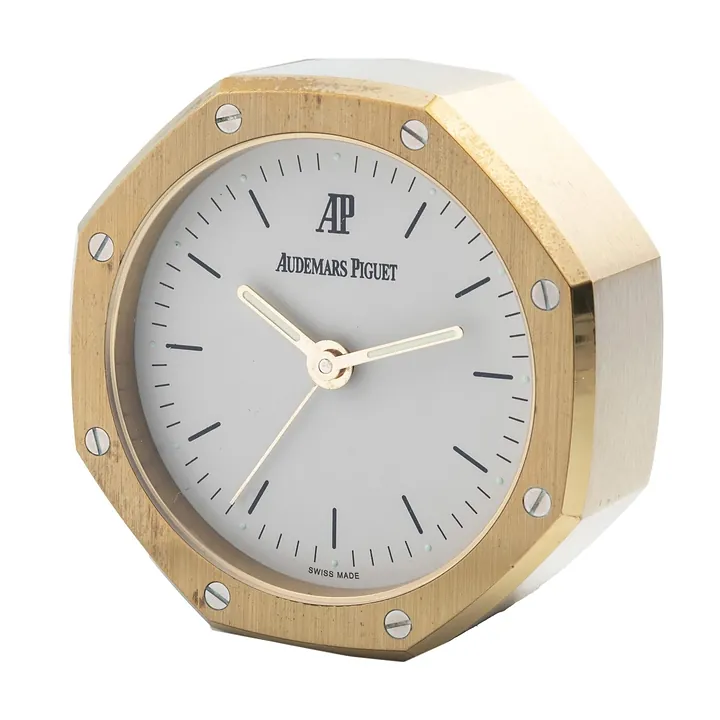
Audemars Piguet Royal Oak, c. 1990s
Antiquorum auction archive, Geneva
Pocket Watches · c. 1960
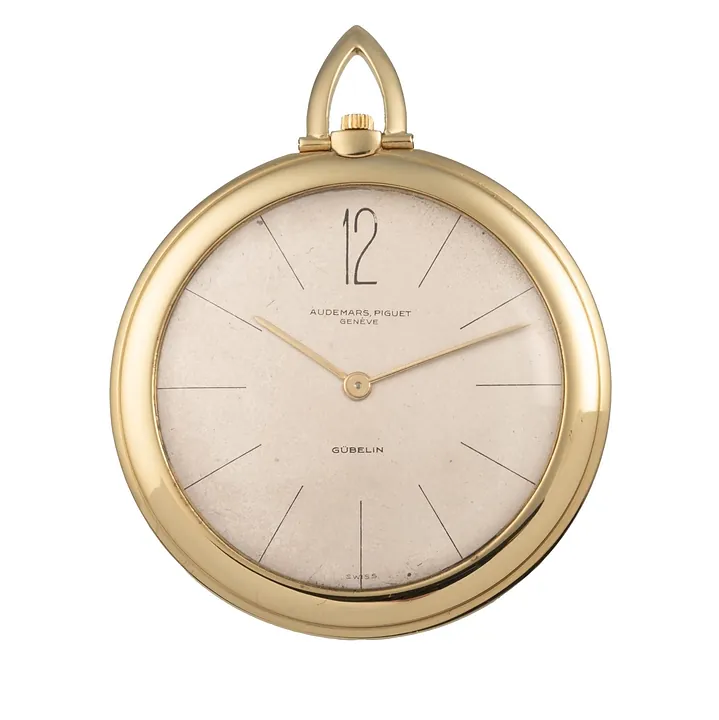
Audemars Piguet ''couteau'', c. 1960
Antiquorum auction archive, Geneva
Pocket Watches · originally sold in November 1961 (per the lot record)
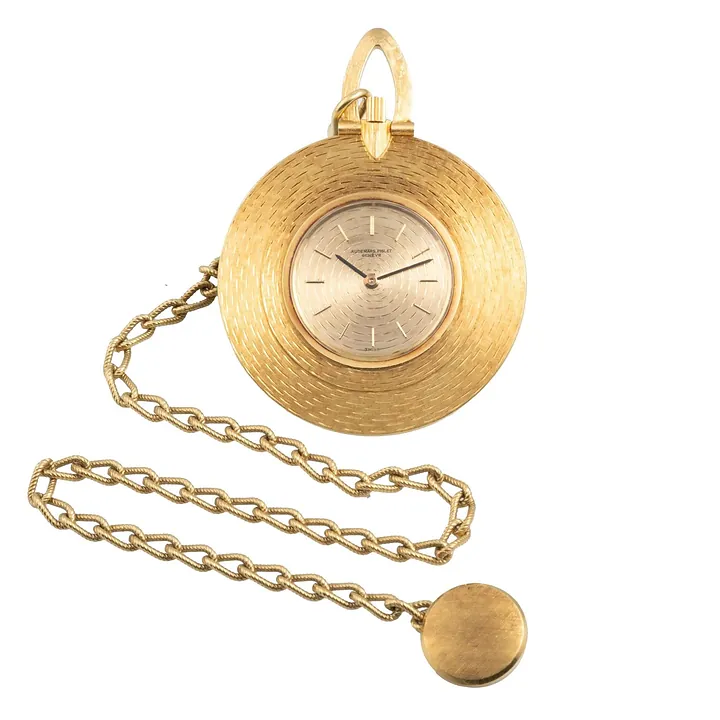
Audemars Piguet "extra Plate", ref. 5633 BA, originally sold in November 1961
Antiquorum auction archive, Geneva
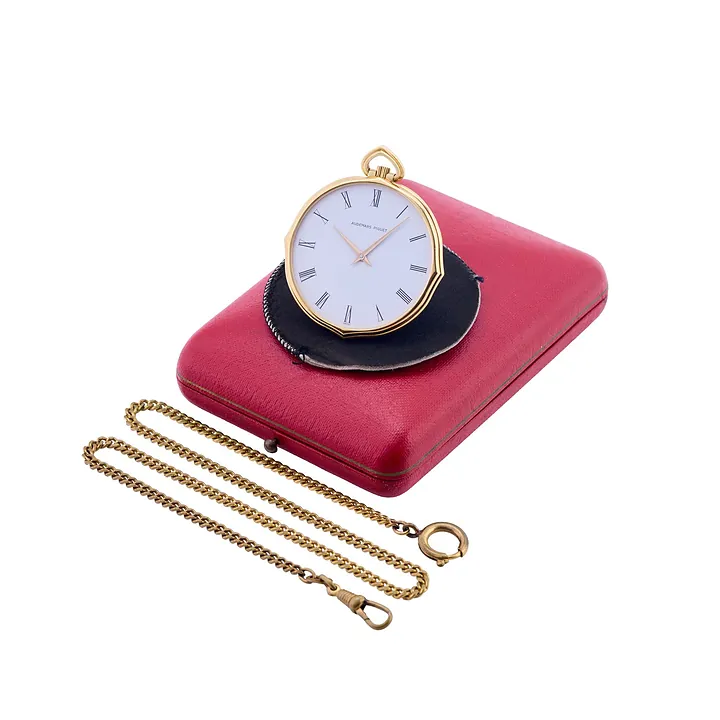
Pocket Watches · c. 1980
Audemars Piguet pocket watch, c. 1980
Antiquorum auction archive, Geneva

Wristwatches · 2008
Wristwatch by Breitling?, 2008
Museum Rotterdam

Wristwatches · c. 1990s
Audemars Piguet Bamboo, c. 1990s
Antiquorum auction archive, Geneva

Wristwatches · c. 1990
Audemars Piguet Huitieme Perpetual Calendar, ref. 25696PT, c. 1990
Antiquorum auction archive, Geneva

Wristwatches · c. 1990
Breitling Chronomat, ref. b13050.1, c. 1990
Antiquorum auction archive, Geneva