
Wristwatches · Wristwatch
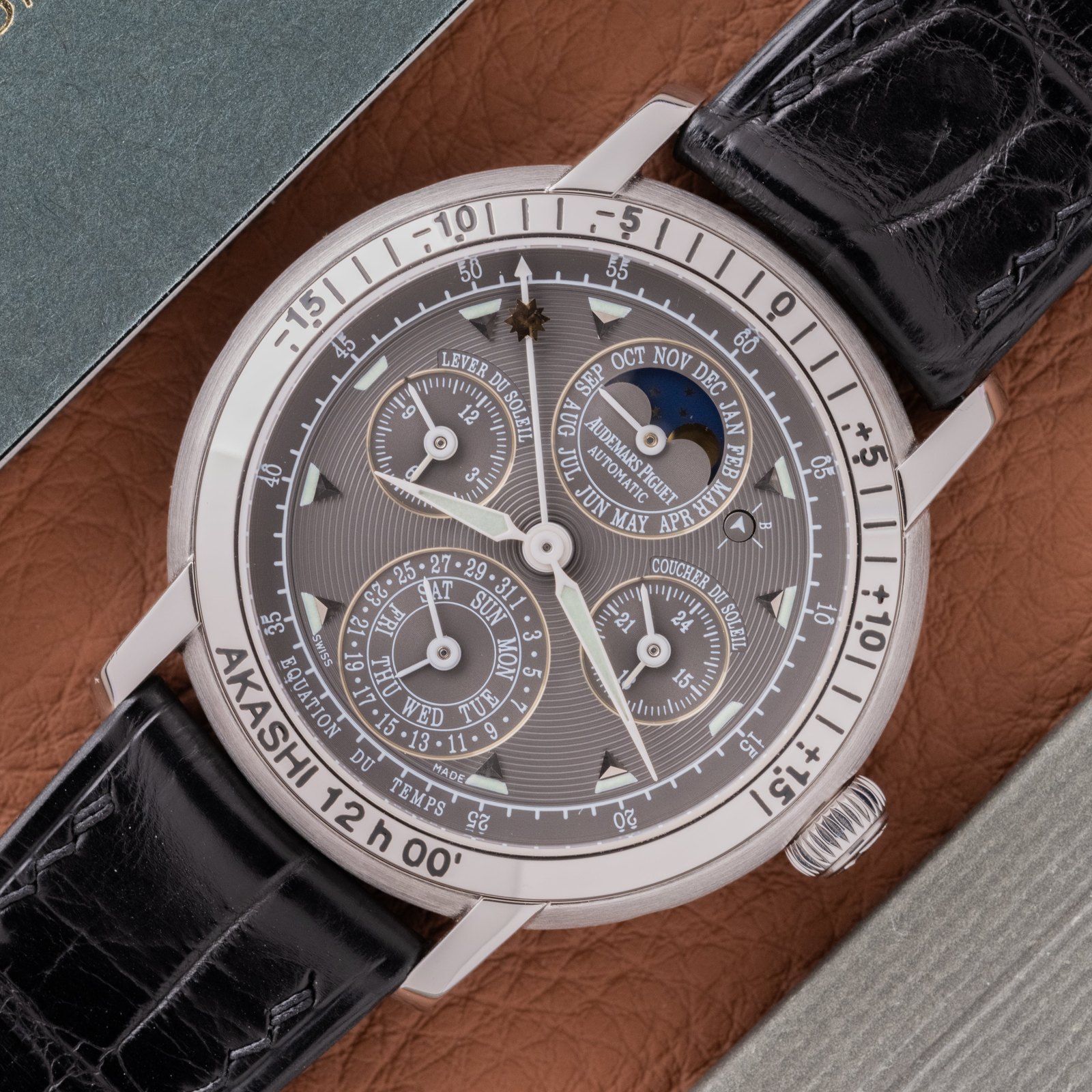
Audemars Piguet Equation of Time (Ref. 25934BC), 2005
- Maker / attribution
- Audemars Piguet (maker)
- Date
- 2005
- Historical period
- Mechanical Renaissance (1990 – 2010)
- Country of origin
- Switzerland
- Object type
- Wristwatch
- Dimensions
- Case 36 mm
- Stock no.
- Product 8566007333047
- Credit line
- Dealer listing, Huntington Company (product 8566007333047)
- Catalogue title (original)
- 2005 Audemars Piguet Equation of Time - Box and Papers (Ref. 25934BC) (English)
View the source record (dealer listing) ↗ (opens another website in a new tab)Suggest a correction
Record summary
Catalogued by Huntington Company (dealer) (stock number Product 8566007333047), this is a wristwatch by Audemars Piguet, made in Switzerland, dated 2005. The Atlas places it in the Mechanical Renaissance period (1990 – 2010) of its Wristwatches collection. Recorded dimensions: Case 36 mm. The record is illustrated with 6 photographs.
Assembled from the source record's structured fields. Dates and attributions are given as the source states them; where a field is missing the Atlas leaves it blank rather than estimating.
Catalogue description
Dealer description — Huntington Company
History and Significance The Jules Audemars collection has always represented the more classical side of Audemars Piguet, focusing on traditional watchmaking rather than the sport-oriented identity of the Royal Oak. Within that lineup, the Equation of Time is one of the most technically ambitious watches the brand has produced. This reference combines a perpetual calendar with an equation of time complication, sunrise and sunset indications, and a rotating city chapter specifically calibrated for a chosen location. In this case, the watch is configured for Akashi, Japan, which is engraved directly on the case. The equation of time complication itself measures the difference between solar time and conventional clock time, a function rooted in astronomical observation and rarely seen in modern wristwatches due to its complexity. The layout is undeniably dense, but highly intentional. Every display serves a purpose, yet the watch maintains balance through the symmetry of the subdials and the restrained black dial execution. Encased in white gold, it carries substantial weight on the wrist while remaining elegant in profile. Writer’s Thoughts This is the kind of watch that reminds you how deep traditional watchmaking can actually go. Most perpetual calendars already feel complicated enough, but the Equation of Time takes it into another category entirely. There is so much information on the dial, yet after wearing it for a bit, it starts to make sense in a surprisingly intuitive way. What I like most is that it does not feel flashy despite how complicated it is. The white gold case and grey dial keep it understated until you really start looking closely. Finding one complete with the original hang tag, pusher, service papers, and deployant makes a huge difference, especially in this condition. The sharp hallmarks on the lugs tell the story immediately. Our Promise Every watch is thoroughly vetted, carefully described with complete transparency, and guaranteed authentic. Each piece is offered in honest condition, ensuring collectors receive a timepiece that reflects both originality and integrity. Specifications Brand: Audemars Piguet Model: Jules Audemars Equation of Time (Ref. 25934BC.OO.D002CR.01) Year: circa 2000s Case Material: White gold Case Size: 36mm Bezel: White gold bezel engraved for Akashi, Japan Dial: Grey dial with perpetual calendar and equation of time displays Movement: Automatic Strap/Bracelet: Black leather strap Buckle/Clasp: Audemars Piguet white gold deployant clasp Contents: Complete set with box, papers, original hang tag, pusher, and AP service papers Condition Case: Excellent overall condition with almost no visible wear; hallmarks on the lugs remain deep and crisp. Dial: Clean with no visible imperfections or damage. Hands: Excellent condition with no visible wear. Crystal: Clean with no noticeable scratches. Strap/Bracelet: New strap fitted to the original Audemars Piguet deployant clasp.
Historical context
Mechanical Renaissance (1990 – 2010)
Mechanical watches return as cultural objects; independent watchmaking flourishes.
Mechanical watches returned as cultural and luxury objects. Complications, tourbillons and new materials proliferated; independent watchmakers such as George Daniels, F.P. Journe and Philippe Dufour revived artisanal watchmaking; collecting vintage watches became a major field.
Read the period in the timelineMore wristwatches from this periodEarlier: Quartz Revolution
Atlas type guide
Calendar, moon-phase and perpetual calendar watches
Calendar complications range from a simple date to the perpetual calendar, which automatically allows for months of different lengths and leap years until 2100. Pocket watches with perpetual calendars were made in the eighteenth and nineteenth centuries; Patek Philippe made the first perpetual calendar wristwatch in 1925, and series production followed in 1941. The annual calendar (Patek Philippe, 1996) needs correction only once a year.
Moon-phase displays use a disc with two moons and 59 teeth advanced daily, approximating the 29.5-day lunation; more precise trains reduce the error to one day in over a century.
What to look for
- Apertures or subsidiary dials for day, date, month and leap year.
- Moon disc under a 'bosom' shaped aperture.
- Recessed correctors on the case band for setting the calendar.
Dating clues
- Triple-date wristwatches: popular c. 1940–1955.
- Perpetual calendar wristwatches: from 1925 (unique) and 1941 (series).
General guidance written by the Atlas editors about this kind of object. It is not a statement about this particular piece; for that, rely on the source record above and on physical examination.
Related records
Clocks · c. 1990s
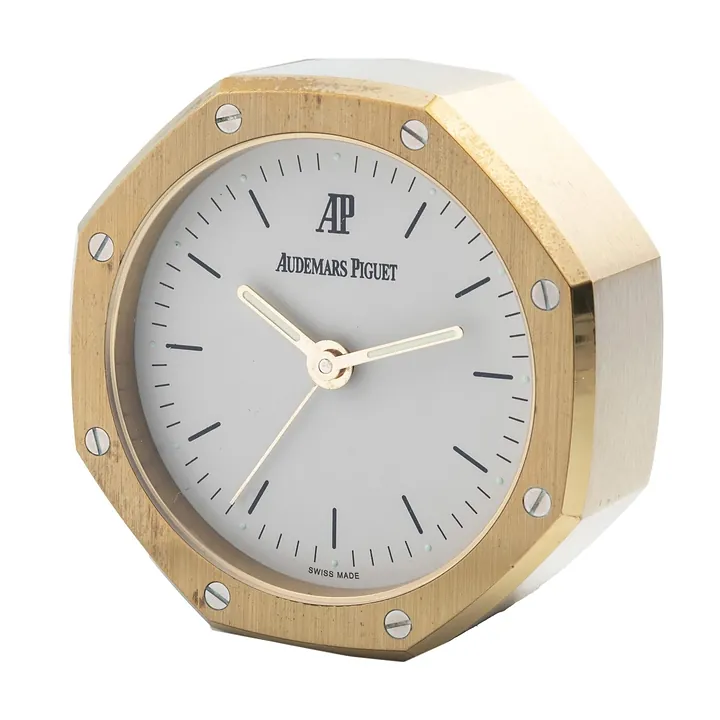
Audemars Piguet Royal Oak, c. 1990s
Antiquorum auction archive, Geneva
Pocket Watches · c. 1960
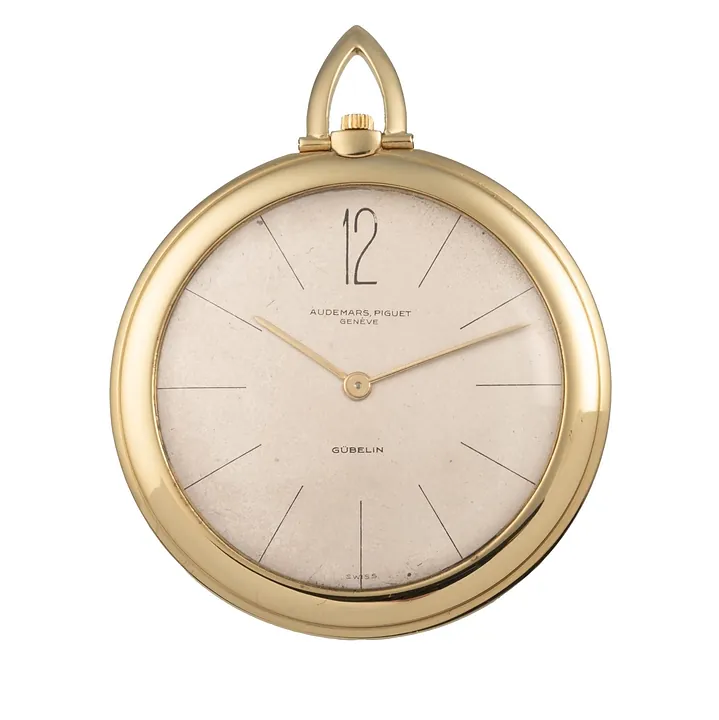
Audemars Piguet ''couteau'', c. 1960
Antiquorum auction archive, Geneva
Pocket Watches · originally sold in November 1961 (per the lot record)
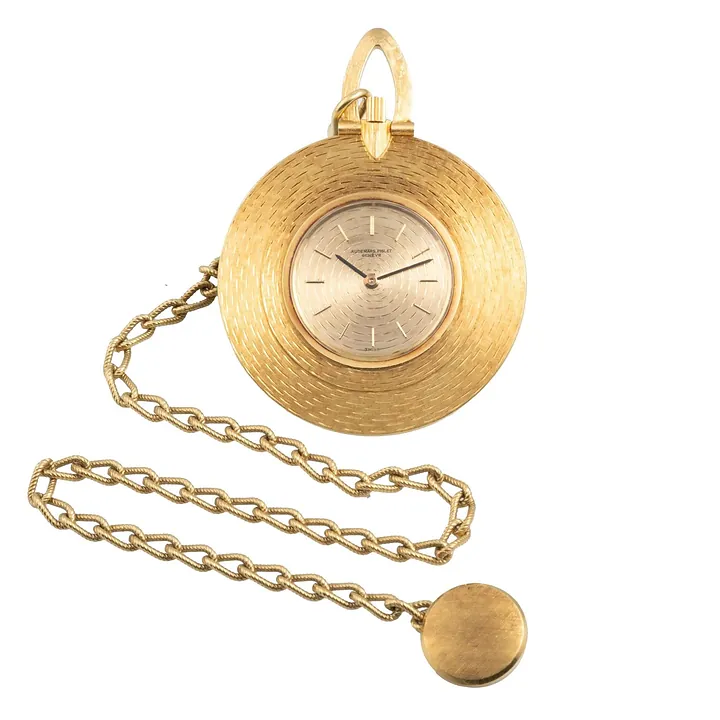
Audemars Piguet "extra Plate", ref. 5633 BA, originally sold in November 1961
Antiquorum auction archive, Geneva
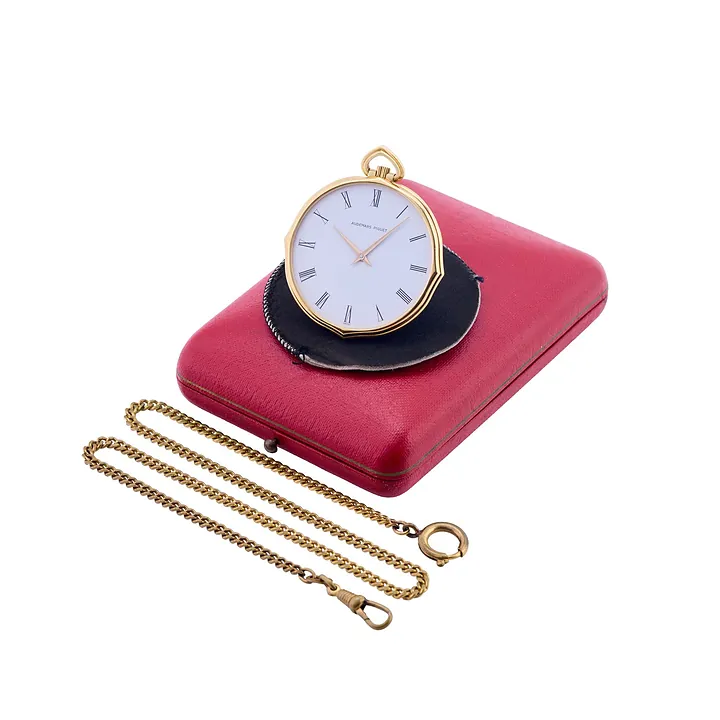
Pocket Watches · c. 1980
Audemars Piguet pocket watch, c. 1980
Antiquorum auction archive, Geneva

Wristwatches · 2008
Wristwatch by Breitling?, 2008
Museum Rotterdam

Wristwatches · c. 1990s
Audemars Piguet Bamboo, c. 1990s
Antiquorum auction archive, Geneva

Wristwatches · c. 1990
Audemars Piguet Huitieme Perpetual Calendar, ref. 25696PT, c. 1990
Antiquorum auction archive, Geneva

Wristwatches · c. 1990
Breitling Chronomat, ref. b13050.1, c. 1990
Antiquorum auction archive, Geneva