
Clocks · Astronomical regulator
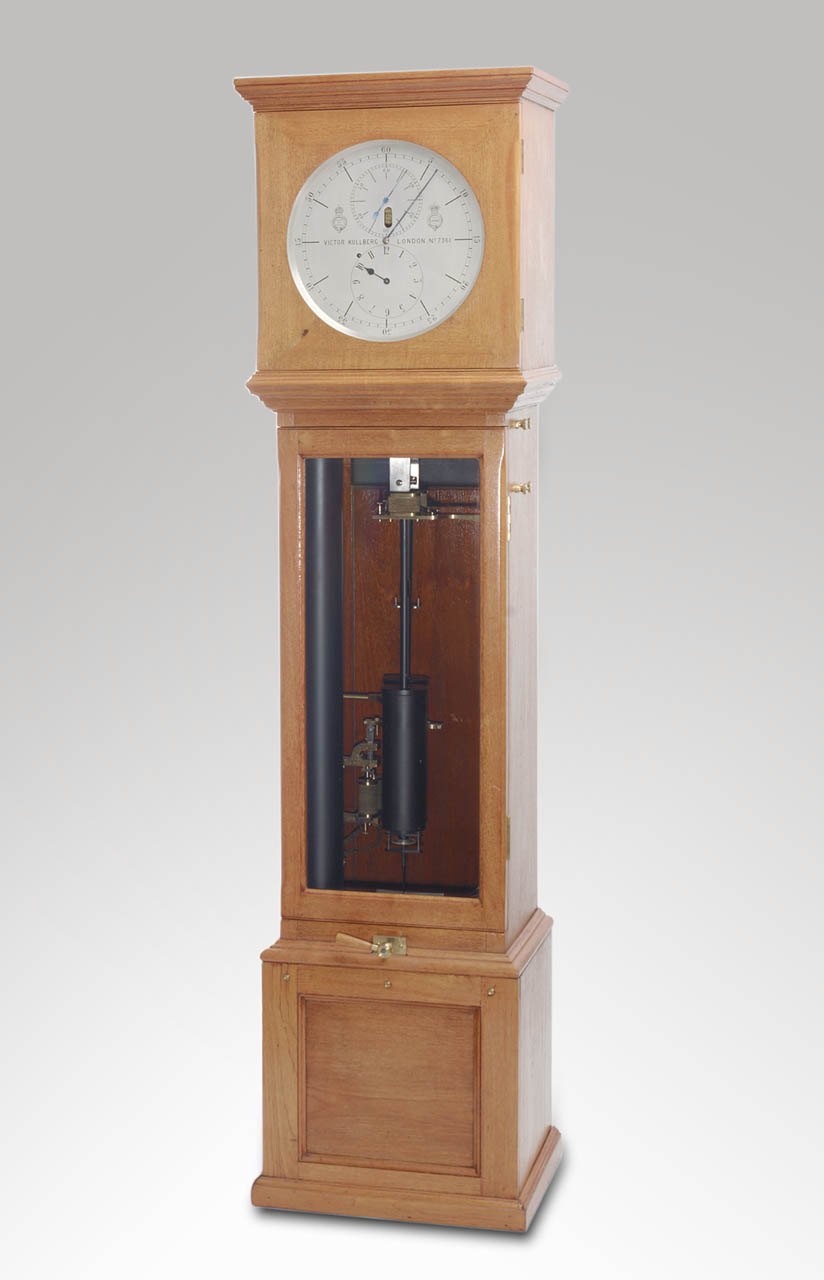
Astronomical regulator no. 7361 by Victor Kullberg
- Maker / attribution
- Victor Kullberg (maker)
- Date
- 1904
- Historical period
- Golden Age of Mechanical Watchmaking (1900 – 1945)
- Country of origin
- England
- Object type
- Astronomical regulator
- Materials / technique
- teak; brass; iron; glass; steel; lead; silver; jewels
- Dimensions
- Overall: 1915 mm x 495 mm x 418 mm
- Holding institution
- Royal Museums Greenwich
- Accession / object no.
- ZBA7911
- Credit line
- National Maritime Museum, Greenwich, London
- Catalogue title (original)
- 7361 (English)
View the source record ↗ (opens another website in a new tab)Suggest a correction
Record summary
Held and catalogued by Royal Museums Greenwich (object number ZBA7911), this is an astronomical regulator by Victor Kullberg, made in England, dated 1904. The Atlas places it in the Golden Age of Mechanical Watchmaking period (1900 – 1945) of its Clocks collection. Materials and techniques recorded by the source: teak; brass; iron; glass; steel; lead; silver; jewels. Recorded dimensions: Overall: 1915 mm x 495 mm x 418 mm. The record is illustrated with 6 photographs.
Assembled from the source record's structured fields. Dates and attributions are given as the source states them; where a field is missing the Atlas leaves it blank rather than estimating.
Catalogue description
Catalogue description — Royal Museums Greenwich
An astronomical regulator with a floor-standing case and hood made of teak. The trunk and hood have hinged, glazed, lockable doors. There is one pair of screwed electrical terminals on the left flank of the trunk, and two pairs on the right flank. Just below the centre of the trunk door is a manually operated lever for re-setting the auxiliary pendulum. The 337 mm diameter silvered brass dial with separate silvered sight ring is laid out in a regulator style. It has concentric Arabic five-minute numerals outside a minute-track and internal observatory marks at five-minute intervals. The subsidiary seconds dial above the centre has Arabic ten-second numerals inside a seconds track with observatory marks at five-second intervals. The subsidiary hour dial below the centre has Arabic one to 12 hour numerals within a circle. The winding aperture is at the 41-minute position, 52 mm from the dial centre. There is an oblong aperture within the seconds dial for observing the adjustment of electrical contacts on the movement. The dial is signed across the centre 'VICTOR KULLBERG LONDON. NO 7361'. There are engraved medals 'TO HM THE KING OF SWEDEN AND NORWAY' AND 'GRAND PRIX PARIS 1900'. The dial is screwed to a brass false plate, which is in turn screwed to four substantial tapering brass dial feet screwed to the movement front plate. All three hands are of blued steel, the minute and hour hands are riveted to brass collets and the second hand is screwed to its collet. The minute hand is internally counterpoised and is retained by a brass collet and taper pin. The seconds hand has an integral counterpoise. Both seconds and hour hands are a friction fit on their respective arbors. The frame consists of a pair of 261 x 195 mm rectangular brass plates, separated by six substantial tapering brass pillars. The frame is held together by large, brass screws and washers. The plates have a curled finish. The movement is secured to a massive cast iron support combined movement and pendulums support by four large brass and steel knurled screws threading into two L-shaped brass brackets screwed to the back of each plate. The four-wheel, eight-day duration train has Harrison's maintaining power acting on the great wheel, and stop-work in the form of a sliding, sprung stop-piece screwed to the front flange of the barrel. This engages with a steel stud screwed to the inside of the front plate when activated by the weight line. The centre wheel is screwed to a collet adjacent to the pinion. The centre arbor has an extended front pivot carrying the minute hand, and driving the motion work. The third wheel is retained in a similar way. The escape is screwed to a collet. The front escape pivot runs in a cock screwed to the outside of the front plate. The jewelled dead-beat pallets are steel and screwed to a collet on their arbor, the front pivot of which runs in a block screwed inside the front plate. The pallet arbor also carries a brass frame for beat adjusting. The steel crutch has a brass fork. The rear centre wheel pivot and both third wheel pivots are fitted with adjustable steel endstops screwed into large brass holders screwed to the plates. The escape and pallet arbor pivots run in screwed, jewelled holes, with screwed end stones to pallet and rear escape pivots. A cannon wheel carried on the extended centre arbor, which drives an intermediate wheel and pinion carried on a stud screwed into the front plate, drives the wheel carrying the hour hand, also carried on a stud on the front plate. Notched disks screwed to the canon wheel and hour wheel control the action of an electrical contact (described below). The clock is driven by a cylindrical, brass cased lead weight (approximately 2.5 kg), suspended from a brass pulley and stirrup. The grooved winding barrel has a keyhole aperture to facilitate replacement of the weight line. A jockey barrel pivoted between the plates draws the driving weight to the left hand side of the case. The weight descends within a matt-black painted steel tube screwed to the side of the case within the trunk door. The concentric tubular zinc and steel temperature compensated pendulum has a cylindrical, matt-black painted brass cased bob with a graduated, silvered rating nut. A steel pointer screwed to the bottom of the rod indicates amplitude on a silvered scale screwed to the base of the case. The movement is fitted with three sets of electrical contacts, two of which are mounted on a dovetail slide screwed to the front, upper right hand side of the front plate. These contacts can be set to close once every minute, and once every hour respectively, by steel contact arms carrying cylindrical jewels mounted on the seconds and minute arbors. Simultaneous closure of both contacts make a circuit on the hour, every hour. The third pair of contacts is mounted on a brass arm pivoted between the movement plates. The position of this arm is controlled by a second arm, also pivoted between the plates that shares a common arbor with an arm mounted outside the front plate. The front plate carries a steel 'V' and a brass roller. The position of this arm, and therefore the internal contact, is controlled by notched discs screwed to the cannon wheel and hour wheel. Once every 12 hours, the notches in the two discs coincide with the positions of the steel 'V' and brass roller, allowing the arm and the internal arm carrying the third contact to drop slightly, and for the contact to come into the path of a second jewelled contact arm mounted on the seconds arbor. This contact arm is set at a position 20 seconds (120°) behind the first jewelled contact arm (this produced a return impulse to the site of the master clock to show the error of the remote clock after correction). Screwed inside the right hand side of the trunk, approximately in line with the centre of the pendulum, is a brass frame that supports a pair of electro-magnetic coils that embrace the pendulum but allow it to swing freely. Thes
Historical context
Golden Age of Mechanical Watchmaking (1900 – 1945)
The wristwatch displaces the pocket watch; waterproof cases, self-winding and grand complications.
Between 1900 and 1945 clocks were electrified: master-clock systems ran factories and offices, synchronous mains clocks entered homes, and the Shortt free-pendulum clock set new standards of accuracy before the first quartz clocks (1927). Art Deco design reshaped mantel and table clocks.
Read the period in the timelineMore clocks from this periodEarlier: Industrial Revolution
Atlas type guide
Regulators, wall and Vienna clocks
A regulator is a precision pendulum clock used as a time standard in observatories, workshops and railway offices. Typical features are a deadbeat or Graham escapement, a temperature-compensated pendulum (mercury jar, gridiron or later invar), maintaining power and a regulator dial that separates hours, minutes and seconds. George Graham's deadbeat escapement (c. 1715) and his mercury pendulum, together with Harrison's gridiron, set the pattern for two centuries.
Wall clocks span a much wider range: the elegant Viennese Laterndluhr and Dachluhr of the Biedermeier period, the Dutch stoelklok and staartklok, English 'dial' clocks used in schools, offices and railway stations, and mass-produced spring and weight wall clocks from Germany (Gustav Becker, Junghans, Kienzle) and America.
What to look for
- Deadbeat escapement and compensated pendulum (gridiron rods, mercury jar or wood rod).
- A regulator dial with a large central minute hand and separate hour and seconds dials.
- Vienna regulators: glazed cases, slender pendulum, small weights, enamel two-piece dials.
- German factory trademarks stamped on the backplate (e.g. Gustav Becker anchor and crown, Junghans star).
Dating clues
- Graham-type deadbeat regulators: from c. 1720.
- Viennese Laterndluhr: c. 1800–1850.
- German factory 'Vienna-style' regulators: c. 1870–1930; Gustav Becker serial numbers allow close dating.
General guidance written by the Atlas editors about this kind of object. It is not a statement about this particular piece; for that, rely on the source record above and on physical examination.
Read next:Deadbeat escapementAnchor (recoil) escapementGrasshopper escapement
Related records
Instruments · 1870–1877
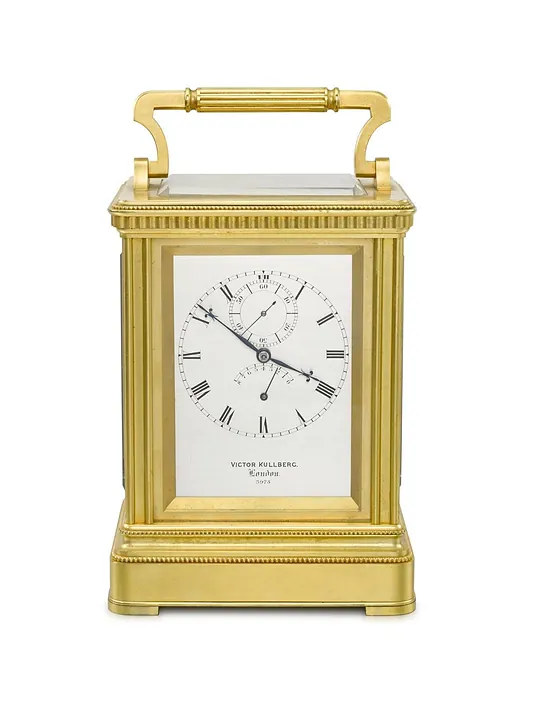
Chronometer by Victor Kullberg, England, 1870–1877
Science Museum Group, London
Movements & Components · 1860–1880
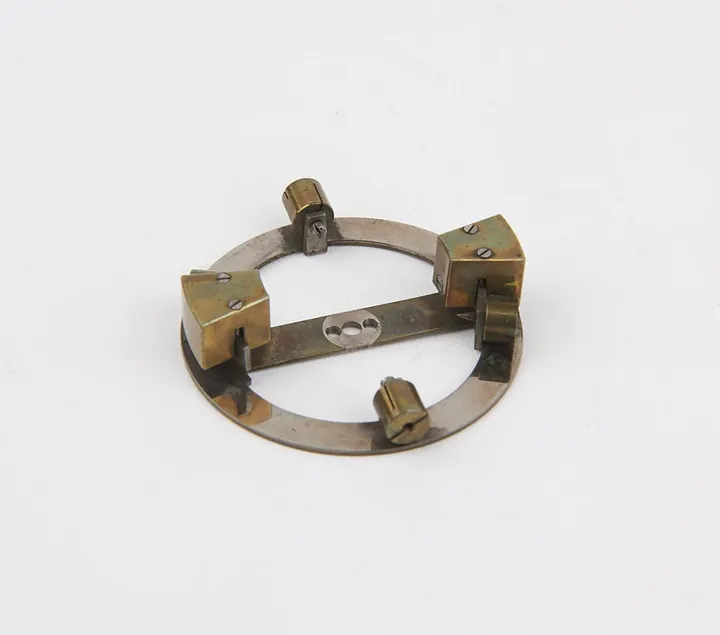
Compensation balance by Victor Kullberg, London, England, 1860–1880.
Science Museum Group, London
Pocket Watches · c. 1890
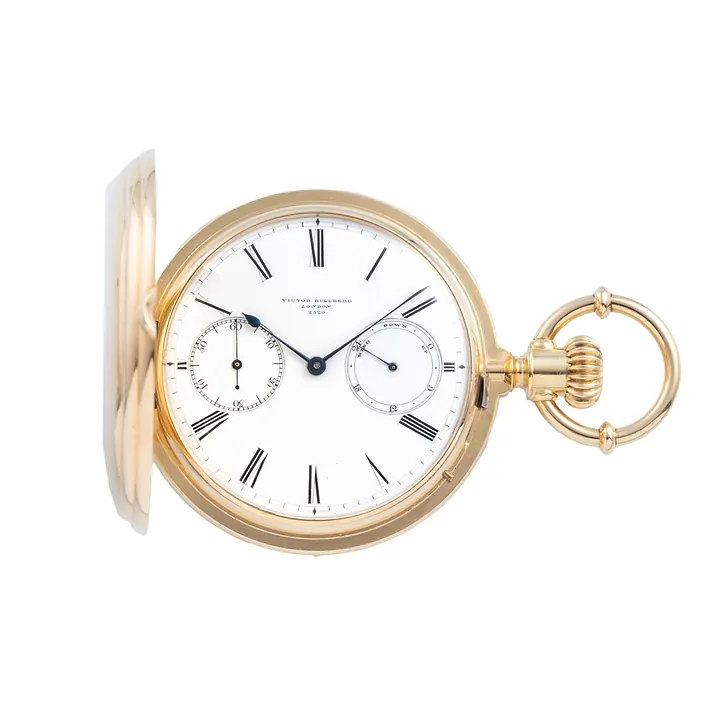
Victor Kullberg Chronometer, c. 1890
Antiquorum auction archive, Geneva
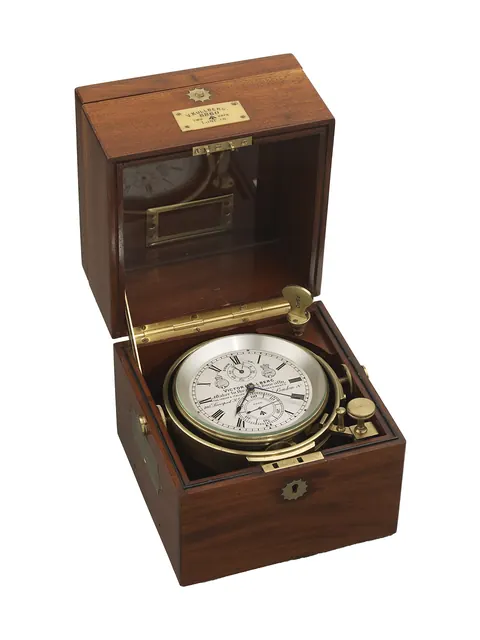
Instruments · c. 1915
Marine chronometer no. 8860 by Victor Kullberg
Royal Museums Greenwich
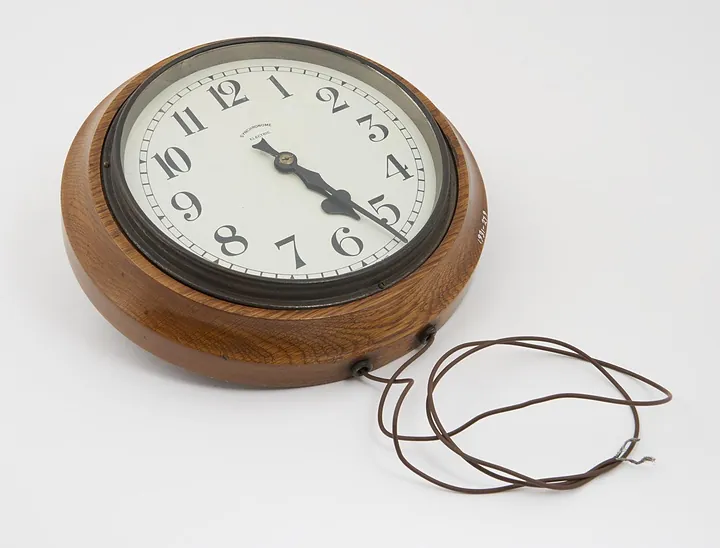
Clocks · 1890–1930
Clock with 8-inch impulse dial, by the Synchronome Company Limited, England, 1890–1930.
Science Museum Group, London
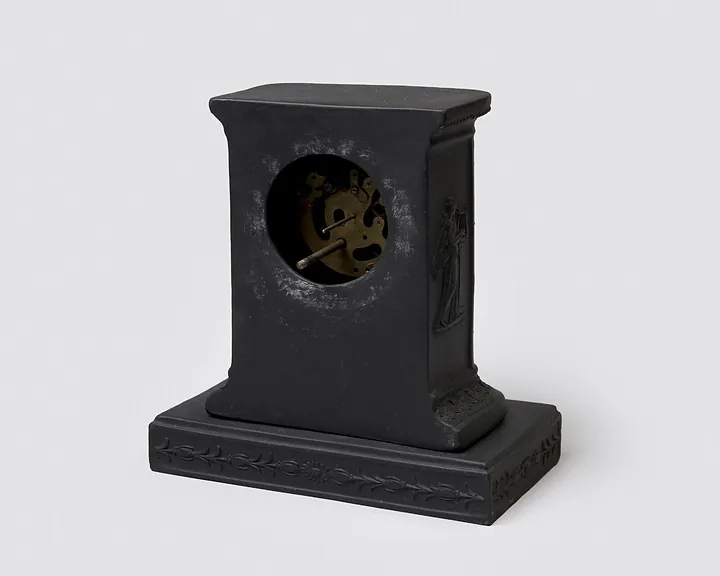
Clocks · c. 1900
Clock, black basalt, brass, Josiah Wedgwood and Sons, Etruria, c. 1900
Victoria and Albert Museum, London
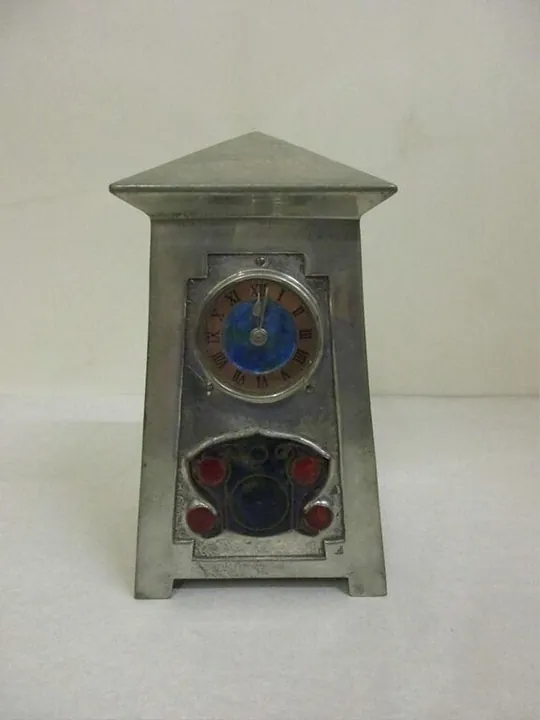
Clocks · c.1903-1904
Clock, pewter, made for Liberty& Co., England. 1903-4.
Victoria and Albert Museum, London
Clocks · 1900–1939
Clock by Cox-Walkers of Darlington, England, 1900–1939
Science Museum Group, London