
Wristwatches · Wristwatch
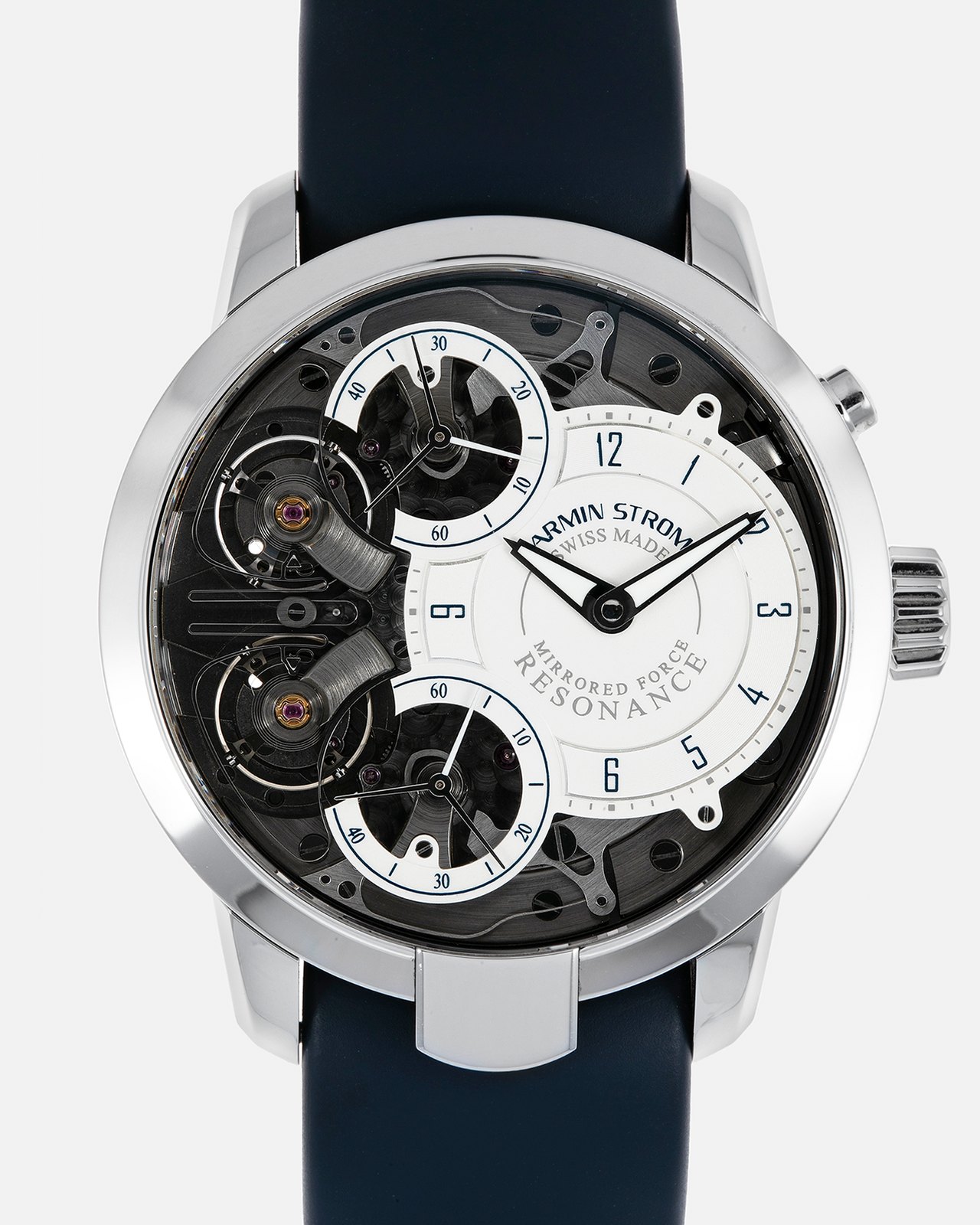
Armin Strom Mirrored Force Resonance Water, 2017
- Maker / attribution
- Armin Strom (maker)
- Date
- 2017
- Historical period
- Contemporary Horology (2010 – Present)
- Country of origin
- Unrecorded in source
- Object type
- Wristwatch
- Dimensions
- Case 43.4 mm
- Stock no.
- Product 7135399149655
- Credit line
- Dealer listing, S.Song Watches (product 7135399149655)
- Catalogue title (original)
- Armin Strom Mirrored Force Resonance Water (English)
View the source record (dealer listing) ↗ (opens another website in a new tab)Suggest a correction
Record summary
Catalogued by S.Song Watches (dealer), Seattle (stock number Product 7135399149655), this is a wristwatch by Armin Strom, dated 2017. The Atlas places it in the Contemporary Horology period (2010 – Present) of its Wristwatches collection. Recorded dimensions: Case 43.4 mm. The record is illustrated with 6 photographs.
Assembled from the source record's structured fields. Dates and attributions are given as the source states them; where a field is missing the Atlas leaves it blank rather than estimating.
Catalogue description
Dealer description — S.Song Watches
Resonance watches are a rarity in watchmaking due to the formidable technical challenges they pose in adjustment and maintenance, which explains why only a handful of modern examples, such as the F. P. Journe Chronomètre à Résonance, Vianney Halter’s La Resonance, and Haldimann's H2 Resonance Flying Tourbillon, are often remembered. In 2016, we saw Armin Strom introduce a noteworthy addition to that list: cue in the Mirrored Force Resonance ‘Water’, which is also the watch offered here today. Before we begin, it is worth noting that Armin Strom categorizes the material used on its watches based on the elements of ‘Earth’, ‘Air’, ‘Fire’, and ‘Water’, with 'water' symbolizing the use of stainless steel. Limited to just 50 pieces, the Mirrored Force Resonance garnered immediate acclaim for its innovative and fresh approach to reimagining the role of resonance in watchmaking, as well as to showcase the manufacture’s technical expertise in expressing their distinctive design language. In the realm of watchmaking history, the concept of resonance holds profound significance, representing one of the most intricate and fascinating phenomena in haute horlogerie. Its origins can be traced back to the 17th century when Galileo Galilei first observed it, with its practical application eventually pioneered by the visionary mathematician and physicist Christiaan Huygens, who also notably invented the pendulum clock. Even in contemporary times, only a select group of watchmakers have truly grasped its intricacies, among them is Claude Griesler, the co-founder and head watchmaker at Armin Strom. The resonance phenomenon, in the context of watchmaking, revolves around the synchronization between two individual oscillating hairsprings to enhance the overall stability and accuracy of their timekeeping. Armin Strom ingeniously recreated this phenomenon with a patented Resonance Clutch Spring - a piece of innovation that acts like a coupling structure, which facilitates a more efficient transfer of vibrational energy between the two corresponding hairsprings, effectively inducing resonance in the balance wheels. To put it simply, this level of synchronization creates a sort of mutual optimisation between the oscillating hairsprings, ensuring a consistent beat rate for the movement, which also serves as a built-in mechanism for regulating timekeeping precision, as well as a protective measure against external perturbations like impacts, etc. Starting with the stainless steel case construction of the Mirrored Force Resonance, it showcases a mirror-polished bezel, a unique protrusion or "chin" at the 6 o'clock position, strong angular lugs, and a brushed mid-case band. In terms of wearability, despite its sizable dimensions measuring 43.4mm x 13mm, the Mirrored Force Resonance feels surprisingly compact on the wrist, considering the number of components housed within. Visually, the dial on the Mirrored Force Resonance is a captivating spectacle. Positioned off-center and leaning towards the right side is a dial which indicates the hour and minutes. Adjacent to this, on the left side, the patented Resonance Clutch Spring captures attention as it pulsates between the two mirrored regulating organs. These components, in turn, drive the two open-worked small seconds indications beside them which also partially intersect with the main dial. Here, their three-handed pointers rotate in opposing directions, creating a truly mesmerizing display. There is a certain hypnotic quality to seeing the motion of the resonance spring along with the synchronized beating of the two balances, beating away in tandem and perfect harmony. Moving on to its movement, if you turn the Mirrored Force Resonance over on its back, you’ll be greeted with Armin Strom’s in-house, manual-winding Cal. ARF15, beating away methodically at 25,200 vph beneath the exhibition sapphire caseback. Despite its seemingly restrained and clean overall aesthetics, the movement is impeccably finished to a very high level with circular côtes de Genève (Geneva stripes) and snailing. It also holds a power reserve of 48 hours when fully wound. Limited to just 50 pieces worldwide, the Armin Strom Mirrored Force Resonance ‘Water’ is a spectacular feat of complexity and a rare gem deserving of considerable attention from collectors. It also presents a compelling proposition for the most discerning collectors who value a modernist approach to watchmaking, particularly one that reimagines age-old concepts such as the resonance phenomenon while seamlessly integrating form and function. Ultimately, the Mirrored Force Resonance exemplifies the technical mastery of a small independent manufacturer and its dedication to pushing the frontiers of horological innovation. It truly represents a technological tour de force for the brand.
Historical context
Contemporary Horology (2010 – Present)
Silicon components, connected watches, optical-lattice research clocks and a thriving independent scene.
Smartwatches became the world's best-selling watches, while mechanical watchmaking focuses on craft, innovation (silicon components, new escapements) and independent makers.
Read the period in the timelineMore wristwatches from this periodEarlier: Mechanical Renaissance
Atlas type guide
Wristwatches
Bracelet watches were worn by women from the early nineteenth century — Breguet made one for Caroline Murat, Queen of Naples, in 1810–12 — but the wristwatch only became a man's instrument with military use and aviation in the early twentieth century. Between the World Wars it overtook the pocket watch; the 1920s and 1930s brought rectangular Art Deco cases, water-resistant cases and the first automatic winding systems.
After 1945 the wristwatch became a carrier of identity — dress watches, sports and dive watches, chronographs, calendars — produced by Swiss, American, Japanese, German, Soviet and Chinese industries. The quartz revolution after 1969 and the mechanical renaissance since the 1990s, including the rise of independent watchmakers, complete the story.
What to look for
- The reference number (between the lugs or inside the case back) and serial number, the starting point for dating.
- The calibre: its maker and number are often stamped under the dial or on the bridge.
- Originality of dial, hands and crown — refinished ('redial') dials are common.
- Case material marks: 18K/750, 14K/585, stainless steel, gold-filled, plated.
Dating clues
- Wire-lug cases: before c. 1925.
- Water-resistant screw-down cases: from 1926.
- Quartz movements: from 1969; sapphire crystals widespread after c. 1980.
General guidance written by the Atlas editors about this kind of object. It is not a statement about this particular piece; for that, rely on the source record above and on physical examination.
Related records
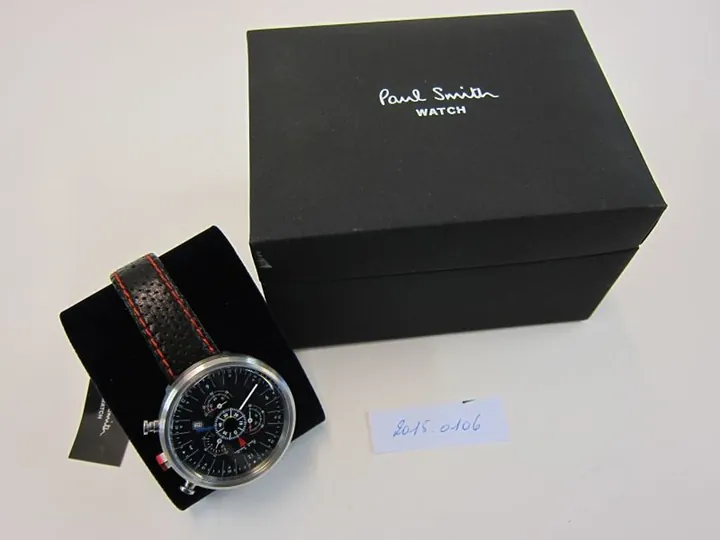
Wristwatches · 2010
Wristwatch, 2010
Modemuseum Hasselt
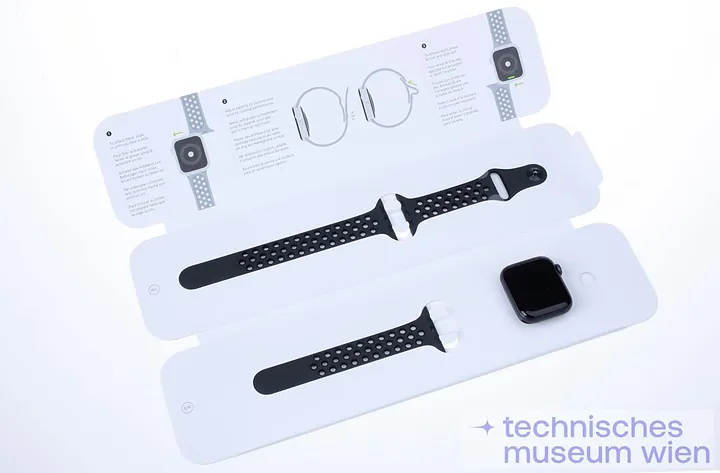
Wristwatches · 2018 (Series 4 released in September 2018; '1977' in the source is the model number A1977)
Apple Watch Series 4 (GPS, 40 mm, model A1977), 2018
Vienna Museum of Science and Technology
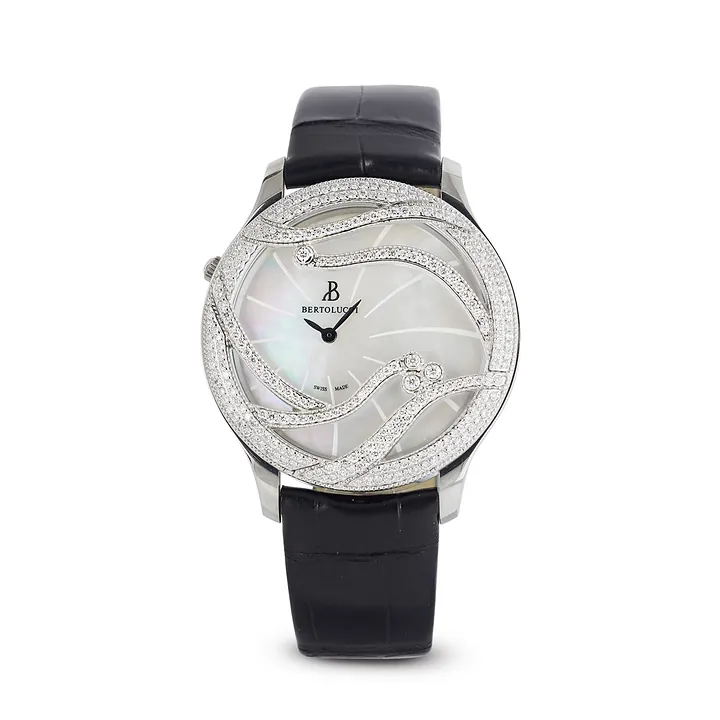
Wristwatches · c. 2010s
Bertolucci Stria III, ref. 11513.50.45.B88.6C1.501, c. 2010s
Antiquorum auction archive, Geneva
Wristwatches · c. 2010s
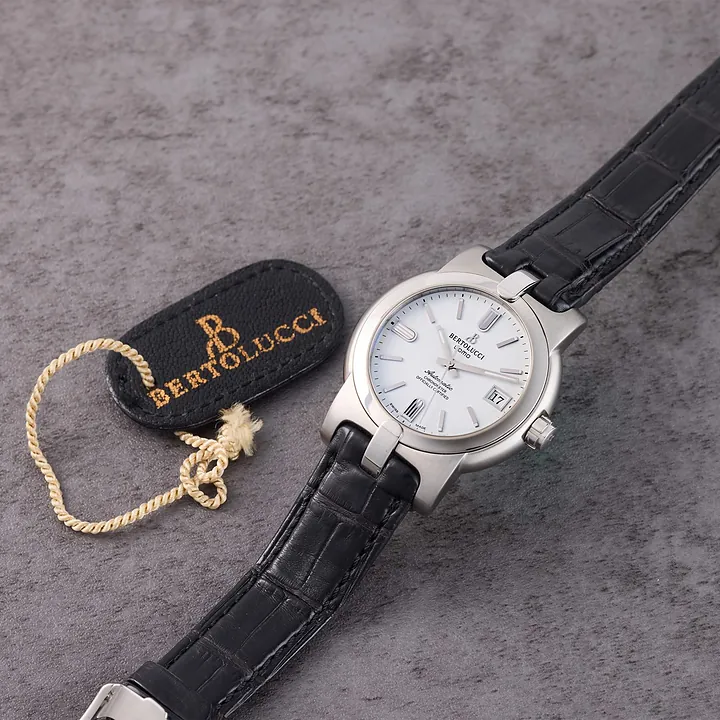
Bertolucci Uoma, ref. 824.51.41.10B, c. 2010s
Antiquorum auction archive, Geneva

Wristwatches · c. 2010s
Breguet Type XXI, ref. 3810, c. 2010s (Antiquorum Lot 381-24)
Antiquorum auction archive, Geneva

Wristwatches · c. 2010s
Breguet Type XXI, ref. 3810, c. 2010s (Antiquorum Lot 386-229)
Antiquorum auction archive, Geneva

Wristwatches · Sold in September 2010
Breitling Cosmonaute, ref. A 22322, Sold in September 2010
Antiquorum auction archive, Geneva
Wristwatches · c. 2010s
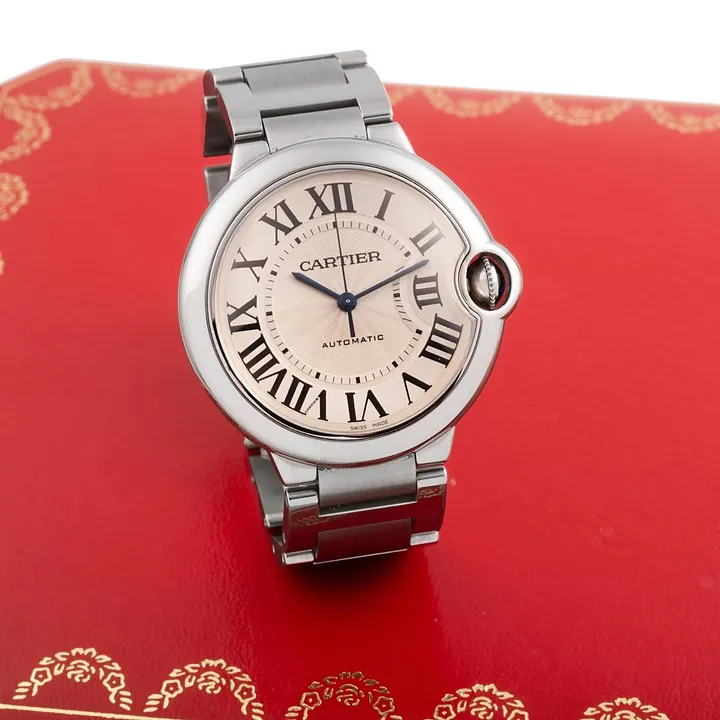
Cartier Ballon Bleu, ref. 3284, c. 2010s
Antiquorum auction archive, Geneva