
Clocks · Mystery clock
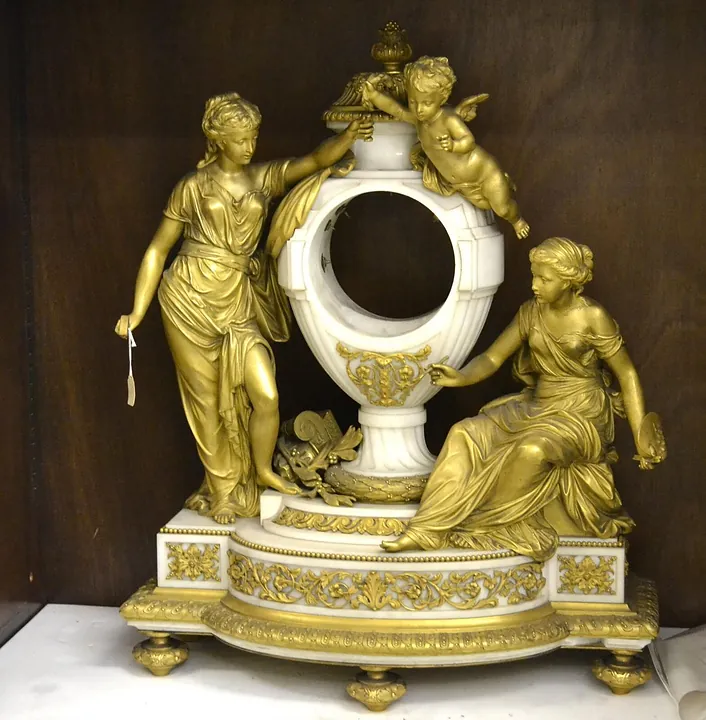
André Romain Guilmet figural mystery clock
- Maker / attribution
- André Romain Guilmet (source attribution)
- Date
- c. 1890
- Historical period
- Industrial Revolution (1850 – 1900)
- Country of origin
- France
- Object type
- Mystery clock
- Dimensions
- 27.5in x 12.75in x 9.75in
- Auction house
- Schmitt Horan & Co.
- Lot
- 462
- Credit line
- Schmitt Horan & Co.
- Catalogue title (original)
- At Auction: A good late 19th century figural mystery clock by Guilmet with crank and stirrup escapement (English)
View the source record (auction lot) ↗ (opens another website in a new tab)Suggest a correction
Record summary
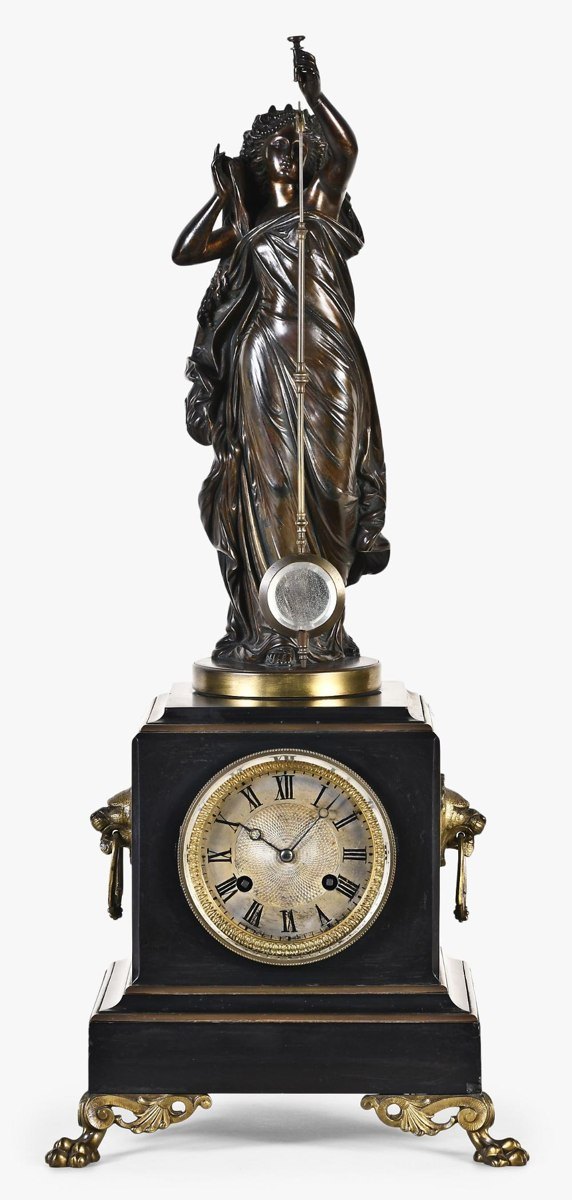
Catalogued by Schmitt Horan & Co. (lot 462), this is a mystery clock attributed to André Romain Guilmet, made in France, dated c. 1890. The Atlas places it in the Industrial Revolution period (1850 – 1900) of its Clocks collection. Recorded dimensions: 27.5in x 12.75in x 9.75in. The record is illustrated with 1 photograph.
Assembled from the source record's structured fields. Dates and attributions are given as the source states them; where a field is missing the Atlas leaves it blank rather than estimating.
Catalogue description
Original object description
Dating to circa 1890 and formerly part of the Victor Kochaver collection, this mystery clock is credited to Parisian clockmaker André Romain Guilmet. The rectangular black marble pedestal stands on gilt bronze paw supports enriched with scroll and honeysuckle terminals, flanked by lion-mask ring handles. Crowning the plinth is a patinated bronze classical female figure whose elevated left hand supports the suspension of a pendulum, which terminates in a brass-rimmed thick glass bob. Microscopic rotational movements of the figure's base plate sustain the pendulum's motion. An engine-turned silvered dial shows black Roman numerals traced by blued steel hands in the Breguet manner. The two-train, eight-day movement features time and strike trains and a crank-and-stirrup escapement, its rear plate bearing Guilmet's mark alongside number 332. Condition issues include worn surface polish, small base corner chips and losses, minor rear edge flakes, rubbed gilding on the mounts, light dial oxidation, retouched numerals, flaking blue treatment on the hands, tarnish on the pendulum framework, and dirt trapped between the two glass halves of the pendulum bob.
Inscriptions & marks
332
Historical context
Industrial Revolution (1850 – 1900)
American interchangeable-parts manufacture; railroad time standards; Swiss and German factory systems.
Factory production transformed the clock into an everyday object. American makers (Seth Thomas, Ansonia, Waterbury) and German factories (Junghans, Gustav Becker, Lenzkirch) sold millions of shelf, wall and alarm clocks worldwide; France produced standardised Paris movements and carriage clocks; electric time distribution began.
Read the period in the timelineMore clocks from this periodEarlier: Precision & Scientific Horology
Atlas type guide
Domestic clocks
A clock combines four systems: a source of power (falling weight, coiled spring, or later electricity), a gear train that divides time, an escapement and oscillator that regulate it (foliot, pendulum or balance), and an indicating system of dial and hands or a bell. Its history runs from the large iron weight-driven clocks of the late thirteenth century to Renaissance spring-driven table clocks, the pendulum revolution of 1656, the factory clocks of the nineteenth century and electric and quartz clocks of the twentieth.
Domestic clocks also reflect regional furniture and decorative traditions — English longcase and bracket clocks, French pendules, Viennese regulators, Black Forest and American shelf clocks — and therefore record changing tastes as much as technical progress.
What to look for
- How the clock is powered: weights, spring barrel, fusee, electric coil.
- The oscillator: foliot, short pendulum, long seconds pendulum or balance.
- Whether it strikes: hour only (count wheel) or hours and quarters (rack striking).
- The maker or retailer's name on dial and movement, and any factory trademarks.
- Signs of alteration — replaced dials, converted escapements, 'married' cases.
Dating clues
- Before 1656 clocks used foliots or balances; after, most domestic clocks have pendulums.
- Anchor escapements spread after c. 1670; minute hands became common at the same time.
- Factory production in America and Germany transformed prices after c. 1840.
General guidance written by the Atlas editors about this kind of object. It is not a statement about this particular piece; for that, rely on the source record above and on physical examination.
Related records
Clocks · 1840–1878
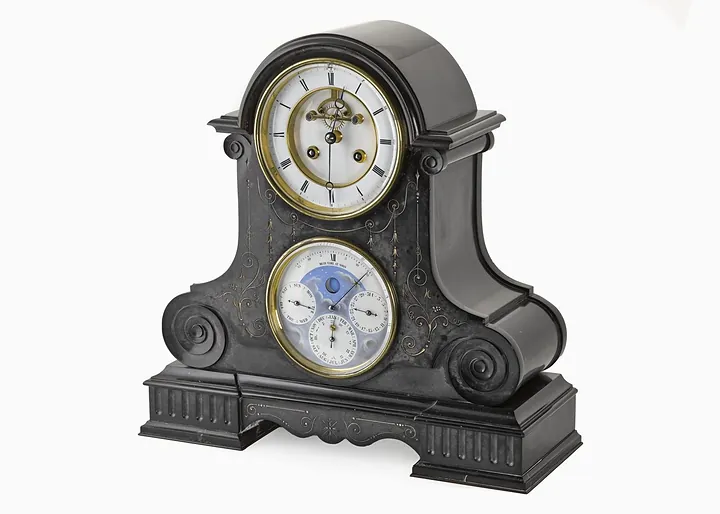
Mantel clock by A. Brocot, France, 1840–1878
Science Museum Group, London
Clocks · c. 1855
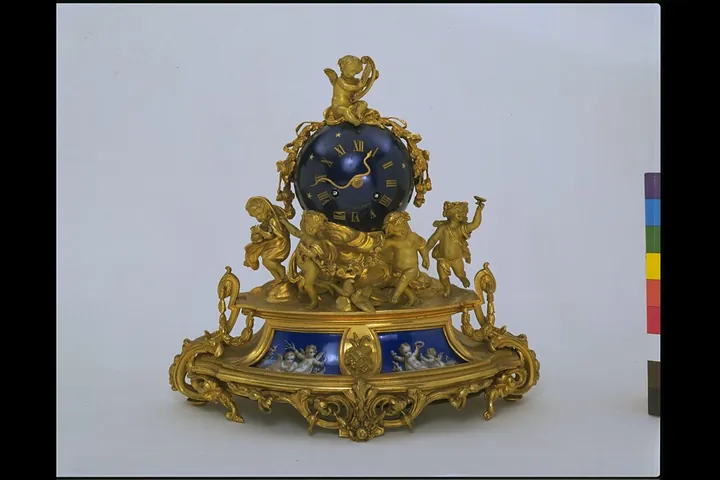
Ormolu and enamel clock, Paris, ca.1855, made by Lévy Frères.
Victoria and Albert Museum, London
Clocks · c. 1850
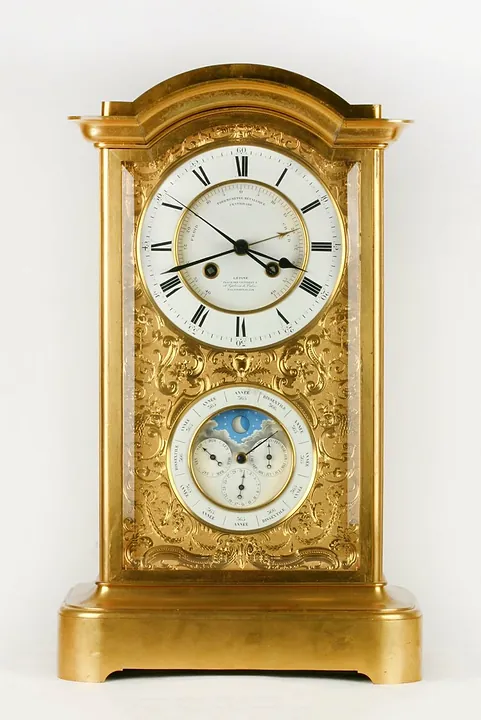
Table clock, France, c. 1850
German Clock Museum
Clocks · c. 1850
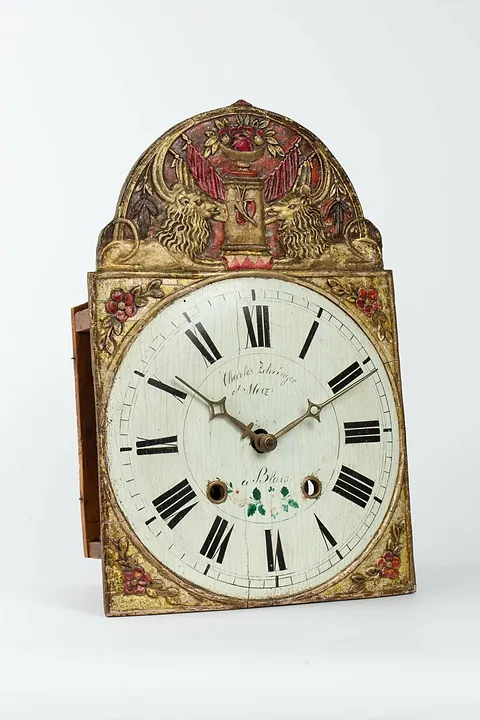
Wall clock by Charles et Merz Zehringer, France, c. 1850
German Clock Museum
Clocks · c. 1860
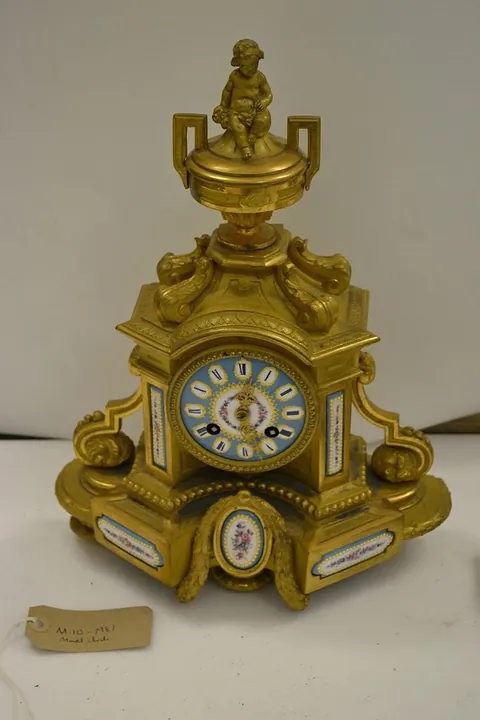
Mantel clock, French, c. 1860
Victoria and Albert Museum, London
Clocks · c. 1860
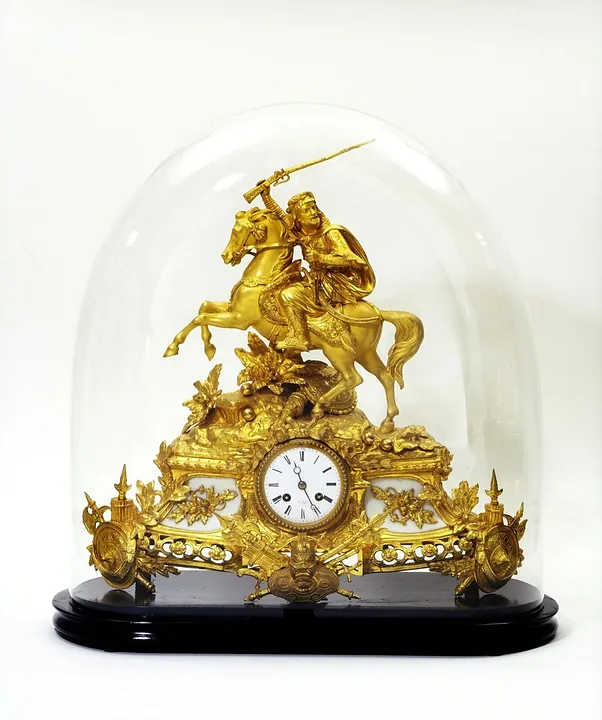
[*] French Clock under glass dome
Victoria and Albert Museum, London
Clocks · c. 1860
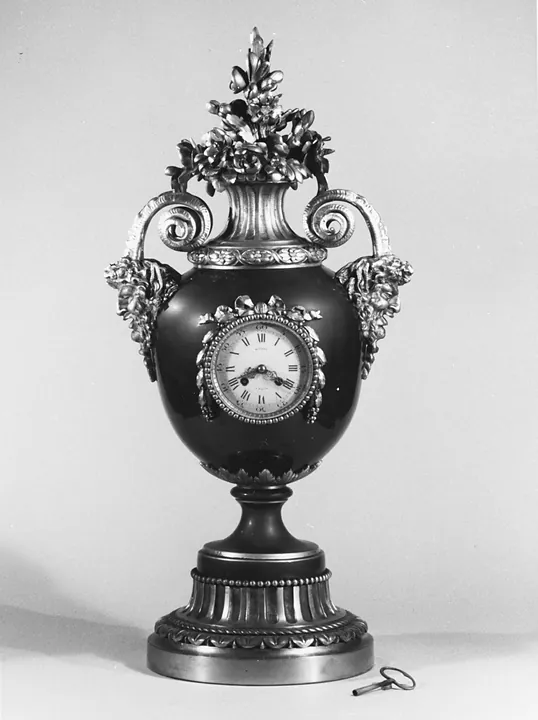
Clock by Auguste-Emile Rinquet-Leprince, France, c. 1860
The Metropolitan Museum of Art, New York
Clocks · 1860–1870
Clock by Raingo Frères, France, 1860–1870
Victoria and Albert Museum, London