
Wristwatches · Wristwatch
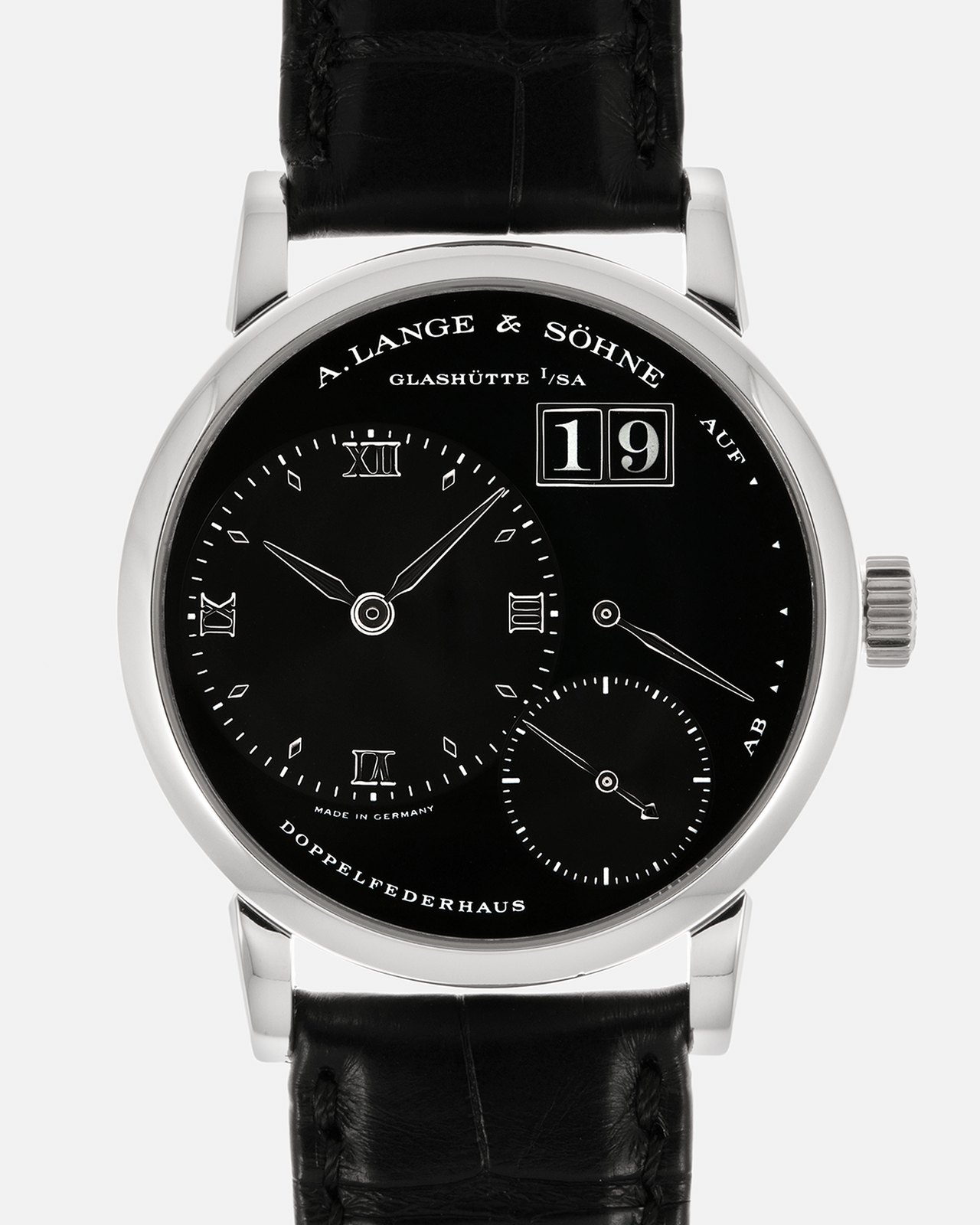
A. Lange & Sohne Little Lange 1 Darth 111.035 Platinum, 2005
- Maker / attribution
- A. Lange & Sohne (maker)
- Date
- 2005
- Historical period
- Mechanical Renaissance (1990 – 2010)
- Country of origin
- Germany
- Object type
- Wristwatch
- Materials / technique
- platinum
- Dimensions
- Case 38.5 mm
- Stock no.
- Product 7486523211863
- Credit line
- Dealer listing, S.Song Watches (product 7486523211863)
- Catalogue title (original)
- A. Lange & Sohne Little Lange 1 Darth 111.035 Platinum (English)
View the source record (dealer listing) ↗ (opens another website in a new tab)Suggest a correction
Record summary
Catalogued by S.Song Watches (dealer), Seattle (stock number Product 7486523211863), this is a wristwatch by A. Lange & Sohne, made in Germany, dated 2005. The Atlas places it in the Mechanical Renaissance period (1990 – 2010) of its Wristwatches collection. Materials and techniques recorded by the source: platinum. Recorded dimensions: Case 38.5 mm. The record is illustrated with 6 photographs.
Assembled from the source record's structured fields. Dates and attributions are given as the source states them; where a field is missing the Atlas leaves it blank rather than estimating.
Catalogue description
Dealer description — S.Song Watches
When it comes to German watchmaking, it's no surprise that A. Lange & Söhne stands among the finest the region has to offer. Among their standout creations, the Lange 1 holds a special place, boasting something of a cult following among collectors and enthusiasts alike. Released in 1994 shortly after the brand’s post-reunification resurgence, the Lange 1 is widely regarded as one of the most recognisable timepieces to emerge from A. Lange & Söhne's hallowed halls. Known for its archetypal Lange design, the Lange 1 marries classical dress watch aesthetics with a striking asymmetrical dial layout, creating what has since become a true icon and a cornerstone of the brand’s core identity. Designed as part of the brand’s initial relaunch collection in the 1990s, the Lange 1 was meant to surprise the watch world, win over critics, and answer the question of what a modern A. Lange & Söhne watch might look like if the brand never ceased operations in 1948. What we have here today, however, is not your typical Lange 1. This is the Little Lange 1. For those unfamiliar, the Little Lange 1 debuted in 1998 as a scaled-down version of the original, developed at the request of an Asian retailer seeking a smaller alternative to the standard 38.5mm case. Originally marketed as a men’s watch, it eventually found a strong following in regions like Japan and Singapore, where more compact case sizes were welcomed in higher demand. Among the many iterations of the Little Lange 1, the “Darth” stands out as one of the most visually distinctive. With its deep black dial, matching date discs, contrasting white date numerals, and complete absence of any striking colors, it offers a bold and stealthy reinterpretation of a design celebrated for its asymmetrical elegance and legibility. Despite being the original's smaller-sized sibling, do not be misled by the “Little” appellation in its name. Yes, on paper, its 36mm x 10mm case is slightly more compact than the standard Lange 1, but in reality, there is nothing little about this watch. Apart from the fact that its case is crafted from hefty platinum, which gives it a discernible sense of gravitas when worn on the wrist, it also retains all the hallmark features of the original Lange 1—and as you read on, you will see exactly why. This is a watch that commands attention quietly and rewards the wearer profoundly. On the rich black dial, the design and aesthetic codes of the Lange 1 family are immediately recognisable with the off-centred hours and minutes, along with the small seconds sub-dial. Inspired by the five-minute clock of Dresden’s Semper Opera House, the watch also features the signature instantaneous jumping date with enlarged numerals and a power reserve indicator placed between 2:00 and 4:00. In keeping with its Saxon roots, the indicator is inscribed in German with AB (down) meaning empty and AUF (up) meaning full. The inscription Doppelfederhaus at 7:00, which literally translates to ‘double barrel’, signals the presence of twin mainspring barrels which provide a robust 3-day power reserve. One of the best things about owning an A. Lange & Söhne timepiece is the opportunity to admire the movement from behind. Powering this little but mighty complexity lies the brand’s manual-winding Cal. L901.0 movement. With its emphatic finishing throughout, stunning ¾ plate, charming German silver architecture, and beautifully engraved balance cock, the Cal. L901.0 is a fitting tribute to the incredible watch it powers. Ultimately, I think the Little Lange 1 ‘Darth’ stands as one of A. Lange & Söhne’s rarest and most visually captivating offerings. Produced only between 1998 and 2006, it is believed—though never definitively confirmed—that fewer than 100 examples exist, making it even more elusive than the already uncommon full-sized Lange 1 ‘Darth’ 101.035. Despite its more compact case, the watch carries the same horological grandeur and iconic design language of the classical Lange 1. For many enthusiasts, myself included, this size strikes the perfect balance for a dress watch, blending German efficiency, elegance, and legibility. The Little Lange 1 Darth remains a quietly spectacular masterpiece from one of the most revered names in German watchmaking.
Historical context
Mechanical Renaissance (1990 – 2010)
Mechanical watches return as cultural objects; independent watchmaking flourishes.
Mechanical watches returned as cultural and luxury objects. Complications, tourbillons and new materials proliferated; independent watchmakers such as George Daniels, F.P. Journe and Philippe Dufour revived artisanal watchmaking; collecting vintage watches became a major field.
Read the period in the timelineMore wristwatches from this periodEarlier: Quartz Revolution
Atlas type guide
Wristwatches
Bracelet watches were worn by women from the early nineteenth century — Breguet made one for Caroline Murat, Queen of Naples, in 1810–12 — but the wristwatch only became a man's instrument with military use and aviation in the early twentieth century. Between the World Wars it overtook the pocket watch; the 1920s and 1930s brought rectangular Art Deco cases, water-resistant cases and the first automatic winding systems.
After 1945 the wristwatch became a carrier of identity — dress watches, sports and dive watches, chronographs, calendars — produced by Swiss, American, Japanese, German, Soviet and Chinese industries. The quartz revolution after 1969 and the mechanical renaissance since the 1990s, including the rise of independent watchmakers, complete the story.
What to look for
- The reference number (between the lugs or inside the case back) and serial number, the starting point for dating.
- The calibre: its maker and number are often stamped under the dial or on the bridge.
- Originality of dial, hands and crown — refinished ('redial') dials are common.
- Case material marks: 18K/750, 14K/585, stainless steel, gold-filled, plated.
Dating clues
- Wire-lug cases: before c. 1925.
- Water-resistant screw-down cases: from 1926.
- Quartz movements: from 1969; sapphire crystals widespread after c. 1980.
General guidance written by the Atlas editors about this kind of object. It is not a statement about this particular piece; for that, rely on the source record above and on physical examination.
Related records
Wristwatches · originally sold on 16 December 2001 (per the lot record)
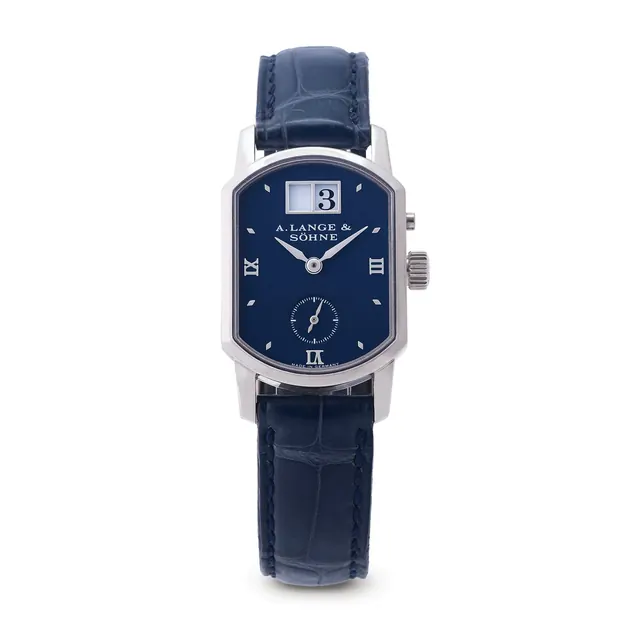
A. Lange & Sohne wristwatch, ref. 103.027, Arkade, originally sold on 16 December 2001
Antiquorum auction archive, Geneva
Instruments · c. 1942
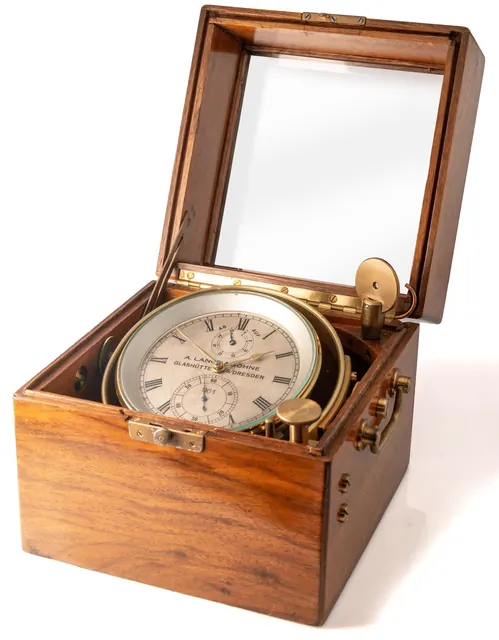
A. Lange & Sohne marine chronometer, Germany Wood, circa 1942
Antiquorum auction archive, Geneva
Wristwatches · 2004
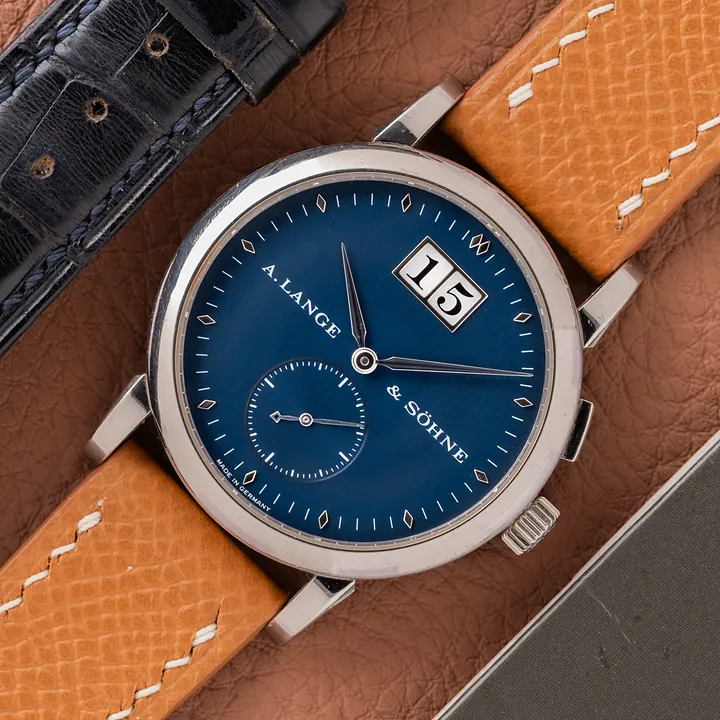
A. Lange & Söhne Saxonia Oversized Date Blue (Ref. 105.027), 2004
Huntington Company (dealer)
Wristwatches · 2000s
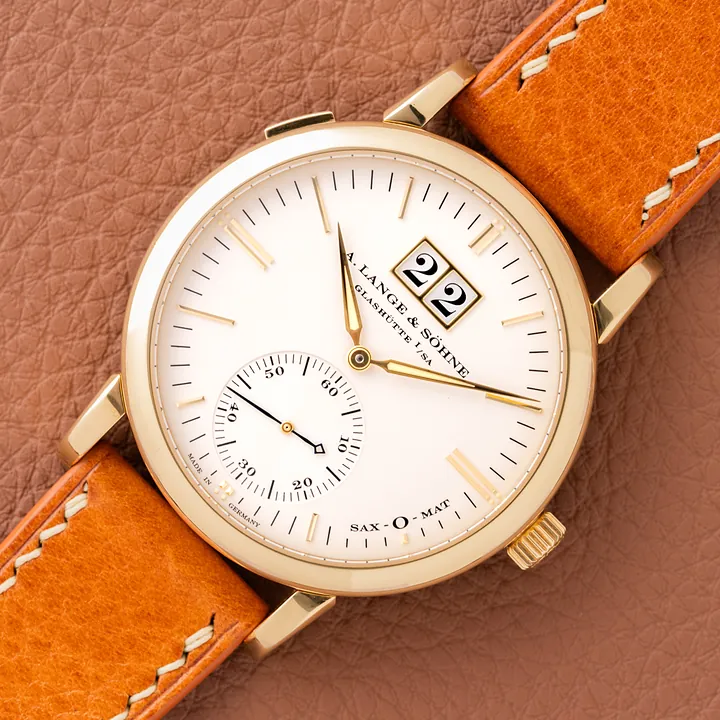
A. Lange & Söhne Langematik Oversized Date (Ref. 308.021), 2000s
Huntington Company (dealer)
Wristwatches · c. 1990
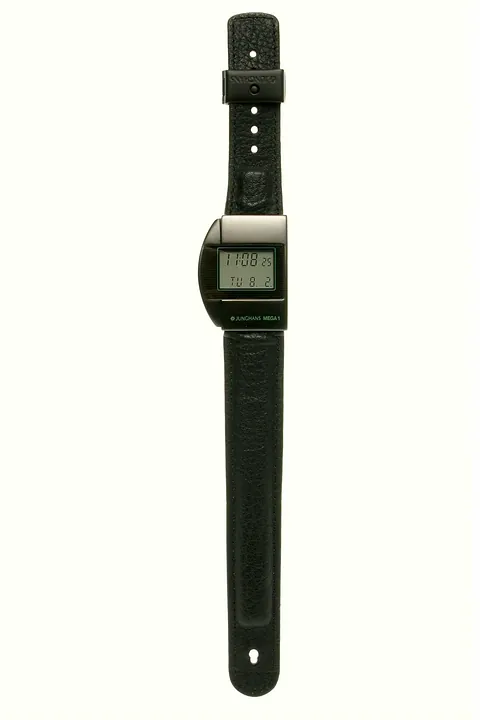
Wristwatch, Germany, c. 1990 (no. 29875)
German Clock Museum
Wristwatches · 1990
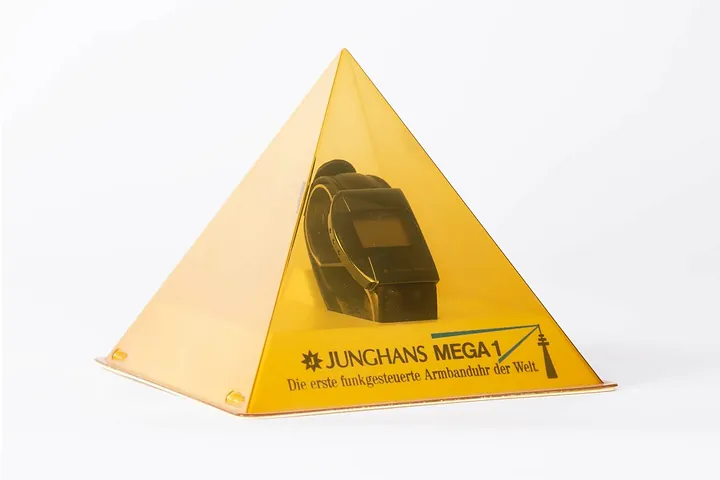
Wristwatch, Germany, 1990 (no. 59620)
German Clock Museum
Wristwatches · c. 1991
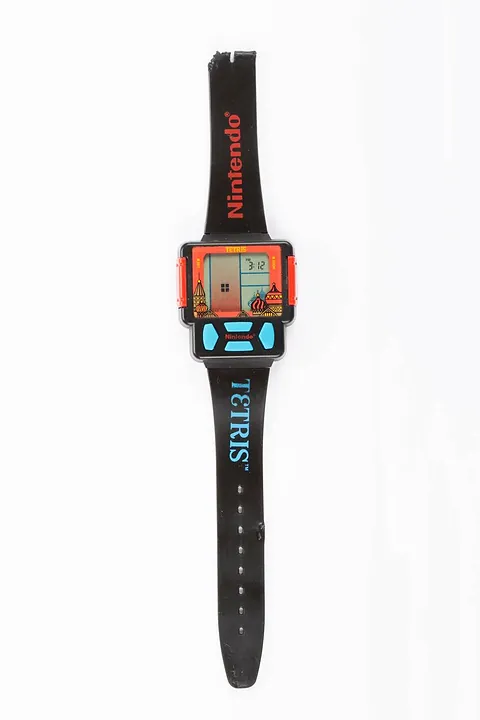
Wristwatch by EM-Entertainment München, Merchandising, Film und Fernseh GmbH, Germany, c. 1991
German Clock Museum
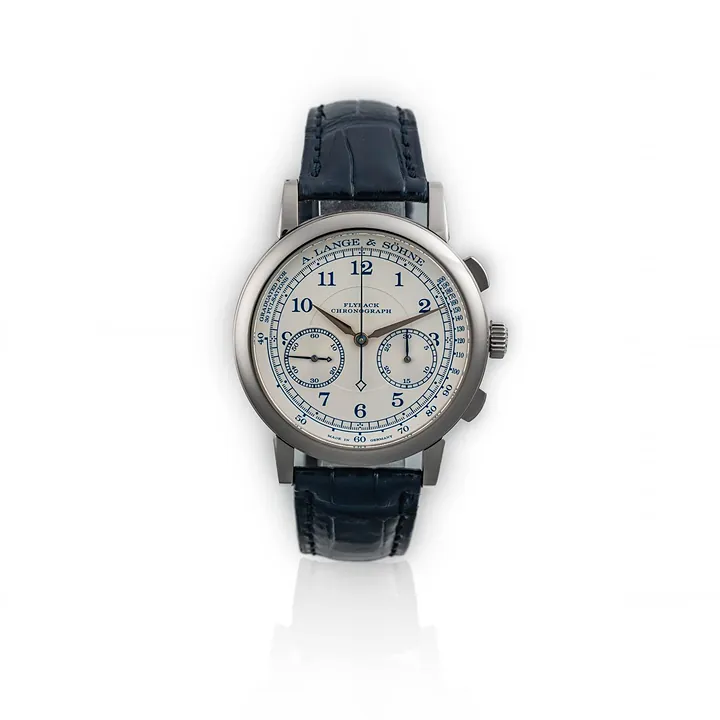
Wristwatches · c. 2000
A.Lange & Söhne 1815 Chronograph, ref. 414.026, c. 2000
Antiquorum auction archive, Geneva