
Clocks · Tall case clock
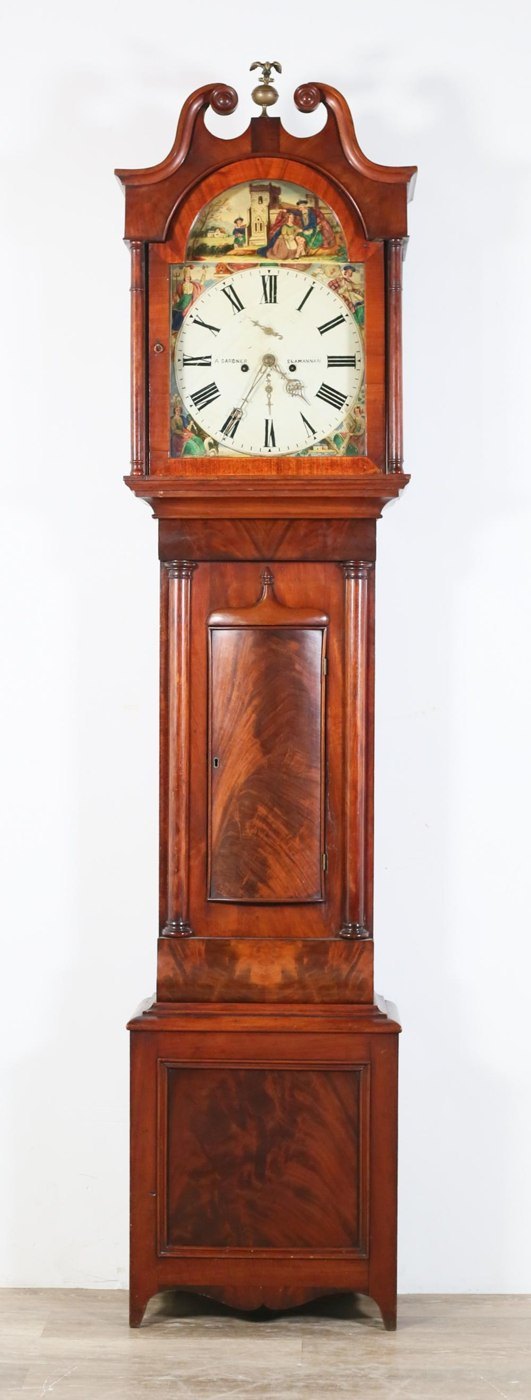
A. Gardner Scottish Tall Case Clock
- Maker / attribution
- A. Gardner (source attribution)
- Date
- Late 19th century
- Historical period
- Industrial Revolution (1850 – 1900)
- Country of origin
- Scotland
- Object type
- Tall case clock
- Materials / technique
- Burled mahogany and brass
- Dimensions
- 88 1/2 inches H x 21 inches W x 10 inches D
- Auction house
- Willow Auction House (via Invaluable)
- Lot
- 49
- Credit line
- Willow Auction House (via Invaluable)
- Catalogue title (original)
- A. Gardner Scottish Tall Case Clock (English)
View the source record (auction lot) ↗ (opens another website in a new tab)Suggest a correction
Record summary
Catalogued by Willow Auction House (via Invaluable) (lot 49), this is a tall case clock attributed to A. Gardner, made in Scotland, dated Late 19th century. The Atlas places it in the Industrial Revolution period (1850 – 1900) of its Clocks collection. Materials and techniques recorded by the source: Burled mahogany and brass. Recorded dimensions: 88 1/2 inches H x 21 inches W x 10 inches D. The record is illustrated with 1 photograph.
Assembled from the source record's structured fields. Dates and attributions are given as the source states them; where a field is missing the Atlas leaves it blank rather than estimating.
Catalogue description
Original object description
Dating to the late 19th century, this Scottish tall case clock stands 88 1/2 inches tall, 21 inches wide, and 10 inches deep within a burled mahogany housing signed on the dial by Slamannan clockmaker A. Gardner. Surmounting the arched hood is a brass eagle finial; condition issues on the bonnet include an imperfect fit to the trunk, minor losses of veneer along the door's lower edge, and fractured door glazing. Structural wear on the remainder of the case comprises side splits, a rear fissure, lower right-side separation, chips and nicks to the feet, and scattered scuff marks throughout. The painted dial displays spandrels depicting personifications of Ireland, Wales, England, and Scotland, below an arch painted with a composition entitled 'Come Under My Plaidie', with the surface showing blemishes, crazing, and paint loss. Accompanied by two driving weights, an associated modern winding key, and a pendulum hung via a safety pin at its suspension point, the unexamined movement lacks documentation regarding its wheelwork and escapement.
Historical context
Industrial Revolution (1850 – 1900)
American interchangeable-parts manufacture; railroad time standards; Swiss and German factory systems.
Factory production transformed the clock into an everyday object. American makers (Seth Thomas, Ansonia, Waterbury) and German factories (Junghans, Gustav Becker, Lenzkirch) sold millions of shelf, wall and alarm clocks worldwide; France produced standardised Paris movements and carriage clocks; electric time distribution began.
Read the period in the timelineMore clocks from this periodEarlier: Precision & Scientific Horology
Atlas type guide
Longcase (tall-case or grandfather) clocks
The longcase clock was born from two seventeenth-century innovations: Christiaan Huygens's pendulum (1656–57) and the anchor escapement (c. 1670). A long seconds pendulum, nearly a metre long, swings with a small arc, and enclosing it together with the driving weights in a tall wooden case protected the mechanism and created a new piece of furniture. London makers such as Ahasuerus Fromanteel, Thomas Tompion and Joseph Knibb set the pattern.
By the eighteenth century longcase clocks were made throughout Britain, the Netherlands, Scandinavia (the Swedish Mora clock), France (the Comtoise from the Franche-Comté), Germany and colonial America. Eight-day movements with two weights became standard in better clocks; thirty-hour clocks with one weight and a rope or chain were cheaper alternatives.
What to look for
- Winding holes in the dial: two (eight-day, going and striking) or none (thirty-hour, pulled up by a chain).
- Brass dials with applied chapter rings (earlier) versus painted iron 'white' dials (after c. 1770 in Britain).
- Moon-phase arches, date apertures, seconds dials and maker's name on the dial.
- Case woods and style: ebonised, walnut marquetry, lacquer, oak or mahogany; regional styles from London, Lancashire, Scotland or America.
- Whether the movement and dial match the case — 'marriages' are common.
Dating clues
- Square brass dials suggest c. 1670–1720; arched brass dials c. 1715–1790.
- Painted (white) dials were made by Birmingham dial-makers from about 1772.
- Comtoise clocks with repoussé pendulums are mostly nineteenth century.
General guidance written by the Atlas editors about this kind of object. It is not a statement about this particular piece; for that, rely on the source record above and on physical examination.
Read next:Anchor (recoil) escapementDeadbeat escapementAnchor escapement
Related records
Clocks · c. 1850
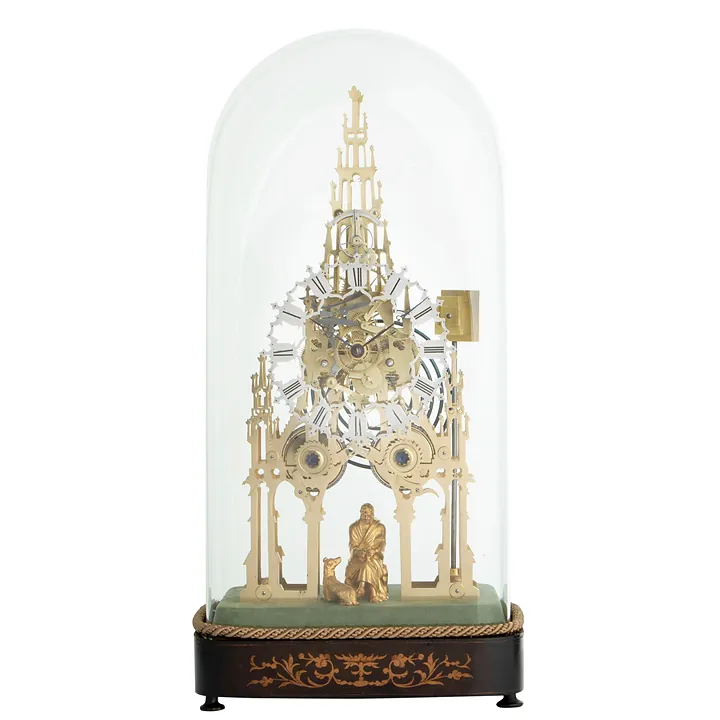
Scott Memorial striking skeleton clock with balance escapement
The Antique Clock Company (dealer), Dorset
Clocks · c. 1850
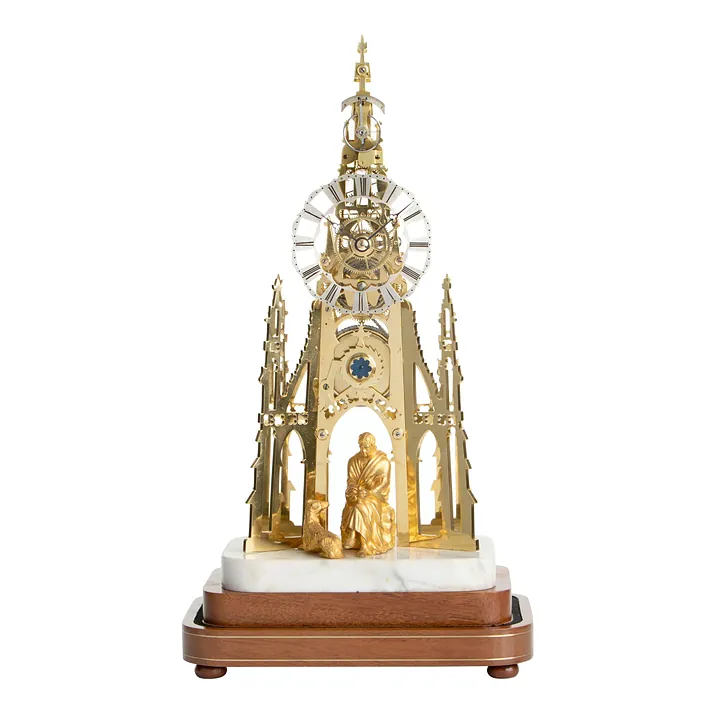
Scott Memorial skeleton clock timepiece with balance escapement
The Antique Clock Company (dealer), Dorset
Clocks · c. 1850
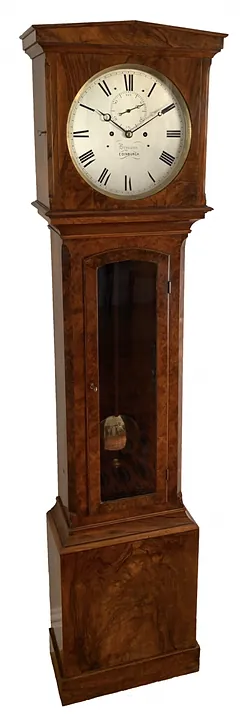
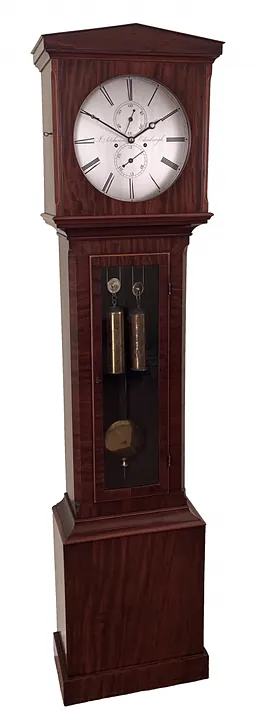
Burr walnut regulator longcase clock by Brysons, Edinburgh, c. 1850
P A Oxley (dealer), Wiltshire
Clocks · c. 1850
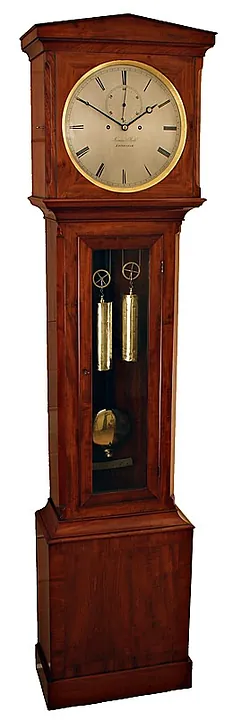
Scottish longcase clock by Aitchison, Edinburgh, c. 1850
P A Oxley (dealer), Wiltshire
Clocks · c. 1850
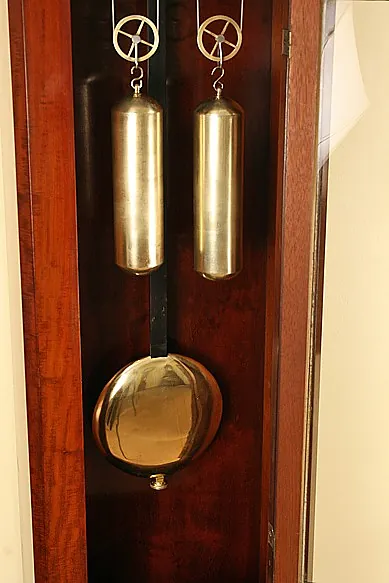
Domestic regulator longcase clock by James Bell, Edinburgh, c. 1850
P A Oxley (dealer), Wiltshire
Clocks · c. 1885
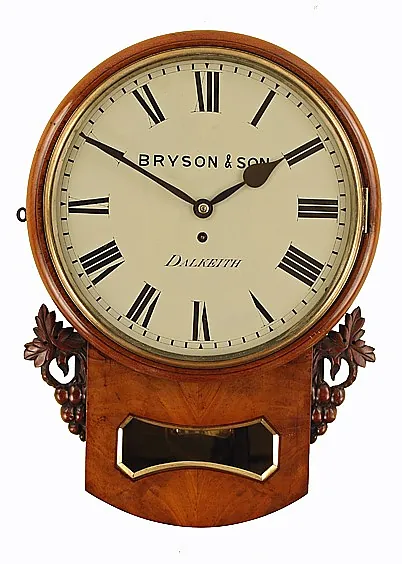
Drop dial wall clock by Bryson & Son, Dalkeith, c. 1885
P A Oxley (dealer), Wiltshire
Clocks · c. 1860
Regulator grandfather clock by Barrie, Edinburgh, c. 1860
P A Oxley (dealer), Wiltshire
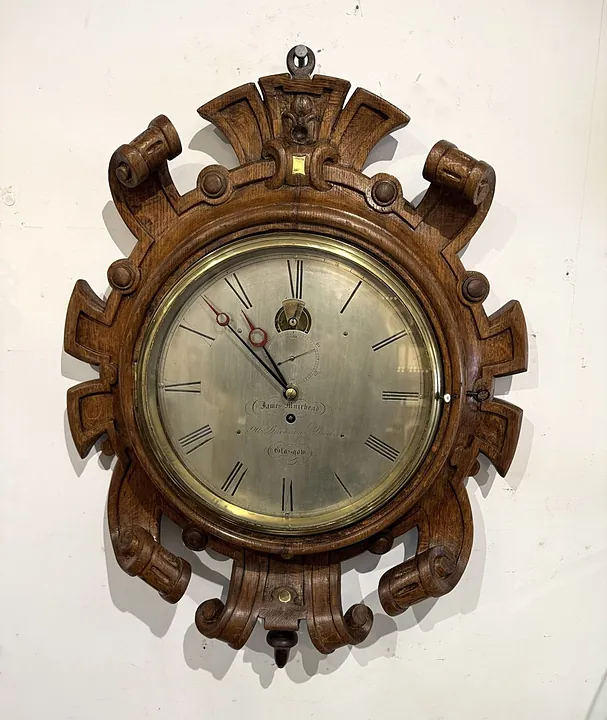
Clocks · c. 1870
Antique Scottish wall clock by James Muirhead
Dutch Time Pieces