
Clocks · Clock
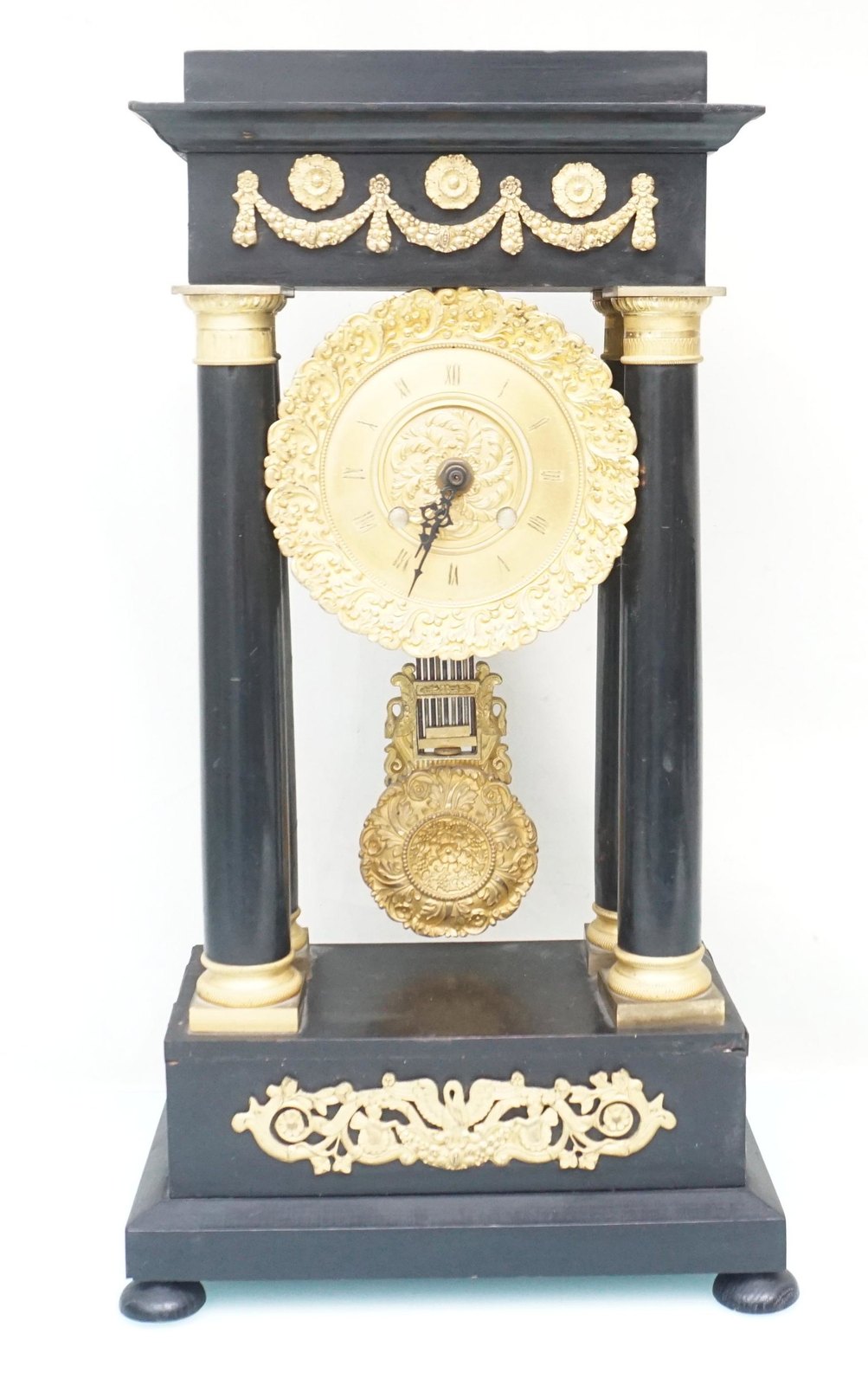
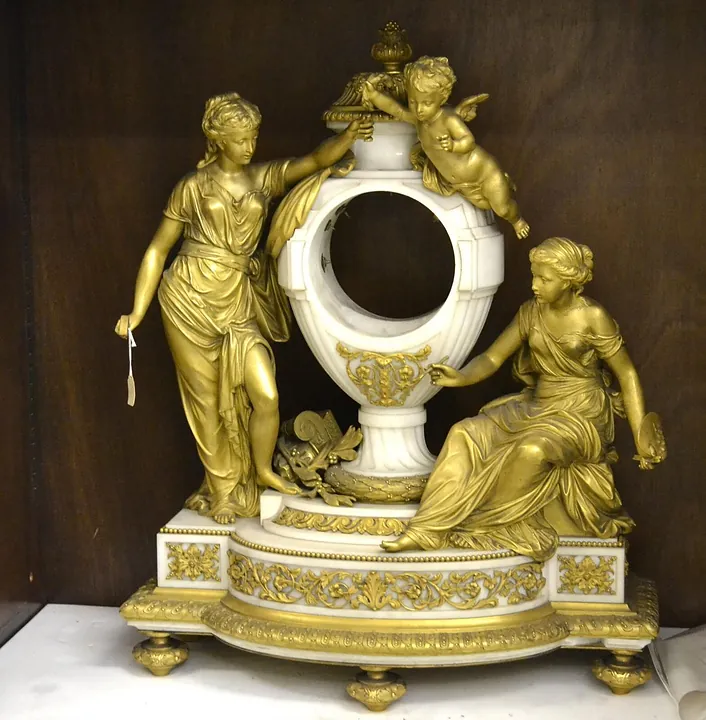
19th C Neoclassical Column French Empire Mantel Clock, c. 1890
- Maker / attribution
- Unrecorded in source
- Date
- c. 1890
- Historical period
- Industrial Revolution (1850 – 1900)
- Country of origin
- France
- Object type
- Clock
- Auction house
- LiveAuctioneers auction archive
- Lot
- Item 105764338
- Credit line
- Auction lot record: lot 288, JUNE SOUTHERN ESTATES, Charleston Estate Auctions (2021), via LiveAuctioneers
- Catalogue title (original)
- 19TH C NEOCLASSICAL COLUMN FRENCH EMPIRE MANTLE CLOCK (English)
View the source record (auction lot) ↗ (opens another website in a new tab)Suggest a correction
Record summary
Catalogued by LiveAuctioneers auction archive (lot Item 105764338), this is a clock, made in France, dated c. 1890. The Atlas places it in the Industrial Revolution period (1850 – 1900) of its Clocks collection. The record is illustrated with 4 photographs.
Assembled from the source record's structured fields. Dates and attributions are given as the source states them; where a field is missing the Atlas leaves it blank rather than estimating.
Catalogue description
Lot description — Charleston Estate Auctions
Antique 19th Century Neoclassical Column Pediment French Empire Style Mantle Clock; circa 1890 in dore bronze and ebony, that has been modified to use a battery operated pendulum. No key, untested. Measures 11"x6 1/2"x20". Weight approximately 12 Pds. NO IN HOUSE SHIPPING. ***Pickup only or Shipping on this item offered through Outward Bound 413-854-3676, Pak Mail 843-849-0310 - info@charlestonshipping.com , Quik Mail Etc 843-723-6598 quikmailetc@gmail.com or locally AJ Williams & Sons 843-442-0462. Please contact one of them or your own choice of shipper directly. ***PROVENANCE: The Estate of Dr. Fraser Wilson, Charleston SC. Dr. Wilson will be remembered for his love of antiques and his dedication to Charleston's history and material culture. He was a Life Trustee of Historic Charleston Foundation and opened his home for house tours for 39 years. Dr. Wilson was appointed to the South Carolina Governor's Mansion Commission by Governors James B. Edwards, Richard W. Riley, Carol Campbell, David M. Beasley, James Hodges, and Mark Sanford. He was awarded the Order of the Palmetto by the Governors for his exemplary service on the Commission He was a member of the Charleston Club, the South Carolina Society, the St. Andrew's Society, the St. Cecilia Society, the Agricultural Society and the Carolina Yacht Club. He was a member of St. Michael's church.
Historical context
Industrial Revolution (1850 – 1900)
American interchangeable-parts manufacture; railroad time standards; Swiss and German factory systems.
Factory production transformed the clock into an everyday object. American makers (Seth Thomas, Ansonia, Waterbury) and German factories (Junghans, Gustav Becker, Lenzkirch) sold millions of shelf, wall and alarm clocks worldwide; France produced standardised Paris movements and carriage clocks; electric time distribution began.
Read the period in the timelineMore clocks from this periodEarlier: Precision & Scientific Horology
Atlas type guide
Mantel and French pendule clocks
The mantel clock — the French pendule de cheminée — is as much decorative art as timekeeper. From the late seventeenth century Parisian clockmakers worked with cabinet-makers, bronze founders and gilders (ciseleurs-doreurs) to create cases in Boulle marquetry, gilt bronze and marble, while the movements were often supplied by specialist makers. Clocks of the Louis XIV, Louis XV and Louis XVI periods, and Empire clocks with allegorical figures, set fashions copied across Europe.
The nineteenth century industrialised the type. The 'Paris movement', a standardised round movement with silk-thread or Brocot suspension and count-wheel striking, was made in huge numbers by firms such as Japy and Vincenti, and fitted into cases of every style and material.
What to look for
- Round 'Paris' movements with makers' stamps (e.g. Japy Frères, Vincenti, S. Marti) and medal marks from exhibitions.
- Suspension type: silk thread (earlier) or Brocot adjustable suspension (after c. 1840).
- Visible Brocot escapement on the dial in later clocks.
- Fire-gilt (mercury) gilding on bronzes versus later electro-gilding.
- Signed dials naming a retailer rather than the movement maker.
Dating clues
- Silk-suspension Paris movements: c. 1800–1850.
- Brocot suspension and visible escapements: after c. 1840.
- Exhibition medal stamps on movements give dates after the medal year.
General guidance written by the Atlas editors about this kind of object. It is not a statement about this particular piece; for that, rely on the source record above and on physical examination.
Read next:Anchor (recoil) escapement
Related records
Clocks · 1840–1878
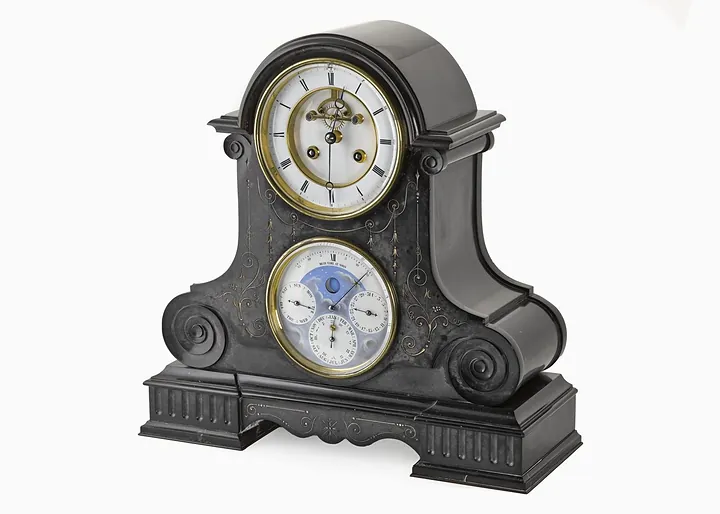
Mantel clock by A. Brocot, France, 1840–1878
Science Museum Group, London
Clocks · c. 1855
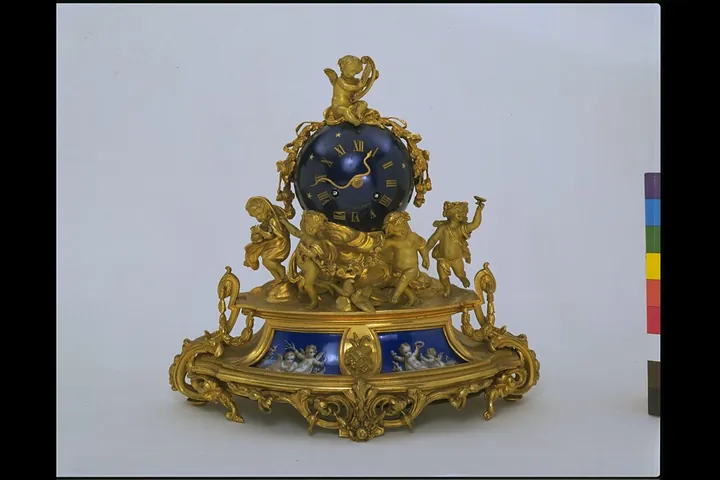
Ormolu and enamel clock, Paris, ca.1855, made by Lévy Frères.
Victoria and Albert Museum, London
Clocks · c. 1850
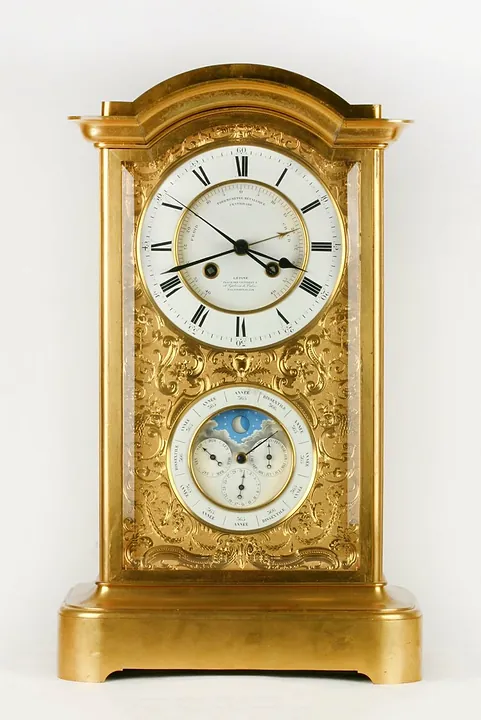
Table clock, France, c. 1850
German Clock Museum
Clocks · c. 1850
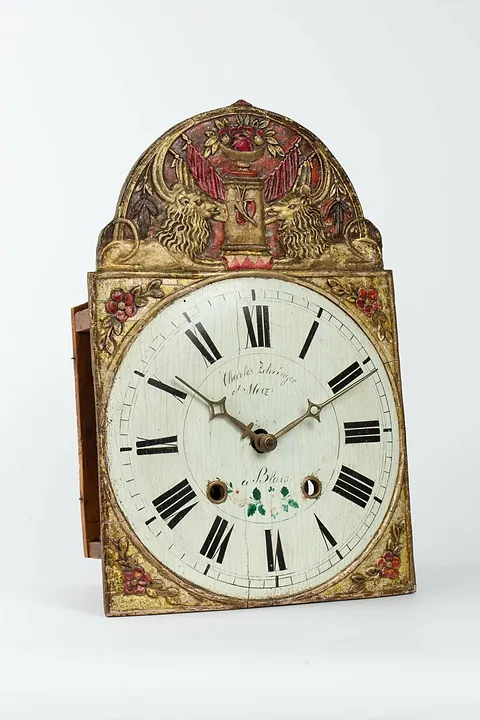
Wall clock by Charles et Merz Zehringer, France, c. 1850
German Clock Museum
Clocks · c. 1860
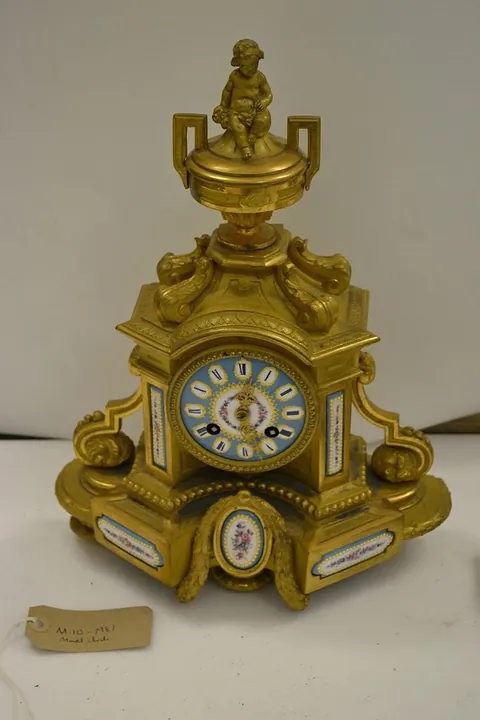
Mantel clock, French, c. 1860
Victoria and Albert Museum, London
Clocks · c. 1860
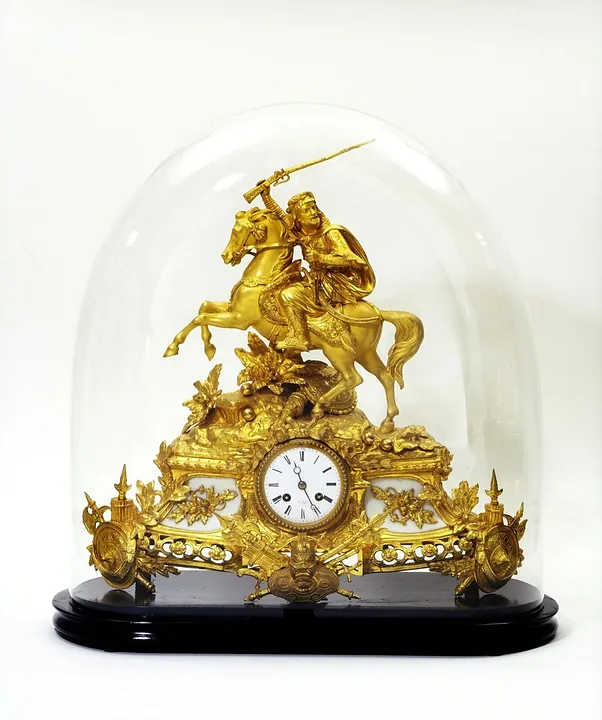
[*] French Clock under glass dome
Victoria and Albert Museum, London
Clocks · c. 1860
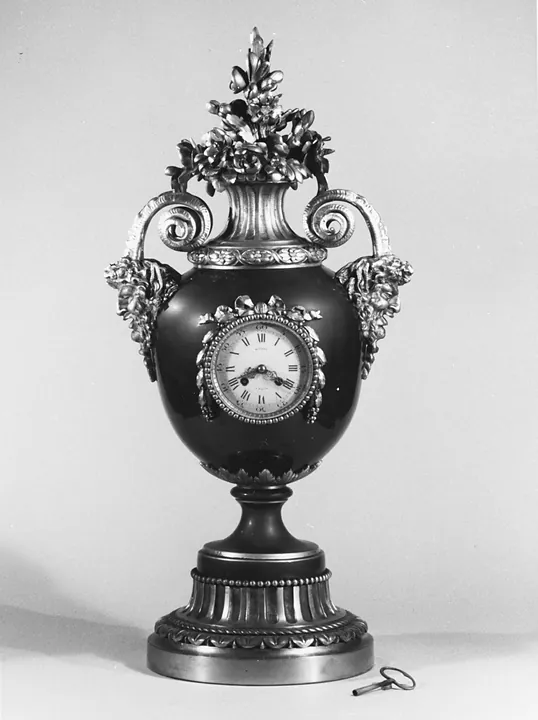
Clock by Auguste-Emile Rinquet-Leprince, France, c. 1860
The Metropolitan Museum of Art, New York
Clocks · 1860–1870
Clock by Raingo Frères, France, 1860–1870
Victoria and Albert Museum, London