
Clocks · Clock
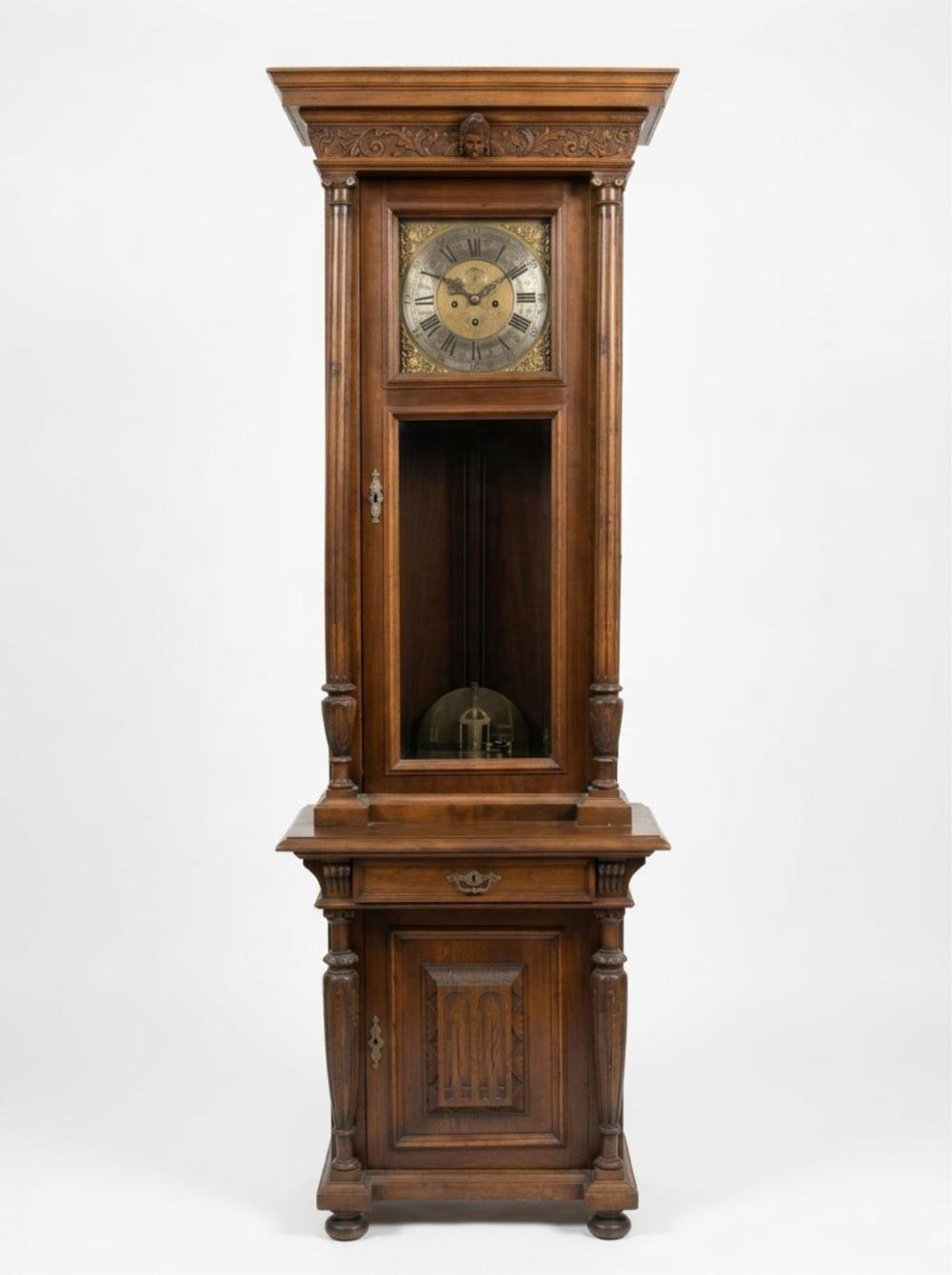
19th C. Austrian Vienna Carved Walnut Tall Clock
- Maker / attribution
- Unrecorded in source
- Date
- 19th century
- Historical period
- Precision & Scientific Horology (1750 – 1850)
- Country of origin
- Austria
- Object type
- Clock
- Materials / technique
- walnut, brass, glass
- Auction house
- Invaluable auction listings
- Lot
- Lot C65793D1C5
- Credit line
- Auction lot record: lot 69, Important California Estates Auction, California Auctioneers (2026), via Invaluable
- Catalogue title (original)
- 19th C. Austrian Vienna Carved Walnut Tall Clock (English)
View the source record (auction lot) ↗ (opens another website in a new tab)Suggest a correction
Record summary
Catalogued by Invaluable auction listings (lot Lot C65793D1C5), this is a clock, made in Austria, dated 19th century. The Atlas places it in the Precision & Scientific Horology period (1750 – 1850) of its Clocks collection. Materials and techniques recorded by the source: walnut, brass, glass. The record is illustrated with 4 photographs.
Assembled from the source record's structured fields. Dates and attributions are given as the source states them; where a field is missing the Atlas leaves it blank rather than estimating.
Catalogue description
Lot description — California Auctioneers
This 19th-century Austrian tall case clock features a walnut cabinet designed with clean Biedermeier architectural lines and deep, low-relief classical carvings. The flat, stepped-molding pediment header is underscored by a detailed frieze highlighting a centrally positioned, sculpted female face tucked among scrolling foliate vines. Fluted pilasters flank the upper square hood door, culminating in lower corner supports carved as dimensional, stylized acanthus leaf urn pods. The trunk door encloses a large glass viewport window, framed by an open keyhole plate featuring an engraved foliate motif with its original key intact. The square brass dial assembly features an ornate gilded center plate with deep foliate scroll engraving, signed below the hands by maker "Fr. Deuwagner / Wien". The center ring houses an independent subsidiary seconds dial, sweeping openwork scrollwork hands, and a square winding arbor cutout, wrapped by a wide silvered chapter ring with dark Roman hour numbers alternating with traditional fleur-de-lis interval markers. Inside the trunk, a heavy brass weight-driven mechanical movement powers a wide silvered pendulum bob decorated with a geometric Greek key border and a leafy center roundel, suspended alongside an ornate, relief-etched cylindrical brass weight. The lower base plinth stands on rounded bun feet and centers a deep, architectural raised panel inset with stylized three-panel reeded vertical carvings and a repeating side fan motif, flanked by matching leaf-carved corner pilasters. Maker Inscription: Signed "Fr. Deuwagner / Wien" to the central dial plate register. Notes 1. Renowned Maker Provenance: The dial plate is explicitly signed by Franz Deuwagner in Wien (Vienna), a documented, high-caliber 19th-century Austrian clockmaker. Unlike mass-produced Black Forest or factory-made German clocks from the late 19th century—this is an individually crafted piece from a recognized Viennese master horologists. 2. Multi-Train Weight-Driven "Regulator" Design: premium movement placed on true weight-driven Vienna regulator movements over cheaper, spring-powered variant floor clocks. The movement features an intricate open-frame design with heavy brass plates and independent winding arbors, paired with a custom-engraved silvered pendulum bob displaying a classical Greek key border. Complete, intact weight-and-pulley systems from this era inherently carry higher structural value. 3. Intermediate Subsidiary Complications: The dial assembly includes a dedicated subsidiary seconds register built directly into the upper gilded center ring. Multi-dial astronomical configurations require higher mechanical precision to manage individual gear ratios, stepping the piece out of standard household timekeeper territory and elevating its desirability among serious clock collectors.
Provenance
The dial plate is explicitly signed by Franz Deuwagner in Wien (Vienna), a documented, high-caliber 19th-century Austrian clockmaker
Historical context
Precision & Scientific Horology (1750 – 1850)
Harrison solves longitude; Mudge invents the lever; Breguet's Paris workshop defines the modern watch.
The age of the deadbeat escapement, compensated pendulums and observatory regulators. Domestic clocks spread through the middle classes: English longcase and bracket clocks, French gilt-bronze mantel clocks, Viennese Biedermeier wall clocks, Black Forest painted-shield clocks, and the first American shelf clocks.
Read the period in the timelineMore clocks from this periodEarlier: Early Modern Horology
Atlas type guide
Longcase (tall-case or grandfather) clocks
The longcase clock was born from two seventeenth-century innovations: Christiaan Huygens's pendulum (1656–57) and the anchor escapement (c. 1670). A long seconds pendulum, nearly a metre long, swings with a small arc, and enclosing it together with the driving weights in a tall wooden case protected the mechanism and created a new piece of furniture. London makers such as Ahasuerus Fromanteel, Thomas Tompion and Joseph Knibb set the pattern.
By the eighteenth century longcase clocks were made throughout Britain, the Netherlands, Scandinavia (the Swedish Mora clock), France (the Comtoise from the Franche-Comté), Germany and colonial America. Eight-day movements with two weights became standard in better clocks; thirty-hour clocks with one weight and a rope or chain were cheaper alternatives.
What to look for
- Winding holes in the dial: two (eight-day, going and striking) or none (thirty-hour, pulled up by a chain).
- Brass dials with applied chapter rings (earlier) versus painted iron 'white' dials (after c. 1770 in Britain).
- Moon-phase arches, date apertures, seconds dials and maker's name on the dial.
- Case woods and style: ebonised, walnut marquetry, lacquer, oak or mahogany; regional styles from London, Lancashire, Scotland or America.
- Whether the movement and dial match the case — 'marriages' are common.
Dating clues
- Square brass dials suggest c. 1670–1720; arched brass dials c. 1715–1790.
- Painted (white) dials were made by Birmingham dial-makers from about 1772.
- Comtoise clocks with repoussé pendulums are mostly nineteenth century.
General guidance written by the Atlas editors about this kind of object. It is not a statement about this particular piece; for that, rely on the source record above and on physical examination.
Read next:Anchor (recoil) escapementDeadbeat escapementAnchor escapement
Related records
Clocks · 1814–1837
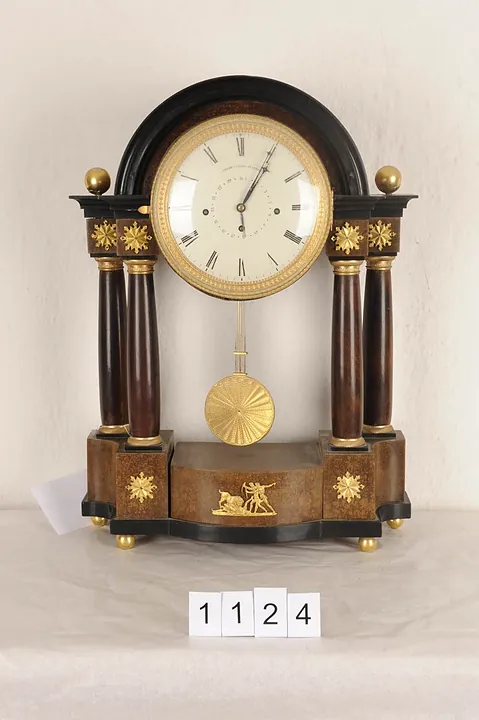
Table clock, Austria, 1814–1837
Treasury of Zwettl Abbey
Clocks · c.1830
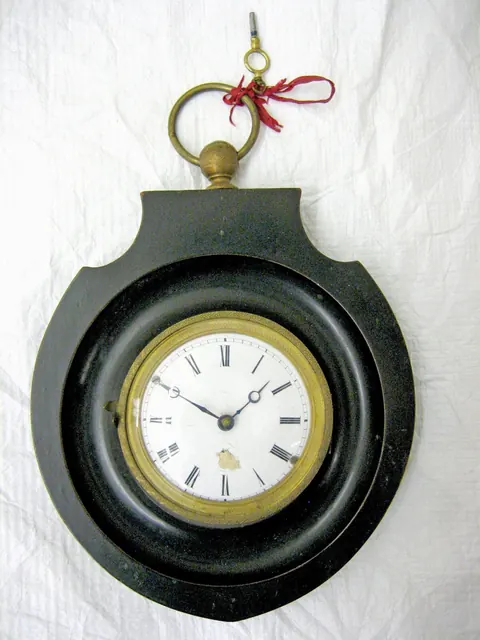
Clock, Austria, c.1830
Victoria and Albert Museum, London
Clocks · c.1830
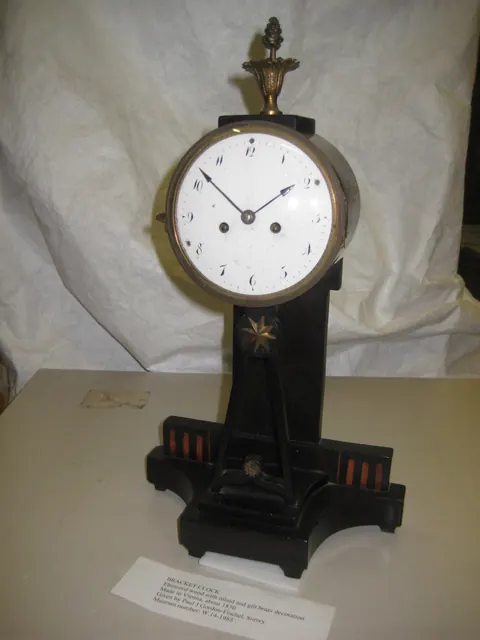
Clock, Austria, c.1830
Victoria and Albert Museum, London
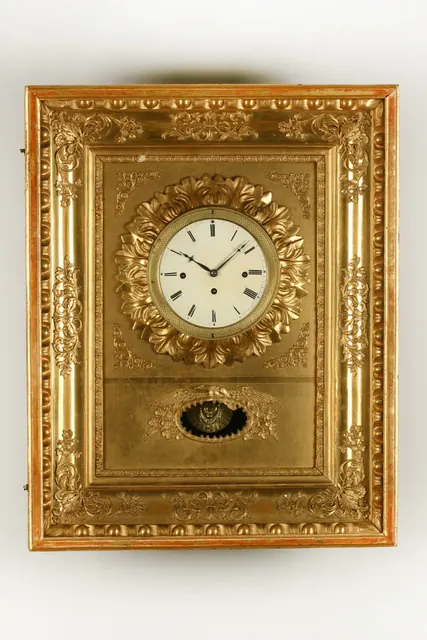
Clocks · c. 1840
Wall clock by Anton Olbrich, Austria, c. 1840
German Clock Museum
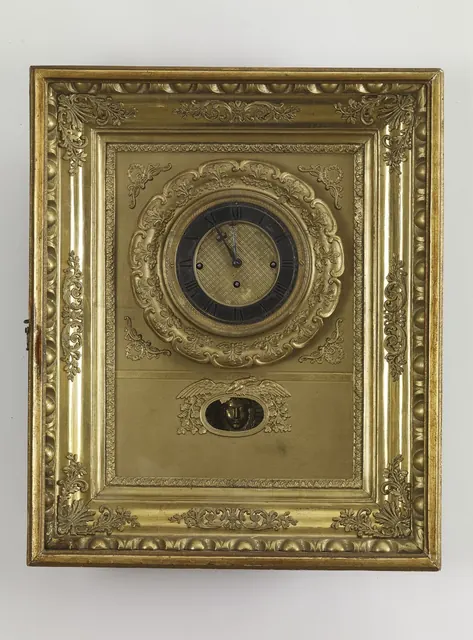
Clocks · 1820–1840
Wall clock, Austria, 1820–1840
Suomen kansallismuseo
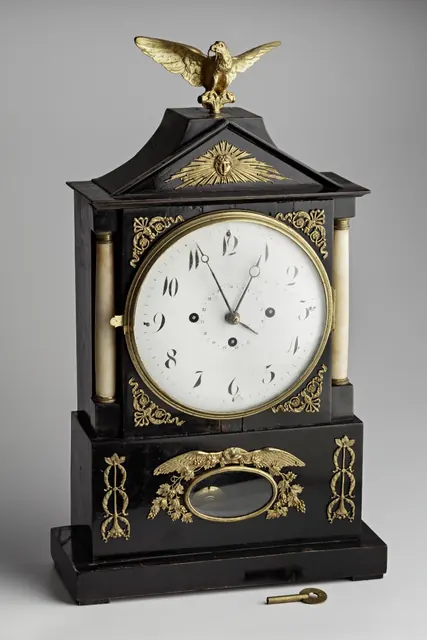
Clocks · 1831–1840
Table clock by Matthias Müller, Austria, 1831–1840
Suomen kansallismuseo

Clocks · 1830s
Picture clock with Alster panorama
Museum für Hamburgische Geschichte
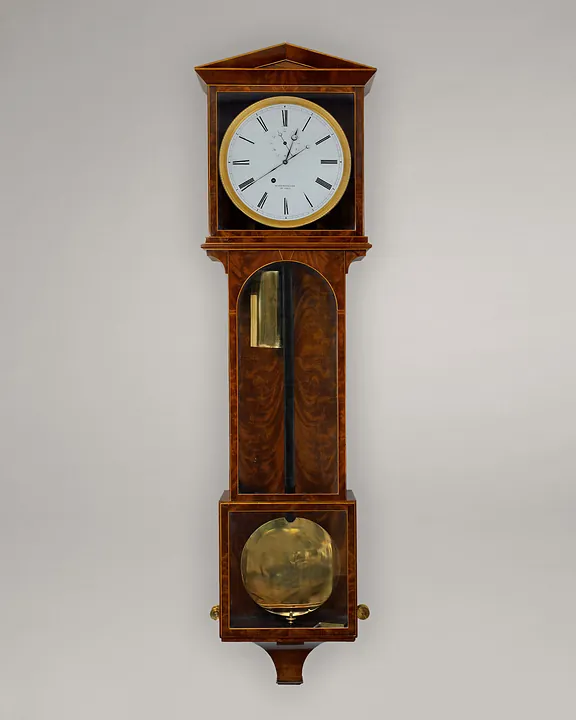
Clocks · c. 1835
Ignaz Marenzeller in Wien, c. 1835
Howard Walwyn Fine Antique Clocks (dealer), London