
Horological History · Historical feature
The Cuckoo Clock: A History of the Black Forest Clock, from Wooden Wheels to the Railway House
Who invented the cuckoo clock, why it is German rather than Swiss, how the two-note call is made, and how to date one — told through painted shield clocks, automata and carved hunting pieces in the collections of the German Clock Museum in Furtwangen and other museums.
Atlas Editorial · · 16 min read
German Clock Museum · CC BY-SA — permission review · source (opens another website in a new tab)
Few clocks are recognised as instantly as the cuckoo clock. A little wooden house hangs on the wall, two cast-iron weights shaped like pine cones dangle on chains beneath it, and every hour a door flies open and a carved bird bows, flaps its wings and calls out the time in two notes. It is sold today in airport shops from Frankfurt to Tokyo, and for many people it stands for clocks in general. Yet behind the souvenir lies a long and genuinely interesting history: of farmers who made clocks in winter, of peddlers who carried them on their backs across Europe and to America, of a design competition run by a state school, and of an industry that turned a remote upland region of south-west Germany into one of the world's great clock-producing centres.
This feature follows that history through real objects. Most of them come from the Deutsches Uhrenmuseum (German Clock Museum) in Furtwangen, the town at the heart of the Black Forest clock trade, whose collection began as a teaching collection for the local clockmaking school. Where an object's story is uncertain, as several of them are, we say so.
A bird before the Black Forest
The idea of a mechanical bird that calls is older than the Black Forest clock. Organ builders and makers of automata in the 16th and 17th centuries delighted in imitating birdsong with small pipes and bellows, and the cuckoo, with its simple two-note call, was an obvious subject. The most frequently quoted early text is the Jesuit scholar Athanasius Kircher's Musurgia universalis, published in Rome in 1650. In its ninth book, on the 'magic' of sound, Kircher describes musical automata driven by a pinned barrel, including a mechanical cuckoo that calls in two notes, and he illustrates how pipes and bellows can be set in motion by clockwork. Earlier still, an account by the Augsburg art agent Philipp Hainhofer from 1629 is often cited as describing a clock with a cuckoo in the collection of the Elector of Saxony.
These sources show that the cuckoo call was a known mechanical trick long before it became the trademark of an entire region. They do not show a continuous line of descent from a princely curiosity to the Black Forest wall clock, and historians are cautious about drawing one. What made the cuckoo clock famous was not its invention but its production: the Black Forest turned it into an affordable object made in tens of thousands.
Winter work in the hills: the first Black Forest clocks
The Black Forest is a range of wooded hills between the Rhine and the upper Danube. In the 17th and 18th centuries it was a poor region of scattered farms, long winters and inheritance rules that left many younger sons without land. Clockmaking began there as a cottage industry. Farmers and their families made simple wooden clocks during the winter months, using the materials they had to hand: beech and other hardwoods for the plates and wheels, hand-cut wooden pinions, and later brass only where wear demanded it.
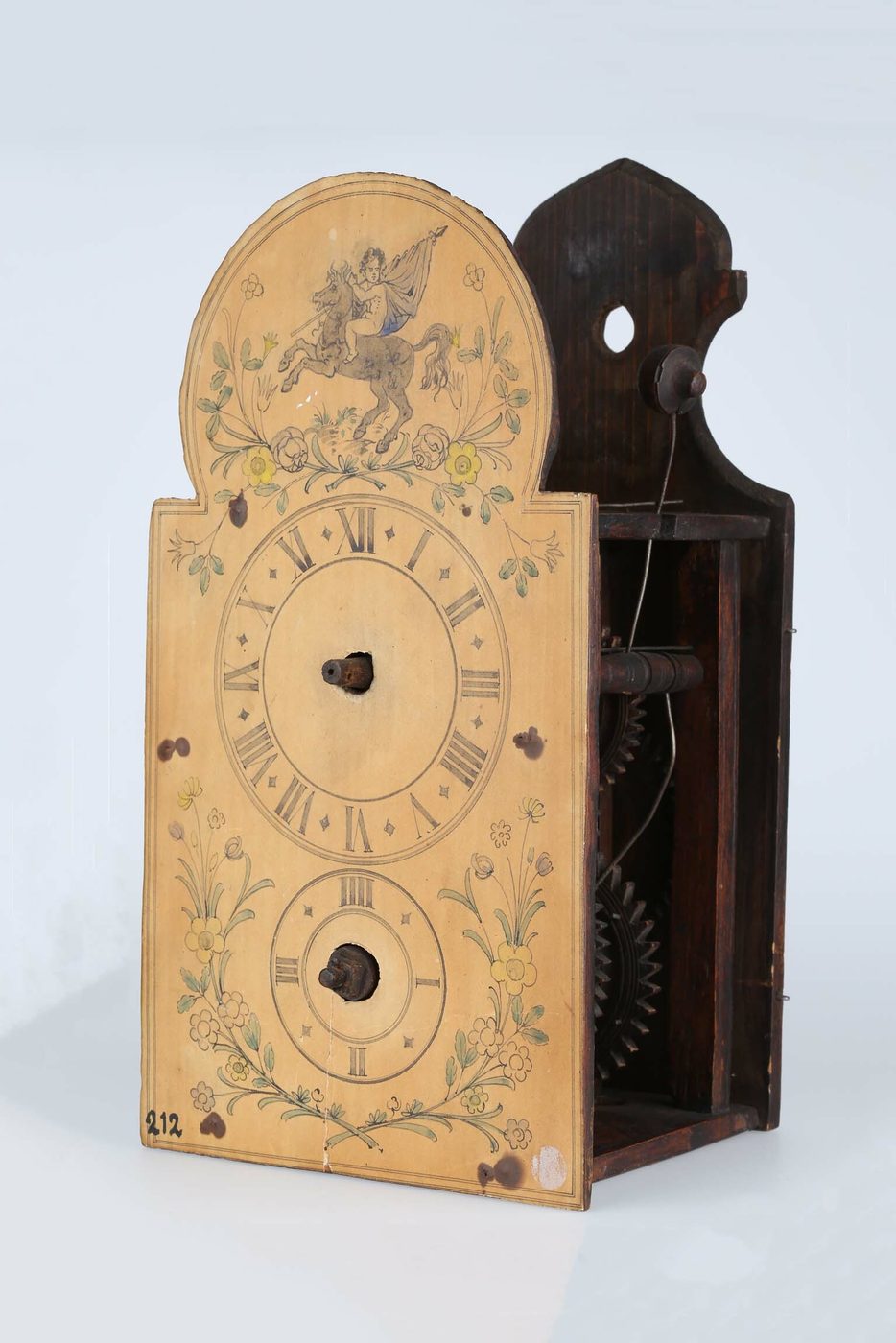
The museum's own account of this clock is a small history of the subject. In 1852 the newly founded Grand Ducal Baden clockmaking school in Furtwangen began to assemble a collection of historical Black Forest clocks, and naturally wanted an example from the very beginning of the trade. That proved difficult. Only on 10 April 1860, after a long search, could the school present what is still the oldest known Black Forest clock. It had been found in the Renchtal, on the western edge of the Black Forest, and probably dates from the first half of the 18th century. It already shows the typical construction of the later Black Forest wooden movements: no case of its own, just two plain boards as side doors. Collectors and historians have searched ever since, and no demonstrably older Black Forest clock has been found.
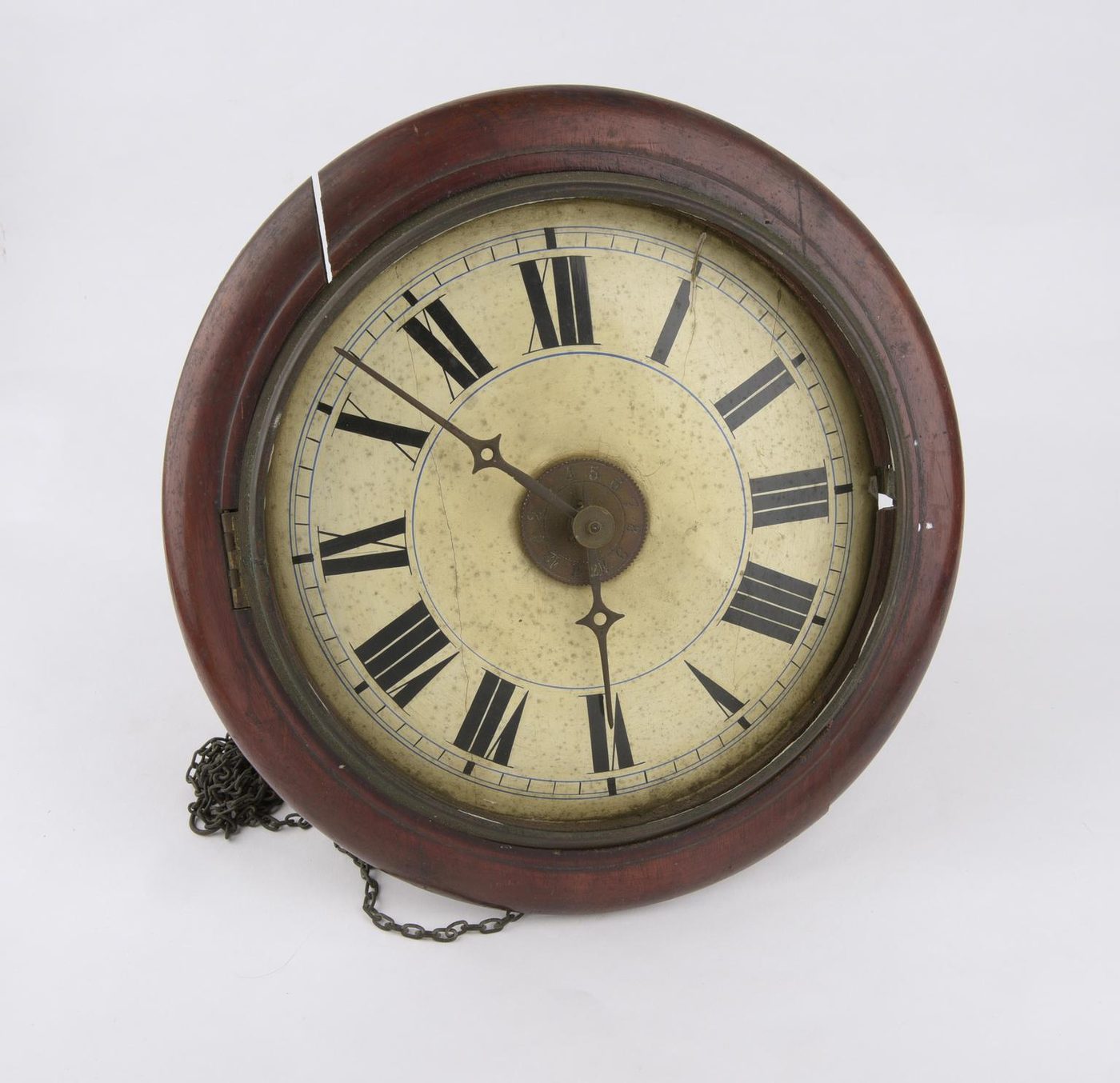
Early clocks of this kind were regulated by a foliot or balance beam (in German Waag or Waagbalken), a horizontal bar with weights swinging to and fro above the movement. During the 18th century the short pendulum, often hung in front of the dial, replaced it. These were one-day clocks with a single hand on the earliest examples, wound by pulling up a weight on a cord or chain. They were cheap, robust, easy to repair, and could be made in quantity by families working to a pattern.
The clock carriers: selling to the world
What turned a winter craft into an industry was trade. From the late 18th century Black Forest merchants sold their clocks across Europe and even overseas. The clock carriers (Uhrenträger), carrying racks of clocks on their backs, walked to markets far beyond the region, and trading companies with partners abroad followed. Black Forest clocks reached France, the Netherlands, Britain, Russia, the Ottoman Empire and the Americas. The economic historian David Landes, in Revolution in Time, treats the region as one of the great centres of cheap domestic clock production before American factory clocks challenged it in the 19th century.
Selling into distant markets shaped the clocks themselves. Painters adapted the dials to local taste, makers chose materials that would survive long journeys, and some clocks were made specially for buyers who counted time differently. Three objects in the Furtwangen collection show this export trade clearly.
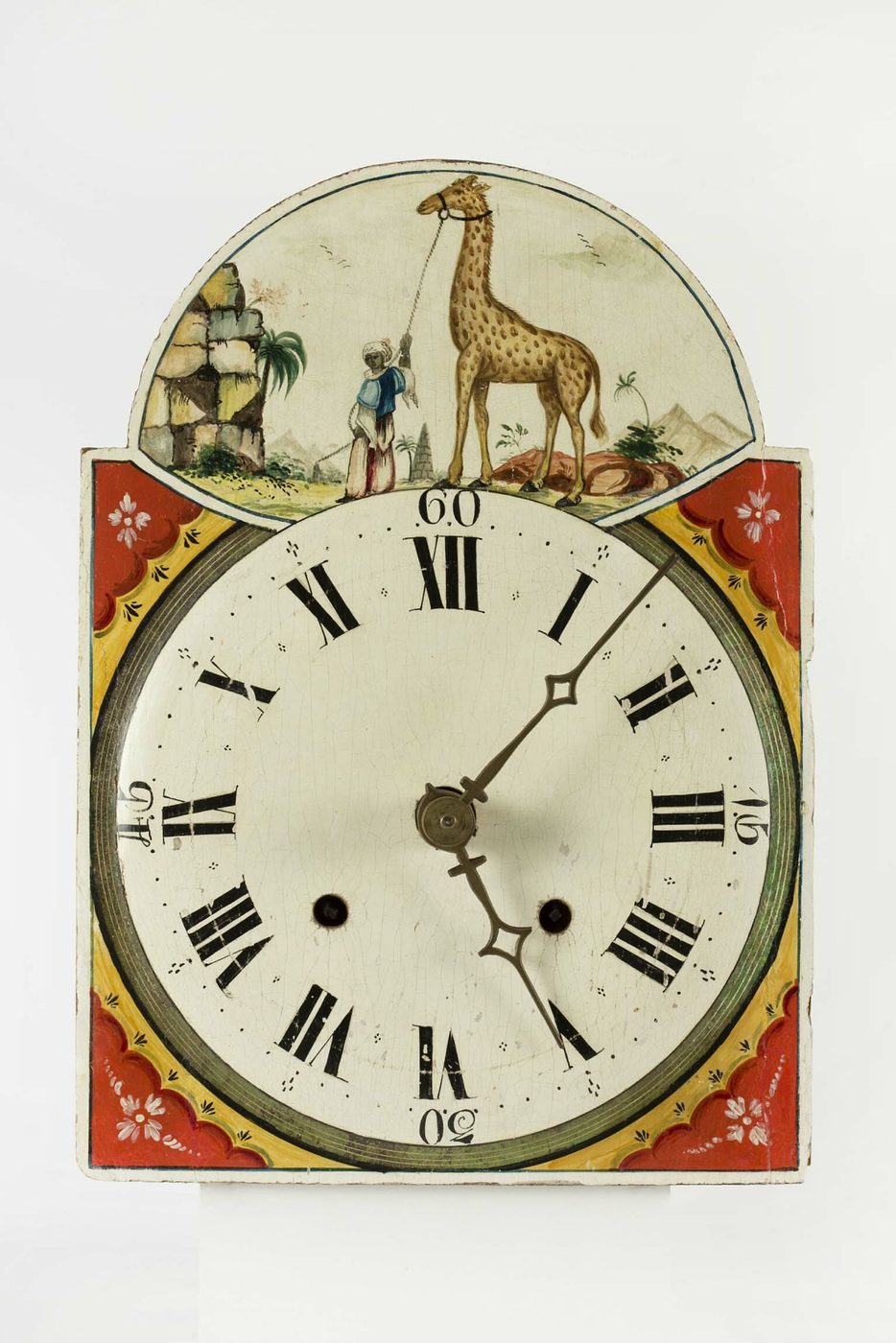
- France, c. 1830: when the first giraffe for more than 300 years arrived in Europe in 1827, the animal, called Zarafa, set off a fashion for giraffe motifs in France. Orders from French clock dealers brought the fashion to the Black Forest, and dial painters copied popular lithographs, complete with the red amulet and two Egyptian keepers.
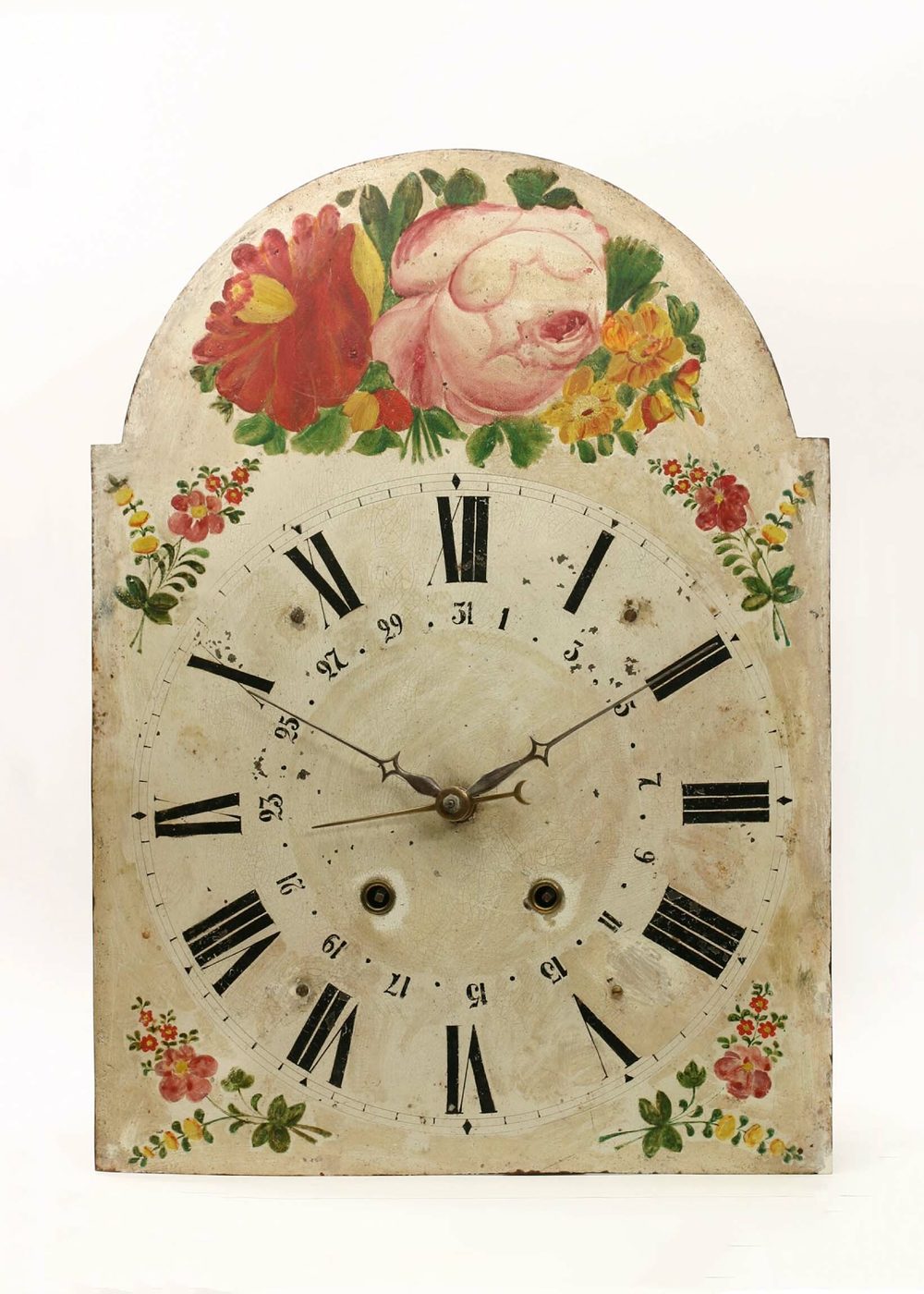
- Overseas, c. 1850: a clock by Lorenz Bob, a leading Furtwangen clockmaker and later a teacher at the clockmaking school, has a painted dial of sheet metal rather than wood. The museum suggests it may have been made for export overseas, since wooden dials could warp on a long sea voyage; Bob is documented as having made clocks that were delivered to the United States.
- The Ottoman Empire: a painted shield clock with a movement by Lorenz Furtwängler of Neukirch, about 1860, has a dial painted in 1908 by Josef Tritschler with Ottoman (Eastern Arabic) numerals, as used for timekeeping in the Ottoman Empire until the end of the First World War.
The painted shield clock: the everyday Black Forest clock
For most of the 19th century the typical Black Forest clock was not a cuckoo clock at all but the painted shield clock or Lackschilduhr: a wooden movement behind a square wooden dial board with a rounded arch on top, painted in bright lacquer colours with flowers, figures, buildings or scenes, and protected by a coat of varnish. Clocks like this hung in farmhouses and town kitchens across Europe. Many museum catalogues, including the online records from which these figures come, group shield clocks and cuckoo clocks together under one heading, 'cuckoo / Black Forest clock', because they share the same movements and makers. Several of the clocks shown here are shield clocks without a bird.
Shield clocks were also personal objects. Many were given as wedding presents, and the couple's names were painted on the dial. One in the Furtwangen collection bears the names of Josef and Josefa Matt, who married in 1870; its movement was made by the clockmaker Joseph Haas. Another, with an eight-day movement striking the quarters, was made for the wedding of Joseph Zähringer and Johanna Fehrenbach in 1897, with a dial signed by Josef Turner of Furtwangen.
| Type | German name | Period | What to look for |
|---|---|---|---|
| Wooden-wheel wall clock | Holzräderuhr | 18th century onwards | Wooden plates and wheels, board side doors, foliot or short pendulum, one-day weight drive |
| Painted shield clock | Lackschilduhr | c. 1770s–1900 | Square wooden dial with painted arch, lacquer colours, often a wedding or export motif |
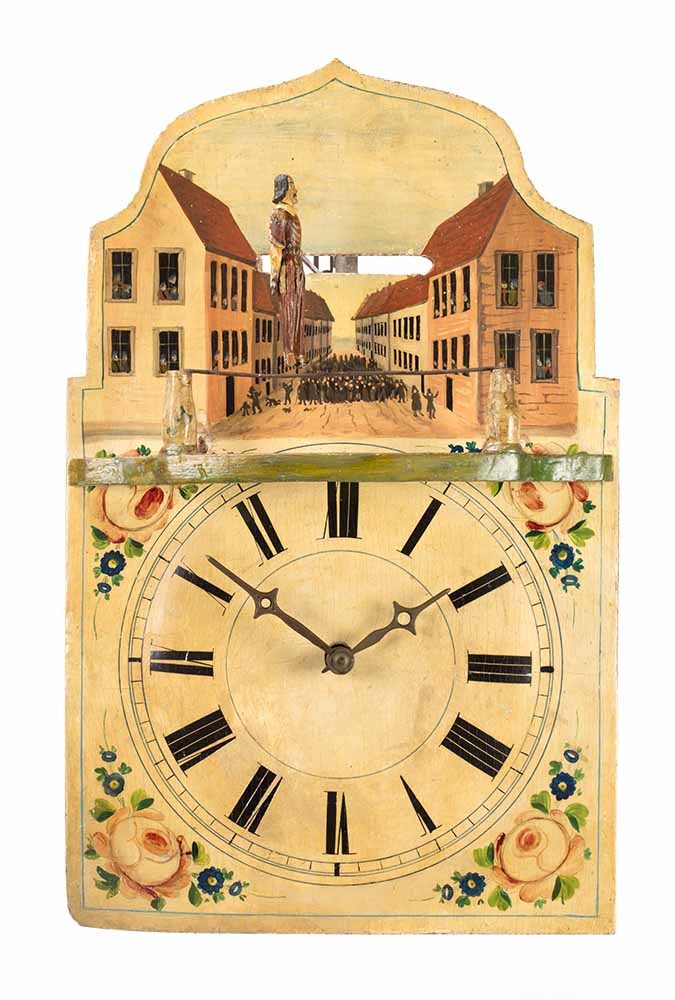
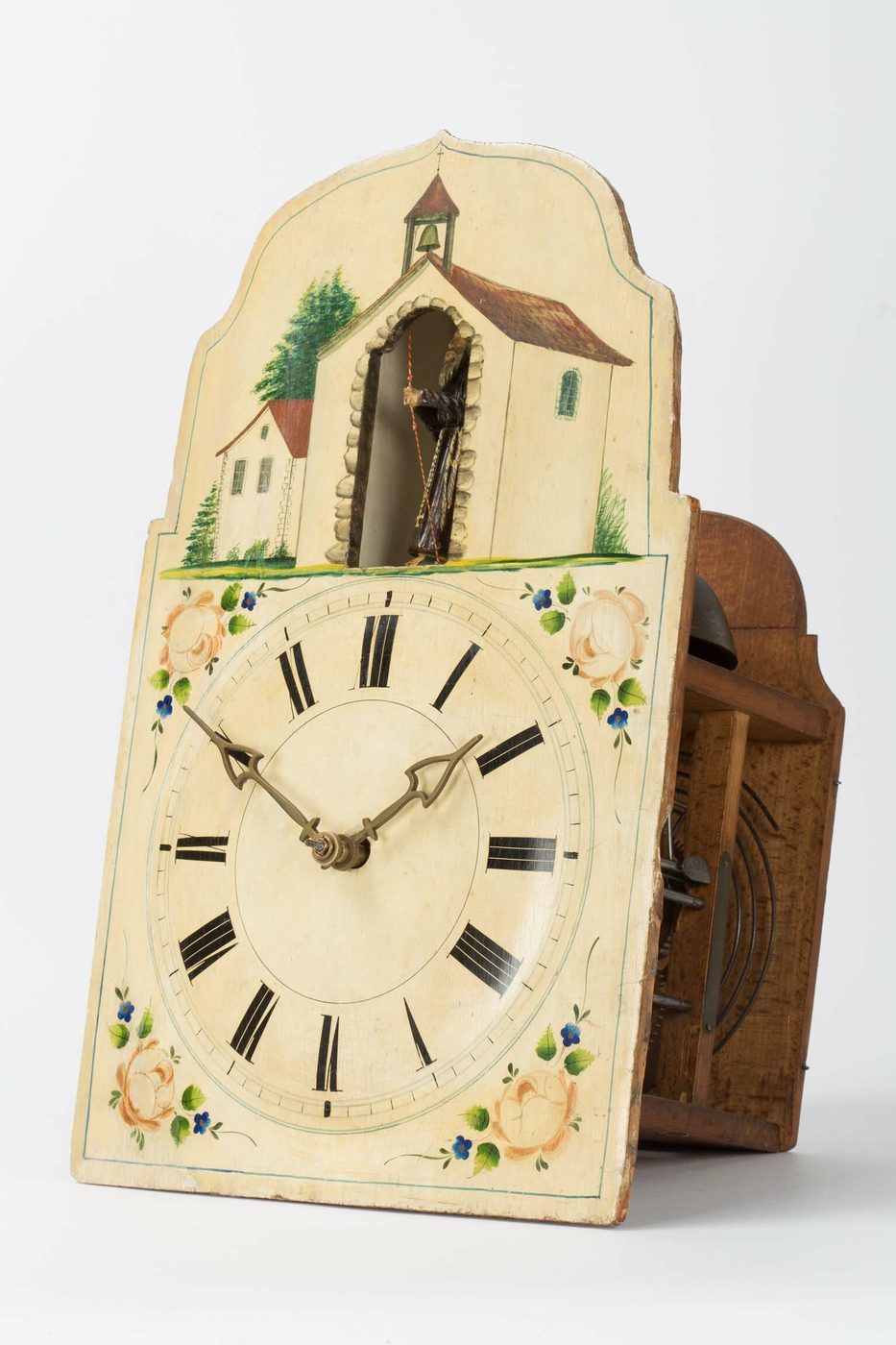
| Automaton clock | Figurenuhr | 18th–19th century | Moving figures driven by the pendulum or striking train: eye-rollers, tightrope walkers, monks ringing bells |
| Railway-house cuckoo clock | Bahnhäusleuhr | From the 1850s | Gabled house-shaped case with fretwork or painted front, cuckoo door above the dial |
| Carved 'hunting piece' | Jagdstück | Later 19th century onwards | Carved oak or vine leaves, deer heads, game birds, crossed rifles, an eagle or stag on top |
| Mantel or bracket cuckoo | Kuckucksuhr (Stockuhr) | Later 19th century | Spring-driven movement in a standing case, sometimes with a music box |
| Quail clock | Wachteluhr | 19th century | A second bird and pipe imitate a quail at the quarters, with the cuckoo at the hour |
Clocks that perform: Black Forest automata
Black Forest makers were not content with a dial. Figures that moved in time with the pendulum or performed when the clock struck were a speciality of the region from the 18th century, and they show the same delight in mechanical theatre as the cuckoo.
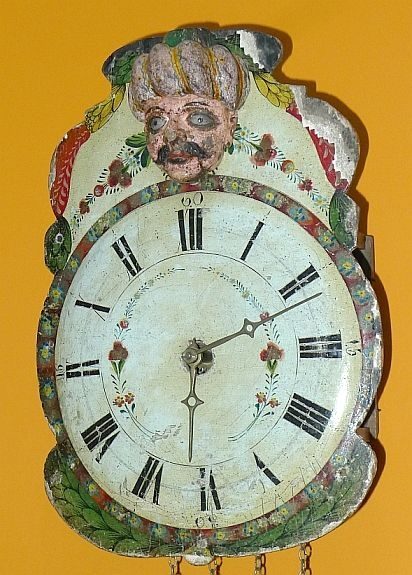
The Badisches Landesmuseum in Karlsruhe describes the 'eye-roller' (Augenwender) as a popular figure of Black Forest automaton making: the eyes are synchronised with the pendulum, and at the hour the figure gapes its mouth. Its shield was milled out afterwards to take the figure, so it was not designed for it in the first place; the museum concludes that customer demand led to the adaptation. Turkish figures began to appear on Black Forest clocks in the 18th century, after the last Ottoman wars had turned the once-feared Ottoman soldier into a figure of popular entertainment and fashion in Western Europe.
1850: the school, the competition and the railway house
By the middle of the 19th century the Black Forest clock trade was in trouble. Factory-made American clocks, made of stamped brass and sold very cheaply, were taking markets the hand-made wooden clocks had held for a century. The Grand Duchy of Baden responded by founding a clockmaking school in Furtwangen in 1850, the Großherzoglich Badische Uhrmacherschule, under the engineer Robert Gerwig. Its task was to modernise the trade: to teach better methods, to improve designs, and to help local makers compete.
One of the school's first initiatives was a design competition for new, more fashionable clock cases. The winning entry, by the architect Friedrich Eisenlohr, who designed buildings for the Baden state railway, proposed a case in the form of a railway lineman's house, with a pitched roof and decorated gable. The idea of the Bahnhäusle, the 'little railway house', took hold. It is the direct ancestor of the classic cuckoo clock case, with the bird's door set in the gable above the dial.
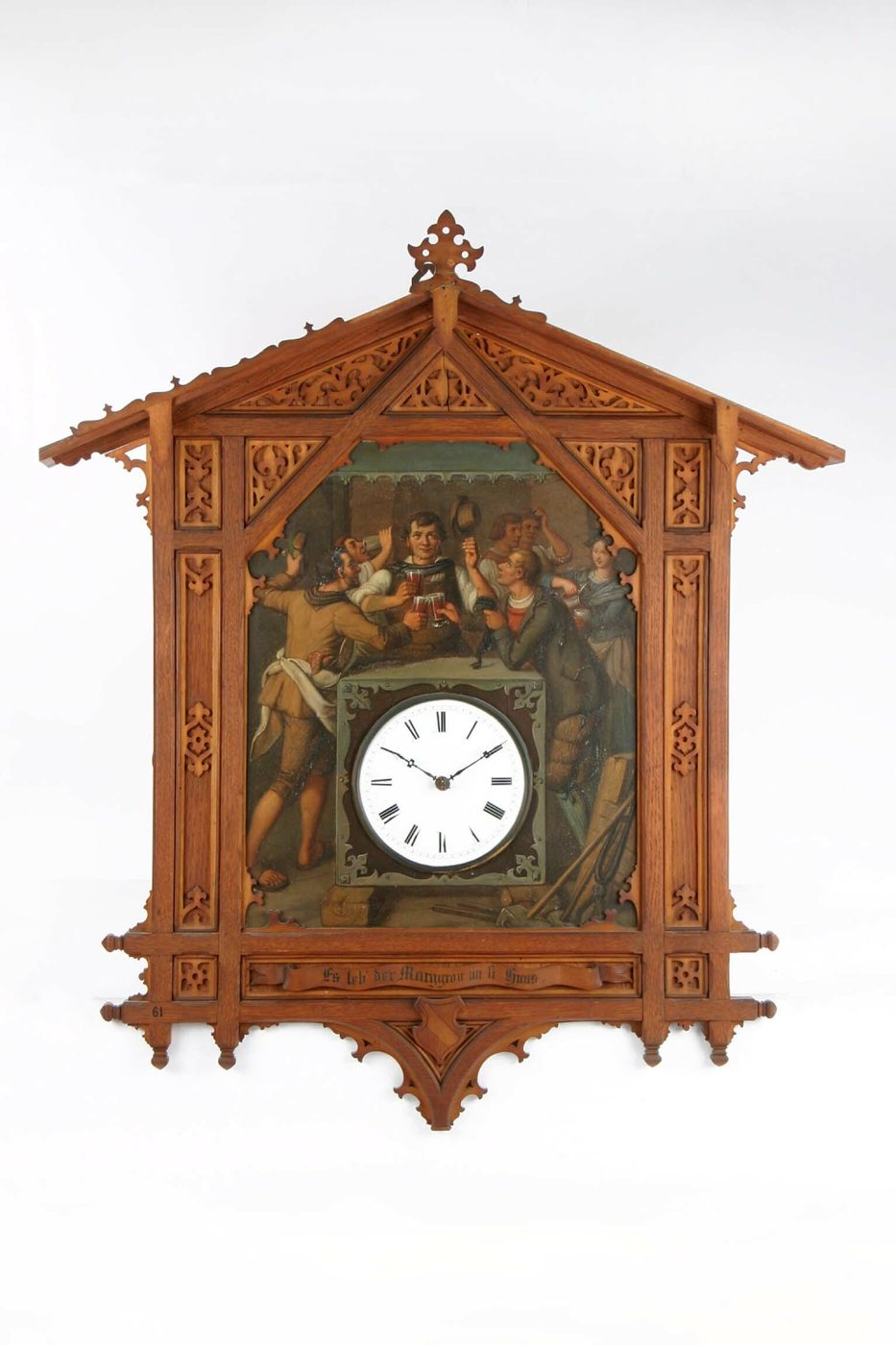
The school's railway-house clocks were used as pattern cases (Mustergehäuse) for local makers to copy. The Furtwangen museum holds several: one of 1860 with a painted front designed by Heinrich Frank and painted by Johann Baptist Laule, another of 1861 painted by Laule, and a third whose case was made by August Tritschler of Furtwangen. These early railway houses are flatter and more architectural than later cuckoo clocks, closer to a framed painting under a roof than a carved chalet, but every element of the later form is there.
Leaves, stags and eagles: the hunting piece
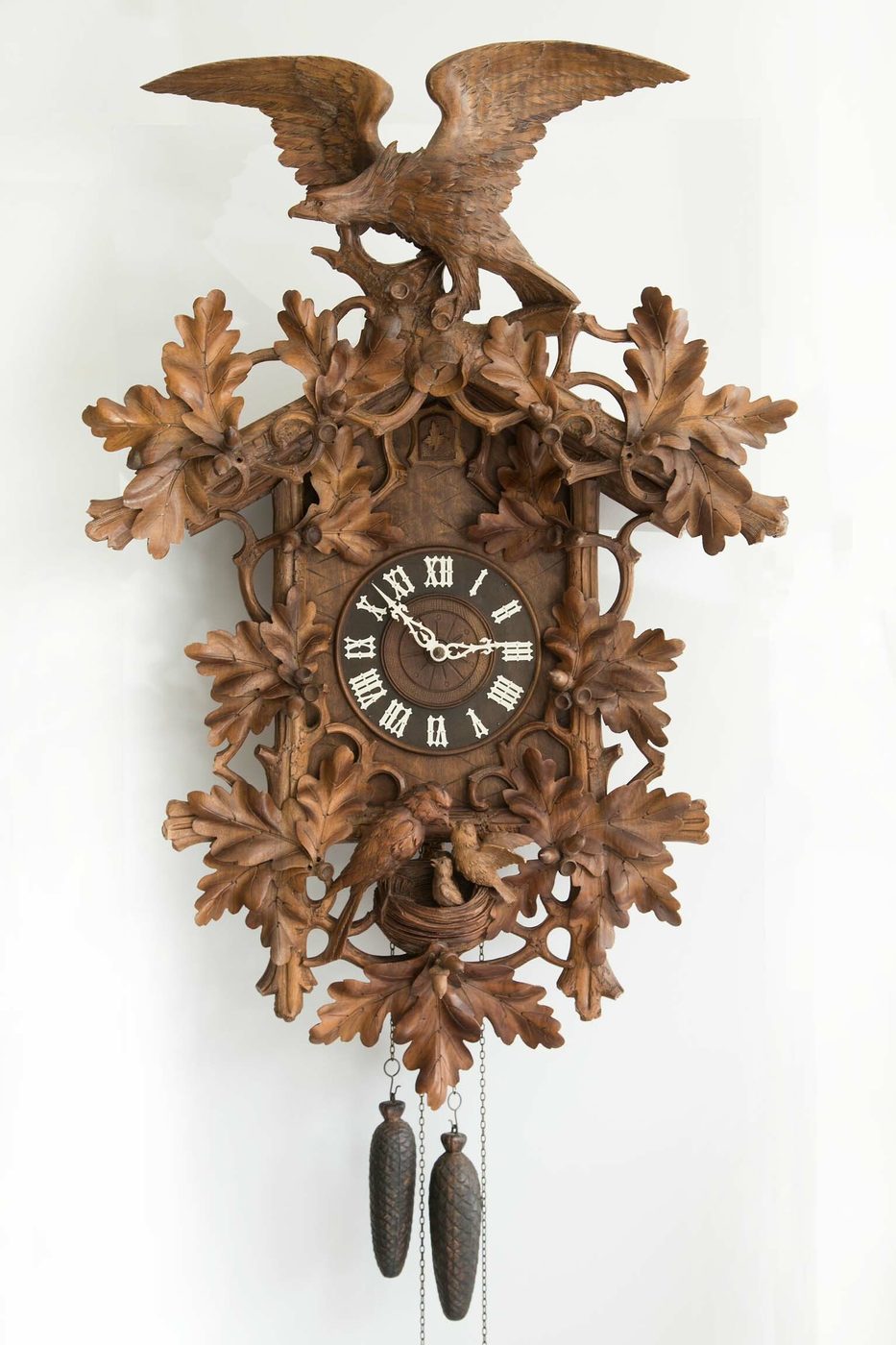
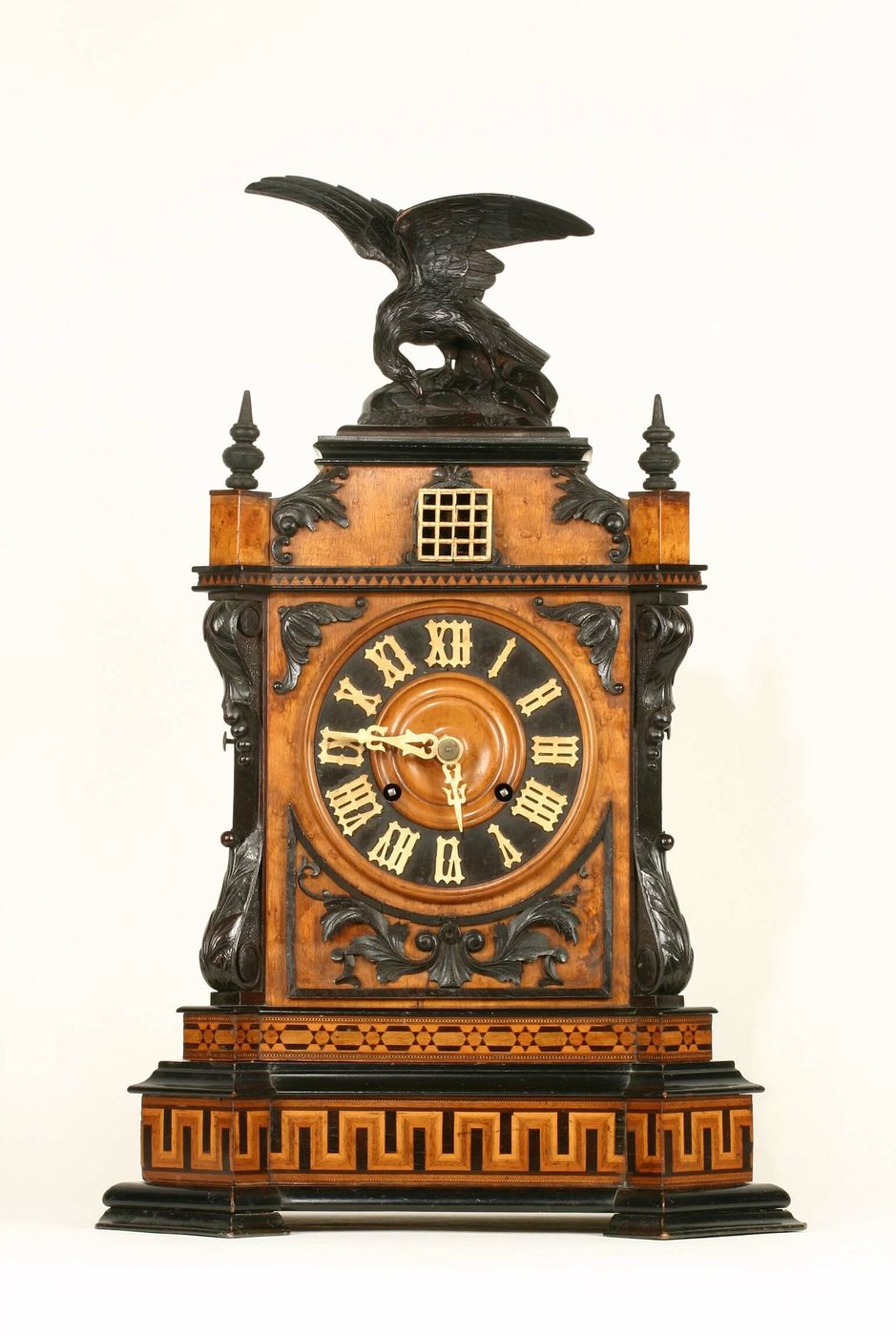
The cuckoo clock most people picture today came a little later. In the second half of the 19th century carvers began to cover the railway house with deeply cut leaves, branches and animals, until the house itself almost disappeared. The most famous form is the Jagdstück, the 'hunting piece', with game birds, hares, deer heads, hunting horns and crossed rifles, often crowned by an eagle or stag. These clocks were showpieces for the bourgeois parlour and for export, and they made Black Forest wood carving famous alongside its clocks.
At the top of the market, cuckoo clocks became elaborate pieces of furniture. A standing cuckoo clock attributed to Johann Baptist Beha of Eisenbach, about 1885, has a wooden-plate movement driven by a spring with a fusee, running for eight days, and a music box in its base. Beha's firm, founded in the mid-19th century, is among the best-known makers of quality cuckoo clocks, and its work is keenly collected today.
How the cuckoo calls: the mechanism
A traditional cuckoo clock has two trains of wheels side by side: a going train that drives the hands, regulated by a pendulum and a simple anchor escapement, and a striking train that sounds the hours. Each train has its own weight, which is why a classic cuckoo clock has two pine cones (three, if it also plays a tune). The cuckoo itself is part of the striking train.
- As the hour approaches, a pin on the going train lifts the warning lever, and at the hour it releases the striking train.
- A count wheel (locking plate) with notches of increasing spacing lets the striking train run for the right number of blows: one at one o'clock, twelve at twelve.
- For each blow, pins on a wheel lift two wires attached to small bellows on top of the movement. Each bellows feeds a wooden pipe, and the two pipes are tuned to different notes.
- The bellows drop one after the other, the higher pipe first, giving the falling two-note 'cuck-oo'. At the same moment a lever pushes the bird forward through the door, opens its beak and flaps its wings.
- Many cuckoo clocks also strike a wire gong for each hour, and a half-hour signal of a single call is common.
The bellows are traditionally made of thin wood with paper or fine leather hinges; old paper cracks and leaks, which is why many old cuckoo clocks call weakly or not at all until the bellows are re-covered. One-day clocks, which need their weights pulled up every day, are the traditional type; eight-day movements, with heavier weights, became common later. Quail clocks add a third bellows and pipe for the quail's call at the quarters.
From workshops to factories
The Furtwangen school and its design reforms were only part of the response to American competition. From the 1860s Black Forest entrepreneurs began to adopt factory methods themselves, building brass movements with stamped plates and interchangeable parts. Junghans in Schramberg, founded in 1861, grew into one of the largest clock factories in the world by the early 20th century, and Kienzle in Schwenningen became another major manufacturer. The traditional cuckoo clock survived alongside this industry, increasingly with brass movements bought in from specialist makers and fitted into carved cases.
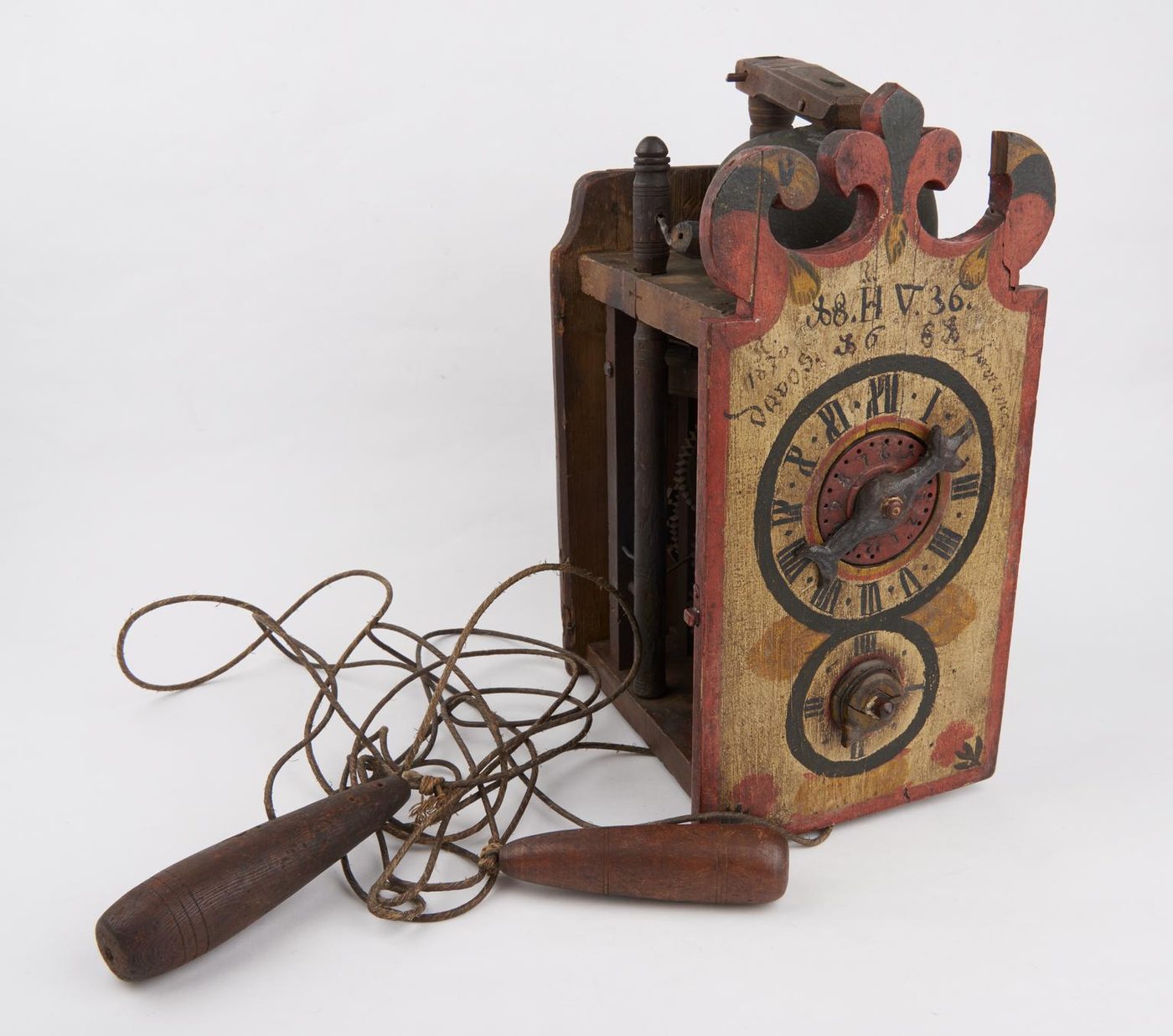
The cuckoo clock's identification with Switzerland, by contrast, is largely a matter of tourism and film. Swiss souvenir shops have long sold them, and Orson Welles's line in The Third Man (1949), in which Harry Lime credits five hundred years of Swiss democracy with producing only the cuckoo clock, fixed the association in the popular mind. The Swiss did make wooden clocks, as the Davos example above shows, but the cuckoo clock as an industry and a design is a product of the German Black Forest.
How to date a cuckoo clock
Cuckoo clocks were made in very large numbers over two centuries, and the same designs were repeated for decades. No single feature dates a clock, but several together narrow it down. The following clues apply to clocks of all qualities.
| Feature | Earlier | Later |
|---|---|---|
| Movement plates | Wooden plates and wooden-arbored wheels | Brass plates (increasingly from the later 19th century) |
| Case form | Painted shield or flat railway-house front | Deep-carved leaves and animals; chalet cases with moving figures (20th century) |
| Dial | Painted wood or metal, often with painted scenes | Carved wood with applied bone or plastic numerals |
| Bellows covers | Paper or fine leather | Synthetic fabric (modern replacements also common) |
| Duration | One-day weight drive | Eight-day movements more common |
| Country mark | Usually no country of origin | 'Germany' (export, especially after 1891), 'Made in Germany', occupation-era marks such as 'US Zone' (late 1940s), 'Made in West Germany' (1949–1990) |
A country-of-origin mark is useful but not decisive. Export rules in Britain (from 1887) and the United States (from 1891) encouraged 'Made in Germany' and 'Germany' marks, so their absence suggests, but does not prove, an earlier date or a clock sold within Germany. Signatures on the movement or dial are often those of the dealer, the shield painter or the case maker rather than the movement maker, as the Angelus clock above shows. A clock with a wooden movement and a painted shield is likely to be 19th century or earlier; a carved cuckoo clock with a brass movement stamped with a factory trademark is almost certainly later.
Seeing Black Forest clocks today
The Deutsches Uhrenmuseum in Furtwangen, successor to the school collection begun in 1852, is the place to see the full story, from the Gfell clock to factory production. The Badisches Landesmuseum in Karlsruhe holds Black Forest clocks among its regional collections, and the Science Museum in London has wooden clocks and later Black Forest alarm clocks. Many smaller museums in the region show local clocks, and auction houses across Europe and North America regularly sell Black Forest shield clocks, automata and carved cuckoo clocks.
- Browse the Atlas catalogue for Black Forest clocks and painted shield clocks from the German Clock Museum.
- Read about the pendulum and the anchor escapement in the mechanisms encyclopedia.
- See the Junghans and Kienzle maker profiles for the factory era of Black Forest clockmaking.
Sources & further reading
- Musurgia universalis, sive Ars magna consoni et dissoni (vol. 2: books VIII–X) — Athanasius Kircher, Heirs of Francesco Corbelletti (Rome), 1650.
- Revolution in Time: Clocks and the Making of the Modern World — David S. Landes, Harvard University Press, 1983.