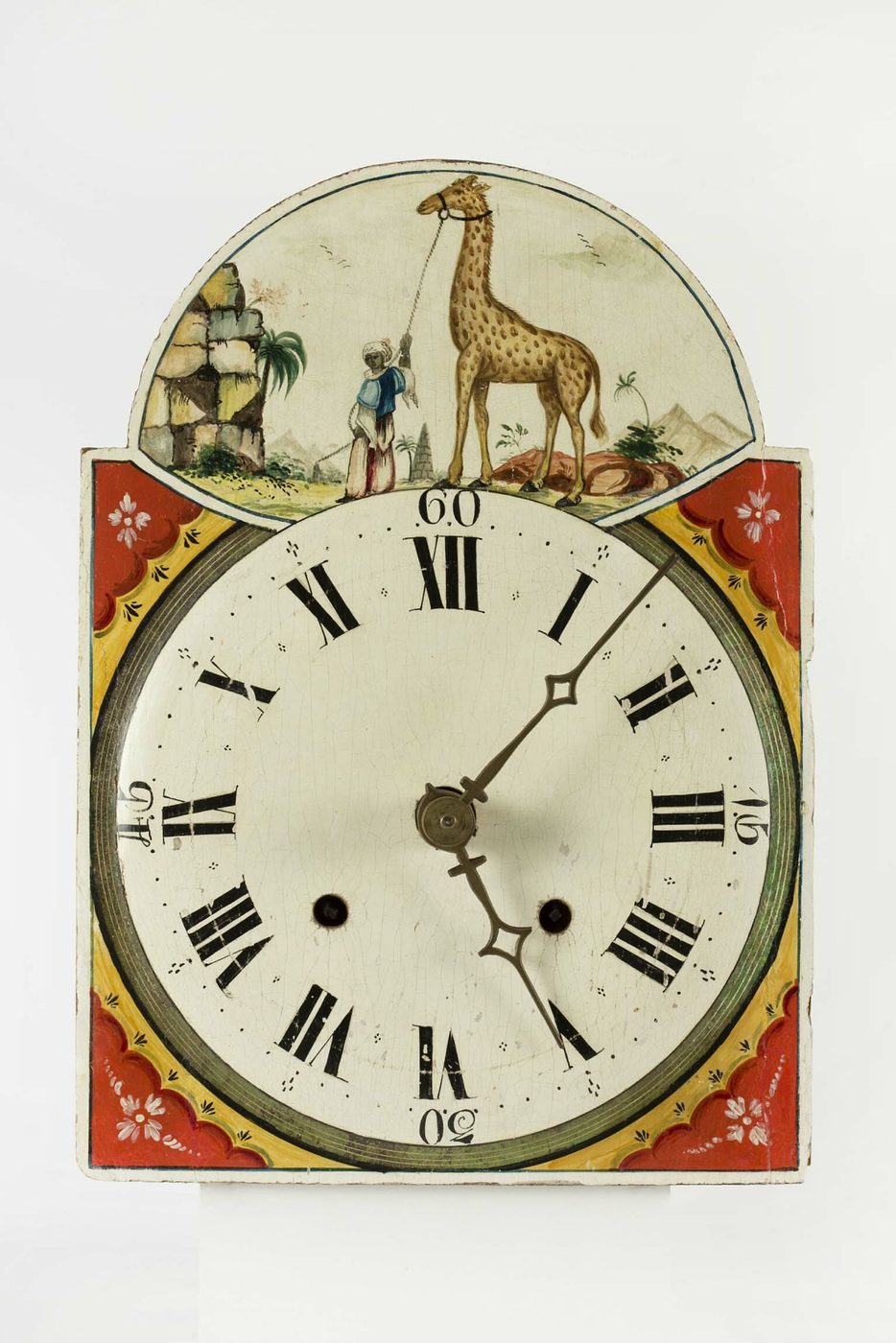
Clocks · Cuckoo / Black Forest clock
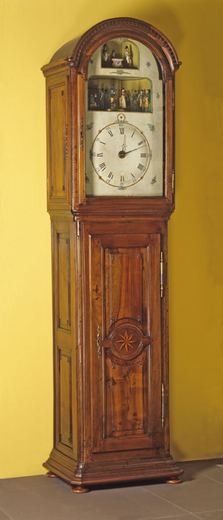
Cuckoo / black forest clock by Joseph Hummel (Uhrmacher), Germany, 1830
- Maker / attribution
- Joseph Hummel (Uhrmacher) (creator)
- Date
- 1830
- Historical period
- Precision & Scientific Horology (1750 – 1850)
- Country of origin
- Germany
- Place
- Furtwangen im Schwarzwald
- Object type
- Cuckoo / Black Forest clock
- Holding institution
- German Clock Museum
- Accession / object no.
- Museu_ProvidedCHO_museum_digital_57151__technical_number_
- Catalogue title (original)
- Lackschilduhr, Joseph Hummel, Furtwangen, um 1830 (German)
Record summary
Held and catalogued by German Clock Museum (object number Museu_ProvidedCHO_museum_digital_57151__technical_number_), this is a cuckoo / black forest clock by Joseph Hummel (Uhrmacher), made in Furtwangen im Schwarzwald, Germany, dated 1830. The Atlas places it in the Precision & Scientific Horology period (1750 – 1850) of its Clocks collection. The record is illustrated with 1 photograph.
Assembled from the source record's structured fields. Dates and attributions are given as the source states them; where a field is missing the Atlas leaves it blank rather than estimating.
Catalogue description
Catalogue description from German Clock Museum (German)
Die um 1830 von Joseph Hummel in Furtwangen gefertigte Lackschilduhr zeigt uns nicht nur die Uhrzeit an. Sie spiegelt auch ein Stück Zeitgeschichte: 1827 kam nach über 300 Jahren die erste Giraffe nach Europa. Das merkwürdige Tier namens Zarafa löste in Frankreich eine regelrechte Giraffomanie aus. Es wurden Souvenirs aller Art mit Giraffenmotiv verkauft. Man fand nun Giraffen auf Vasen, auf Salzstreuern oder Tabakdosen und als Briefbeschwerer. Schmuckstücke wie Broschen, Ketten und Fächer zierte das Abbild der Giraffe. Wie aber kam die Giraffe auf die Lackschilduhren aus dem Schwarzwald? Seit dem ausgehenden 18. Jahrhundert verkauften die Schwarzwälder Händler ihre Uhren in ganz Europa und sogar in Übersee. Durch die Bestellungen der Uhrenhändler aus Frankreich erfuhr man auch hier von der Giraffenmode und gestaltete die Zifferblätter für den französischen Markt entsprechend. Als Vorlage dienten populäre Lithographien, oft ergänzt mit anekdotischen Details wie z. B. dem roten Amulett und den beiden ägyptischen Führern. Der Lackschilduhrenmaler adaptierte hier eine Lithographie von Karl Joseph Brodtmann aus: Naturhistorische Bilder Gallerie aus dem Theirreiche (Lindau, o.J.) (Deutsches Uhrenmuseum Furtwangen)
Shown in the original language of the source catalogue. An editor-reviewed English translation has not yet been published; we do not publish machine translations as authoritative text.
Historical context
Precision & Scientific Horology (1750 – 1850)
Harrison solves longitude; Mudge invents the lever; Breguet's Paris workshop defines the modern watch.
The age of the deadbeat escapement, compensated pendulums and observatory regulators. Domestic clocks spread through the middle classes: English longcase and bracket clocks, French gilt-bronze mantel clocks, Viennese Biedermeier wall clocks, Black Forest painted-shield clocks, and the first American shelf clocks.
Read the period in the timelineMore clocks from this periodEarlier: Early Modern Horology
Atlas type guide
Black Forest and cuckoo clocks
Clockmaking spread through the Black Forest in south-west Germany in the late seventeenth century as a winter occupation for farming families. Early clocks had wooden plates and wheels and a foliot ('Waaguhr') or short pendulum, with a painted wooden shield dial; pedlars (Uhrenträger) carried them across Europe. The cuckoo clock, which imitates the bird's call with two small bellows-driven pipes, appeared in the mid-eighteenth century.
The industry was organised around Furtwangen, Triberg, Schwenningen and Lenzkirch. The Furtwangen clockmaking school (1850) introduced the railway-house cuckoo clock design, and from the late nineteenth century factories such as Junghans, Kienzle and Hamburg-Amerikanische Uhrenfabrik produced clocks by the million. The German Clock Museum in Furtwangen preserves the region's history.
What to look for
- Wooden plates and wheels (earlier) versus brass movements (later).
- Painted shield dials (Lackschilduhr) with floral or figurative decoration.
- Cuckoo bellows and pipes, the carved 'railway house' or hunting-scene case.
- Trademarks and movement stamps of Black Forest factories.
Dating clues
- Wooden-wheeled foliot clocks: c. 1680–1750.
- Painted shield clocks: c. 1780–1880.
- Railway-house cuckoo clocks: after 1850; carved hunting-style cases after c. 1860.
General guidance written by the Atlas editors about this kind of object. It is not a statement about this particular piece; for that, rely on the source record above and on physical examination.
Read next:FoliotAnchor (recoil) escapement
Related records
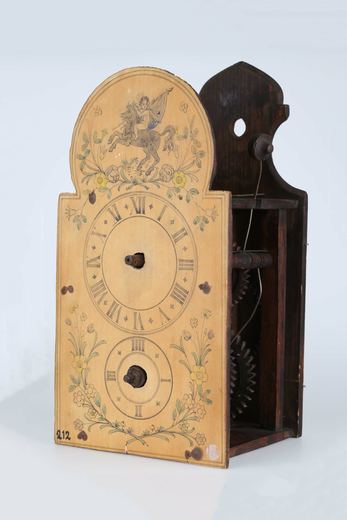
Clocks · 1750
Clock by Georg Gfell, Germany, 1750
German Clock Museum
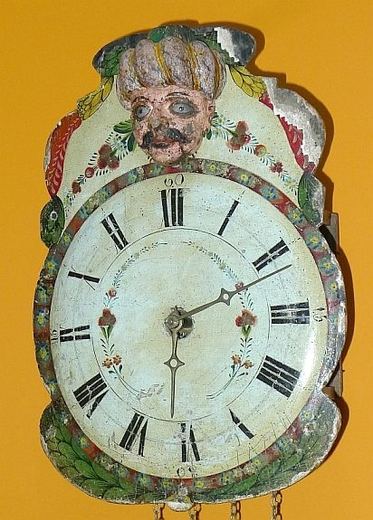
Clocks · 1750–1799
Cuckoo / black forest clock, Germany, 1750–1799
Badisches Landesmuseum Karlsruhe
Clocks · ca. 1774–75
Longcase clock by Hermann Achenbach, Germany, ca. 1774–75
The Metropolitan Museum of Art, New York
Clocks · ca. 1780–90
Clock by Workshop of David Roentgen, Germany, ca. 1780–90
The Metropolitan Museum of Art, New York
Clocks · ca. 1800
Musical clock by Martin Vanlo?, Germany, ca. 1800
The Metropolitan Museum of Art, New York
Clocks · 1787
Astronomical clock, Germany, 1787
German Clock Museum
Clocks · 1800–1899
Clock by Carl Meeß, Germany, 1800–1899
Badisches Landesmuseum Karlsruhe
Clocks · 1800–1899
Clock by Ignaz Bruder, Germany, 1800–1899
Badisches Landesmuseum Karlsruhe