
Horological History · Identification feature
The Comtoise Clock (Horloge Comtoise): History, How It Works and How to Date One
The iron-framed, double-striking country clock of the Haut-Jura — called comtoise, Morbier or Morez — ticked in almost every French farmhouse for two centuries. Where it came from, how its movement works, why it strikes the hour twice, and how the dial, crest, pendulum and case help you date one.
Atlas Editorial · · 16 min read
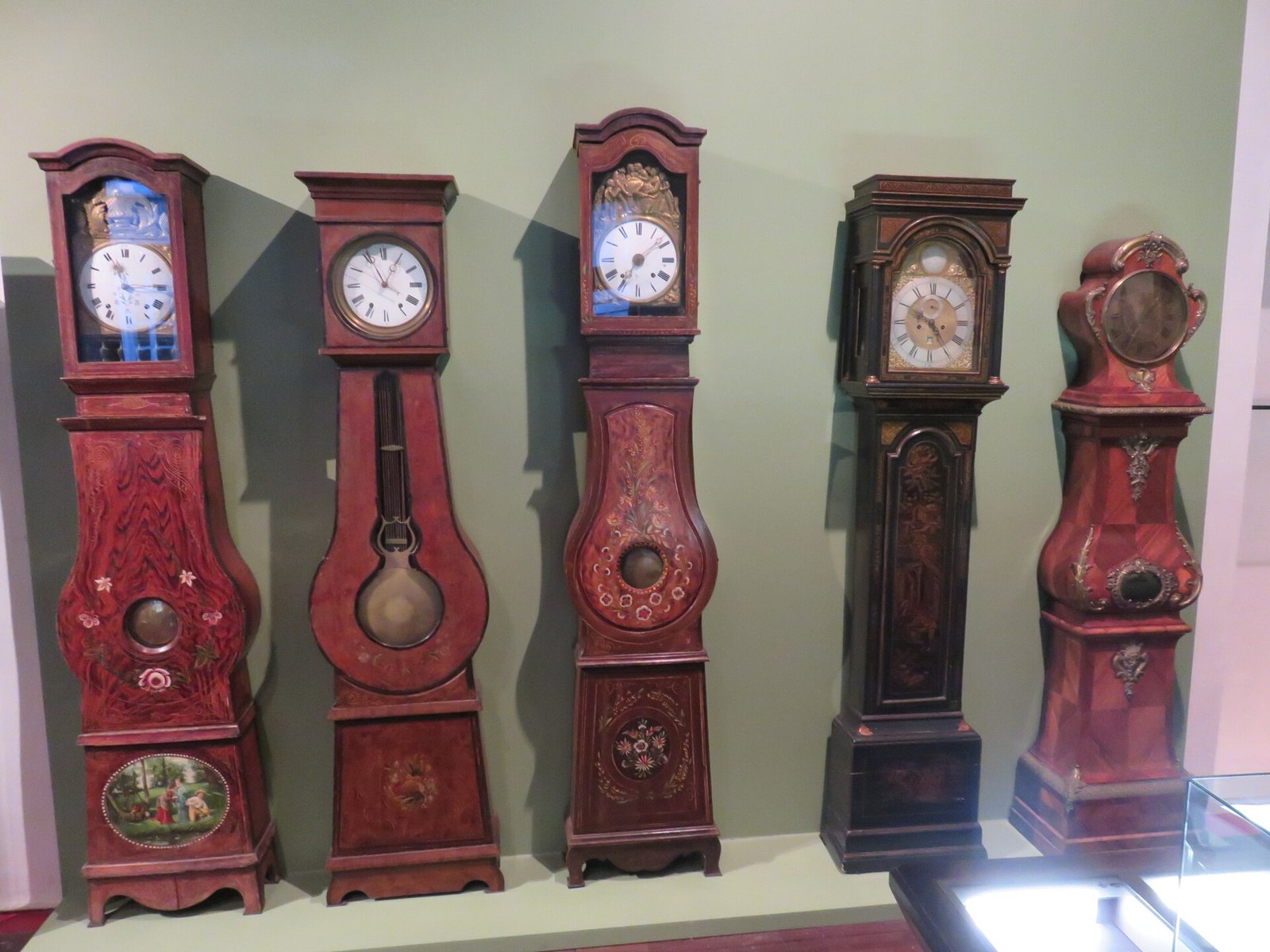
Arnaud 25 · CC BY-SA 4.0 · source (opens another website in a new tab)
A comtoise (horloge comtoise in French) is a weight-driven pendulum clock with an iron-framed movement, made in the Haut-Jura mountains of Franche-Comté in eastern France from the end of the seventeenth century to the early twentieth. The clocks are also called Morbier or Morez clocks, after the two villages at the heart of the trade, and the same names are used by collectors in English, German and Dutch. For generations a comtoise hung on the wall or stood in a tall wooden case in almost every farmhouse in France, and many were exported to other parts of Europe and beyond.
This guide explains where the comtoise came from, how its movement works, why it strikes every hour twice, and which features — the dial, the brass crest above it, the pendulum and the case — help to date one. Each point is illustrated with clocks from museum collections and auction archives in the Atlas catalogue. Dates given here for changes in style are tendencies rather than rules: these clocks were made by thousands of workshops over more than two hundred years, and old features lingered while new ones spread.
Origins: the Mayet family and the turret clock
The Haut-Jura had a long tradition of ironworking — the villages around Morbier made nails — before it made clocks. The founding story was written down in 1821 by Jean-Baptiste Reverchon, a former justice of the peace at Morez. In his account, around 1660 the guardian of the Capuchin friary at Saint-Claude looked for a craftsman able to repair the friary's wooden clock, and a smith of the Mayet family of Morbier made an iron copy of it. The regional heritage inventory, which retells the story, notes that the craftsman was more probably Claude Mayet, born in 1619, working with four of his sons.
Whatever the truth of the legend, the Mayets became turret-clock makers. The oldest of their clocks that survive are those of the church of Saint-Nizier in Lyon (1684) and the church at Orgelet (1685), and they supplied an iron turret clock to the abbey of Saint-Claude in 1689. These are cage-frame movements: the wheels and levers are mounted on a forged iron frame, as in medieval tower clocks. At the end of the seventeenth century the family built the same kind of movement on a smaller scale for use in houses. That domestic clock was the comtoise.
The Mayets adopted the pendulum, which Christiaan Huygens had applied to clocks in 1656–57 and described in his Horologium Oscillatorium of 1673. The inventory quotes Reverchon's story that the brothers built a pendulum clock but could not make it run until one of them travelled to Geneva to see a clock with Huygens's improvement — and came home shouting to his brothers, in dialect, to set the pendulum swinging. The anecdote may be no more reliable than the founding legend, but the change it describes was real and decisive: a pendulum reduced a clock's daily error from something like ten or fifteen minutes to ten or fifteen seconds.
A comtoise made around 1720–1730 by Pierre Claude Mayet of Morbier is in the Musée de la Lunette at Morez, and his tombstone survives in the church at Morbier. The earliest comtoises are often called 'Mayet-type' clocks. They had a single hand, and although two-handed clocks appeared from about 1720, single-hand clocks continued to be made until about 1780.
A cottage industry that grew into a mass trade
For most of the eighteenth century comtoises were made in farmhouses. A report of 1847, quoted in the inventory, describes the system: 'clockmaking should not be imagined as a regularly organised manufacture; each head of family has his workshop in his house; some work only in winter. Unremitting work, with means and skill, can produce 30 clocks in a year; but such results are rare.' The trade spread from Morbier to the neighbouring villages, and Morez, with its forges and foundries, supplied the iron, the toothed wheels and other parts. By the end of the eighteenth century the whole area made about 4,000 movements a year.
Between about 1780 and 1840 the trade was reorganised in the way known in the Jura as établissage. Instead of making whole clocks, independent workers at home specialised in one operation or a group of operations, which made them faster and led them to improve their tools. A merchant, the établisseur, gave out the rough parts made at Morez, collected the finished work, and took charge of assembling the clocks and selling them. Farming families gained winter income without leaving the land, and the merchants gained a cheap, skilled and reliable workforce.
The result was an extraordinary growth in output. By the middle of the nineteenth century the canton produced more than 100,000 clocks a year. A report of 1867 counted 100,000 comtoise and turret clocks, 4,000 spring clocks, 3,000 small clocks, 80,000 clock cases and 25,000 roasting jacks — spring- or weight-driven spits that used the same clockwork. In 1882 the canton had 55 clock factories employing 3,275 people. Comtoises spread across France, and the trade nearly displaced the other regional clockmaking traditions of the country.
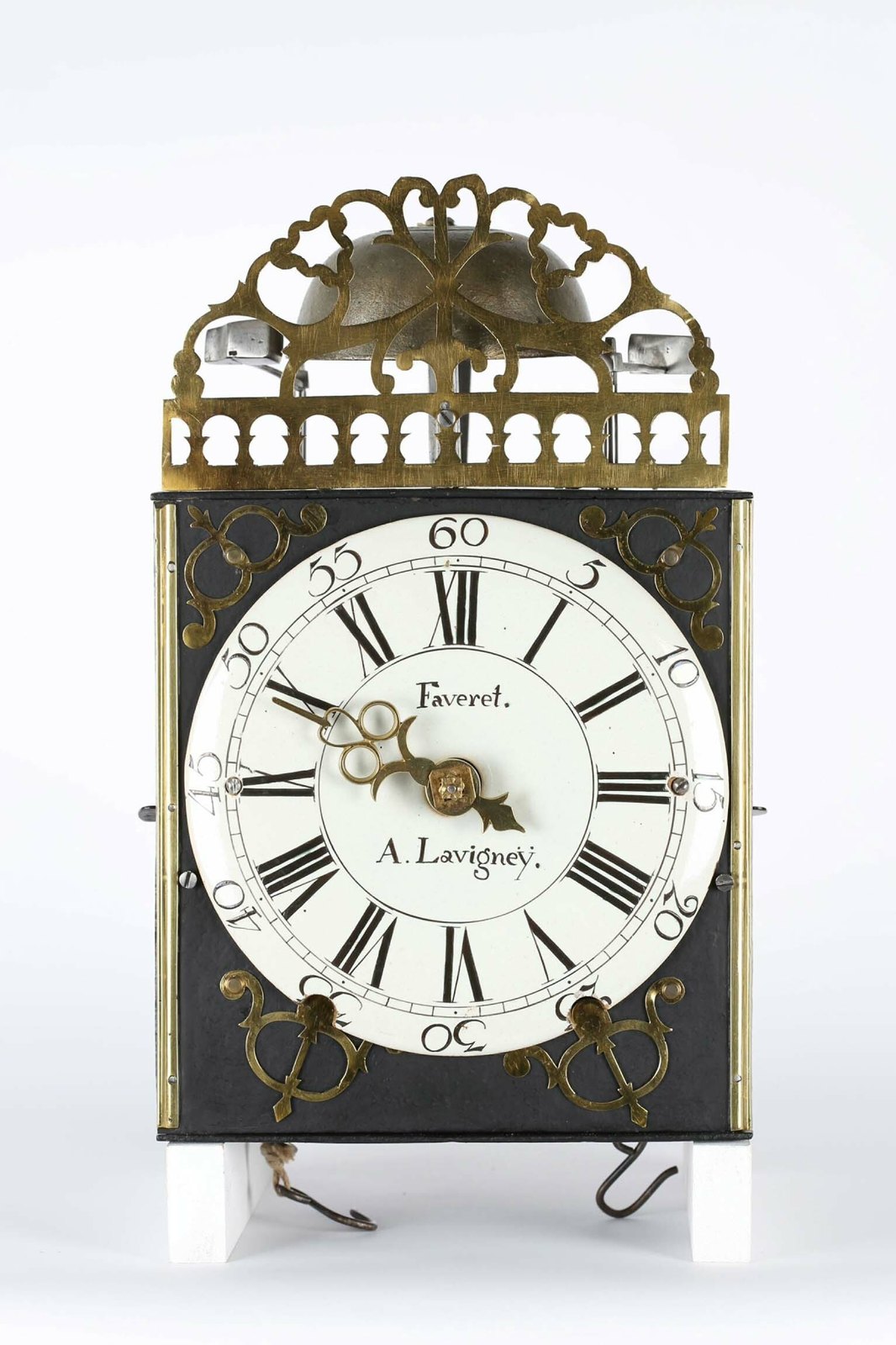
Other trades grew around the clocks. The first comtoises had only a simple brass chapter ring, but from about 1720 they were fitted with enamel dials. These were at first bought in Switzerland; to end that dependence, the people of Morez brought in Swiss enamellers to train apprentices — Huguenin in 1755, Durand and Buzard around 1774 — and there were eleven enamellers in the area around 1791 and fifty-three in 1846. Sawmills, joiners and decorators made cases, and specialised workshops made the brass crests and pendulums. In 1821 Reverchon counted at Morez six forges for ironwork, seven workshops for spring clocks, two workshops making stamped and gilt brass crests, a file works and six enamel-dial makers.
How a comtoise works
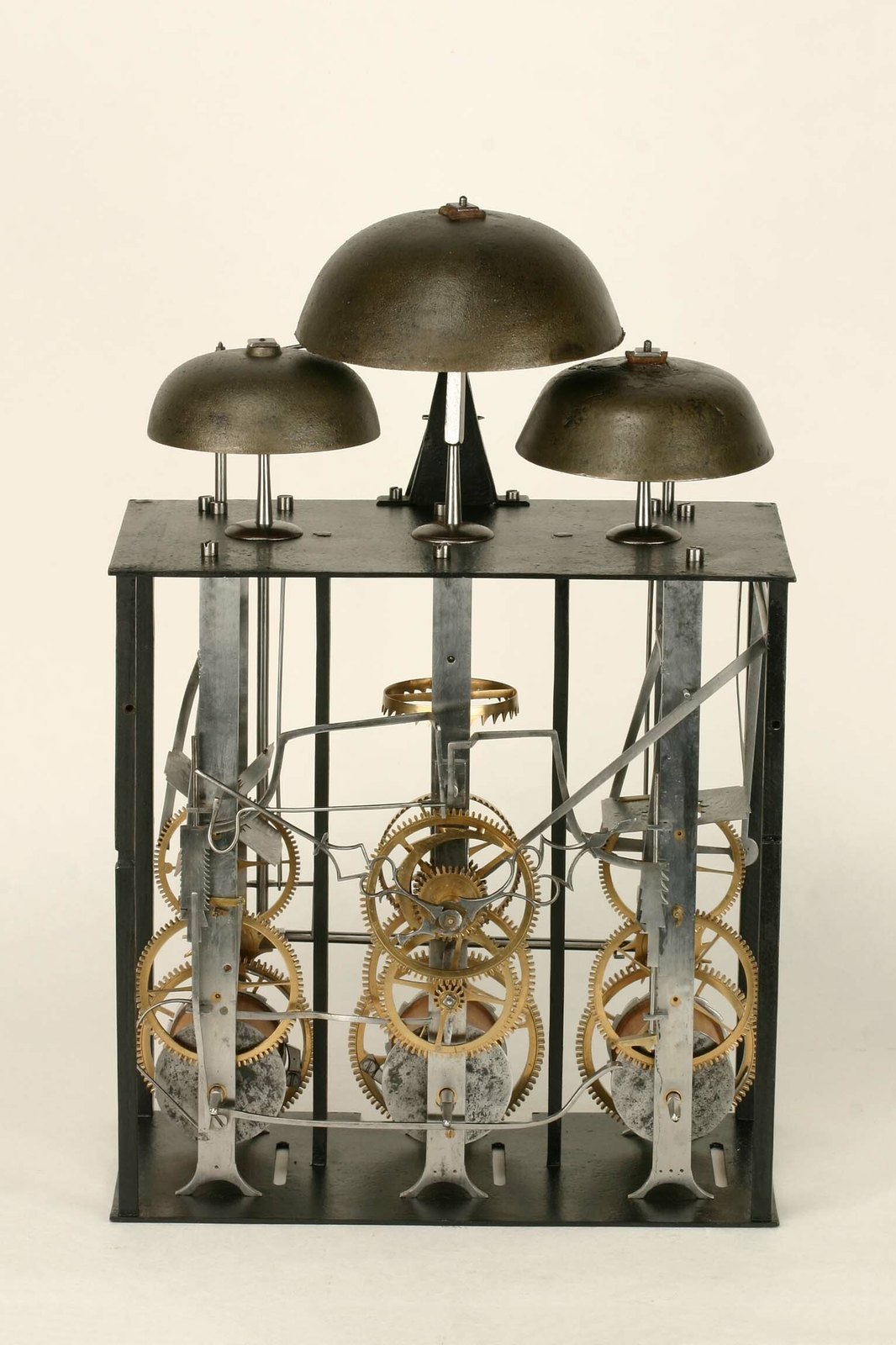
Technically a comtoise is a turret clock in miniature. Its movement is an open iron cage: vertical iron pillars and bars hold two trains of wheels side by side, one for the going train that turns the hands and one for the striking train that sounds the hours. Some clocks have a third train for the quarters. Each train typically has four arbors. The wheels are usually brass and the rest of the clock iron, and the open cage, with removable side doors, makes the movement easy to inspect and repair. It is a movement that tolerates wear and the inaccuracies of hand manufacture, which helps explain why so many still run.
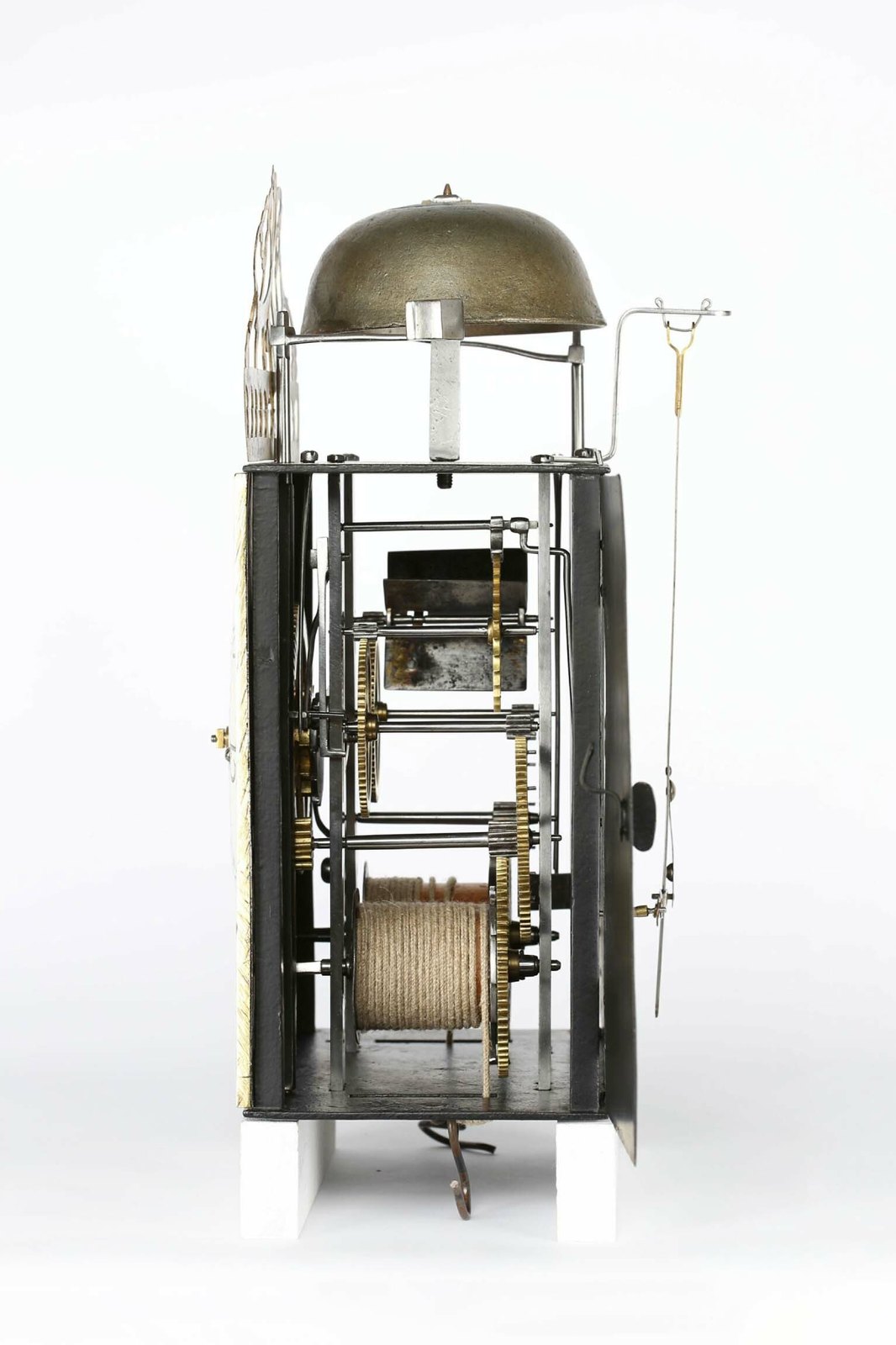
Both trains are driven by weights hanging on cords or chains — of stone, lead and above all cast iron — and a typical comtoise is wound once every eight days. In the eighteenth century the escapement was a verge with a crown wheel; later clocks have a recoil anchor escapement. The pendulum usually beats seconds. On many clocks after about 1800 it swings between the movement and the dial, driven through a cranked crutch, which is why the decorative pendulum of a comtoise hangs in front of the case's trunk rather than behind the movement.
The striking is governed by a rack and snail. A snail-shaped cam turning with the hour wheel sets how far a toothed rack can fall before each hour; the train then strikes once for each tooth gathered back. Because the number of blows is read from the snail each time, a rack-striking clock cannot get out of step with its hands, unlike a clock with a count wheel that counts the hours round in sequence. The rack also made it easy to repeat the hour.
| Part | What it does | What to look for |
|---|---|---|
| Iron cage frame | Holds the trains between vertical pillars; side doors give access | Forged iron, often with brass wheels; screws or wedges at the corners |
| Going train | Turns the hands through the motion work | Usually four arbors; escape wheel at the top |
| Striking train | Sounds the hours (and sometimes half-hours) on the bell | Rack and snail on the front; second hammer on quarter-striking clocks |
| Escapement | Releases the train one tooth at a time | Verge and crown wheel in 18th-century clocks; recoil anchor later |
| Pendulum | Regulates the rate, usually beating seconds | Long rod with a stamped or embossed brass bob; often in front of the movement after about 1800 |
| Weights | Drive the going and striking trains | Cast iron is usual; check they are a pair of the right size |
| Bell | Mounted above the cage | One bell; two or three on quarter-striking clocks |
Why does a comtoise strike the hour twice?
The most distinctive habit of a comtoise is that it strikes each hour and then, about two minutes later, strikes it again. Many French country clocks share the feature, and the usual explanation is practical: in a farmhouse or a field, someone who heard only part of the first strike could count the hours properly the second time. Many comtoises also sound a single blow at the half-hour. The repeat is made by the rack mechanism, which lets the clock strike the same number from the snail a second time.
Owners sometimes take the second strike for a fault. It is not: a comtoise that strikes twice is working as designed. A clock whose second strike gives a different number from the first, or whose strike does not match the hands, has a fault in the rack, the snail or the warning work, and a restorer should look at it before the clock is forced.
Dials, crests and pendulums: the clues to date
Most comtoises were bought for use, not as furniture, and their makers followed fashion in the parts the owner saw — the dial, the brass crest above it (the fronton) and the pendulum. Those parts are the best guides to age, with two warnings: parts were often replaced when they were damaged or out of fashion, and the trade kept making older types for buyers who liked them. Date a comtoise from all its features together, and from the movement as well as the front.
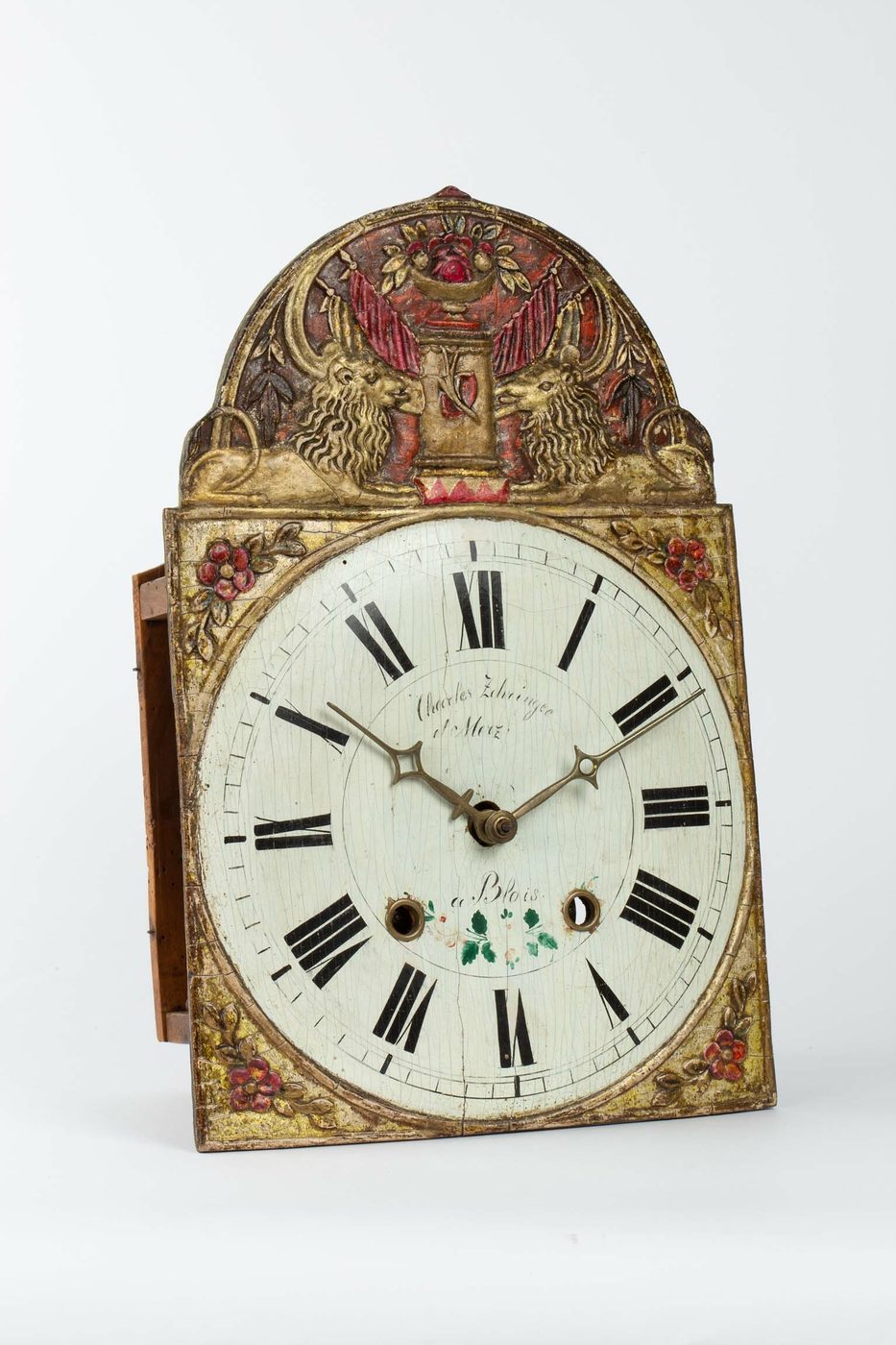
Early dials were of pewter or brass with numerals filled in black, and had a single hour hand. Later, the hours were painted on separate enamel plaques (cartouches) set into a brass dial; later still the whole dial was a single enamelled plate, and in the late nineteenth century some dials were even printed paper. A third hand sometimes shows the date. The crest above the dial was at first cut out of brass sheet, then cast — the cast type became usual from about 1725 — and finally stamped, from about 1820. Early pierced crests often show a cockerel with the royal arms or motifs that followed the politics of the day; stamped crests use a wide range of designs, among the most common a pair of cornucopias, classical anthemion ornaments or a basket of flowers.
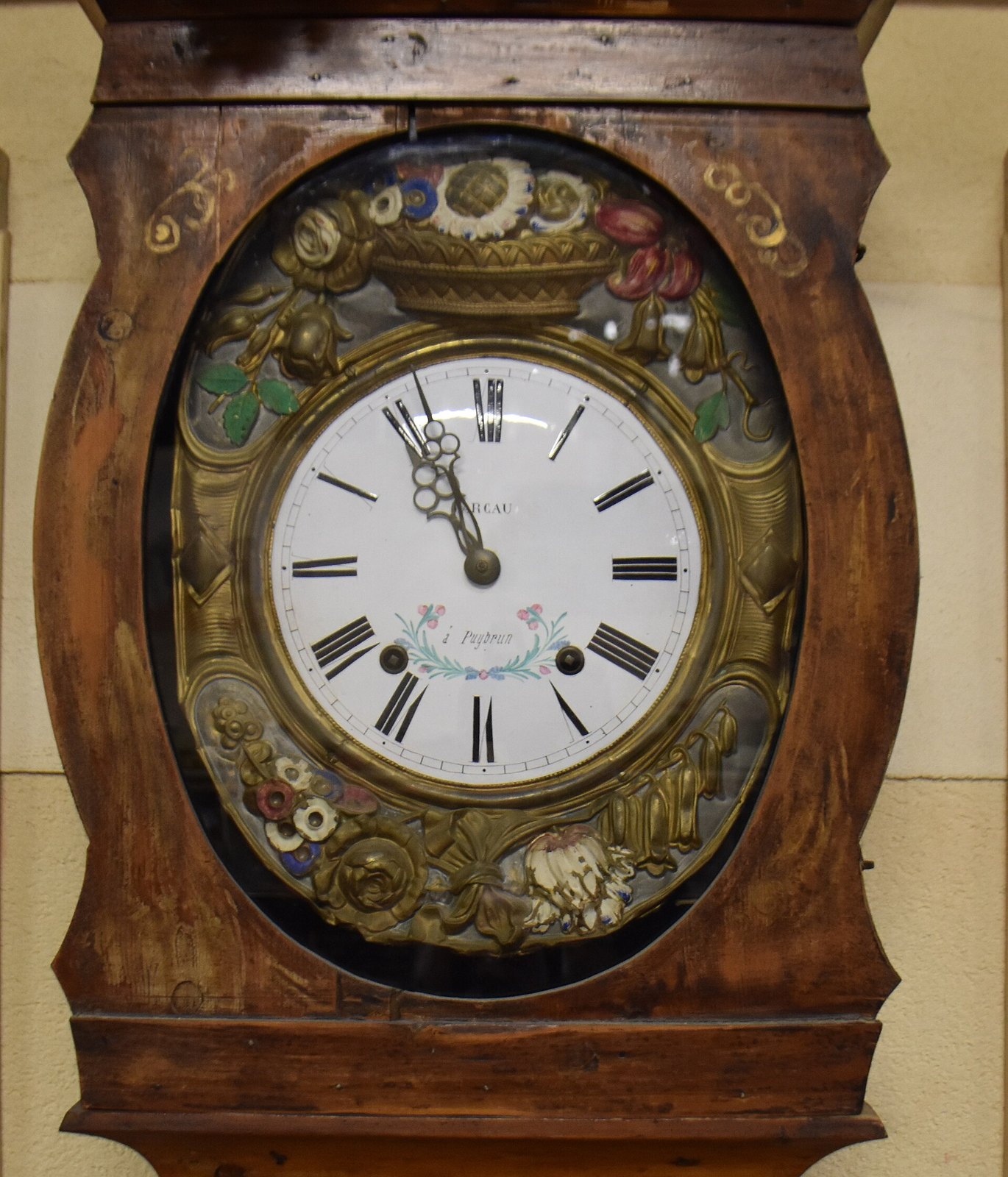
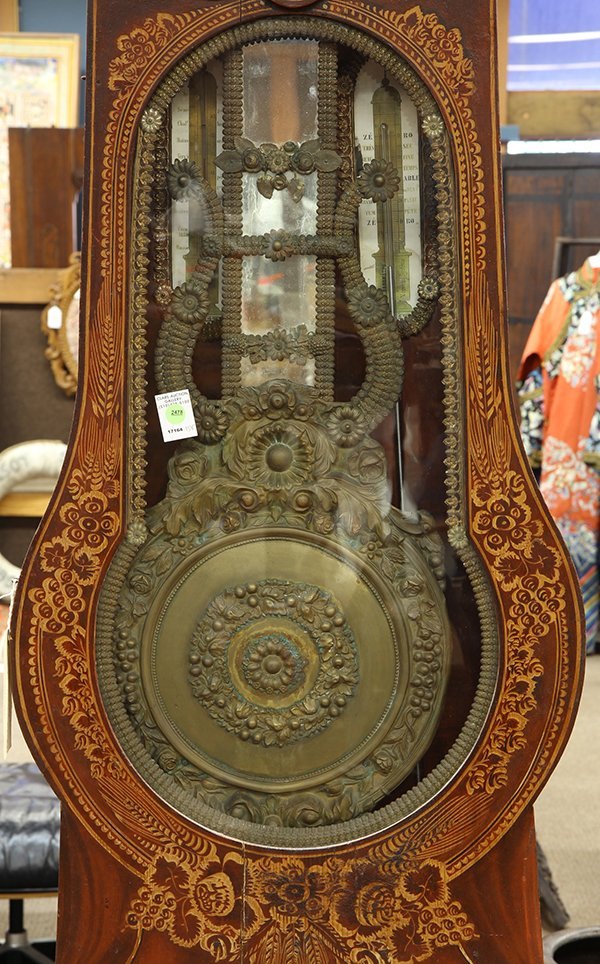
The pendulum changed most. The earliest were simply a lead weight on a 'surveyor's chain'; in the nineteenth century a fashion grew for very large pendulums whose bobs and rods were stamped, gilt and painted brass or sheet iron, and some were even animated. The elaborate 'lyre' pendulums that many people now associate with the comtoise belong to this later period, as do the full-length embossed brass panels that surround the dial of many late clocks.
| Feature | Earlier (about 1680–1780) | Middle (about 1780–1830) | Later (about 1830–1910) |
|---|---|---|---|
| Hands | Single hour hand usual; two hands from about 1720 | Two hands usual | Two hands; sometimes a date hand |
| Dial | Pewter or brass ring, then enamel cartouches | Enamel cartouches or one-piece enamel | One-piece enamel; printed paper on some late clocks |
| Crest (fronton) | Cut brass sheet, then cast (from about 1725) | Cast, pierced brass | Stamped brass (from about 1820), often a full embossed surround |
| Escapement | Verge and crown wheel | Verge or recoil anchor | Recoil anchor |
| Pendulum | Lead bob on a chain or plain rod | Plain or modestly decorated bob | Large stamped and painted bobs, lyre pendulums |
| Case | Often none: the movement hung on the wall | Pine longcases appear widely | Painted, grained or veneered cases, often shaped |
Cases: from bare movement to painted longcase
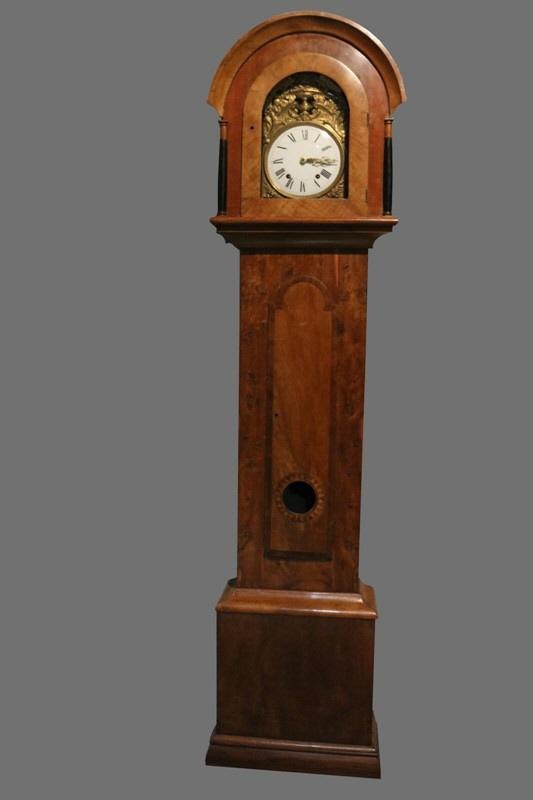
A comtoise movement was originally sold bare and fixed directly to the wall, with its weights and pendulum hanging free. Many owners later had it put into a tall wooden case, and the demand created a case-making trade of its own: the 1867 report counted 80,000 cases a year in the Morez area. But cases were also made all over France, and the movement was often fitted into its case where it was sold. That is why comtoise cases vary so much by region — in shape, wood and decoration — and why the case and the movement of the same clock may come from places hundreds of kilometres apart.
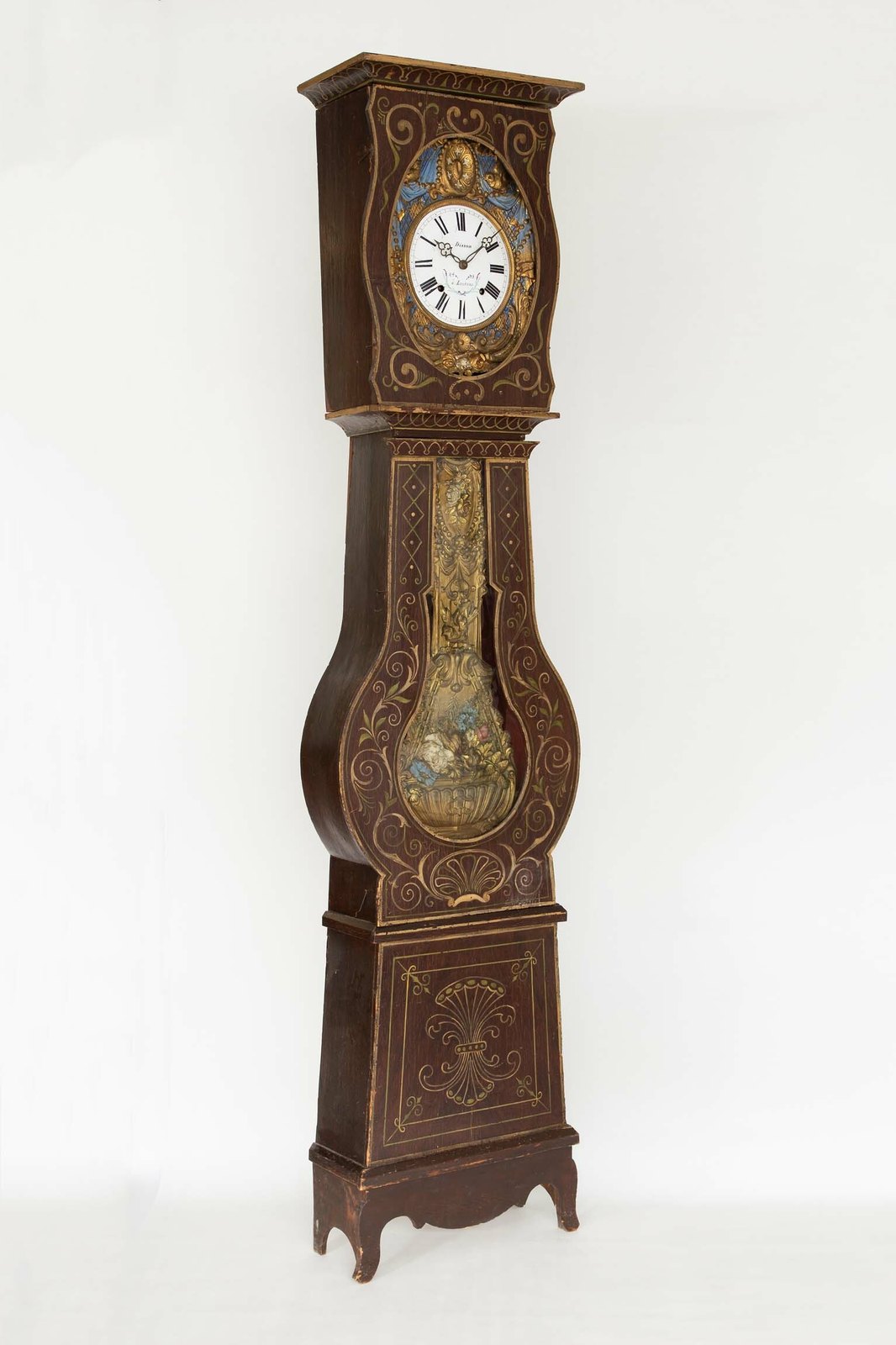
Country cases were usually made of pine, often with tapering or violin-shaped sides, and were frequently painted or grained to imitate finer woods. More expensive clocks have cases of oak, walnut or fruitwood, and many have a glazed window in the trunk so that the pendulum can be seen.
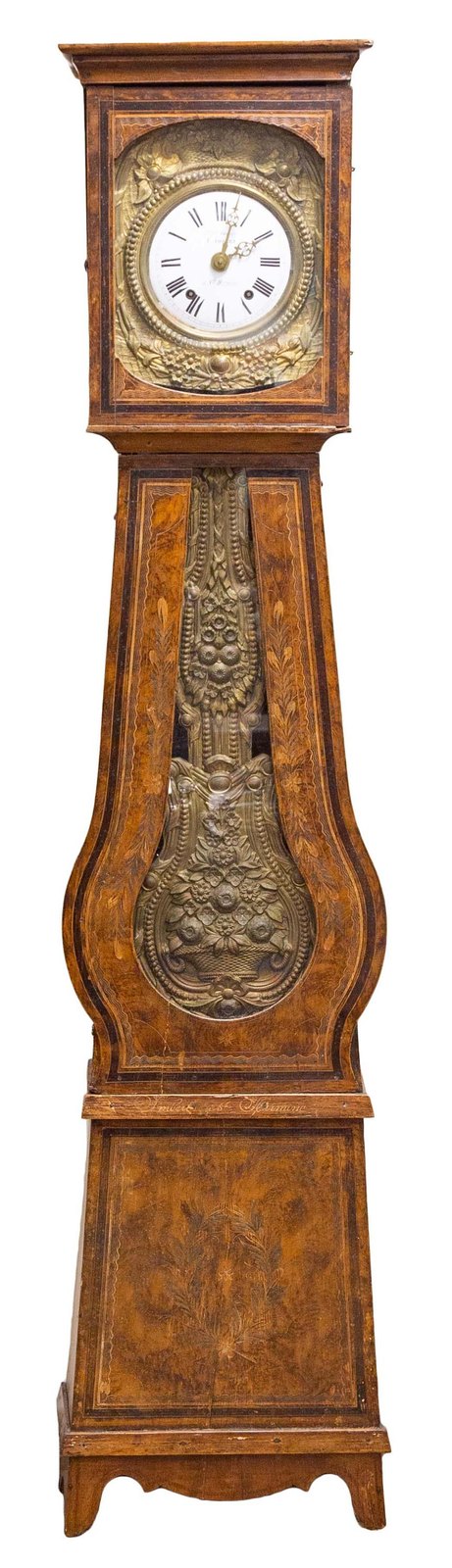
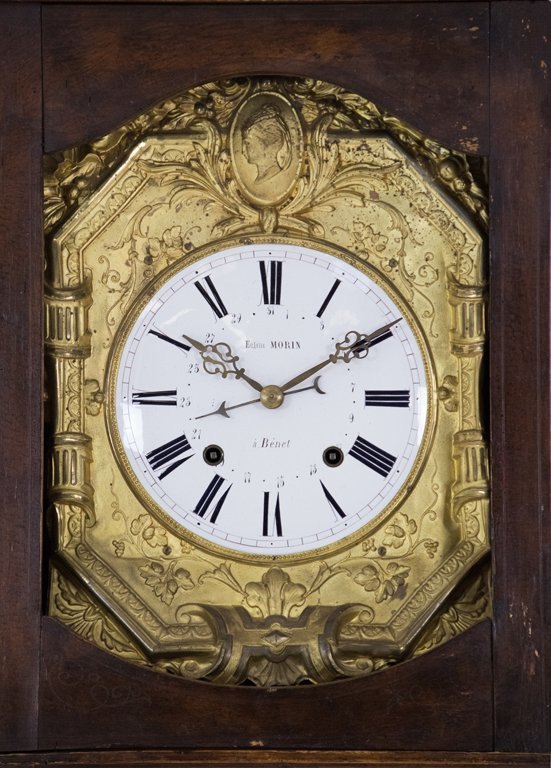
Comtoises travelled far. French accounts of the trade record exports to other European countries and even to the Ottoman Empire and Siam, and abroad, as at home, the movements were often put into cases made where they were sold.
Whose name is on the dial?
A name on a comtoise dial is usually that of the clockmaker or merchant who sold the clock, often with his town, not that of the workshop that made the movement. The signatures in this article show the pattern: Disson of Louhans in Burgundy, Imbert of Saint-Herime, Morin of Benet, Heude of Brionne in Normandy. A retailer's name is still useful — it tells you where the clock was first sold, and local directories may date the business — but it does not identify the maker. Makers' marks, when present, are more often stamped on the movement itself.
Decline: railways, the Black Forest and the electric clock
The comtoise trade peaked in the middle of the nineteenth century and then declined. By 1901 the area made only 35,000 comtoises, alongside 25,000 spring clocks for the wall and the shelf and 13,500 spring roasting jacks and lark mirrors. The heritage inventory gives several causes: the railway reached Morez only in 1900; the Black Forest, whose makers were supported by the German state, was selling cheaper clocks across Europe; and the market was saturated with clocks — comtoises and turret clocks alike — that almost never wore out. Collectors' literature adds the effect of the Treaty of Frankfurt of 1871, after which German clocks entered France more easily.
Morez tried to adapt. A school to teach watchmaking opened in 1855 but closed in 1861–62, apparently because the difference between large-volume clockmaking and the small-scale precision of watches had been underestimated, and because the Jura was technically behind Switzerland. The industry turned to regulators, spring clocks and chimes, with springs and brass plate movements — some bought in from Beaucourt, the home of the Japy firm — instead of weights and iron cages, while many workers moved into spectacle-making, for which Morez is now known. The Odo company, founded in 1924 by the Odobez family of Morbier clockmakers, did so well with Westminster chiming clocks from 1931 that it built new factories at Morez. But tastes moved towards small electric clocks, the last turret-clock factories of Morez closed in the 1960s, and clockmaking left the town in 1987–1990. Odo moved to a factory at Morbier, where two years later it made 3,000 comtoises and 40,000 electric clocks and alarm clocks; it closed in 2005.
A few French firms continued to make comtoises in the late twentieth century, and reproductions were also made in Germany and Hungary. A comtoise in a shiny case with a pristine dial, a light stamped movement and electric or quartz parts is likely to be one of these rather than a nineteenth-century clock.
Checking a comtoise before you buy
- The movement: an iron cage with brass wheels and side doors is the comtoise type; a brass plate movement is a later or different kind of clock.
- The strike: the hour should be repeated about two minutes later and agree with the hands; listen to a full hour before buying.
- The escapement: a verge suggests an earlier clock; most later clocks have a recoil anchor. Signs of conversion are common and not necessarily a fault.
- The dial and crest: are they the same age and do they fit? Holes, filled screw-holes or a dial that sits awkwardly suggest replacement.
- The pendulum and weights: elaborate pendulums were often added later; weights should be a pair of the right size for the clock.
- The case: cases were often made locally and some movements have been 'married' to later cases. A marriage is normal for a comtoise but should be reflected in the description.
- The name: remember it is usually the seller's; check the town and the name in directories before treating it as a maker.
Comtoises are strong and simple, but they still need care. Keep the clock level and in beat — the tick and tock evenly spaced — wind both weights every week, and have it cleaned and oiled by a clock restorer rather than with household oil. Move the hands forward gently, never against resistance, and let a clock that has stopped for a long time be checked before it is set going again.
The comtoise today
The comtoise has become a collector's object, prized for its long history and its endless variety of dials, crests, pendulums and cases. The oldest one-handed clocks are rare and sought after, and so are clocks with complications — extra bells, date or moon-phase indications, alarms and, occasionally, animated figures. Museums in the region, including the Musée de la Lunette at Morez and the Musée des maisons comtoises at Nancray, show the clocks in their setting, and local associations continue to research the makers.
For historians the comtoise is a rare example of a rural, home-based industry that made a technical product in huge numbers without the factory system — the same kind of 'proto-industry' that produced the Black Forest cuckoo clock and the Swiss watch. In the catalogue you can compare it with those traditions, and with the English longcase clock whose iron-and-brass country cousins it often resembles.
Sources & further reading
- L'horlogerie dans le Haut-Jura (dossier IA39002034) — Raphaël Favereaux and Laurent Poupard, Inventaire général du patrimoine culturel, Région Bourgogne-Franche-Comté, 1988, revised 2020.
- La Comtoise, la Morbier, la Morez : son histoire, sa technique, ses particularités, ses complications, sa réparation — Francis Maitzner and Jean Moreau, F. Maitzner and J. Moreau (Épinal), 1976.
- La grande horloge : la comtoise au XIXe siècle — Alain Caudine, Éditions de l'Amateur (Paris), 1992.
- L'horloge comtoise et ses horlogers — François Buffard, Association Horlogerie comtoise (Morez), 2019.
- Horologium Oscillatorium — Christiaan Huygens, F. Muguet (Paris), 1673.
- Dictionnaire des horlogers français — Tardy (Henri Lengellé), Tardy (Paris), 1971–1972.