
Horological History · Historical feature
After Harrison: How Le Roy, Arnold and Earnshaw Turned the Marine Timekeeper into an Industry
Harrison proved that a watch could find longitude. It took another half-century of French and English invention — the detent escapement, the compensation balance and the helical balance spring — to make a timekeeper that navies could buy by the hundred.
Atlas Editorial · · 11 min read
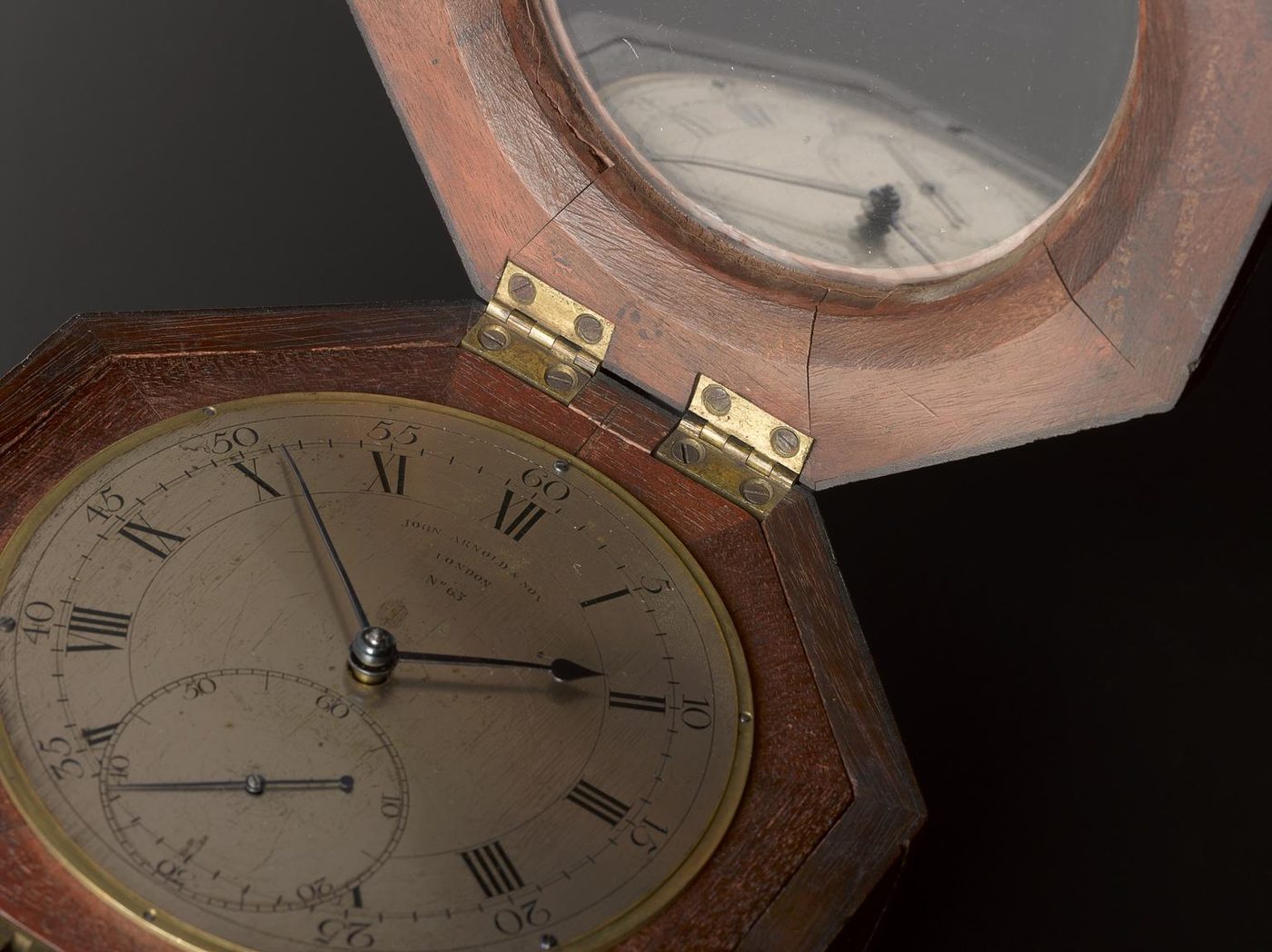
Science Museum Group, London · CC BY-NC-SA 4.0 (Science Museum Group) — permission review · source (opens another website in a new tab)
The story of longitude is usually told as the story of John Harrison: a self-taught Yorkshire carpenter, a series of extraordinary sea clocks, a large silver watch called H4 and a long quarrel with the Board of Longitude. That story ends, in most retellings, around 1773, when the elderly Harrison finally received most of the reward he believed he was owed. But in 1773 there was still no such thing as a marine chronometer that a navy could order, a shipowner could afford or a provincial watchmaker could repair. H4 was a masterpiece made by a master; it was not a design that could be repeated by the dozen.
This feature follows what happened next. Between roughly 1765 and 1820, a handful of makers in Paris and London took the problem apart and rebuilt it around three ideas — a detached escapement, a balance that corrected itself for temperature, and a balance spring shaped to keep its swings in time whatever their size. By the 1820s the result had become a standard instrument, made in workshops that bought parts from specialist suppliers and tested at an observatory. Many of these instruments survive, and a number of them can be explored in the Atlas catalogue.
The problem Harrison left behind
Finding longitude by timekeeper is simple in principle. A navigator who knows the time at a reference meridian, such as Greenwich or Paris, and who measures local time from the Sun or stars, can convert the difference into degrees: one hour is fifteen degrees of longitude. The difficulty is keeping the reference time through weeks of motion, damp and changing temperature. An error of one minute in the clock is an error of a quarter of a degree, which near the equator is about fifteen nautical miles.
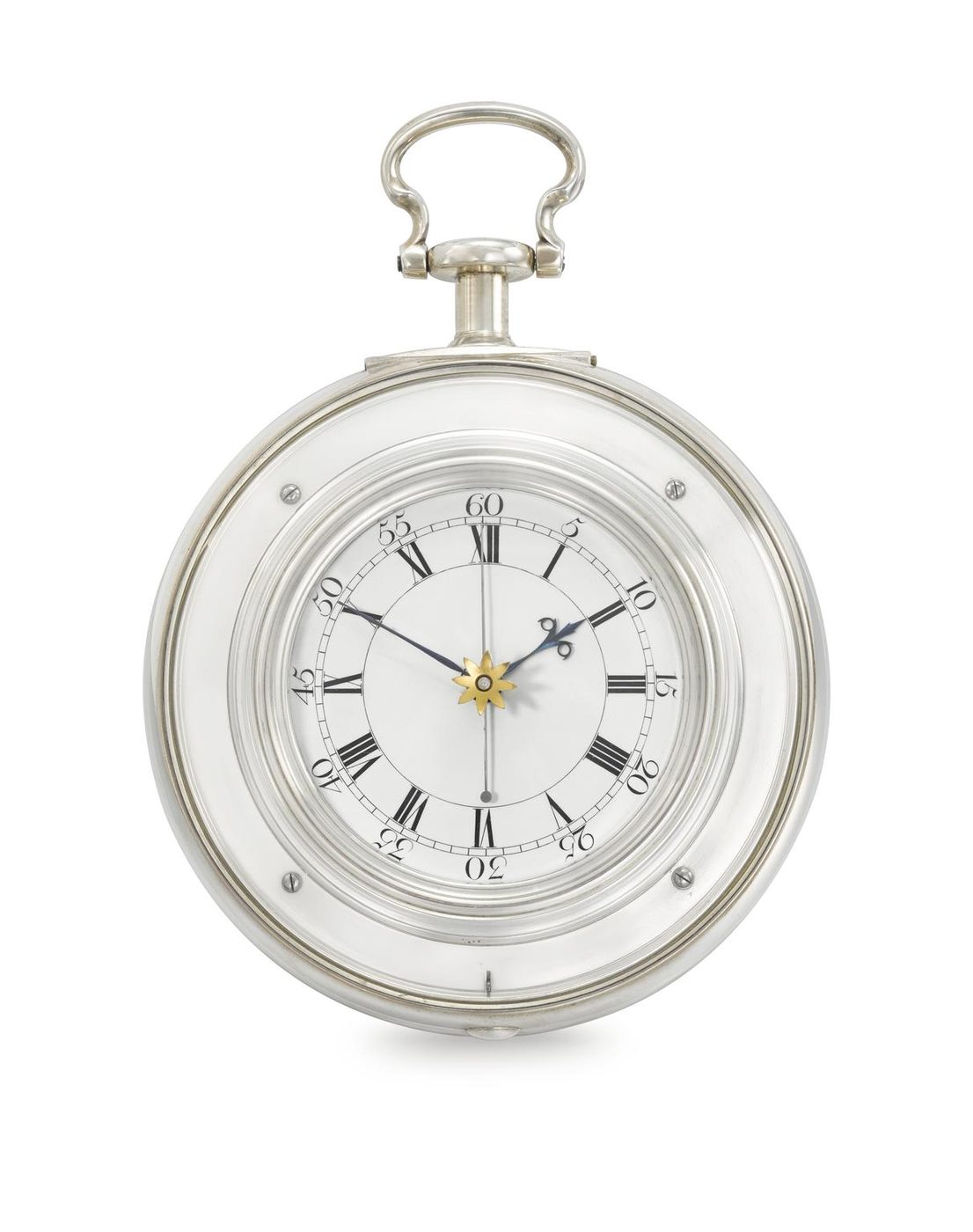
Harrison's H4, finished in 1759, met the Act of 1714's most demanding standard on its trials to Jamaica and Barbados in the early 1760s. Yet its escapement was a refined verge with diamond pallets, its movement was crowded with subtle corrections, and it needed a craftsman of the first rank to make. When the Board asked for copies, the London watchmaker Larcum Kendall produced K1, a close replica completed in 1769, which James Cook carried on his second Pacific voyage (1772–75) and praised in his journal. Kendall's later, simplified versions showed how hard it was to make Harrison's design cheaper without losing its performance.
The French route: Le Roy and Berthoud
The decisive conceptual step was taken in Paris. Pierre Le Roy, son of the royal watchmaker Julien Le Roy, unveiled his marine timekeeper — the montre marine — in 1766. Its escapement touched the balance only briefly to give it an impulse and otherwise left it free — a detent escapement in essence, although its form differed from the later English type. Its balance carried a compensation for temperature, and Le Roy studied the conditions under which a balance spring makes long and short swings take the same time, the property called isochronism. Historians of the chronometer, from Rupert Gould onwards, have treated Le Roy's machine as the first to combine the principles of the modern instrument, even though it was not itself the model that went into production.
Ferdinand Berthoud, born in the principality of Neuchâtel and settled in Paris, took a different path: methodical experiment, prolific publication and close ties with the French navy. He built a long series of marine clocks, was appointed to supply timekeepers to the Marine, and set out his methods in books such as the Traité des horloges marines (1773) and later works on the measurement of time and the finding of longitude. Where Le Roy's insight was elegant, Berthoud's contribution was to show that marine timekeepers could be built, tested and improved as a programme rather than as single masterpieces.
The English route: Arnold and Earnshaw
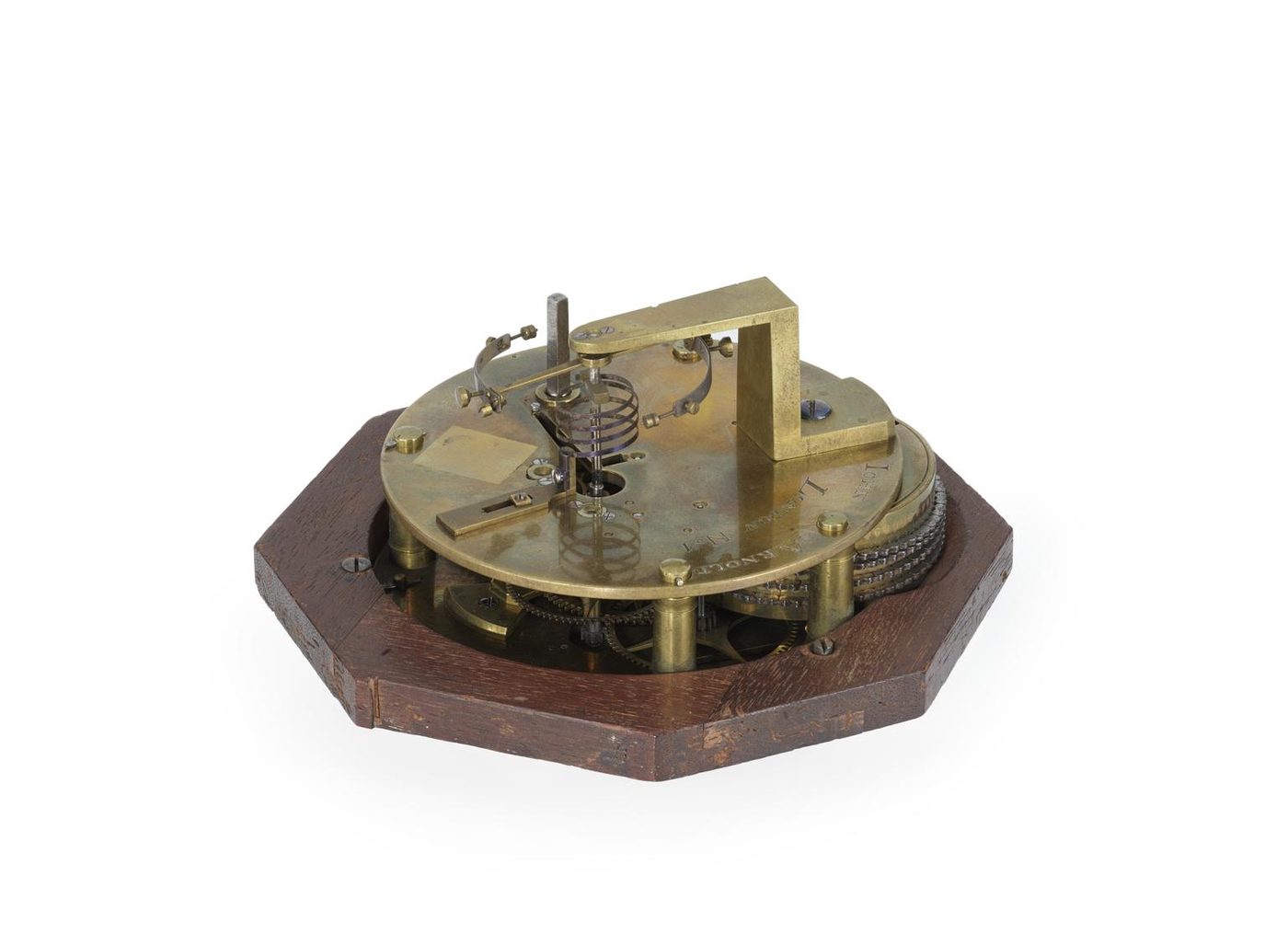
In London the practical breakthrough came from two rivals. John Arnold, a Cornish-born watchmaker with royal patronage, set out to make timekeepers that were small, reliable and, above all, repeatable. Through the 1770s and 1780s he developed a pivoted detent and then a spring detent escapement, bimetallic compensation balances and — patented in 1782 — the helical balance spring with curved ends, which helped the balance to 'breathe' symmetrically and improved isochronism. Arnold made pocket chronometers as well as marine instruments, and he did much to popularise the word chronometer itself for a precision timekeeper.
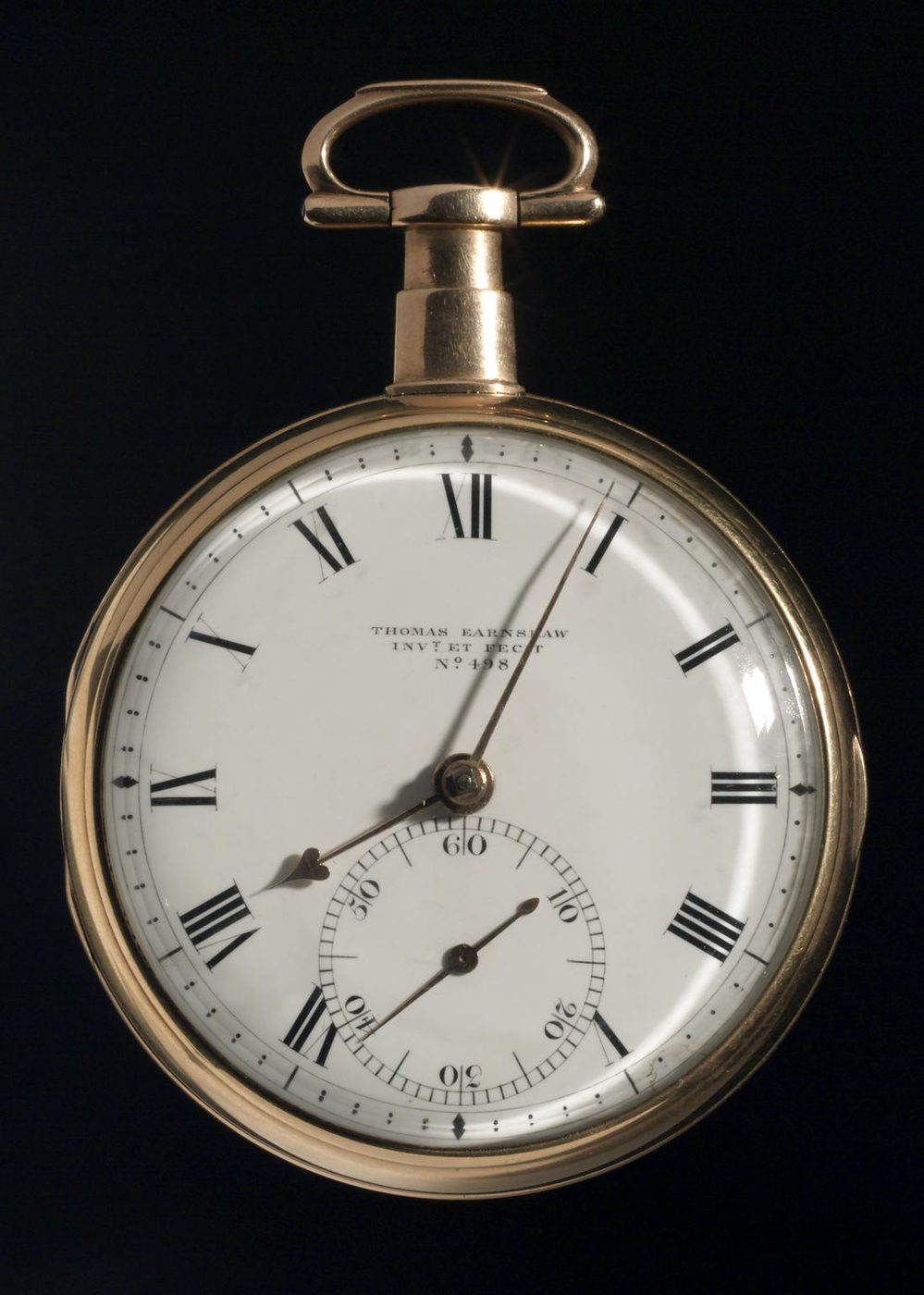
Thomas Earnshaw, a Lancashire-born watch finisher working in London, arrived at a spring detent escapement of his own in the early 1780s. Lacking the money to patent it, he allowed the watchmaker Thomas Wright to take out the patent in 1783, and a bitter priority dispute with Arnold followed that drew in the Board of Longitude and the Royal Society for years. Earnshaw also made his compensation balances by fusing brass onto a steel disc before cutting the rim, rather than riveting or soldering the two metals together, which gave a more stable bimetallic strip. The combination — spring detent, fused compensation balance, helical spring — became the standard English marine chronometer for the next century and a half. The Board eventually rewarded both sides: Earnshaw and Arnold's son and successor, John Roger Arnold, received awards in the early nineteenth century.
| Date | Event | Why it matters |
|---|---|---|
| 1714 | British Longitude Act offers rewards for a practical method | Creates a standard of accuracy and a body (the Board of Longitude) to judge it |
| 1759 | Harrison completes H4 | Proves a watch-sized timekeeper can meet the standard |
| 1766 | Pierre Le Roy unveils his montre marine in Paris | Combines a detached escapement, temperature compensation and attention to isochronism |
| 1769 | Larcum Kendall completes K1 | Shows H4 can be copied; carried by Cook on his second voyage |
| 1773 | Berthoud publishes the Traité des horloges marines | Puts French marine horology on a published, experimental footing |
| 1782–83 | Arnold patents the helical spring; Earnshaw's spring detent is patented through Wright | The two features of the standard English chronometer |
| 1820s | Annual chronometer trials at the Royal Observatory, Greenwich | Turns rating into a public competition and a basis for Admiralty purchases |
| 1831–36 | HMS Beagle carries 22 chronometers on its survey voyage | Illustrates the practice of carrying several instruments and comparing them |
| 1890s–1920 | Charles-Édouard Guillaume's nickel-steel alloys (Invar, Elinvar) and integral balance | Reduce the 'middle temperature error'; Guillaume receives the 1920 Nobel Prize in Physics |
What a marine chronometer is
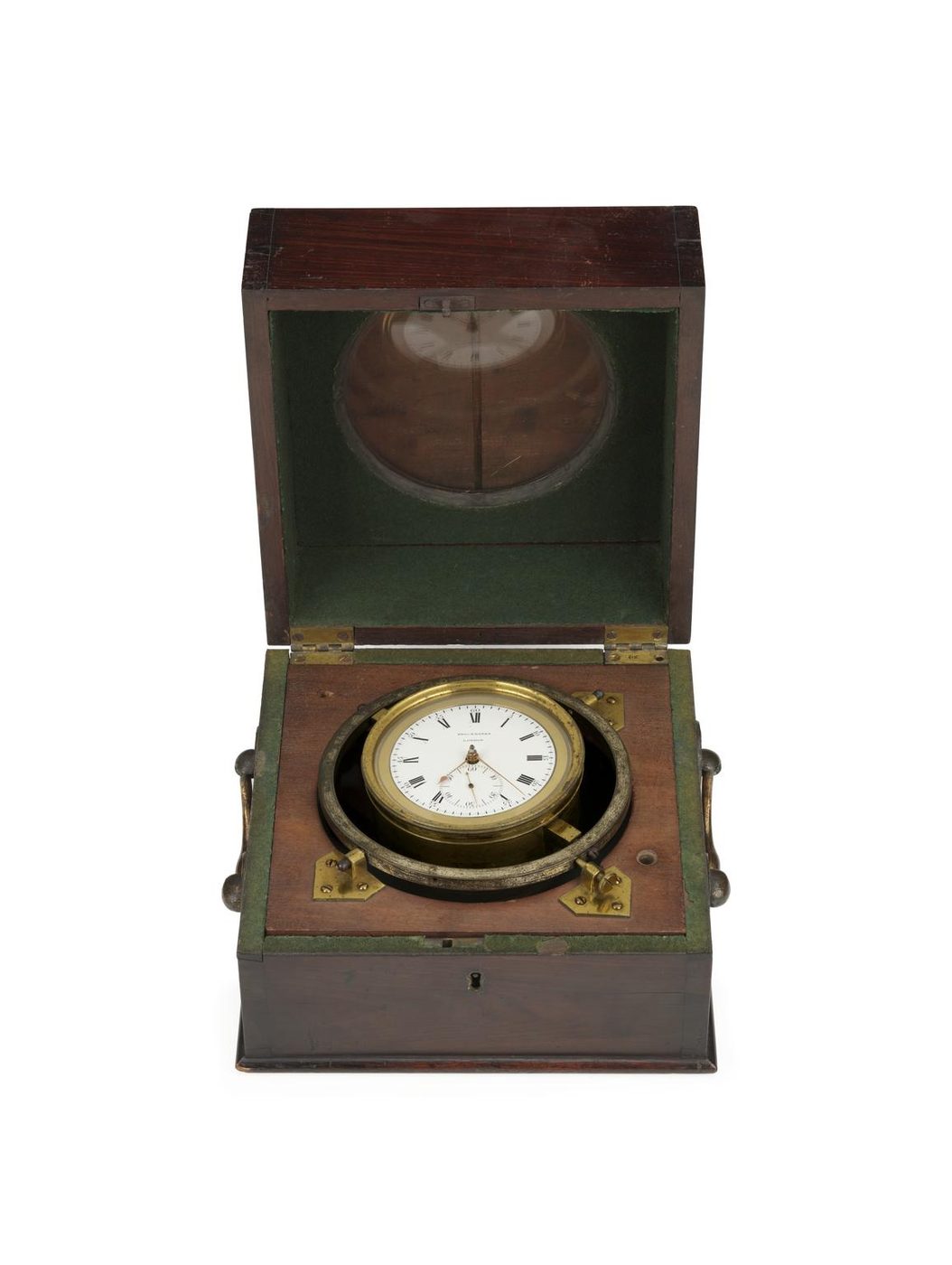
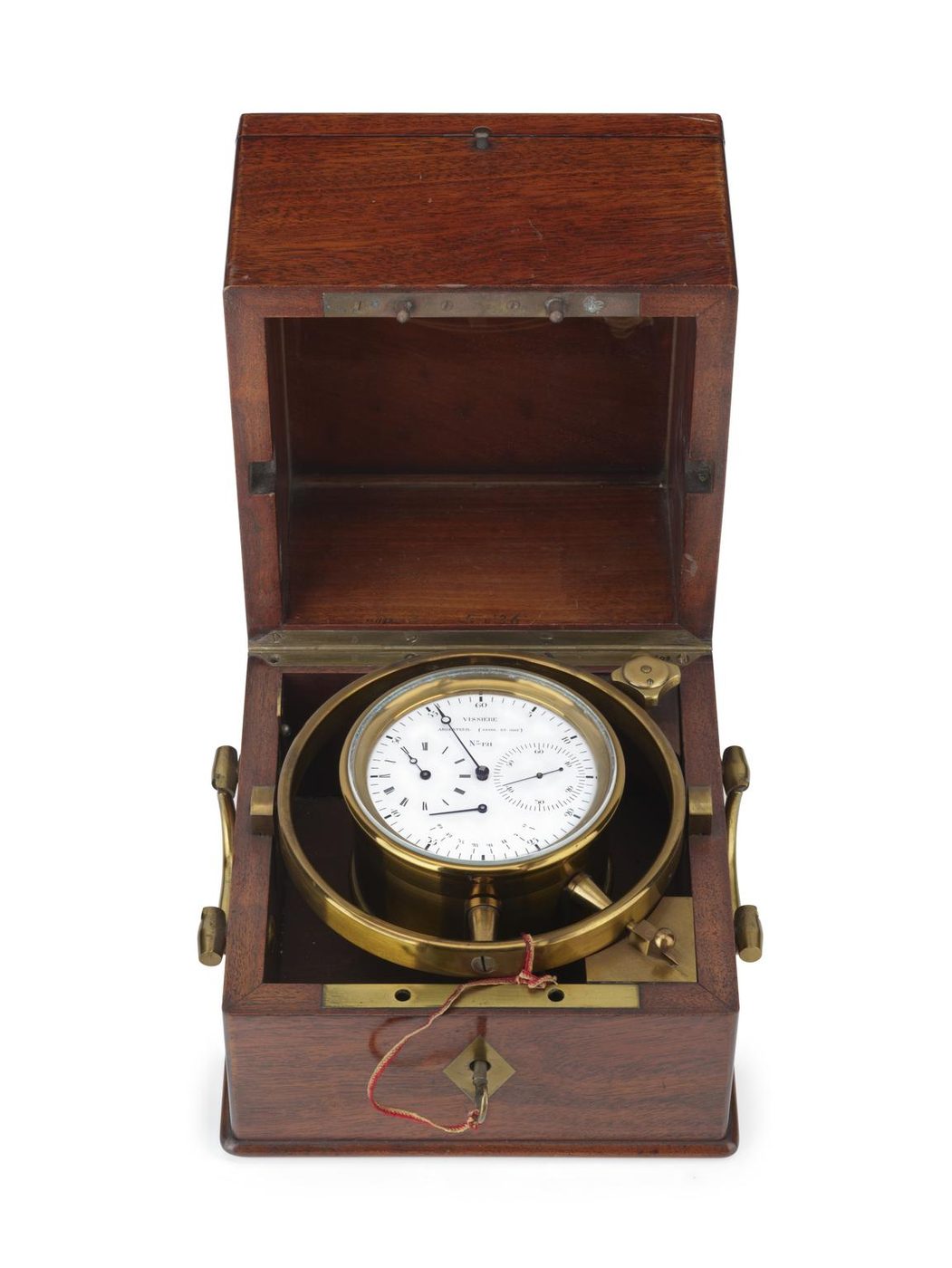
By about 1820 the English marine chronometer had settled into a recognisable form. A large movement — typically with a dial of around four inches — sits in a brass bowl suspended in gimbals inside a wooden box, so that it stays level as the ship rolls. The mainspring drives through a fusee, a cone-shaped pulley with a chain that evens out the spring's pull from fully wound to nearly run down. A maintaining power keeps the instrument going while it is wound. The escapement is a spring detent; the balance is a bimetallic compensation balance with adjustable weights; the spring is a blued-steel or later palladium helix. Most instruments run for two days on a winding and are wound daily at the same hour, so that the spring always works over the same part of its range; eight-day versions also exist.
- Dial: usually silvered, with hours and minutes, a separate small seconds dial and an up-and-down (power reserve) indicator showing how far the spring has run down.
- Box: often three tiers — a lid with a glass panel so the dial can be read without opening it, and a locking clamp to secure the gimbals in transit.
- Signature and number: the dial and movement are normally signed and numbered by the firm that finished and sold the instrument, which was not always the workshop that made the rough movement.
- Rating papers: surviving certificates from an observatory or a maker record the instrument's daily rate at different temperatures, and are valuable historical documents in their own right.
From workshop to industry
Demand grew steadily as the Royal Navy, the East India Company and merchant shipping adopted chronometers, and the trade organised itself around it. In England, movements were commonly made 'in the rough' by specialist workshops in and around Prescot in Lancashire and finished, adjusted and signed by London firms. Escapement makers, spring makers and balance makers worked as subcontractors, and the name on the dial identified the firm responsible for the instrument's performance rather than the hands that made every part. Firms such as Barraud, Brockbank, Frodsham, Dent, Mercer and Kullberg became household names at sea.
Testing became institutional. From the early 1820s the Royal Observatory at Greenwich ran annual trials in which makers submitted instruments to be compared over many months and at different temperatures, with premiums for the best performers in the early years and purchase by the Admiralty as the lasting prize. Greenwich also cared for the Navy's growing stock of chronometers, rating them before issue and receiving them back for checking. Other observatories and naval services, in France, Germany, the United States and elsewhere, developed comparable systems.
The middle temperature error
Even the best instruments had a stubborn defect. A bimetallic balance can be adjusted to keep the same rate at two temperatures, but the steel balance spring loses stiffness with heat in a way that does not match the balance's correction exactly, so the instrument gains or loses at temperatures between and beyond the two adjustment points. Nineteenth-century makers devised many 'auxiliary compensations' — extra bimetallic pieces that acted only over part of the temperature range — and Greenwich trial results show how much effort went into them. The problem was largely resolved only when Charles-Édouard Guillaume, working at the International Bureau of Weights and Measures near Paris, developed nickel-steel alloys whose properties barely change with temperature; balances and springs made from them simplified chronometer adjustment in the twentieth century.
| Marine chronometer | Deck (hack) watch | Pocket chronometer | |
|---|---|---|---|
| Purpose | Primary time standard aboard ship | Carried on deck to time sights against the chronometer | Precision personal timekeeper |
| Escapement | Spring (or pivoted) detent | Often lever; sometimes detent | Detent, later often lever |
| Mounting | Gimbals in a box, kept below | Small box or hand-held | Pocket, so vulnerable to jolts |
| Power | Fusee and chain; two- or eight-day | Going barrel or fusee | Fusee in early examples |
| Typical record | Rate certificates, naval issue marks | Naval or maker numbers | Maker's number, hallmarked case |
Beyond Britain
Chronometer making was never only English. In France, successors to Berthoud such as Louis Berthoud, Henri Motel and the Vissière family supplied the navy, and the Paris Observatory and the Bureau des longitudes oversaw testing. In Switzerland, Le Locle and Neuchâtel developed a strong precision tradition; Ulysse Nardin, founded in Le Locle in 1846, became one of the best-known suppliers of marine chronometers to navies and merchant fleets, and observatory competitions at Neuchâtel and Geneva encouraged precision work across the industry. In Germany, makers in Glashütte and Hamburg built chronometers for the imperial navy. During the Second World War, the American firm Hamilton produced its Model 21 marine chronometer in large numbers, using factory methods to make an instrument that had been a craft product for two centuries.
The end of the chronometer's reign
The chronometer's monopoly ended not because it failed but because time could be sent instead of carried. Time balls dropped at fixed hours in harbours from the late 1820s and 1830s let ships in port check their instruments without going ashore. Telegraph lines spread observatory time on land in the second half of the nineteenth century. In the early twentieth century, radio time signals — broadcast from stations such as the Eiffel Tower in Paris from 1910 — allowed a ship at sea to check its chronometers daily. Chronometers remained in service for decades, but as instruments that held the time between signals. Quartz clocks replaced them aboard ship from the 1960s and 1970s, and satellite navigation removed the need to carry time for longitude altogether.
Seen in a museum case, a marine chronometer looks less dramatic than Harrison's gleaming sea clocks. Its importance lies precisely in that ordinariness. It is the form in which the longitude problem was actually solved for working navigators: a repeatable design, built by a trade, tested by an institution and carried by the thousand. The objects linked from this feature trace that transition, from the Harrison workshop and the first instruments of Arnold and Earnshaw to the standardised products of the nineteenth-century London firms.
Sources & further reading
- The Marine Chronometer: Its History and Development — Rupert T. Gould, J. D. Potter (London), 1923.
- Harrison — Jonathan Betts, National Maritime Museum (London), 1993.
- Longitude — Dava Sobel, Walker & Company (New York), 1995.
- Les longitudes par la mesure du temps — Ferdinand Berthoud, Paris, 1775.
- De la mesure du temps, ou Supplément au Traité des horloges marines — Ferdinand Berthoud, Paris, 1787.
- A Description Concerning Such Mechanism as Will Afford a Nice, or True Mensuration of Time — John Harrison, London, 1775.
- Revolution in Time: Clocks and the Making of the Modern World — David S. Landes, Harvard University Press, 1983.