
Wristwatches · Wristwatch
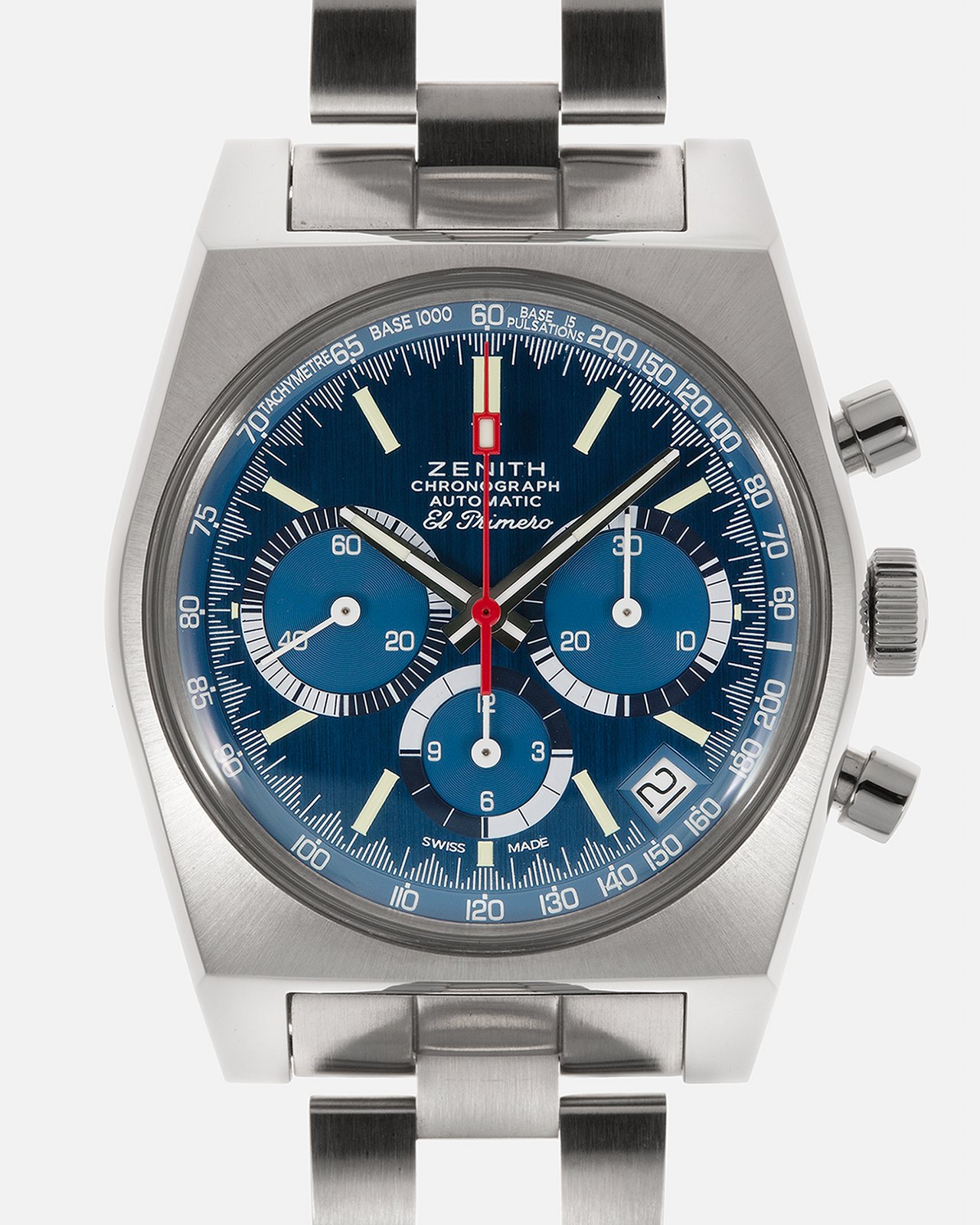
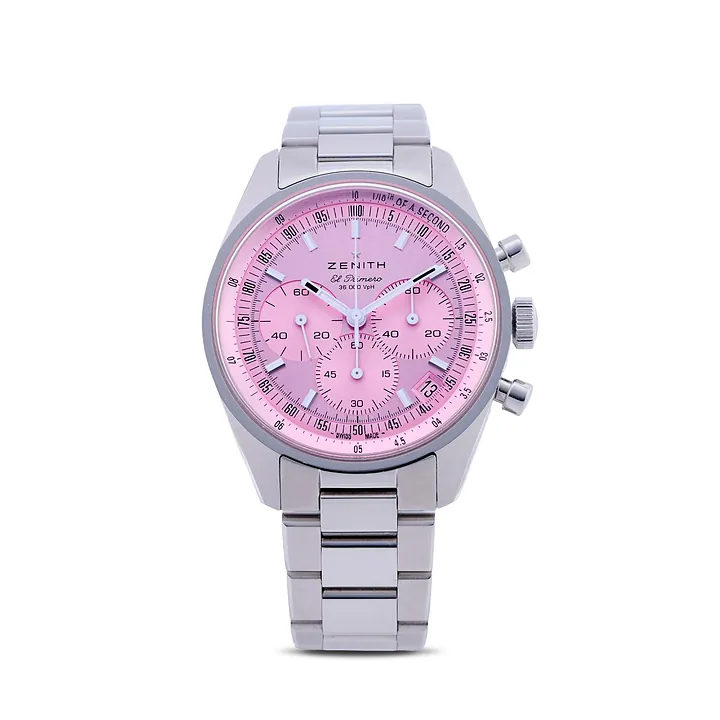
Zenith El Primero x Revolution & The Rake Revival Ref. A3818 Cover Girl, 2020
- Maker / attribution
- Zenith (maker)
- Date
- 2020
- Historical period
- Contemporary Horology (2010 – Present)
- Country of origin
- Switzerland
- Object type
- Wristwatch
- Dimensions
- Case 37 mm
- Stock no.
- Product 7354485899351
- Credit line
- Dealer listing, S.Song Watches (product 7354485899351)
- Catalogue title (original)
- Zenith El Primero x Revolution & The Rake Revival Ref. A3818 Cover Girl (English)
View the source record (dealer listing) ↗ (opens another website in a new tab)Suggest a correction
Record summary
Catalogued by S.Song Watches (dealer), Seattle (stock number Product 7354485899351), this is a wristwatch by Zenith, made in Switzerland, dated 2020. The Atlas places it in the Contemporary Horology period (2010 – Present) of its Wristwatches collection. Recorded dimensions: Case 37 mm. The record is illustrated with 6 photographs.
Assembled from the source record's structured fields. Dates and attributions are given as the source states them; where a field is missing the Atlas leaves it blank rather than estimating.
Catalogue description
Dealer description — S.Song Watches
In recent horological history, the release of the Zenith El Primero in the late '60s stands out as one of the industry’s most defining moments. Known as the first-ever automatic chronograph to enter mass production, the El Primero remains largely unchanged to this day and is truly an icon in its own right. If you've been following us for a while, you know that we don’t often feature modern Zenith El Primeros on our site. So, to see one here is somewhat of an anomaly—and for good reason, as this is no ordinary El Primero. Allow me to explain. What we have for you today is perhaps one of the most visually stunning El Primeros we’ve come across so far: the Ref. A3818, affectionately known within collector circles as the ‘Cover Girl.’ This nickname stems from its iconic appearance on the cover of Manfred Rössler’s book ‘Zenith: Swiss Watch Manufacture Since 1865’. As seen in the photos, the brilliant blue dial is visually arresting, and in addition to that, the watch itself also stands out as a truly remarkable piece of watch design—genuinely unlike any Zenith El Primeros that came before it. For those who may not know, it is believed that only 1,000 pieces of the original were ever produced, making it a rare find and, undoubtedly, one of the most sought-after El Primeros to date. Although this is a recent modern iteration from 2020, produced in a limited run of just 100 pieces via a collaboration between Zenith, Revolution and The Rake magazine, I truly believe it serves as a fitting tribute to the original from 1971. Everything about it just works as it aptly honors its design spirit, with only very subtle and tasteful updates to suit modern design sensibilities, and to distinguish it from an exact reissue—a sentiment that will undoubtedly resonate with collectors who appreciate both craftsmanship, brand heritage and legacy. Starting with its iconic tonneau-shaped case, the Ref. A3818 features a highly wearable 37mm x 13mm case with a somewhat muscular presence despite its size, a trait that speaks volumes to its heritage and utilitarian DNA. That said, for me, the dial is where the magic happens, and it's also the main reason why Manfred Rössler chose it to grace the cover of his Zenith book. Simply put, he was captivated by the striking blue dial, and so are we. The dial is packed with a wealth of intricate details: three distinct sub-dials with radial internals and beautifully-accented outer rings, a unique, demarcated and SuperLuminova-filled ‘sharktooth-like’ minutes track around the periphery, a tachymeter and pulsations scale encircling the outer part of the dial, a discreet date window at 4:30, and a vibrant red chronograph seconds hand with a small luminous paddle that adds a nice pop of color against its rich blue dial. Yes, the Ref. A3818 is undeniably busy, but in the best way possible. Meticulously balanced, visually captivating, functional, and, above all, just downright stunning to look at. Powering this Ref. A3818 from within is the imperious Zenith El Primero Cal. 400, a 5Hz, self-winding movement with gorgeous architecture and a power reserve of 50 hours on a full wind, all fully displayed in its glory beneath the exhibition caseback. Another detail I appreciate about the Ref. A3818 is the inclusion of a Gay Frères ladder-style bracelet. Avid collectors will recognize that this style of bracelet was featured on the original El Primero Ref. A3818 and was the epitome of '70s vogue. As for the modern iteration seen here, the bracelet is solid in its construction and has a slightly tapered profile, giving it a sleek and svelte look, with polished central links. When it comes to re-editions, revivals, or reissues, it’s fair to say that many of us who have been in the collecting world for a while have seen brands release uninspiring versions—updates that seem superfluous and merely for the sake of doing so without truly respecting the horological significance, heritage, or the design ethos of the original piece. However, the Ref. A3818 Revival stands out as one of the best re-editions I’ve seen so far. Zenith has managed to strike the perfect balance, preserving the key aesthetic elements that collectors find highly desirable while incorporating subtle updates that enhance rather than overwhelm, This thoughtful approach leaves just enough to draw you back again and again, inviting you to admire the dial and its intricate details anew each time. Needless to say, I do think that the El Primero Ref. A3818 ‘Cover Girl’ is a compelling watch to own—one that effortlessly complements any serious collector’s watch box and daily rotation.
Historical context
Contemporary Horology (2010 – Present)
Silicon components, connected watches, optical-lattice research clocks and a thriving independent scene.
Smartwatches became the world's best-selling watches, while mechanical watchmaking focuses on craft, innovation (silicon components, new escapements) and independent makers.
Read the period in the timelineMore wristwatches from this periodEarlier: Mechanical Renaissance
Atlas type guide
Wristwatches
Bracelet watches were worn by women from the early nineteenth century — Breguet made one for Caroline Murat, Queen of Naples, in 1810–12 — but the wristwatch only became a man's instrument with military use and aviation in the early twentieth century. Between the World Wars it overtook the pocket watch; the 1920s and 1930s brought rectangular Art Deco cases, water-resistant cases and the first automatic winding systems.
After 1945 the wristwatch became a carrier of identity — dress watches, sports and dive watches, chronographs, calendars — produced by Swiss, American, Japanese, German, Soviet and Chinese industries. The quartz revolution after 1969 and the mechanical renaissance since the 1990s, including the rise of independent watchmakers, complete the story.
What to look for
- The reference number (between the lugs or inside the case back) and serial number, the starting point for dating.
- The calibre: its maker and number are often stamped under the dial or on the bridge.
- Originality of dial, hands and crown — refinished ('redial') dials are common.
- Case material marks: 18K/750, 14K/585, stainless steel, gold-filled, plated.
Dating clues
- Wire-lug cases: before c. 1925.
- Water-resistant screw-down cases: from 1926.
- Quartz movements: from 1969; sapphire crystals widespread after c. 1980.
General guidance written by the Atlas editors about this kind of object. It is not a statement about this particular piece; for that, rely on the source record above and on physical examination.
Related records
Pocket Watches · 1900
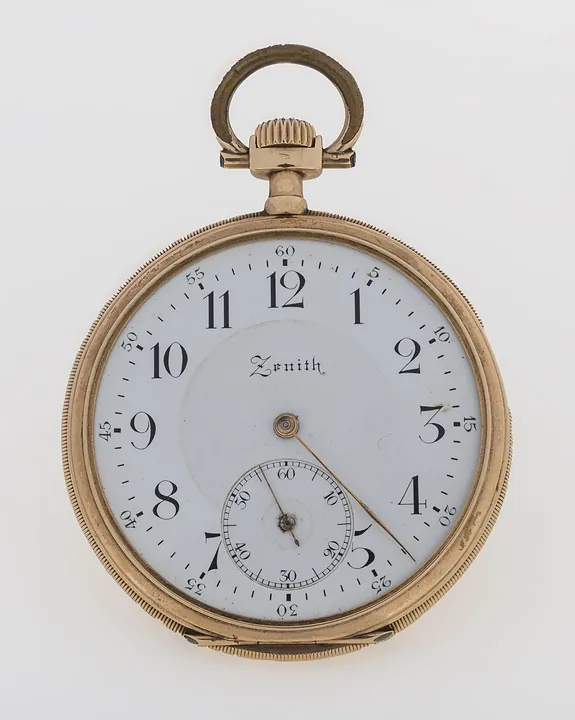
Pocket watch by Zenith, Switzerland, 1900
Museum Rotterdam
Pocket Watches · c. 1900s
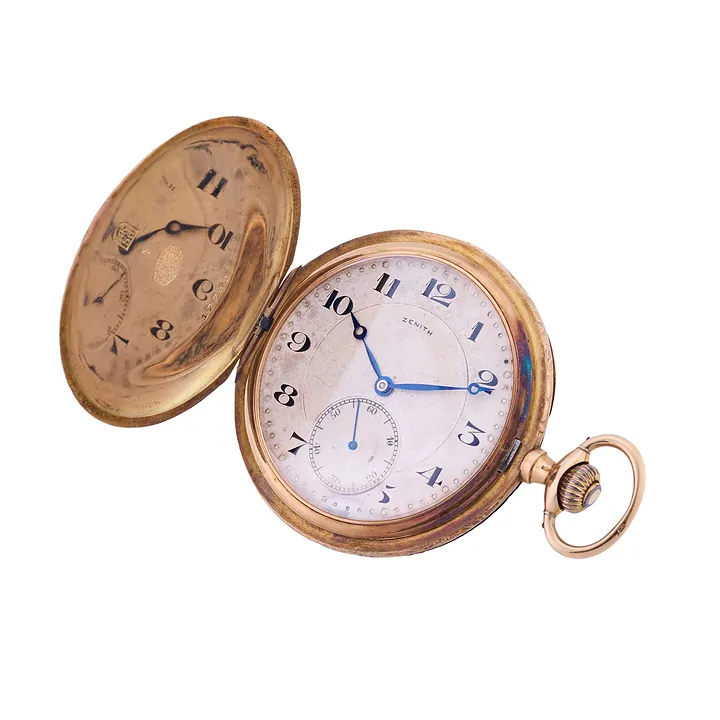
Zenith pocket watch, c. 1900s
Antiquorum auction archive, Geneva
Wristwatches · c. 1980s
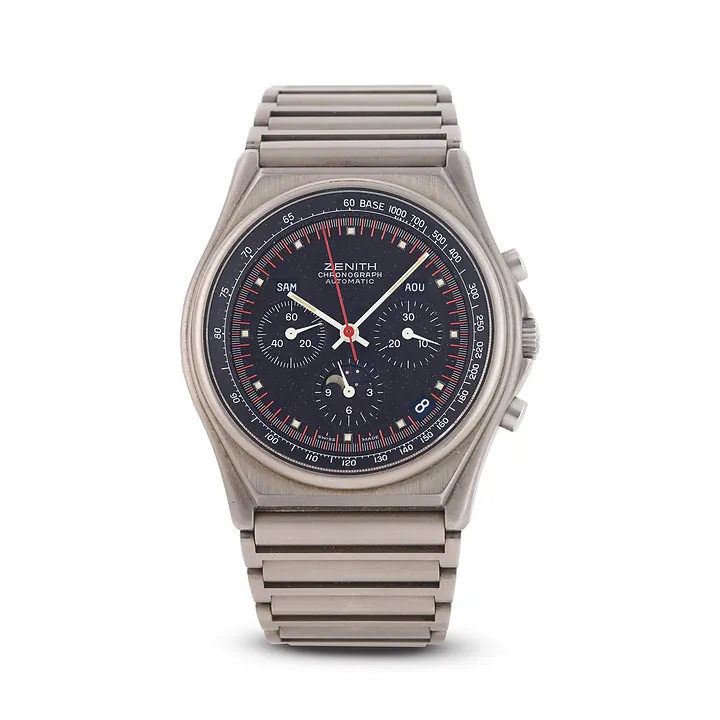
Zenith El Primero Triple Calendar Chronograph, ref. 95.0100.418, c. 1980s
Antiquorum auction archive, Geneva
Wristwatches · originally sold in 2022 (per the lot record)
Zenith Chronomaster Original, ref. 03.3202.3600/33.M3200, originally sold in 2022
Antiquorum auction archive, Geneva

Wristwatches · c. 2010s
Breguet Type XXI, ref. 3810, c. 2010s (Antiquorum Lot 381-24)
Antiquorum auction archive, Geneva

Wristwatches · c. 2010s
Breguet Type XXI, ref. 3810, c. 2010s (Antiquorum Lot 386-229)
Antiquorum auction archive, Geneva

Wristwatches · Sold in September 2010
Breitling Cosmonaute, ref. A 22322, Sold in September 2010
Antiquorum auction archive, Geneva

Wristwatches · c. 2010
Corum Bubble Chrono, ref. 396.150.20, c. 2010
Antiquorum auction archive, Geneva