
Wristwatches · Wristwatch
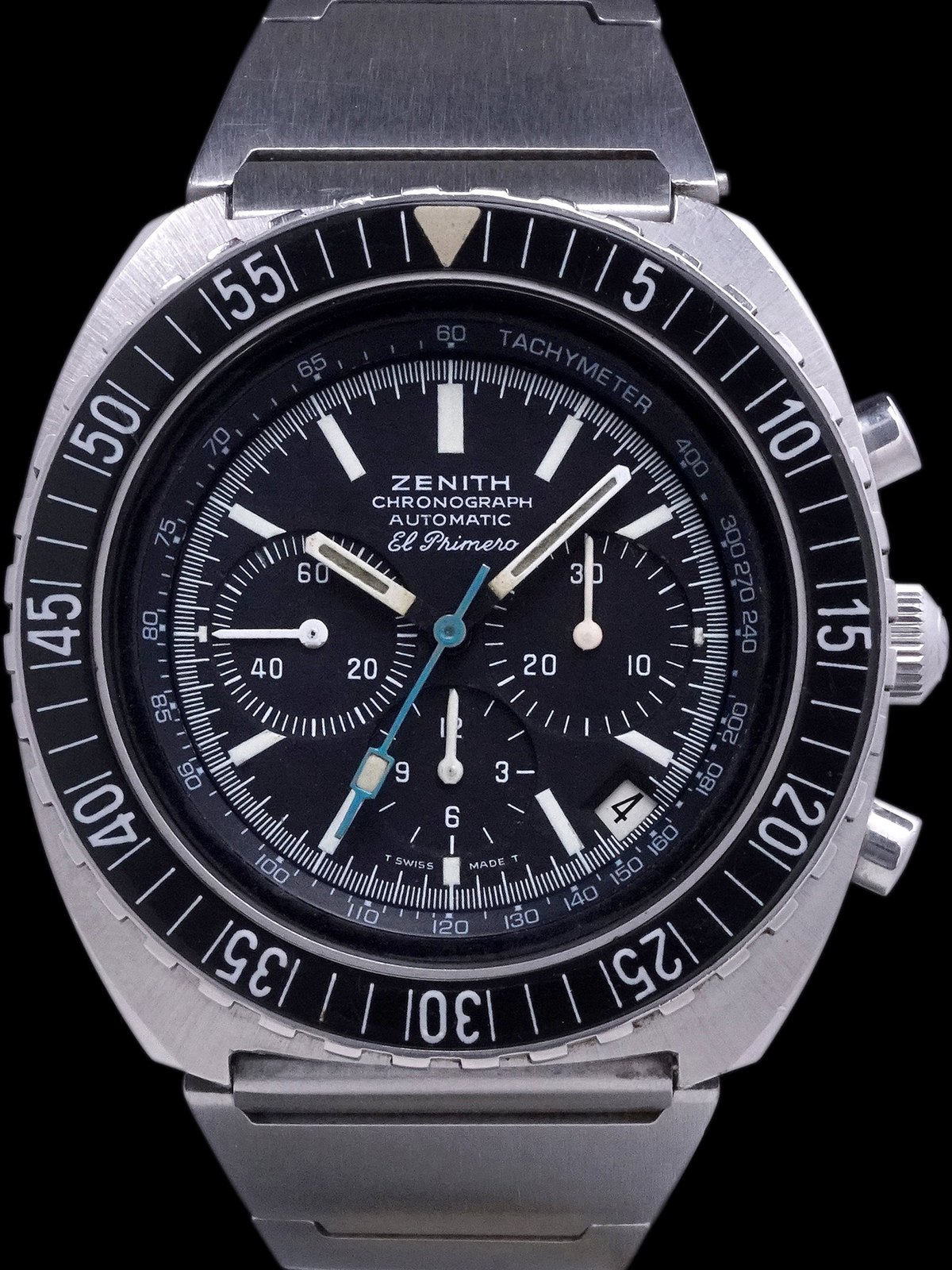
Zenith El Primero Sub Sea Pilot (Ref. 01-0190-415), 1972
- Maker / attribution
- Zenith (maker)
- Date
- 1972
- Historical period
- Quartz Revolution (1969 – 1990)
- Country of origin
- Switzerland
- Object type
- Wristwatch
- Dimensions
- Case 44 mm
- Stock no.
- ZTHEPPL72
- Credit line
- Dealer listing, Craft & Tailored (ZTHEPPL72)
- Catalogue title (original)
- 1972 Zenith El Primero Sub Sea Pilot (Ref. 01-0190-415) (English)
View the source record (dealer listing) ↗ (opens another website in a new tab)Suggest a correction
Record summary
Catalogued by Craft & Tailored (dealer), Los Angeles (stock number ZTHEPPL72), this is a wristwatch by Zenith, made in Switzerland, dated 1972. The Atlas places it in the Quartz Revolution period (1969 – 1990) of its Wristwatches collection. Recorded dimensions: Case 44 mm. The record is illustrated with 6 photographs.
Assembled from the source record's structured fields. Dates and attributions are given as the source states them; where a field is missing the Atlas leaves it blank rather than estimating.
Catalogue description
Dealer description — Craft & Tailored
The Zenith El Primero movement, specifically the Calibre 3019PHC, was unlike any other chronograph movement when it was released. On January 10th, 1969, Zenith introduced the world's first automatic chronograph caliber the 3019PHC El Primero beating out the Seiko 6139 movement and the Chronomatic group consisting of Breitling, Heuer, Hamilton, and Büren in the competition to build the first automatic chronograph. The elusive Zenith El Primero Sub Sea Pilot ref. 01-0190-415 is one of the rarest creations from the Zenith brand. Released in a few variations: the “diver bezel” which counts for elapse minutes, with about 1000 pieces made, and the “pilot bezel” used for tracking a second timezone, with about 800 pieces made. These large multifunctional chronographs also close out the cal. 3019PHC era and feature a large 44mm case and robust “lobster tail” bracelets. SPECS Stock # ZTHEPPL72 Brand Zenith Style El Primero Pilot Chronograph Model 01-0190-415 Serial N/A Size Men's Material Stainless Steel Dial Matte Black Millimeters 44 Bracelet Zenith 1174 Flip-Lock Bracelet W/ ZR End Pieces CASE & BRACELET The large case is believed to remain unpolished, displaying strong factory sunburst finishing and angles with light signs of use. The original bakelite bezel is exceptionally well preserved with no cracks or major signs of use. The case retains its original Zenith signed screw-down crown and pump pushers. The watch comes supplied on its original Zenith 1174 "lobster tail" flip-lock bracelet with ZR end pieces. DIAL & HANDS The original matte black dial is in excellent vintage condition, showing appropriate signs of age and no major blemishes. The markers of the dial have been cleaned of their tritium material and remain bright white. The tritium lumed hands have aged to a dark coloration, under U.V. light inspection the hour and minute hands retain original tritium, the blue chronograph hand has been professionally restored with tritium lume. The 3 o'clock and 6 o'clock sub-dial hands have been repainted in the watches past, the 9 o'clock hand retains its original paint. ACCESSORIES None. The watch is keeping time and functioning perfectly previous service history is unknown.
Historical context
Quartz Revolution (1969 – 1990)
Seiko's Astron begins mass quartz timekeeping; traditional industries contract sharply.
Quartz and digital watches transformed the market after 1969. Swiss employment collapsed, Japanese and Hong Kong production soared, and the Swatch (1983) helped the Swiss industry recover; mechanical watches survived as luxury goods.
Read the period in the timelineMore wristwatches from this periodEarlier: Modern Mechanical Horology
Atlas type guide
Military, pilot and travel watches
The wristwatch owes much of its adoption by men to warfare and aviation. Wristlets — small pocket watches soldered with lugs and worn on a strap — were used in colonial campaigns and became standard equipment in the First World War, with protective grilles over the crystal ('shrapnel guards'). Louis Cartier's Santos (1904), designed for the aviator Alberto Santos-Dumont, is often cited as an early purpose-made pilot's watch.
In the Second World War governments specified watches in detail: the German B-Uhr observation watches, the American A-11, and the British 'W.W.W.' (the 'Dirty Dozen' set of 1945). After the war, jet travel brought GMT and world-time watches, which show two or more time zones at once — Louis Cottier's world-time mechanism and the Rolex GMT-Master (1955) are examples.
What to look for
- Military markings on the case back: broad arrow, issue numbers, 'W.W.W.', 'A.T.P.'
- High-legibility black dials with luminous Arabic numerals; oversized crowns for gloved hands.
- 24-hour hands and rotating 24-hour bezels or city rings on GMT/world-time watches.
- Wire lugs on early wristlets converted from pocket watches.
Dating clues
- Wire-lug wristlets: c. 1900–1925.
- Military specifications of the Second World War: 1939–1945.
- GMT and world-time wristwatches: mainly after 1950.
General guidance written by the Atlas editors about this kind of object. It is not a statement about this particular piece; for that, rely on the source record above and on physical examination.
Related records
Pocket Watches · 1900
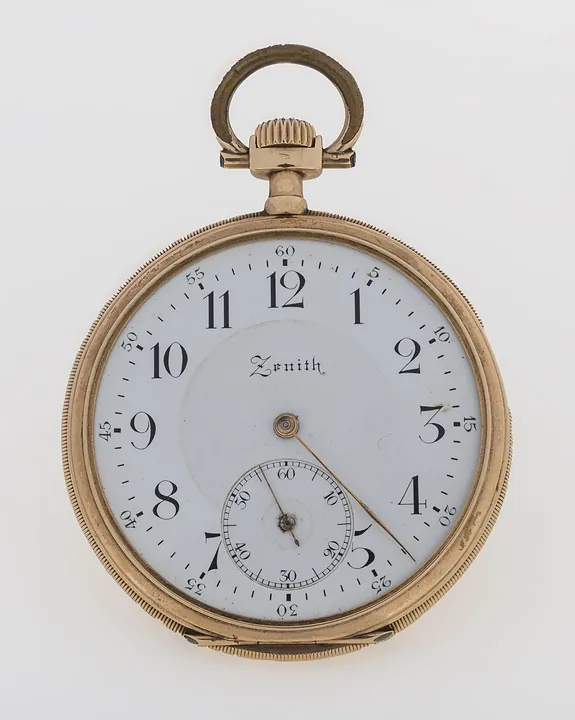
Pocket watch by Zenith, Switzerland, 1900
Museum Rotterdam
Pocket Watches · c. 1900s
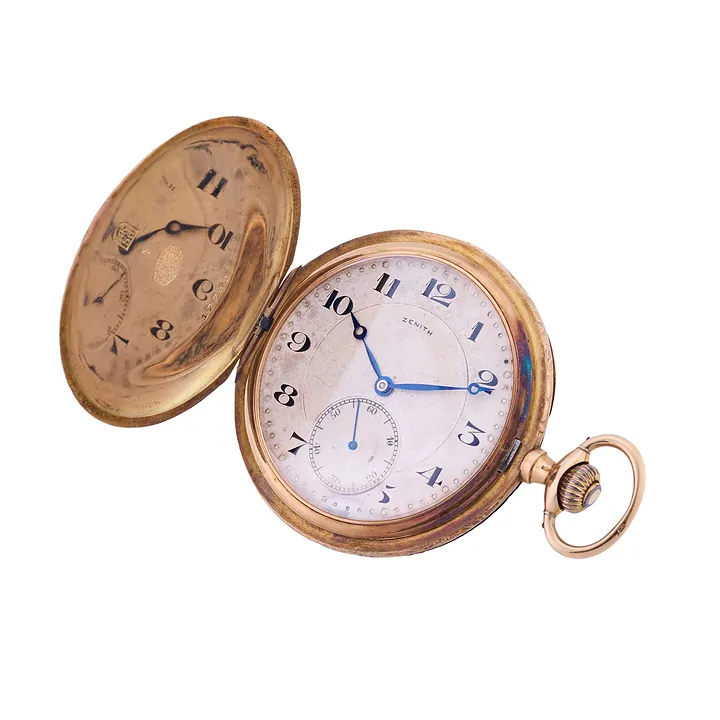
Zenith pocket watch, c. 1900s
Antiquorum auction archive, Geneva
Wristwatches · c. 1980s
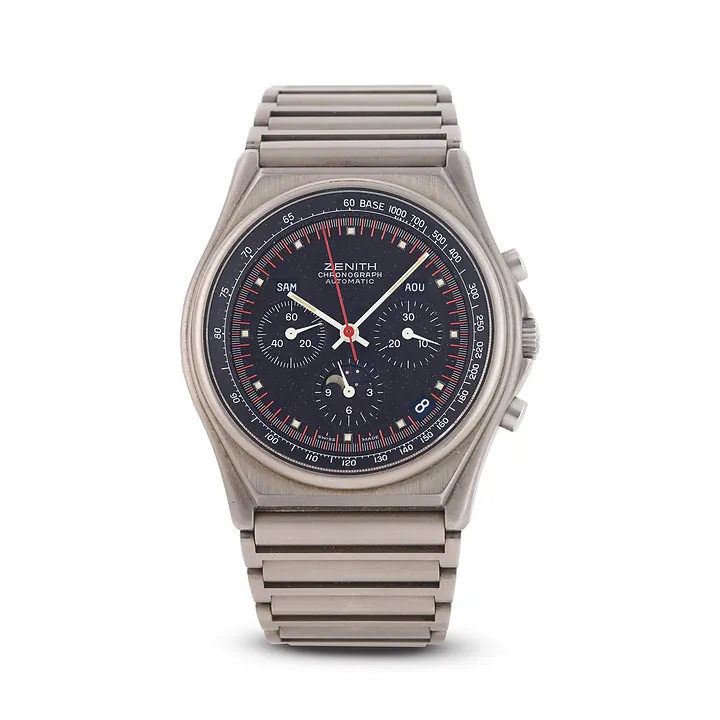
Zenith El Primero Triple Calendar Chronograph, ref. 95.0100.418, c. 1980s
Antiquorum auction archive, Geneva
Wristwatches · originally sold in 2022 (per the lot record)
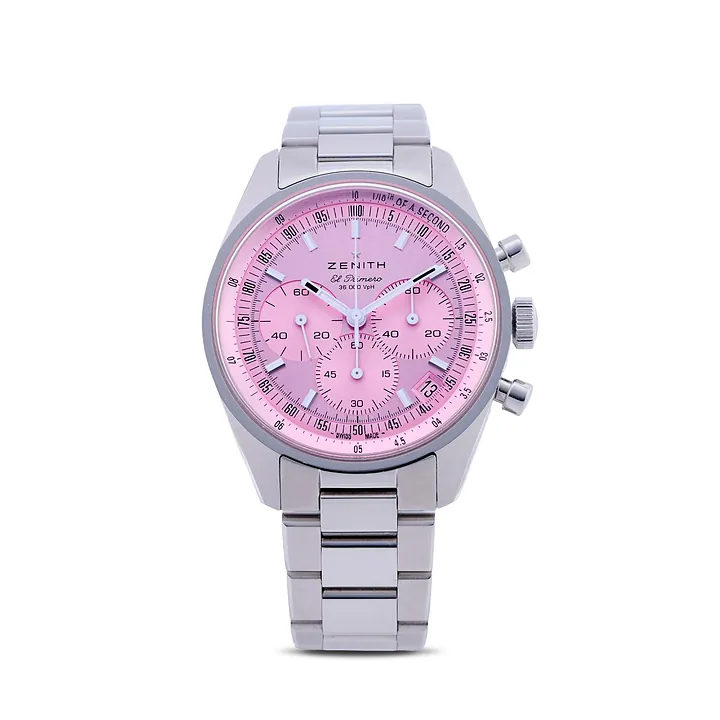
Zenith Chronomaster Original, ref. 03.3202.3600/33.M3200, originally sold in 2022
Antiquorum auction archive, Geneva

Wristwatches · 1970
Wristwatch by Heno, Switzerland, 1970
Museum Rotterdam

Wristwatches · 1960–1986
'Tri-Compax' calendar chronograph wristwatch in gold case, by Universal, Geneva, Switzerland, 1960–1986.
Science Museum Group, London

Wristwatches · 1969–1970
Beta 21 Quartz wristwatch movement, made in Switzerland, 1970.
Science Museum Group, London

Wristwatches · c. 1969
Omega Speedmaster Moonwatch, ref. 145022-69st, c. 1969
Antiquorum auction archive, Geneva