
Wristwatches · Wristwatch
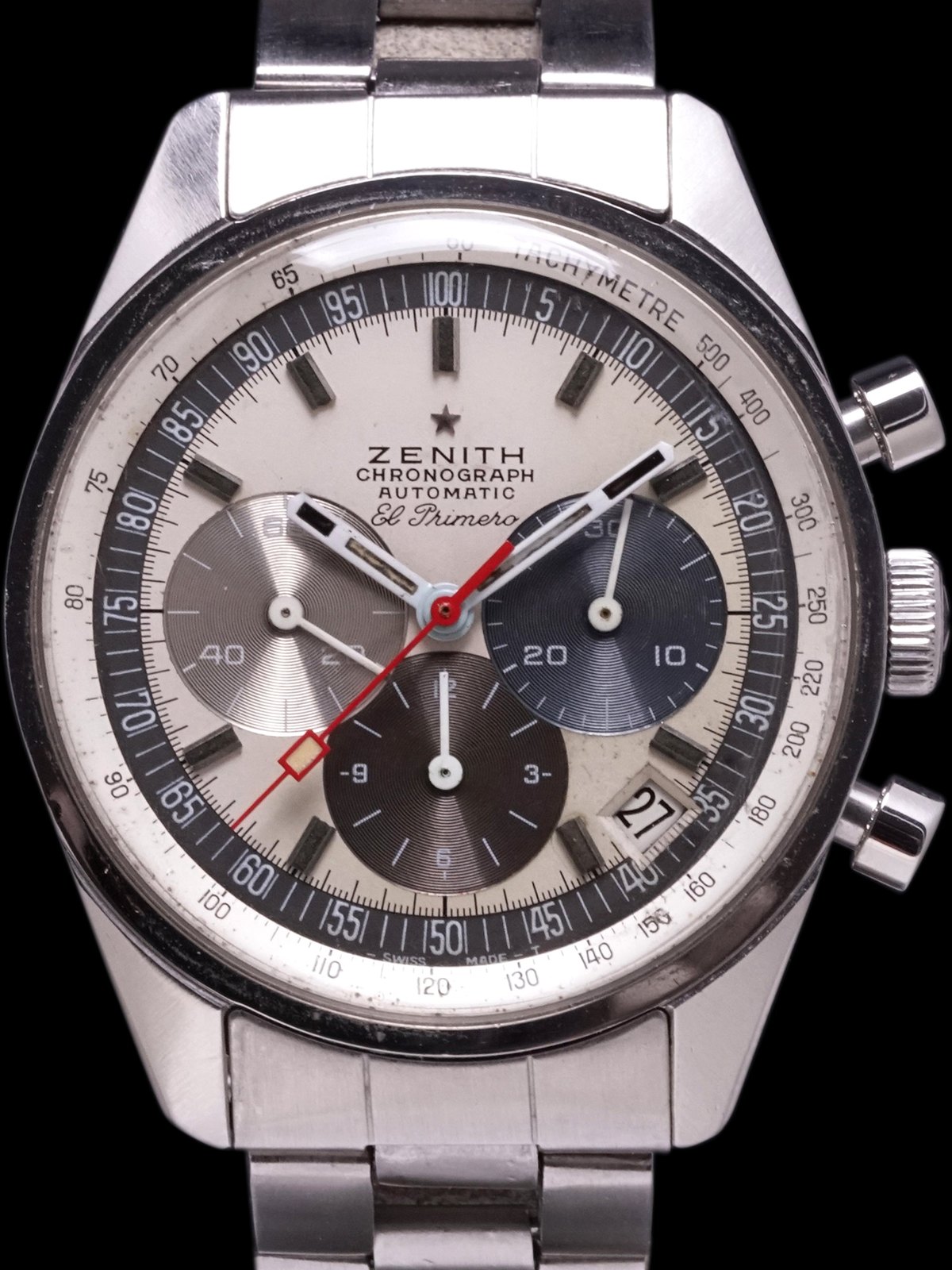
Zenith El Primero (Ref. A386), 1970s
- Maker / attribution
- Zenith (maker)
- Date
- 1970s
- Historical period
- Quartz Revolution (1969 – 1990)
- Country of origin
- Switzerland
- Object type
- Wristwatch
- Stock no.
- ZEPA386-1
- Credit line
- Dealer listing, Craft & Tailored (ZEPA386-1)
- Catalogue title (original)
- 1970s Zenith El Primero (Ref. A386) (English)
View the source record (dealer listing) ↗ (opens another website in a new tab)Suggest a correction
Record summary
Catalogued by Craft & Tailored (dealer), Los Angeles (stock number ZEPA386-1), this is a wristwatch by Zenith, made in Switzerland, dated 1970s. The Atlas places it in the Quartz Revolution period (1969 – 1990) of its Wristwatches collection. The record is illustrated with 6 photographs.
Assembled from the source record's structured fields. Dates and attributions are given as the source states them; where a field is missing the Atlas leaves it blank rather than estimating.
Catalogue description
Dealer description — Craft & Tailored
The Zenith El Primero ref. A386 was unlike any other chronograph when it was released both aesthetically and mechanically. On January 10th, 1969, Zenith introduced the world's first automatic chronograph caliber the 3019PHC El Primero beating out Seiko and the Chronomatic group consisting of Breitling, Heuer, Hamilton, and Büren in the competition to build the first automatic chronograph. Carrying the Calibre 3019 PHC. The A386 was a born classic with its drastically recognizable tri-color overlapping subdials, eye-catching red sweep second hand, and its original and distinctively unique ladder style bracelet. What makes the A386 and the other Zenith El Primero-based chronographs true legends and icons is to think about the many watches outside of the Zenith brand that features this legendary movement, which of course, includes the first self-winding Rolex Daytona, aka the "Zenith Daytonas." Rolex used a modified version of El Primero until the brand released its own in-house automatic chronograph movement in the year 2000. The example we are featuring remains in overall stunning shape and has acquired a delightful patina. The dial has aged to a rich cream color, yet the tri-color sub-dials remain vibrant. The original red enameled sweep seconds hand jumps off the dial and catches the eye, and the minute and hour hands have achieved the same warm and inviting patina much like the dial. The case remains intact, showing its original geometry, and the watch comes with its Zenith-stamped, original Gay Fréres ladder bracelet, clasp, ZJ end-links. This A386 is not only worthy of time on the wrist but retains all the key elements that make this worthy of adding into the collection as examples that remain in this condition are becoming scarce and extremely hard to find. 3019PHC El Primero movement SPECS Stock # ZEPA386-1 Brand Zenith Style El Primero Chronograph Model A386 Serial 852DXXX Size Men's Material Stainless Steel Dial White/ 3-Color Sub-Dials Millimeters 38 Bracelet Zenith Grey Fréres ladder bracelet, ZJ end-links CASE & BRACELET The MK3 case was likely polished in the past yet remains in superb overall condition, showing thick and symmetrical case geometry with slight bevels remaining present. The original pump-pushers and "large circle" crown remain in a wonderful condition, much like the case. The MK3 caseback displays a deep and visible serial number. The watch comes with its original Zenith-stamped, Gay Fréres ladder bracelet, clasp, ZJ end-links. The bracelet shows normal stretch from use. DIAL & HANDS The original El Primero dial with tri-color sub-dials is in excellent condition showing no blemishes and an even and warm patina throughout, the sub-dials remain exceptionally clean as well. The original tritium-filled hands show some darkening which is common and expected from age. When inspected under U.V. light, both the tritium on the dial and within the hands remains intact and shows no visible lume loss. ACCESSORIES
Historical context
Quartz Revolution (1969 – 1990)
Seiko's Astron begins mass quartz timekeeping; traditional industries contract sharply.
Quartz and digital watches transformed the market after 1969. Swiss employment collapsed, Japanese and Hong Kong production soared, and the Swatch (1983) helped the Swiss industry recover; mechanical watches survived as luxury goods.
Read the period in the timelineMore wristwatches from this periodEarlier: Modern Mechanical Horology
Atlas type guide
Wristwatches
Bracelet watches were worn by women from the early nineteenth century — Breguet made one for Caroline Murat, Queen of Naples, in 1810–12 — but the wristwatch only became a man's instrument with military use and aviation in the early twentieth century. Between the World Wars it overtook the pocket watch; the 1920s and 1930s brought rectangular Art Deco cases, water-resistant cases and the first automatic winding systems.
After 1945 the wristwatch became a carrier of identity — dress watches, sports and dive watches, chronographs, calendars — produced by Swiss, American, Japanese, German, Soviet and Chinese industries. The quartz revolution after 1969 and the mechanical renaissance since the 1990s, including the rise of independent watchmakers, complete the story.
What to look for
- The reference number (between the lugs or inside the case back) and serial number, the starting point for dating.
- The calibre: its maker and number are often stamped under the dial or on the bridge.
- Originality of dial, hands and crown — refinished ('redial') dials are common.
- Case material marks: 18K/750, 14K/585, stainless steel, gold-filled, plated.
Dating clues
- Wire-lug cases: before c. 1925.
- Water-resistant screw-down cases: from 1926.
- Quartz movements: from 1969; sapphire crystals widespread after c. 1980.
General guidance written by the Atlas editors about this kind of object. It is not a statement about this particular piece; for that, rely on the source record above and on physical examination.
Related records
Pocket Watches · 1900
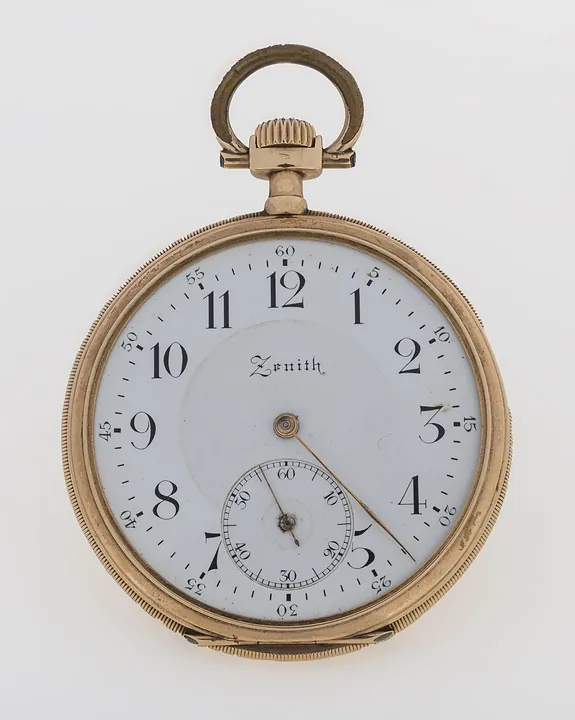
Pocket watch by Zenith, Switzerland, 1900
Museum Rotterdam
Pocket Watches · c. 1900s
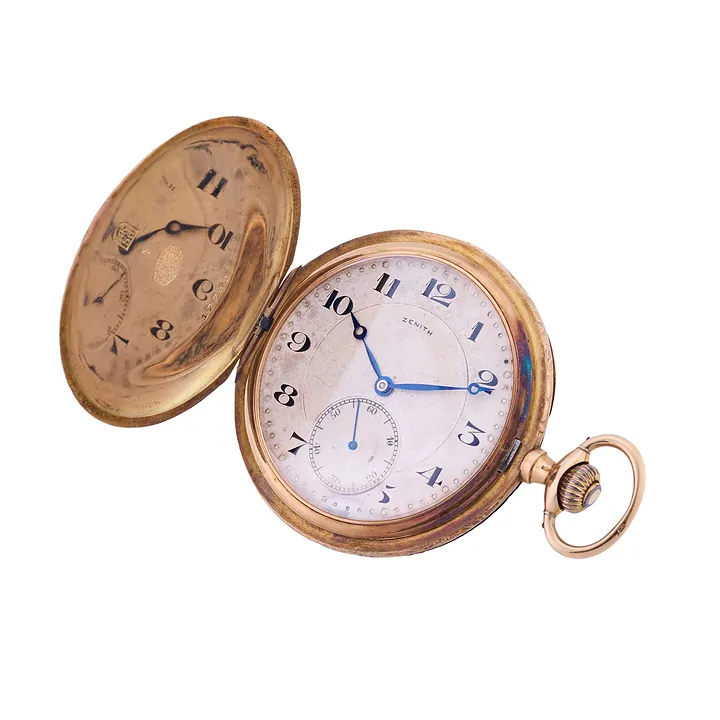
Zenith pocket watch, c. 1900s
Antiquorum auction archive, Geneva
Wristwatches · c. 1980s
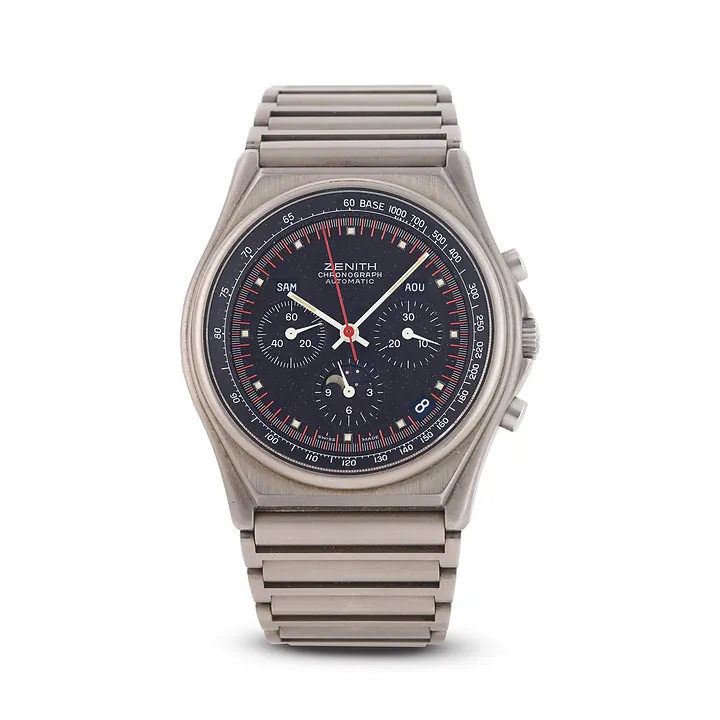
Zenith El Primero Triple Calendar Chronograph, ref. 95.0100.418, c. 1980s
Antiquorum auction archive, Geneva
Wristwatches · originally sold in 2022 (per the lot record)
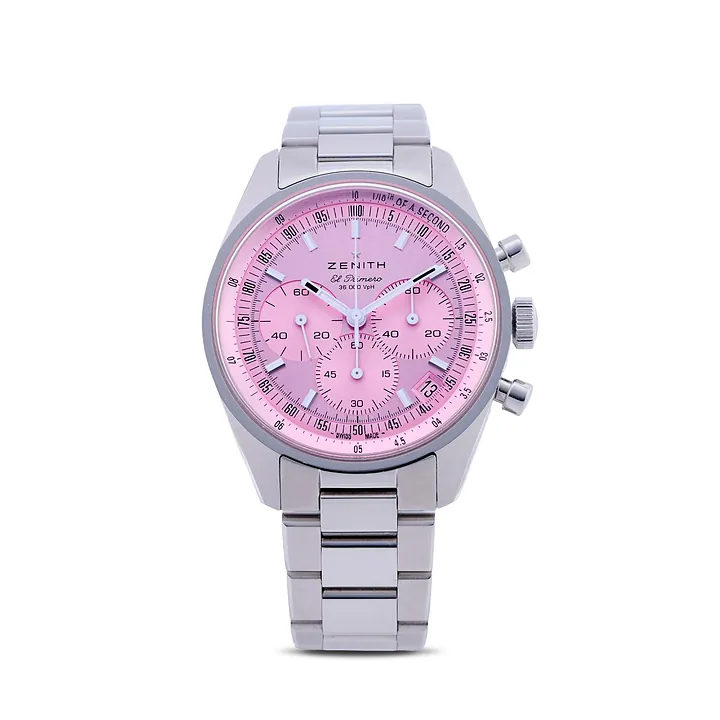
Zenith Chronomaster Original, ref. 03.3202.3600/33.M3200, originally sold in 2022
Antiquorum auction archive, Geneva

Wristwatches · 1970
Wristwatch by Heno, Switzerland, 1970
Museum Rotterdam

Wristwatches · 1960–1986
'Tri-Compax' calendar chronograph wristwatch in gold case, by Universal, Geneva, Switzerland, 1960–1986.
Science Museum Group, London

Wristwatches · 1969–1970
Beta 21 Quartz wristwatch movement, made in Switzerland, 1970.
Science Museum Group, London

Wristwatches · c. 1969
Omega Speedmaster Moonwatch, ref. 145022-69st, c. 1969
Antiquorum auction archive, Geneva