
Wristwatches · Wristwatch
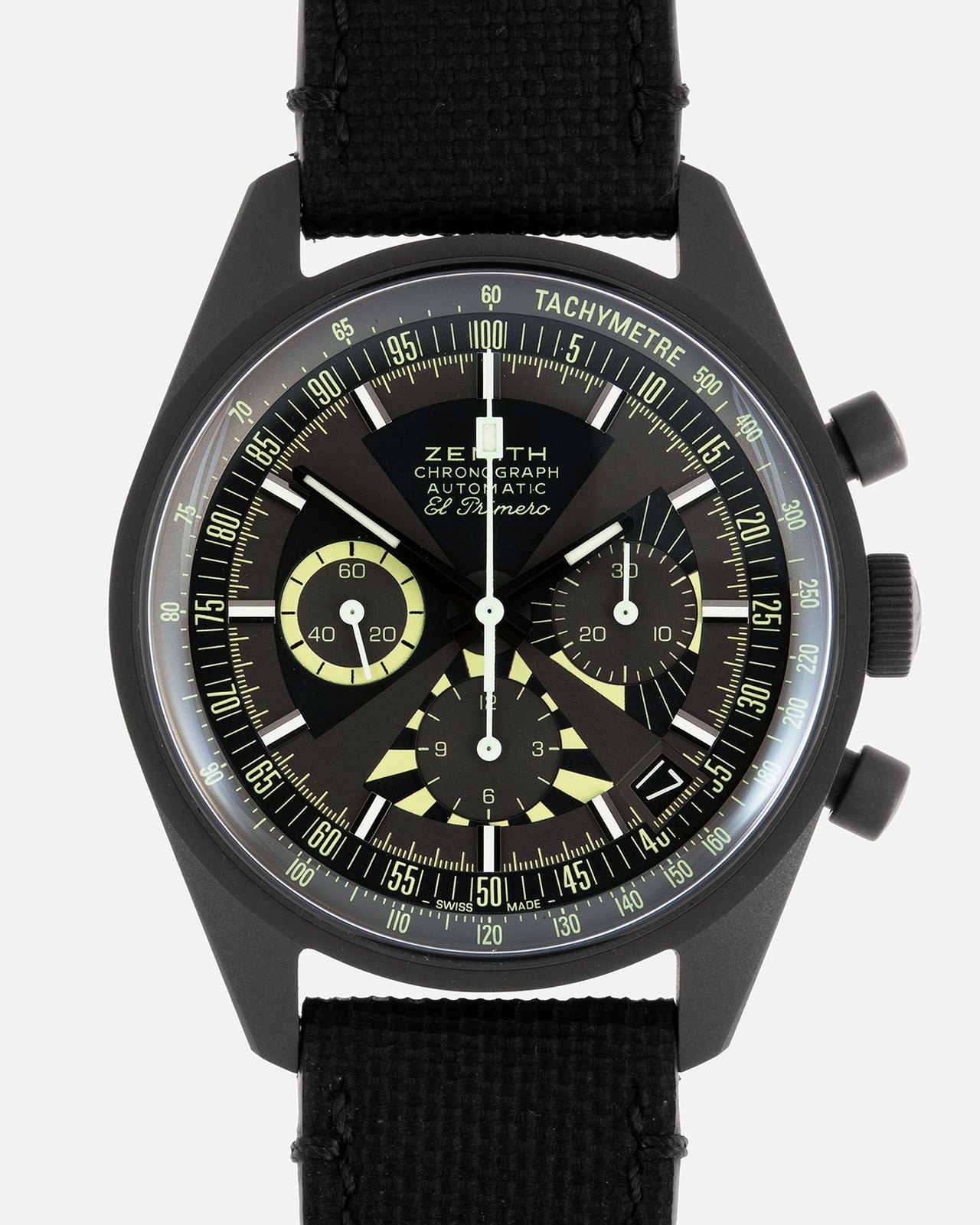
Zenith El Primero Chronomaster SJX Poker Chip, 2021
- Maker / attribution
- Zenith (maker)
- Date
- 2021
- Historical period
- Contemporary Horology (2010 – Present)
- Country of origin
- Switzerland
- Object type
- Wristwatch
- Dimensions
- Case 38 mm
- Stock no.
- Product 6760679669847
- Credit line
- Dealer listing, S.Song Watches (product 6760679669847)
- Catalogue title (original)
- Zenith El Primero Chronomaster SJX Poker Chip (English)
View the source record (dealer listing) ↗ (opens another website in a new tab)Suggest a correction
Record summary
Catalogued by S.Song Watches (dealer), Seattle (stock number Product 6760679669847), this is a wristwatch by Zenith, made in Switzerland, dated 2021. The Atlas places it in the Contemporary Horology period (2010 – Present) of its Wristwatches collection. Recorded dimensions: Case 38 mm. The record is illustrated with 6 photographs.
Assembled from the source record's structured fields. Dates and attributions are given as the source states them; where a field is missing the Atlas leaves it blank rather than estimating.
Catalogue description
Dealer description — S.Song Watches
In horological history, the release of the Zenith El Primero in the late ’60s stands out as one of its more defining moments. Dubbed the first-ever automatic chronograph to be made in production, the El Primero to this day remains largely unchanged and truly an icon. If you have been following us for some time now, you would know that we don’t very often put out modern Zenith El Primeros on the site, so to see one here is a bit of an anomaly- and for good reason, because this is a very unique El Primero. Allow me to explain. The watch we have on offer here is the Zenith Chronomaster Revival “Poker Chip”, Ref. 97.G383.400.38.C880, which was limited to 200 pieces and was a collaborative edition with SJX Watches back in November 2021. There is something strangely mysterious and appealing about this watch, perhaps due to the familiarity of it being an El Primero, but vastly different aesthetic we usually expect from the brand. According to SJX, the watch is loosely inspired by the disco-era El Primero G383, a funky looking watch that looks unmistakably from the 60s and 70s era. The dial on this watch has a very quirky aesthetic to it with the disco-era flavour very apparent here due to the generous application of Super Luminova all over the dial, coupled with a “poker chip” motif at the centre of it all which ties everything together. To balance out the almost excessive and loud design on the dial, the design team opted for a fairly restrained, compact, micro-blasted titanium case to present the watch in its full glory. This gives the watch a very subdued, minimalistic two-colour look, despite the elaborate dial design. Encased within this 38mm titanium case is the El Primero 400, which is an identical calibre found in the Poker Chip’s inspirational model G383 and all other El Primeros of the past. It features a hi-beat 36,000 Vph (5 hz) and boasts a respectable power reserve of 50 hours. For many collectors and enthusiasts (including myself), the Zenith El Primero holds a special place in our hearts due to what the watch represented when it was first introduced. It is certainly a refreshing sight to see a well-designed contemporary version of a true vintage classic in this particular edition, and I am sure many Zenith enthusiasts would share my sentiments.
Historical context
Contemporary Horology (2010 – Present)
Silicon components, connected watches, optical-lattice research clocks and a thriving independent scene.
Smartwatches became the world's best-selling watches, while mechanical watchmaking focuses on craft, innovation (silicon components, new escapements) and independent makers.
Read the period in the timelineMore wristwatches from this periodEarlier: Mechanical Renaissance
Atlas type guide
Wristwatches
Bracelet watches were worn by women from the early nineteenth century — Breguet made one for Caroline Murat, Queen of Naples, in 1810–12 — but the wristwatch only became a man's instrument with military use and aviation in the early twentieth century. Between the World Wars it overtook the pocket watch; the 1920s and 1930s brought rectangular Art Deco cases, water-resistant cases and the first automatic winding systems.
After 1945 the wristwatch became a carrier of identity — dress watches, sports and dive watches, chronographs, calendars — produced by Swiss, American, Japanese, German, Soviet and Chinese industries. The quartz revolution after 1969 and the mechanical renaissance since the 1990s, including the rise of independent watchmakers, complete the story.
What to look for
- The reference number (between the lugs or inside the case back) and serial number, the starting point for dating.
- The calibre: its maker and number are often stamped under the dial or on the bridge.
- Originality of dial, hands and crown — refinished ('redial') dials are common.
- Case material marks: 18K/750, 14K/585, stainless steel, gold-filled, plated.
Dating clues
- Wire-lug cases: before c. 1925.
- Water-resistant screw-down cases: from 1926.
- Quartz movements: from 1969; sapphire crystals widespread after c. 1980.
General guidance written by the Atlas editors about this kind of object. It is not a statement about this particular piece; for that, rely on the source record above and on physical examination.
Related records
Pocket Watches · 1900
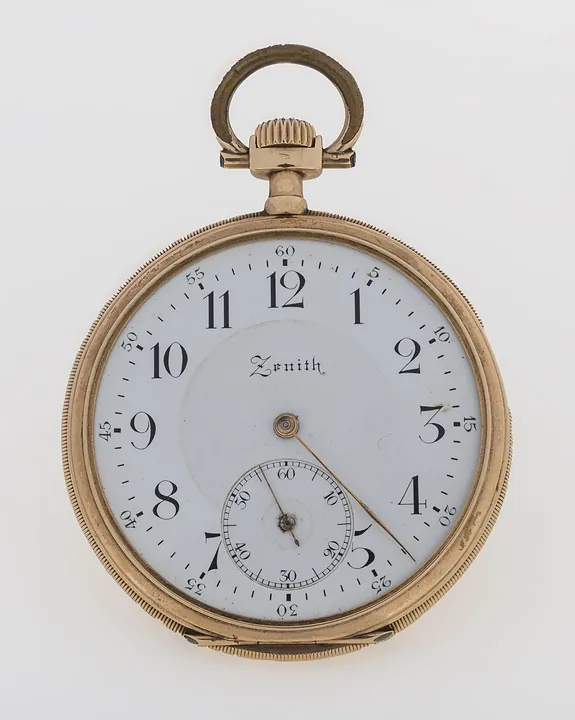
Pocket watch by Zenith, Switzerland, 1900
Museum Rotterdam
Pocket Watches · c. 1900s
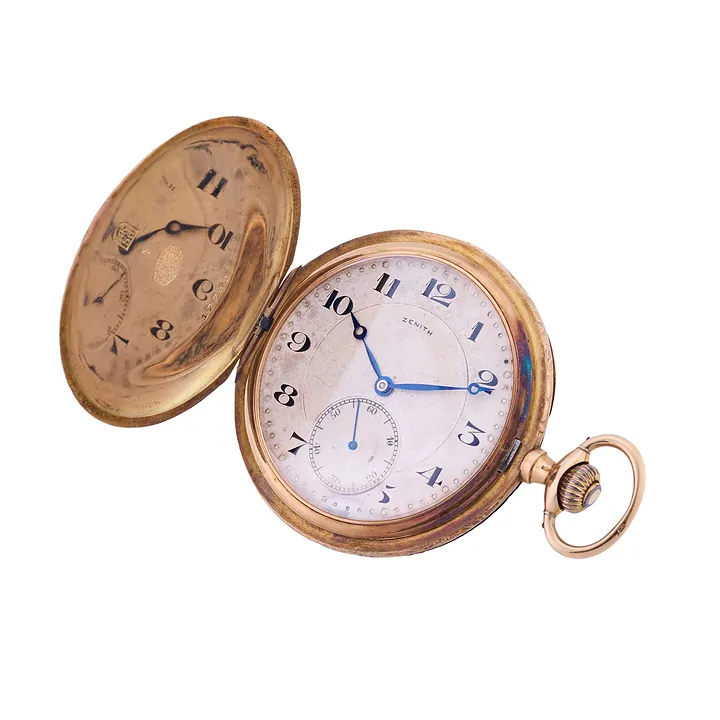
Zenith pocket watch, c. 1900s
Antiquorum auction archive, Geneva
Wristwatches · c. 1980s
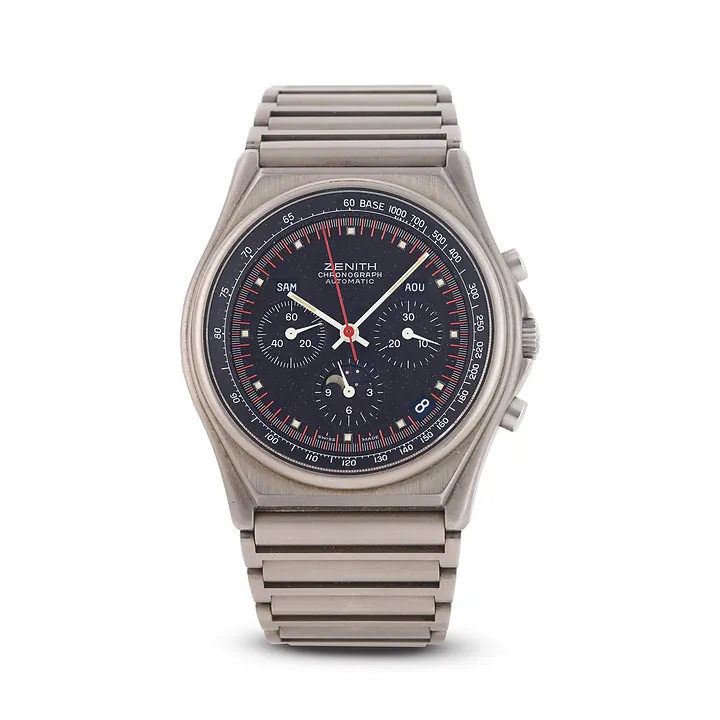
Zenith El Primero Triple Calendar Chronograph, ref. 95.0100.418, c. 1980s
Antiquorum auction archive, Geneva
Wristwatches · originally sold in 2022 (per the lot record)
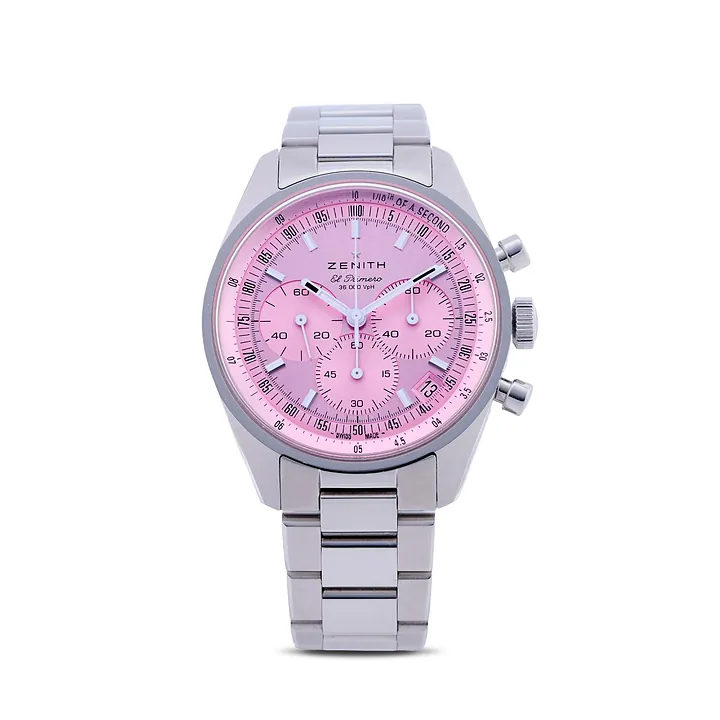
Zenith Chronomaster Original, ref. 03.3202.3600/33.M3200, originally sold in 2022
Antiquorum auction archive, Geneva

Wristwatches · c. 2010s
Breguet Type XXI, ref. 3810, c. 2010s (Antiquorum Lot 381-24)
Antiquorum auction archive, Geneva

Wristwatches · c. 2010s
Breguet Type XXI, ref. 3810, c. 2010s (Antiquorum Lot 386-229)
Antiquorum auction archive, Geneva

Wristwatches · Sold in September 2010
Breitling Cosmonaute, ref. A 22322, Sold in September 2010
Antiquorum auction archive, Geneva

Wristwatches · c. 2010
Corum Bubble Chrono, ref. 396.150.20, c. 2010
Antiquorum auction archive, Geneva