
Wristwatches · Wristwatch
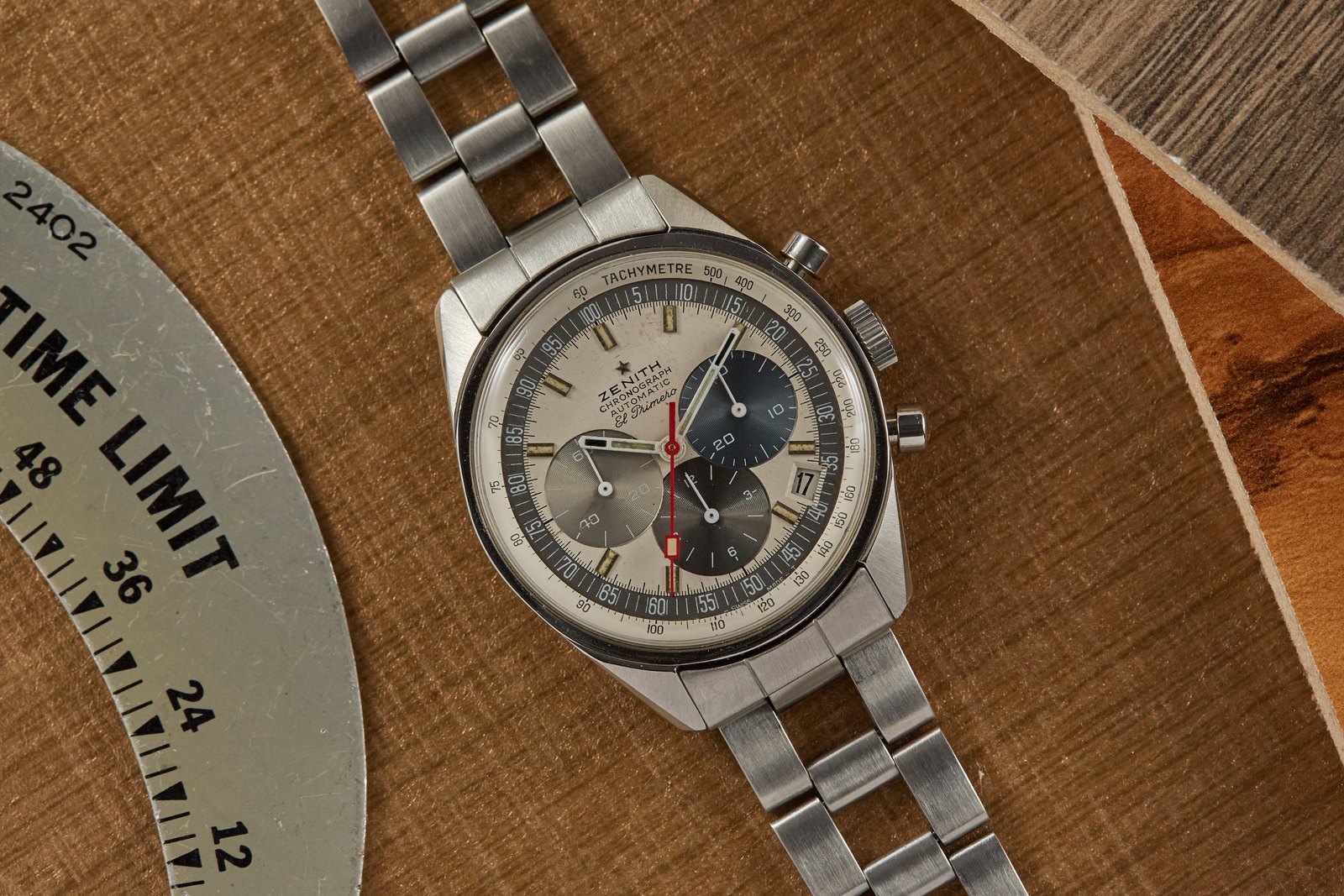
Zenith El Primero A386 MKII, c. 1971
- Maker / attribution
- Zenith (maker)
- Date
- c. 1971
- Historical period
- Quartz Revolution (1969 – 1990)
- Country of origin
- Switzerland
- Object type
- Wristwatch
- Dimensions
- Case 37 mm
- Stock no.
- Product 1964692832343
- Credit line
- Dealer listing, Analog/Shift (product 1964692832343)
- Catalogue title (original)
- Zenith El Primero A386 MKII (English)
View the source record (dealer listing) ↗ (opens another website in a new tab)Suggest a correction
Record summary
Catalogued by Analog/Shift (dealer), New York (stock number Product 1964692832343), this is a wristwatch by Zenith, made in Switzerland, dated c. 1971. The Atlas places it in the Quartz Revolution period (1969 – 1990) of its Wristwatches collection. Recorded dimensions: Case 37 mm. The record is illustrated with 6 photographs.
Assembled from the source record's structured fields. Dates and attributions are given as the source states them; where a field is missing the Atlas leaves it blank rather than estimating.
Catalogue description
Dealer description — Analog/Shift
Why We Love It As the first model to be fitted with the El Primero automatic chronograph movement, the Zenith A386 was—visually and technically—a standout. And 2019 marks 50 years since its debut! With a groundbreaking movement and tremendous looks, it makes sense why these pieces are so coveted. The standout visual feature of the A386 are its 'Tri-colore' overlapping sub registers. The 37mm steel case wears perfectly on the wrist. And the Gay Freres ladder bracelet will turn heads wherever you go. This particular example is a 'MKII" execution dating to roughly 1971. Featuring a crisp case and a perfectly patinated dial and handset - not to mention correct crown and bracelet - this is a no-excuses A386 that will make someone very, very happy! The Story In 1969, as the Soviets and the Americans raced to put a man on the moon, watch brands raced to develop the first automatic chronograph movement. The fiercest competition was among the Swiss, with two camps vying against each other for supremacy: Hamilton, in concert with Heuer, Breitling, Dubois-Depraz, and new Hamilton acquisition, Buren, who would use Buren's Intra-Matic to develop the "Chrono-Matic" (or Caliber 11) under the mysterious title of Project 99. Then there were Zenith and Movado, who'd already made a name for themselves as producers of fine chronographs . Zenith’s journey to develop the El Primero began in 1962, for a target date of 1965, the company’s centennial. Although Zenith would overshoot the date by four years, the movement that they produced would break the mold as far as chronograph movements were concerned—both literally and figuratively. It would be the first automatic chronograph movement. Furthermore, it would be the first chronograph movement where the construction would fully integrate the chronograph complication, rather than containing it in a module. Instead, the El Primero would contain a column wheel and a rotor mounted on ball bearings. Moreover, of the three automatic chronograph movements that were released in 1969, only the El Primero was high-beat, meaning that it beat at a rate of 36,000 bph. This offered significant added accuracy, down to one tenths of a second.
Historical context
Quartz Revolution (1969 – 1990)
Seiko's Astron begins mass quartz timekeeping; traditional industries contract sharply.
Quartz and digital watches transformed the market after 1969. Swiss employment collapsed, Japanese and Hong Kong production soared, and the Swatch (1983) helped the Swiss industry recover; mechanical watches survived as luxury goods.
Read the period in the timelineMore wristwatches from this periodEarlier: Modern Mechanical Horology
Atlas type guide
Wristwatches
Bracelet watches were worn by women from the early nineteenth century — Breguet made one for Caroline Murat, Queen of Naples, in 1810–12 — but the wristwatch only became a man's instrument with military use and aviation in the early twentieth century. Between the World Wars it overtook the pocket watch; the 1920s and 1930s brought rectangular Art Deco cases, water-resistant cases and the first automatic winding systems.
After 1945 the wristwatch became a carrier of identity — dress watches, sports and dive watches, chronographs, calendars — produced by Swiss, American, Japanese, German, Soviet and Chinese industries. The quartz revolution after 1969 and the mechanical renaissance since the 1990s, including the rise of independent watchmakers, complete the story.
What to look for
- The reference number (between the lugs or inside the case back) and serial number, the starting point for dating.
- The calibre: its maker and number are often stamped under the dial or on the bridge.
- Originality of dial, hands and crown — refinished ('redial') dials are common.
- Case material marks: 18K/750, 14K/585, stainless steel, gold-filled, plated.
Dating clues
- Wire-lug cases: before c. 1925.
- Water-resistant screw-down cases: from 1926.
- Quartz movements: from 1969; sapphire crystals widespread after c. 1980.
General guidance written by the Atlas editors about this kind of object. It is not a statement about this particular piece; for that, rely on the source record above and on physical examination.
Related records
Pocket Watches · 1900
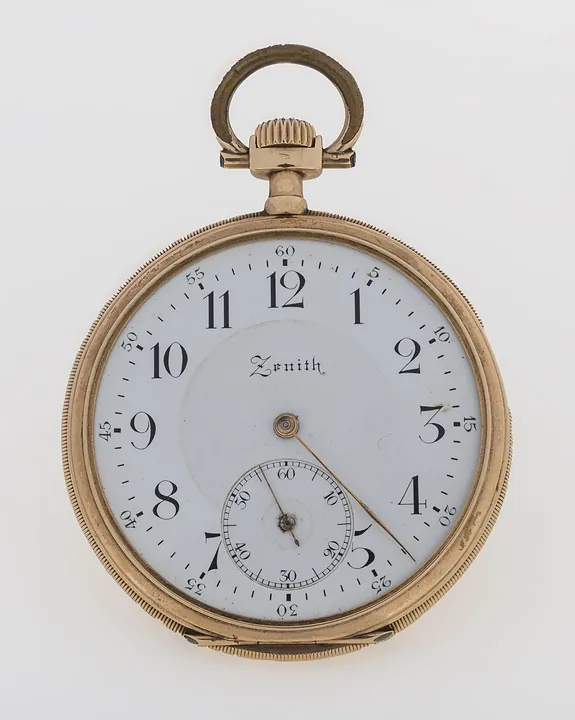
Pocket watch by Zenith, Switzerland, 1900
Museum Rotterdam
Pocket Watches · c. 1900s
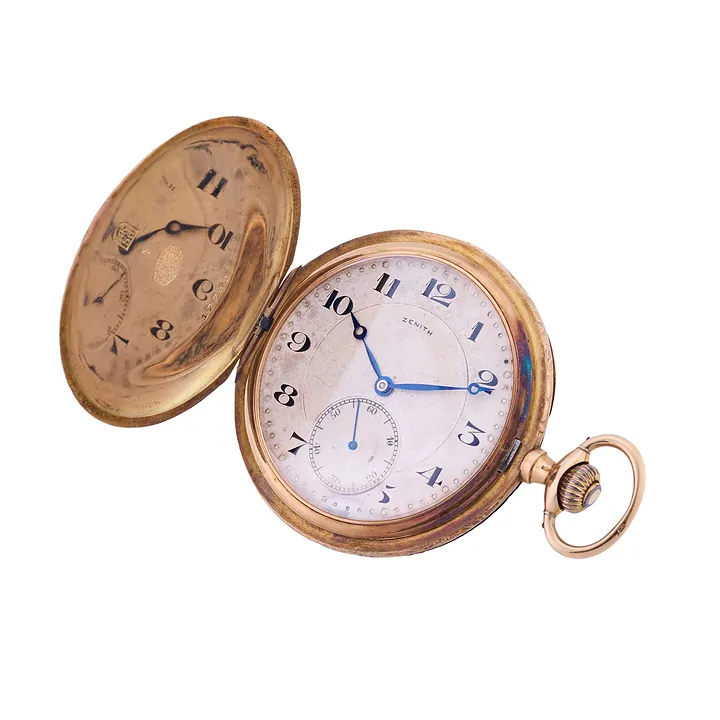
Zenith pocket watch, c. 1900s
Antiquorum auction archive, Geneva
Wristwatches · c. 1980s
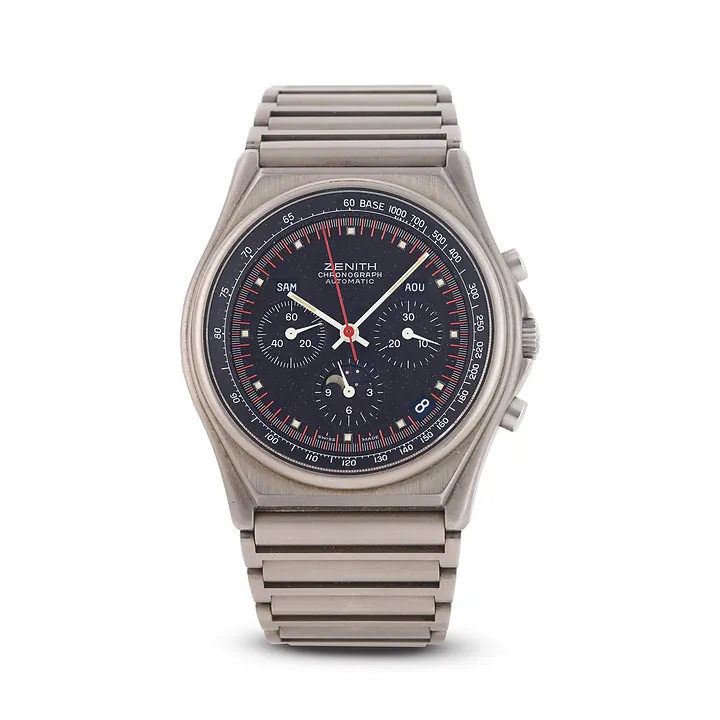
Zenith El Primero Triple Calendar Chronograph, ref. 95.0100.418, c. 1980s
Antiquorum auction archive, Geneva
Wristwatches · originally sold in 2022 (per the lot record)
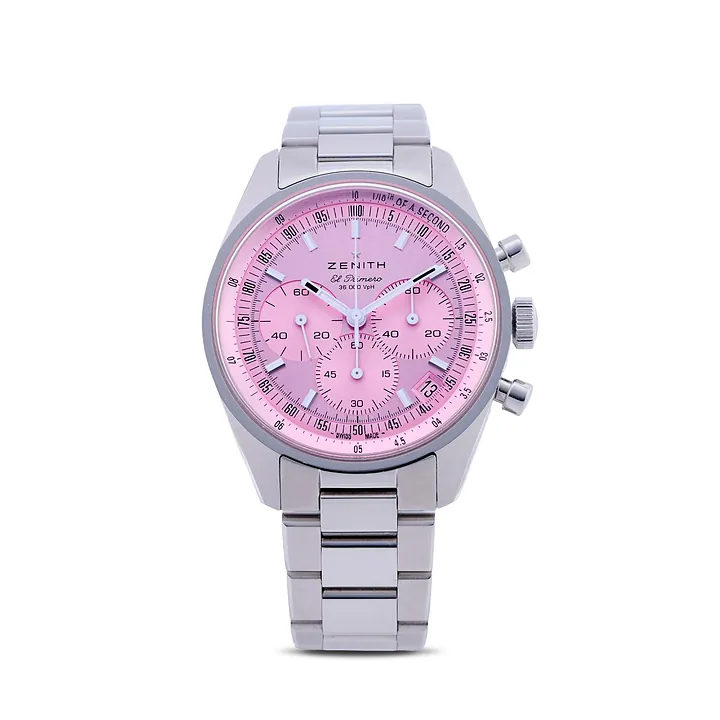
Zenith Chronomaster Original, ref. 03.3202.3600/33.M3200, originally sold in 2022
Antiquorum auction archive, Geneva

Wristwatches · 1970
Wristwatch by Heno, Switzerland, 1970
Museum Rotterdam

Wristwatches · 1960–1986
'Tri-Compax' calendar chronograph wristwatch in gold case, by Universal, Geneva, Switzerland, 1960–1986.
Science Museum Group, London

Wristwatches · 1969–1970
Beta 21 Quartz wristwatch movement, made in Switzerland, 1970.
Science Museum Group, London

Wristwatches · c. 1969
Omega Speedmaster Moonwatch, ref. 145022-69st, c. 1969
Antiquorum auction archive, Geneva