
Wristwatches · Wristwatch
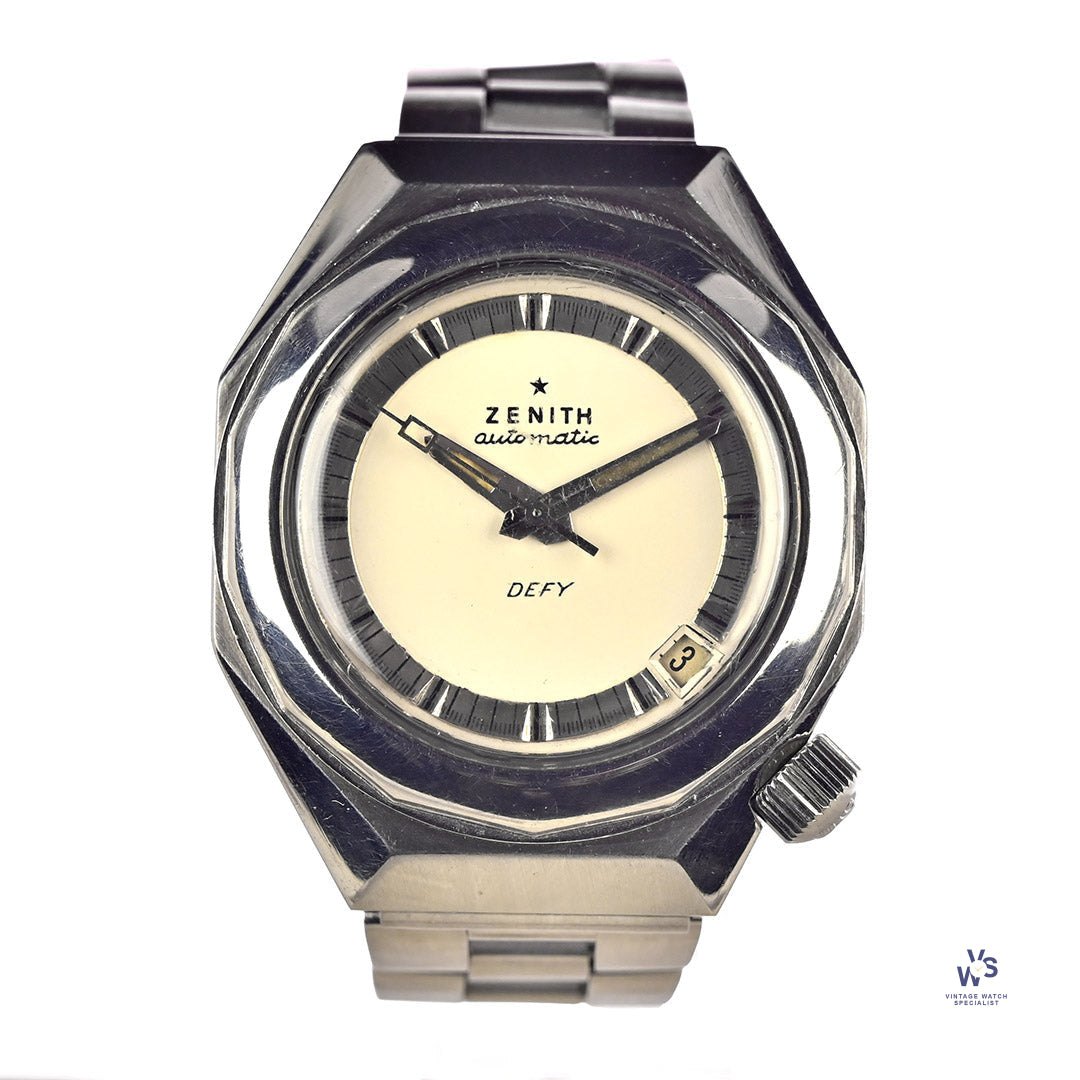
Zenith Defy, Model 1808-68, Automatic Calendar, Gay Freres Bracelet, circa 1970s
- Maker / attribution
- Zenith (maker)
- Date
- c. 1970s
- Historical period
- Quartz Revolution (1969 – 1990)
- Country of origin
- Switzerland
- Object type
- Wristwatch
- Stock no.
- vws3244
- Credit line
- Dealer listing, Vintage Watch Specialist (vws3244)
- Catalogue title (original)
- Zenith Defy - Model 1808-68 - Automatic Calendar - Gay Freres Bracelet - c.1970s (English)
View the source record (dealer listing) ↗ (opens another website in a new tab)Suggest a correction
Record summary
Catalogued by Vintage Watch Specialist (dealer), United Kingdom (stock number vws3244), this is a wristwatch by Zenith, made in Switzerland, dated c. 1970s. The Atlas places it in the Quartz Revolution period (1969 – 1990) of its Wristwatches collection. The record is illustrated with 6 photographs.
Assembled from the source record's structured fields. Dates and attributions are given as the source states them; where a field is missing the Atlas leaves it blank rather than estimating.
Catalogue description
Dealer description — Vintage Watch Specialist
A Superb Zenith Defy Automatic Calendar, Model Reference 1808-68, in Fantastic Vintage Condition with its Original Gay Freres Bracelet, c.1970s The Zenith Defy watch, a hallmark of Swiss horological innovation, made its debut in 1969. This iconic timepiece set a new standard for precision and durability, embodying Zenith's commitment to pushing the boundaries of watchmaking. Initially launched as part of the brand's effort to create robust sports watches, the Defy featured an avant-garde design with a bold case and an integrated bracelet, making it instantly recognizable. Over the decades, Zenith continually evolved the Defy collection to include groundbreaking technologies. In 2017, the introduction of the Defy El Primero 21 marked a significant milestone with its revolutionary 1/100th of a second chronograph movement. The collection expanded with models like the Defy Classic and Defy Inventor, showcasing innovative materials such as carbon fibre and silicon. Today, the Zenith Defy remains a symbol of cutting-edge craftsmanship and timeless style, celebrated by watch enthusiasts around the world. What's on Offer Instantly recognisable with its unique octagonal case and Tetradecagon (14 sided lol) bezel, this Zenith Defy represents perfectly the free-spirited attitude and forward thinking of the 1970s. The dial is a handsome brute, simple in design and beautifully sophisticated with chunky Dauphine hands with luminous inserts and a square 'lollipop' seconds hand. There is a subtle date wheel at 5 o'clock adjacent to the meaty crown. The dial is encapsulated underneath a shatterproof Plexiglas crystal and encased in stainless steel. The watch is paired with its original Gay Freres bracelet with a fold over clasp that boasts the Zenith signature. This is a fairly substantial watch on the wrist but it wears comfortably, it does have signs of previous wear but they are minimal. It is running well and keeping good time, a great-looking watch with bags of charisma. Don't sleep on this one!
Historical context
Quartz Revolution (1969 – 1990)
Seiko's Astron begins mass quartz timekeeping; traditional industries contract sharply.
Quartz and digital watches transformed the market after 1969. Swiss employment collapsed, Japanese and Hong Kong production soared, and the Swatch (1983) helped the Swiss industry recover; mechanical watches survived as luxury goods.
Read the period in the timelineMore wristwatches from this periodEarlier: Modern Mechanical Horology
Atlas type guide
Calendar, moon-phase and perpetual calendar watches
Calendar complications range from a simple date to the perpetual calendar, which automatically allows for months of different lengths and leap years until 2100. Pocket watches with perpetual calendars were made in the eighteenth and nineteenth centuries; Patek Philippe made the first perpetual calendar wristwatch in 1925, and series production followed in 1941. The annual calendar (Patek Philippe, 1996) needs correction only once a year.
Moon-phase displays use a disc with two moons and 59 teeth advanced daily, approximating the 29.5-day lunation; more precise trains reduce the error to one day in over a century.
What to look for
- Apertures or subsidiary dials for day, date, month and leap year.
- Moon disc under a 'bosom' shaped aperture.
- Recessed correctors on the case band for setting the calendar.
Dating clues
- Triple-date wristwatches: popular c. 1940–1955.
- Perpetual calendar wristwatches: from 1925 (unique) and 1941 (series).
General guidance written by the Atlas editors about this kind of object. It is not a statement about this particular piece; for that, rely on the source record above and on physical examination.
Related records
Pocket Watches · 1900
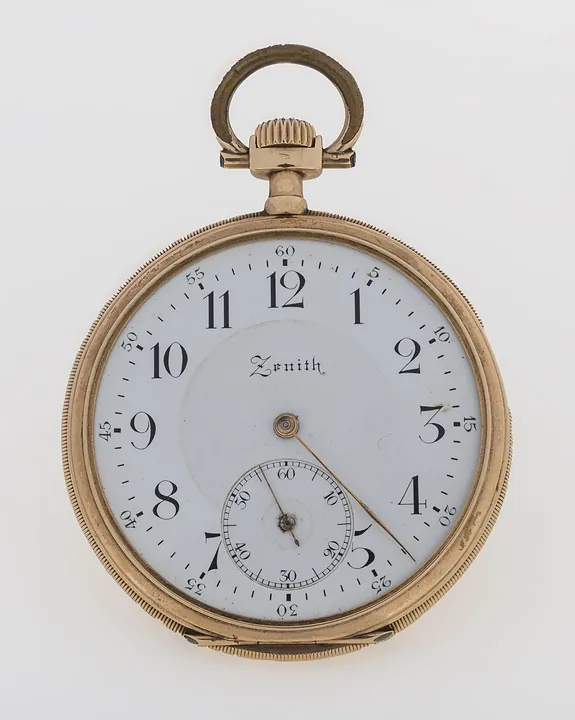
Pocket watch by Zenith, Switzerland, 1900
Museum Rotterdam
Pocket Watches · c. 1900s
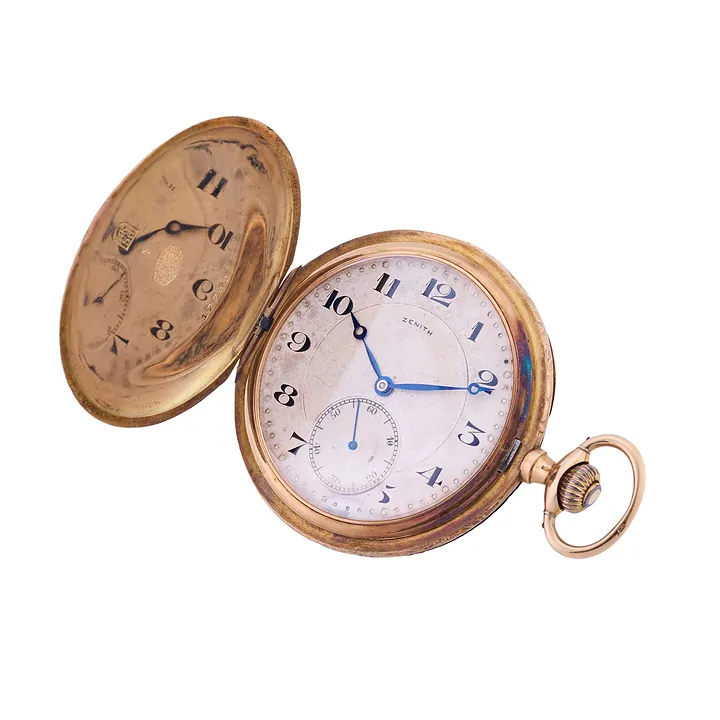
Zenith pocket watch, c. 1900s
Antiquorum auction archive, Geneva
Wristwatches · c. 1980s
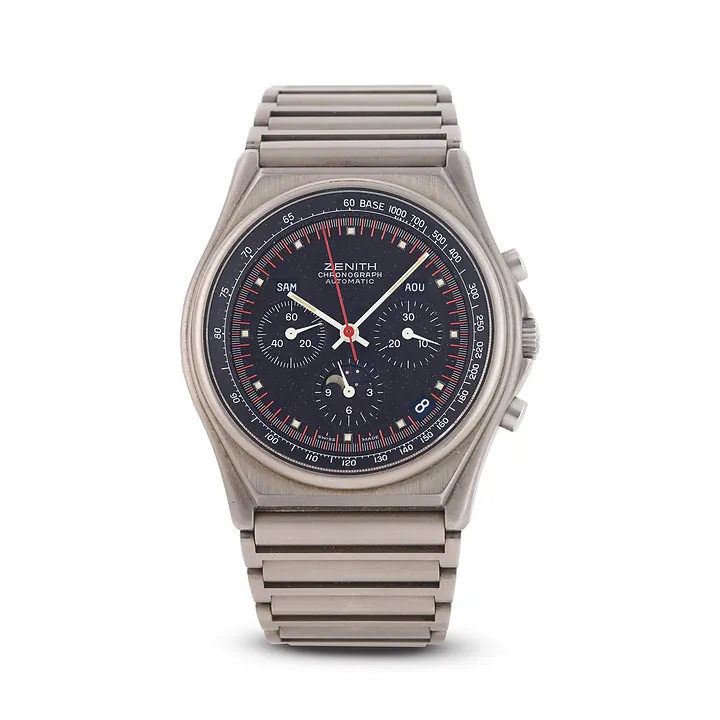
Zenith El Primero Triple Calendar Chronograph, ref. 95.0100.418, c. 1980s
Antiquorum auction archive, Geneva
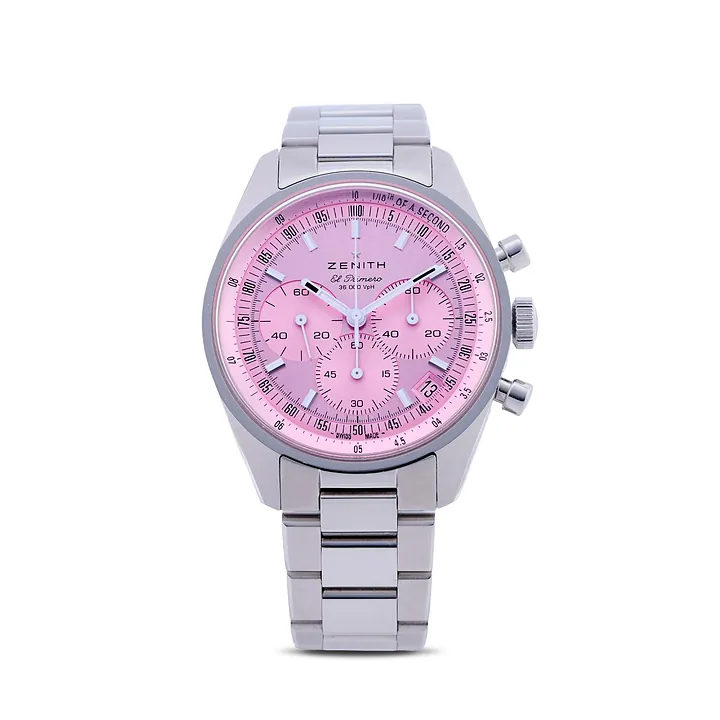
Wristwatches · originally sold in 2022 (per the lot record)
Zenith Chronomaster Original, ref. 03.3202.3600/33.M3200, originally sold in 2022
Antiquorum auction archive, Geneva

Wristwatches · 1970
Wristwatch by Heno, Switzerland, 1970
Museum Rotterdam

Wristwatches · 1960–1986
'Tri-Compax' calendar chronograph wristwatch in gold case, by Universal, Geneva, Switzerland, 1960–1986.
Science Museum Group, London

Wristwatches · 1969–1970
Beta 21 Quartz wristwatch movement, made in Switzerland, 1970.
Science Museum Group, London

Wristwatches · c. 1969
Omega Speedmaster Moonwatch, ref. 145022-69st, c. 1969
Antiquorum auction archive, Geneva