
Wristwatches · Wristwatch
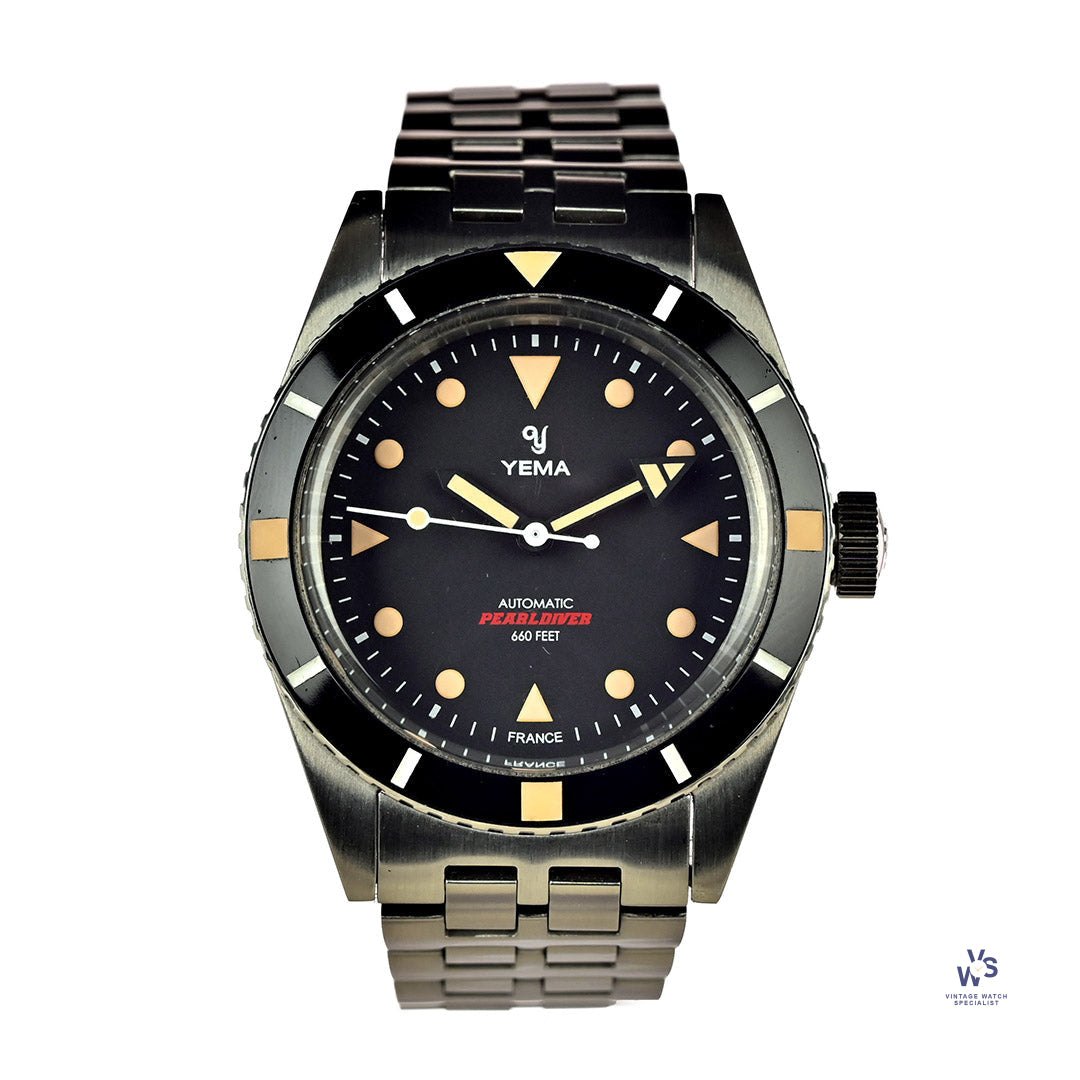
Yema Pearl Diver Automatic, ref. YCL1-MRM, 2021
- Maker / attribution
- Yema (maker)
- Date
- 2021
- Historical period
- Contemporary Horology (2010 – Present)
- Country of origin
- Unrecorded in source
- Object type
- Wristwatch
- Stock no.
- vws3262cs
- Credit line
- Dealer listing, Vintage Watch Specialist (vws3262cs)
- Catalogue title (original)
- Yema Pearl Diver Automatic - Model Reference YCL1-MRM - Box and Papers - 2021 (English)
View the source record (dealer listing) ↗ (opens another website in a new tab)Suggest a correction
Record summary
Catalogued by Vintage Watch Specialist (dealer), United Kingdom (stock number vws3262cs), this is a wristwatch by Yema, dated 2021. The Atlas places it in the Contemporary Horology period (2010 – Present) of its Wristwatches collection. The record is illustrated with 6 photographs.
Assembled from the source record's structured fields. Dates and attributions are given as the source states them; where a field is missing the Atlas leaves it blank rather than estimating.
Catalogue description
Dealer description — Vintage Watch Specialist
A Superb Pre-Owned 2021 Yema Pearl Diver Automatic, Model Ref: YCL1-MRM, in Fantastic Pre-Owned Condition and Sold with its Original Box and Papers Yema, a distinguished French watch brand, was founded in 1948 by Henry Louis Belmont. Known for its innovative designs and technical prowess, Yema quickly gained a reputation for creating reliable timepieces. In the 1960s, the brand introduced iconic models like the Yachtingraf and Rallygraf, tailored for sailing and motorsports enthusiasts. The company's commitment to precision led to the development of the Superman in 1963, a robust dive watch celebrated for its unique bezel-lock mechanism. During the 1970s and '80s, Yema continued to innovate with space-oriented watches like the Spationaute I, worn by French astronaut Jean-Loup Chrétien during his space missions. Despite facing challenges in the quartz crisis era, Yema managed to preserve its legacy through strategic adaptations. In recent years, Yema has experienced a renaissance under new ownership, focusing on heritage-inspired designs while incorporating modern technology. Today, it remains an emblem of French horological craftsmanship and adventure-driven spirit. What's on Offer
Historical context
Contemporary Horology (2010 – Present)
Silicon components, connected watches, optical-lattice research clocks and a thriving independent scene.
Smartwatches became the world's best-selling watches, while mechanical watchmaking focuses on craft, innovation (silicon components, new escapements) and independent makers.
Read the period in the timelineMore wristwatches from this periodEarlier: Mechanical Renaissance
Atlas type guide
Dive and water-resistant watches
Keeping water and dust out of a wristwatch was a long-standing challenge. Rolex's screw-down Oyster case (1926) and Omega's Marine (1932) were landmarks; in the early 1950s Blancpain's Fifty Fathoms and Rolex's Submariner defined the professional dive watch with rotating bezels for timing dives, luminous dials and high water resistance. The ISO 6425 standard (1982) later codified what a 'diver's watch' must do.
Dive watches became icons of post-war design and exploration, and their evolution — helium escape valves, ceramic bezels, saturation-diving depth ratings — records the history of underwater work.
What to look for
- Unidirectional or bidirectional rotating bezel with minute markings.
- Screw-down crown and case back; depth rating printed on the dial.
- Luminous hands and markers (radium before c. 1960, tritium c. 1960–1998, then Super-LumiNova).
- Reference numbers on the case between the lugs or inside the back.
Dating clues
- Screw-down Oyster cases: from 1926.
- Professional dive watches: from 1953.
- Tritium 'T' marks on dials: c. 1960–1998.
General guidance written by the Atlas editors about this kind of object. It is not a statement about this particular piece; for that, rely on the source record above and on physical examination.
Related records
Wristwatches · 1970s
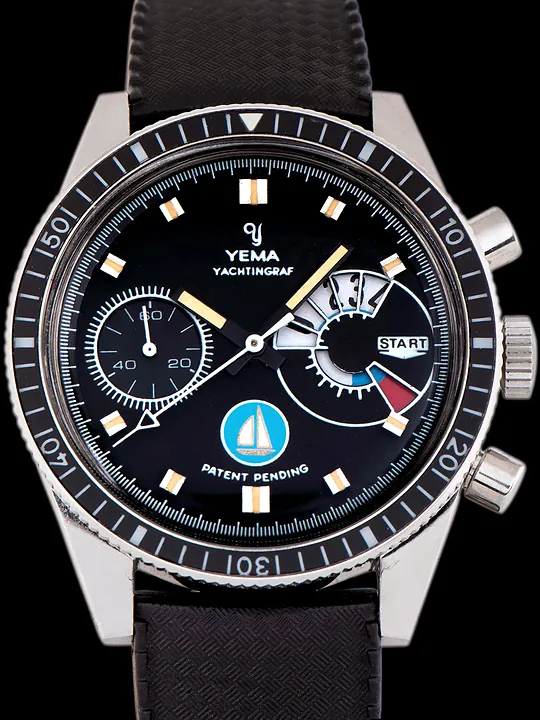
Yema Yachtingraf Régate (Ref. 5667370) "Blue Ship", 1970s
Craft & Tailored (dealer), Los Angeles
Wristwatches · 1960s
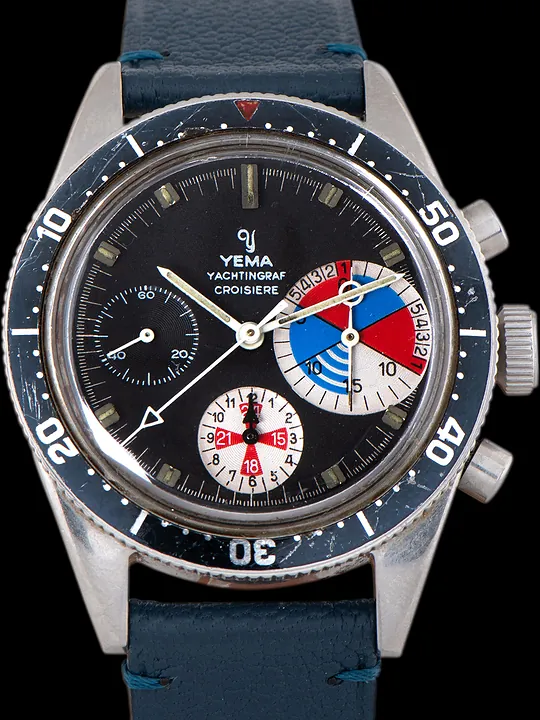
Yema Yachtingraf Croisière (Ref. 93012) "Big Eye", 1960s
Craft & Tailored (dealer), Los Angeles
Wristwatches · 1998
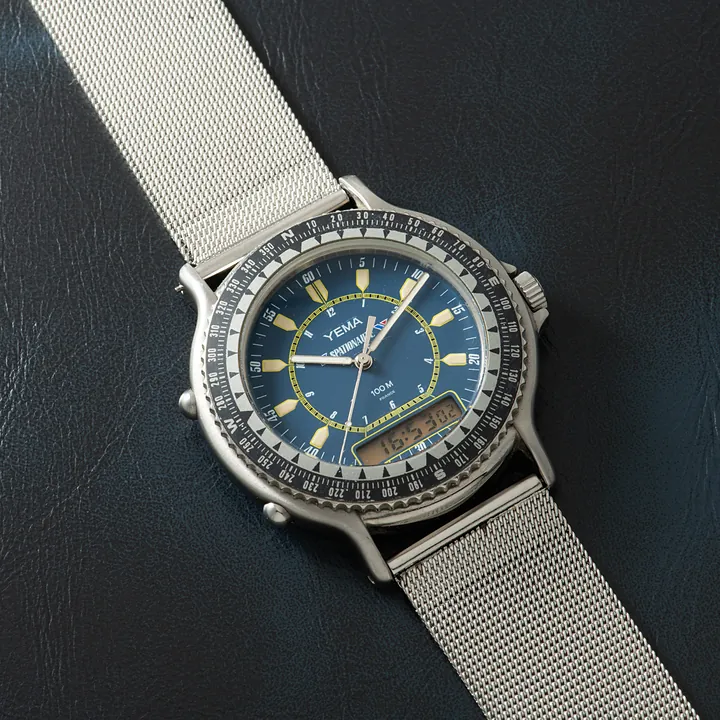
Yema Spationaute ISS, 1998
Analog/Shift (dealer), New York
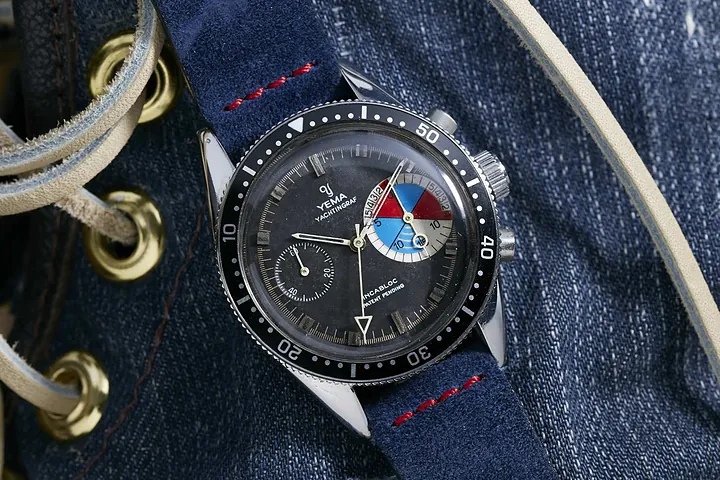
Wristwatches · late 1960s
Yema Yachtingraf, late 1960s
Analog/Shift (dealer), New York
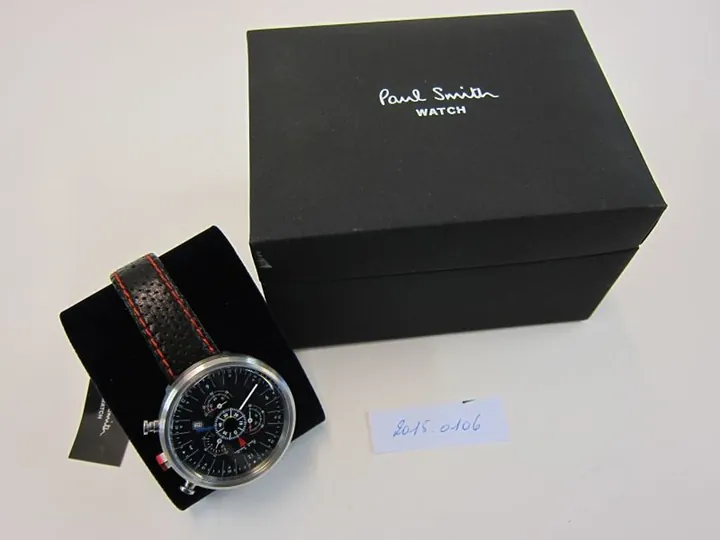
Wristwatches · 2010
Wristwatch, 2010
Modemuseum Hasselt
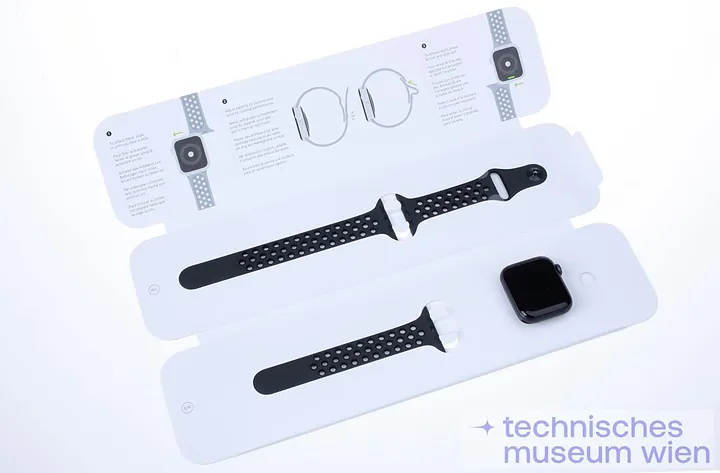
Wristwatches · 2018 (Series 4 released in September 2018; '1977' in the source is the model number A1977)
Apple Watch Series 4 (GPS, 40 mm, model A1977), 2018
Vienna Museum of Science and Technology
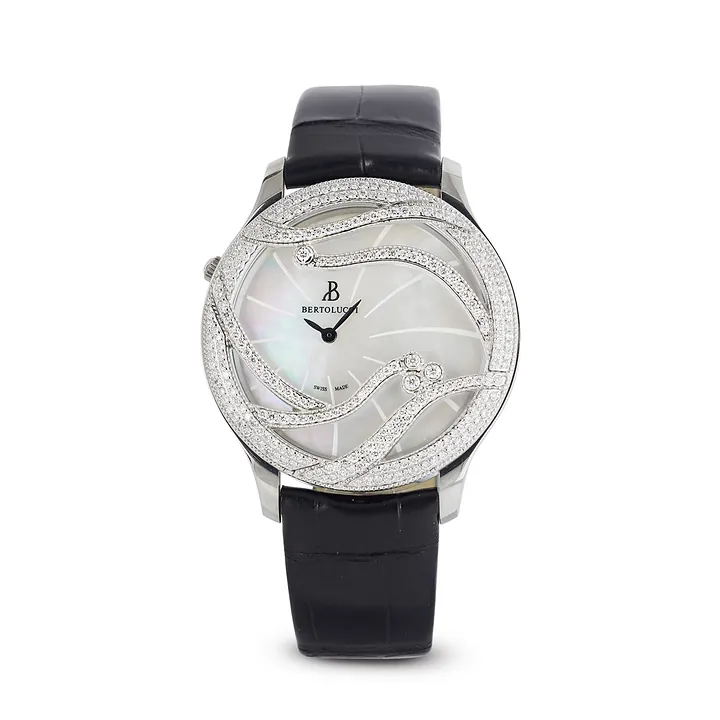
Wristwatches · c. 2010s
Bertolucci Stria III, ref. 11513.50.45.B88.6C1.501, c. 2010s
Antiquorum auction archive, Geneva
Wristwatches · c. 2010s
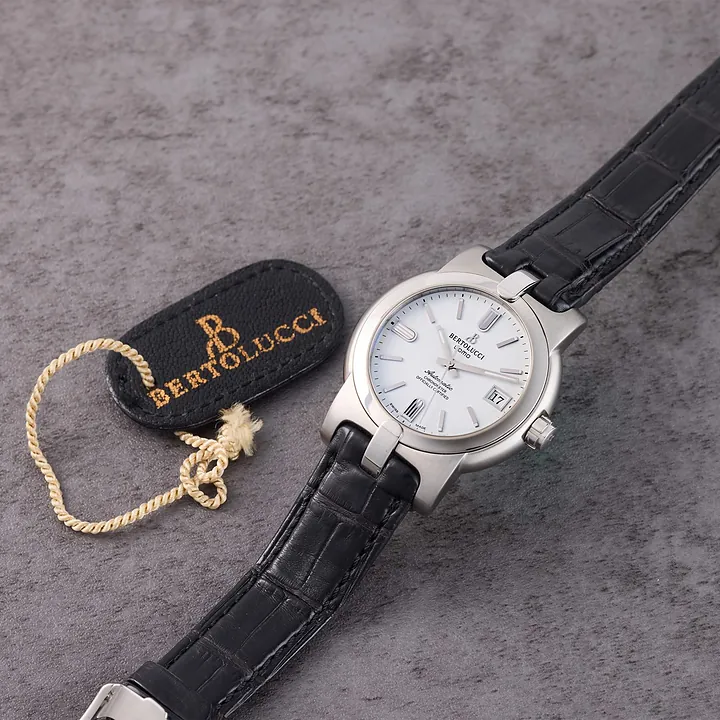
Bertolucci Uoma, ref. 824.51.41.10B, c. 2010s
Antiquorum auction archive, Geneva