
Wristwatches · Wristwatch
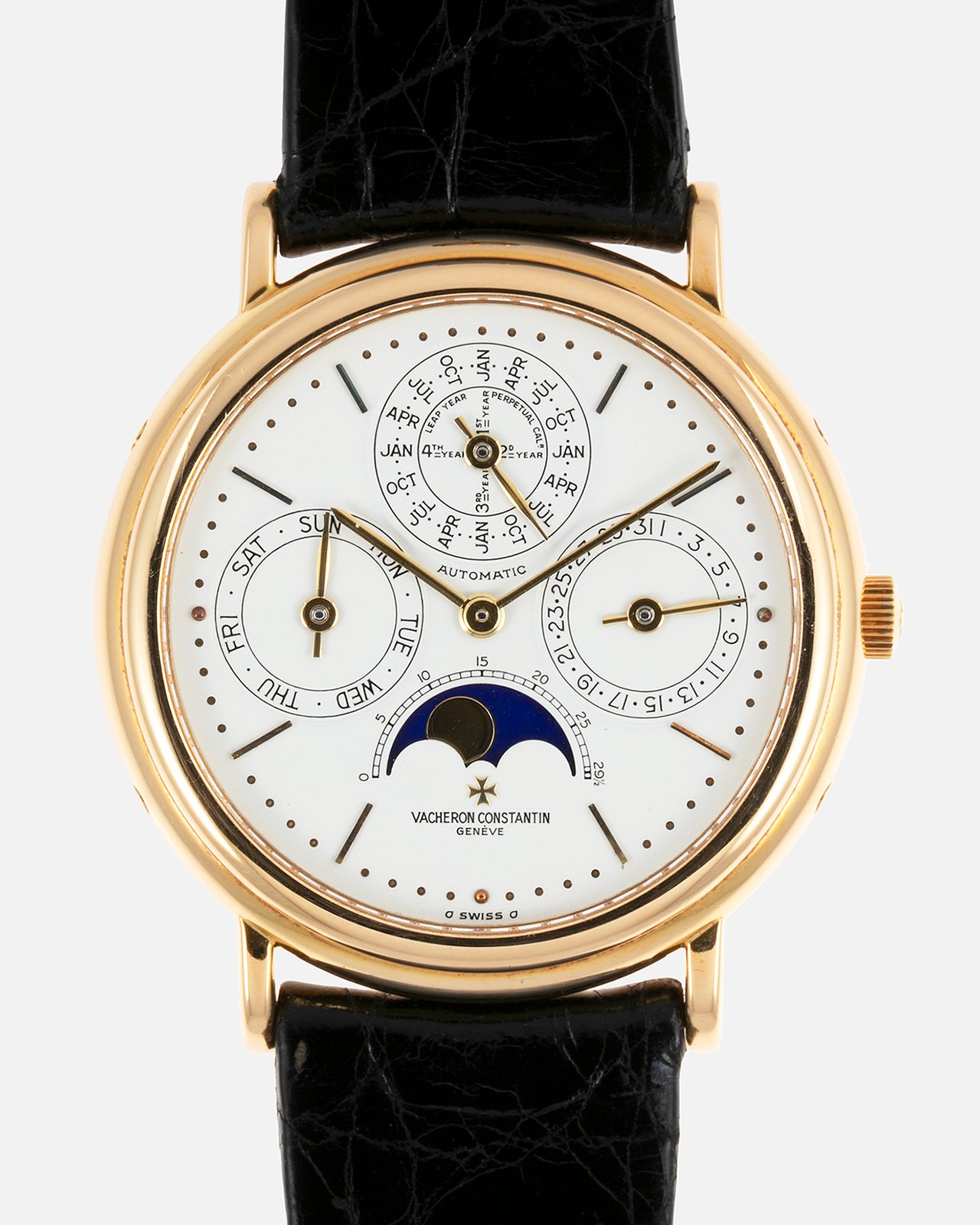
Vacheron Constantin Perpetual Calendar 43031 'NOS', 1990s
- Maker / attribution
- Vacheron Constantin (maker)
- Date
- 1990s
- Historical period
- Mechanical Renaissance (1990 – 2010)
- Country of origin
- Switzerland
- Object type
- Wristwatch
- Dimensions
- Case 36 mm
- Stock no.
- Product 6834911084631
- Credit line
- Dealer listing, S.Song Watches (product 6834911084631)
- Catalogue title (original)
- Vacheron Constantin Perpetual Calendar 43031 'NOS' (English)
View the source record (dealer listing) ↗ (opens another website in a new tab)Suggest a correction
Record summary
Catalogued by S.Song Watches (dealer), Seattle (stock number Product 6834911084631), this is a wristwatch by Vacheron Constantin, made in Switzerland, dated 1990s. The Atlas places it in the Mechanical Renaissance period (1990 – 2010) of its Wristwatches collection. Recorded dimensions: Case 36 mm. The record is illustrated with 6 photographs.
Assembled from the source record's structured fields. Dates and attributions are given as the source states them; where a field is missing the Atlas leaves it blank rather than estimating.
Catalogue description
Dealer description — S.Song Watches
With the onslaught of the Swiss watchmaking industry brought about by the Quartz Crisis at its peak in the early 1980s, the public's interest in complicated mechanical watches had begun to wane as digital and electronic technology took precedence. One watch that was instrumental in reversing that now antiquated mindset was the Vacheron Constantin Perpetual Calendar ref. 43031 - as it put high-end horology firmly back on the map and aided in getting complicated mechanical watches back on the wrists of the public. Released in 1983, the Vacheron Constantin Perpetual Calendar ref. 43031 followed Audemars Piguet's own perpetual calendar model and preceded that of Patek Philippe in what was a classic battle for the top spot between the Holy Trinity's three watchmakers. Evolving into Vacheron's quintessential perpetual calendar model, the ref. 43031 saw around two decades of service with its eventual discontinuation in 2002 following the production of several variants in different metals and dial configurations. Offered here, I have the yellow gold variant with a beautiful silver dial. Measuring 36mm across, the ref. 43031 was delightfully on point in proportions, and with its long lugs, it continues to wear well in the contemporary era of watchmaking too. What makes this particular example so special is the fact that it remains in pristine, new old stock condition with its original case back sticker still attached. With a stepped bezel and its perfectly circular case interrupted only by a small discreet crown, the ref. 43031 is a beautiful watch that sparkles like a jewel with its polished surface finish. Contrasting its polished finish, the ref. 43031 features an opaline dial with four subdials marking the day, month, leap year, date, and moon phase - which combine to make for an elegantly symmetrical layout. A wonderful design all-around, the ref. 43031's secret lies in its moon phase indicator, with a lapis lazuli moon phase backdrop bringing a deep rich textured blue color to the ref. 43031's dial. A semi-precious gemstone, lapis lazuli is often used in jewelry and antiquity, yet some watchmakers use it as a means to mark their best watches. A splendid watch on the outside, the ref. 43031 is an alluring piece of work on the inside too. While fitted with a solid caseback, the movement found within the ref. 43031 is still undoubtedly a horological heavyweight. Based on the legendary JLC cal. 920 and retrofitted with a Dubois-Depraz perpetual calendar module, the resultant movement is Vacheron's cal. 1120/2 - an elegantly finished and historically significant movement that Vacheron still uses to this day. Powered by an iconic movement and featuring an elegant design, the ref. 43031 is the sort of watch that put Vacheron on the map and earned them the plaudits they still enjoy. Vacheron Constantin’s perpetual calendars are the latest watches to join the neo-vintage rebirth and it is a model line that deserves its re-found fame. I am sure that it will continue to appreciate over time after many years of being seen as an outdated ‘dress’ watch.
Historical context
Mechanical Renaissance (1990 – 2010)
Mechanical watches return as cultural objects; independent watchmaking flourishes.
Mechanical watches returned as cultural and luxury objects. Complications, tourbillons and new materials proliferated; independent watchmakers such as George Daniels, F.P. Journe and Philippe Dufour revived artisanal watchmaking; collecting vintage watches became a major field.
Read the period in the timelineMore wristwatches from this periodEarlier: Quartz Revolution
Atlas type guide
Calendar, moon-phase and perpetual calendar watches
Calendar complications range from a simple date to the perpetual calendar, which automatically allows for months of different lengths and leap years until 2100. Pocket watches with perpetual calendars were made in the eighteenth and nineteenth centuries; Patek Philippe made the first perpetual calendar wristwatch in 1925, and series production followed in 1941. The annual calendar (Patek Philippe, 1996) needs correction only once a year.
Moon-phase displays use a disc with two moons and 59 teeth advanced daily, approximating the 29.5-day lunation; more precise trains reduce the error to one day in over a century.
What to look for
- Apertures or subsidiary dials for day, date, month and leap year.
- Moon disc under a 'bosom' shaped aperture.
- Recessed correctors on the case band for setting the calendar.
Dating clues
- Triple-date wristwatches: popular c. 1940–1955.
- Perpetual calendar wristwatches: from 1925 (unique) and 1941 (series).
General guidance written by the Atlas editors about this kind of object. It is not a statement about this particular piece; for that, rely on the source record above and on physical examination.
Related records
Pocket Watches · c. 1896
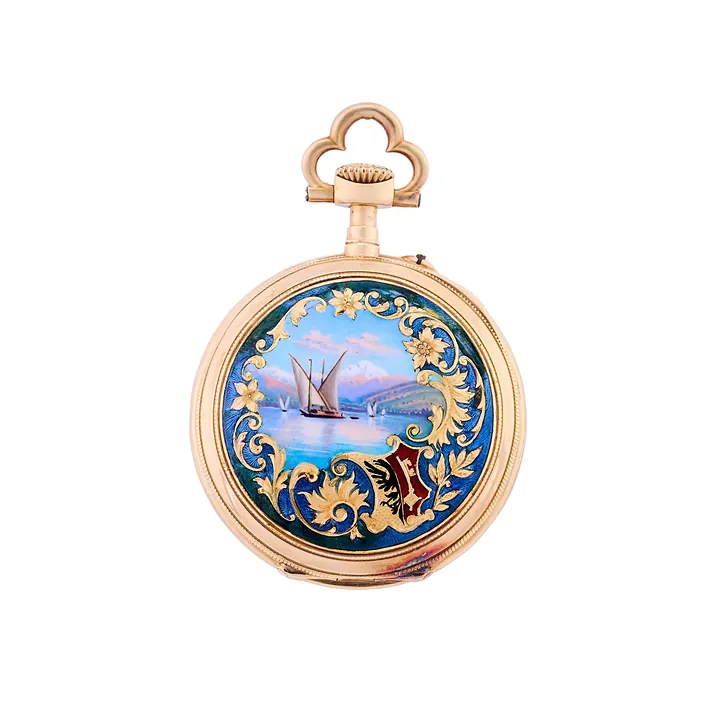
Vacheron Constantin “grand TIR de L’exposition Nationale, Genève 1896, c. 1896
Antiquorum auction archive, Geneva
Pocket Watches · c. 1940
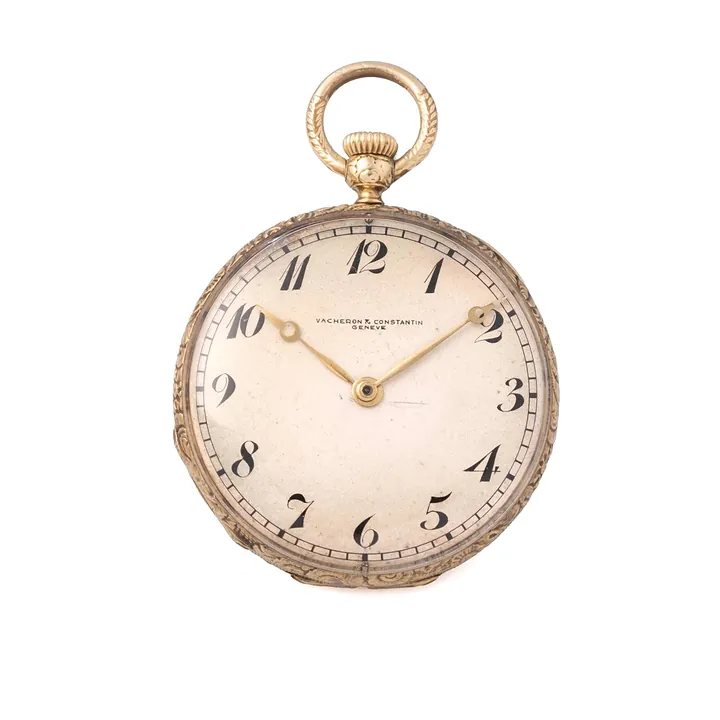
Vacheron Constantin pocket watch, ref. 345, c. 1940
Antiquorum auction archive, Geneva
Pocket Watches · c. 1945
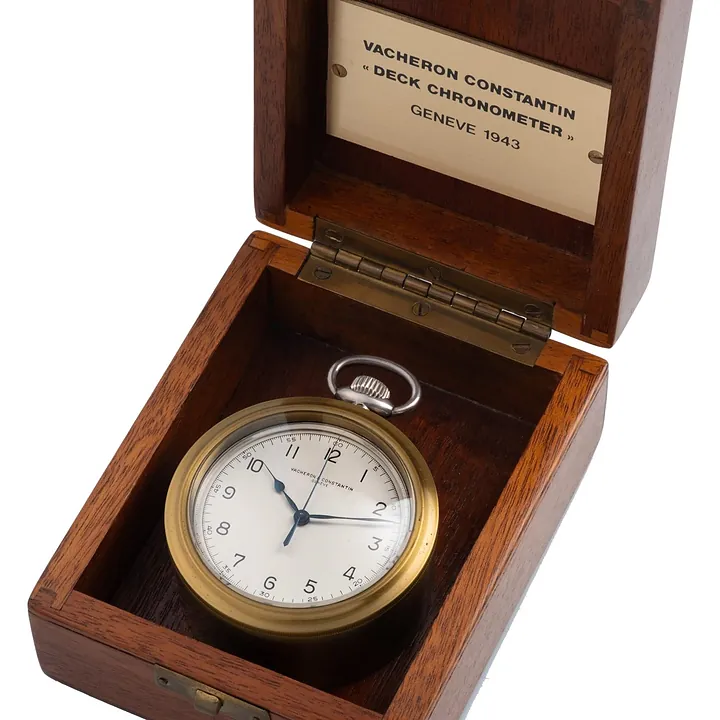
Vacheron Constantin pocket chronometer, c. 1945
Antiquorum auction archive, Geneva
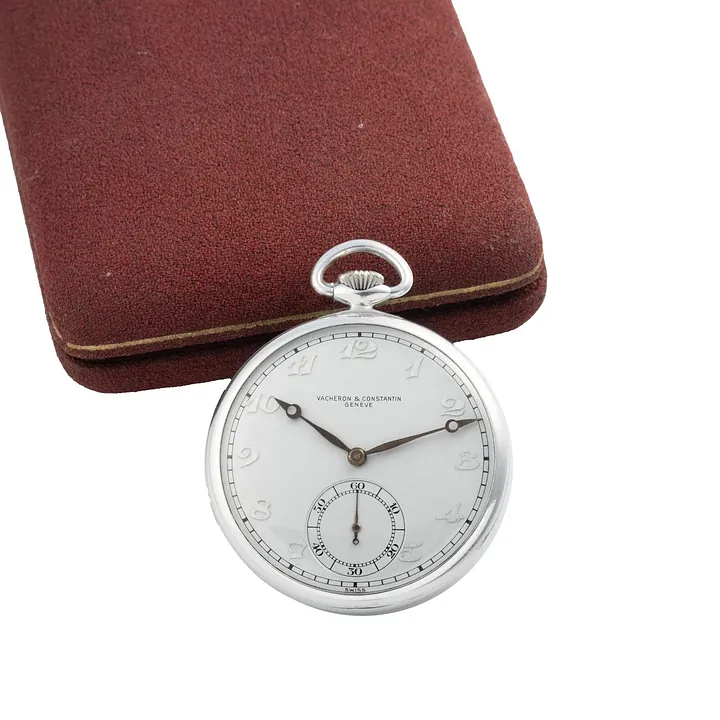
Pocket Watches · c. 1945
Vacheron Constantin watch, c. 1945
Antiquorum auction archive, Geneva

Wristwatches · 2008
Wristwatch by Breitling?, 2008
Museum Rotterdam

Wristwatches · c. 1990s
Audemars Piguet Bamboo, c. 1990s
Antiquorum auction archive, Geneva

Wristwatches · c. 1990
Audemars Piguet Huitieme Perpetual Calendar, ref. 25696PT, c. 1990
Antiquorum auction archive, Geneva

Wristwatches · c. 1990
Breitling Chronomat, ref. b13050.1, c. 1990
Antiquorum auction archive, Geneva