
Wristwatches · Wristwatch
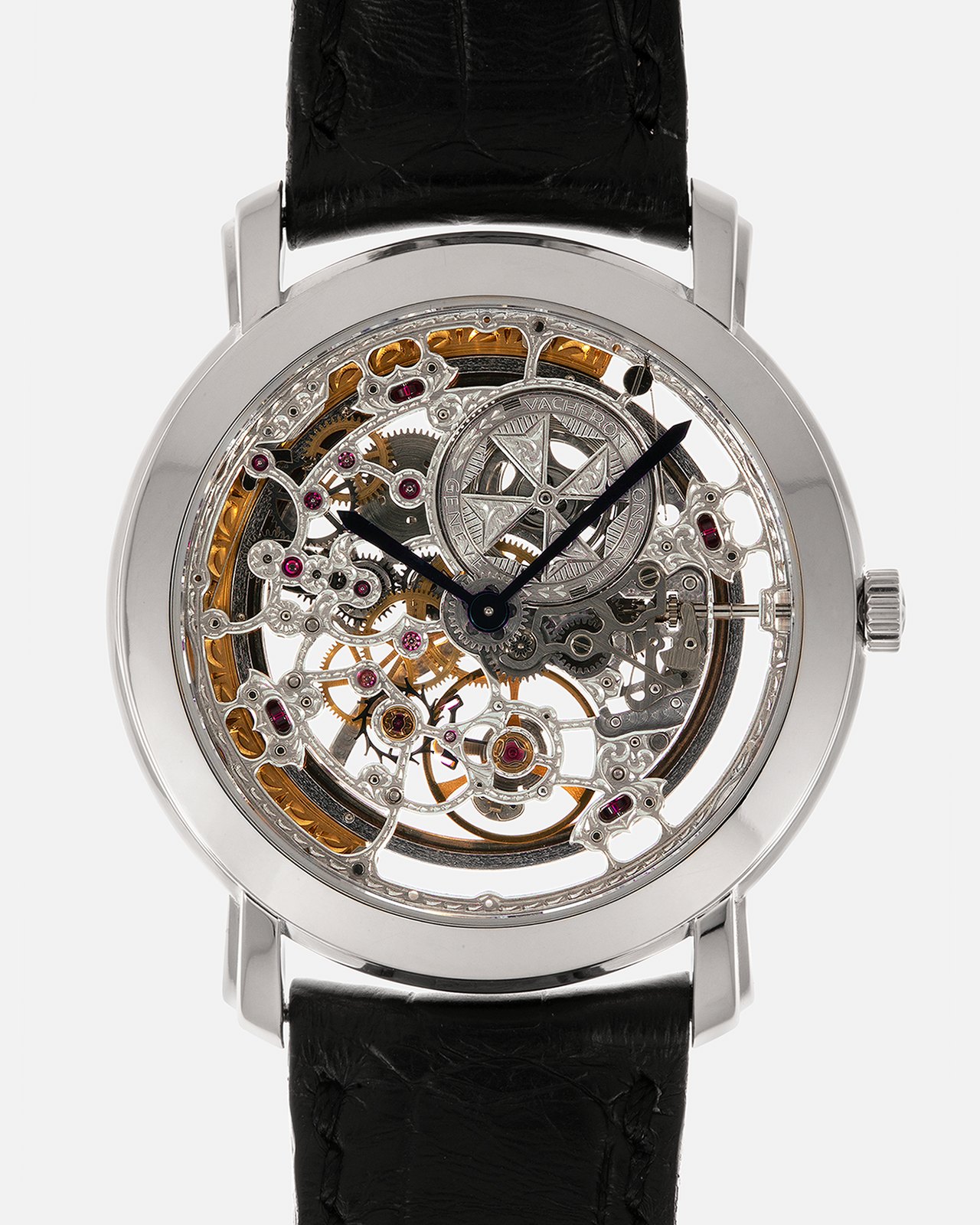
Vacheron Constantin Malte Squelette/Skeleton 43080 White Gold, 2000s
- Maker / attribution
- Vacheron Constantin (maker)
- Date
- 2000s
- Historical period
- Mechanical Renaissance (1990 – 2010)
- Country of origin
- Switzerland
- Object type
- Wristwatch
- Materials / technique
- white gold
- Dimensions
- Case 35.5 mm
- Stock no.
- Product 7665825185879
- Credit line
- Dealer listing, S.Song Watches (product 7665825185879)
- Catalogue title (original)
- Vacheron Constantin Malte Squelette/Skeleton 43080 White Gold (English)
View the source record (dealer listing) ↗ (opens another website in a new tab)Suggest a correction
Record summary
Catalogued by S.Song Watches (dealer), Seattle (stock number Product 7665825185879), this is a wristwatch by Vacheron Constantin, made in Switzerland, dated 2000s. The Atlas places it in the Mechanical Renaissance period (1990 – 2010) of its Wristwatches collection. Materials and techniques recorded by the source: white gold. Recorded dimensions: Case 35.5 mm. The record is illustrated with 6 photographs.
Assembled from the source record's structured fields. Dates and attributions are given as the source states them; where a field is missing the Atlas leaves it blank rather than estimating.
Catalogue description
Dealer description — S.Song Watches
The world of skeletonized watches can often feel overly theatrical. In many cases, exposed dials prioritise spectacle above all else, revealing as much of the movement as possible without necessarily preserving the coherence of the watch as a whole. The Vacheron Constantin 43080 takes a markedly different approach. Rather than relying on sheer complexity or visual drama, it approaches transparency in a far more understated and considered manner, preserving the character of a traditional ultra-thin dress watch while transforming the movement into the focal point of the watch. The Ref. 43080 emerged during a particularly interesting period for Vacheron Constantin, preceding the renewed collector interest in neo-vintage dress watches and ultra-thin complications. During this era, the manufacture placed a strong emphasis on traditional watchmaking, exceptional finishing, and balanced proportions rather than overt statement-making. The reference was offered in both white and yellow gold, with the present example executed in the former. This variant of the 43080 presents a compelling contrast between visual lightness and physical presence. On the wrist, the watch carries the reassuring heft expected of white gold, yet remains airy and delicate thanks to the exposed calibre beneath the crystal. Measuring 35.5 mm x 6 mm, the watch maintains the restrained proportions expected of a traditional dress watch, though it carries more wrist presence than its dimensions might initially suggest, owing largely to its stepped Maltese-style lugs. When viewed from the side, the construction becomes even more interesting, with the sculpted lugs welded directly onto the case band before being painstakingly hand-finished to eliminate any visible traces of soldering. Combined with the subtly fluted shoulder, the result is a surprisingly strong architectural profile that gives the watch far more definition on the wrist. Aesthetically, the scintillating display here is genuinely remarkable. With virtually no traditional surface interrupting the view, the calibre remains almost entirely exposed beneath the crystal, revealing a striking level of mechanical intricacy within such a compact package. Yet rather than feeling cluttered or overly technical, the bridges, wheels, and engraved surfaces flow naturally into one another, creating a display that feels endlessly engaging to study. It is the sort of watch you can easily lose yourself in for several minutes at a time, constantly noticing new shapes, transitions, and flourishes within the movement. The near absence of overt branding only reinforces that impression, with the Maltese cross revealing itself subtly within the mainspring barrel cover at 1:00. Just as interesting is the way the watch interacts with the wearer. Engaging the crown activates the visible keyless works beneath at 3:00, allowing the winding pinion and motion works to come alive while the exposed mainspring barrel gradually tightens during winding. What is typically hidden beneath a dial becomes fully visible, turning even the simple act of setting or winding the watch into something deeply satisfying to observe. At the heart of the watch is the Cal. 1120 SQ, a heavily skeletonised interpretation of the Cal. 1120, itself based on the legendary Jaeger-LeCoultre Cal. 920 architecture, one of the most respected ultra-thin automatic movements ever produced. Measuring just 2.45mm thick, the calibre had already earned a reputation for its exceptional proportions long before undergoing this transformation. Here, Vacheron Constantin elevated the movement through intricate engraving and meticulous hand-finishing while preserving the elegance and fluidity of the original design. Sharp interior angles, polished bevels, and expressive engraving showcase the depth of craftsmanship achieved during this period, while the full 360-degree 21-carat gold rotor operates on four ruby roller bearings designed to absorb shock and minimise interference with the surrounding bridges. Ultimately, the 43080 feels more like a study in mechanical artistry than an exercise in spectacle. It represents a particularly thoughtful interpretation of skeletonisation, succeeding through proportion, finishing, and interaction rather than excess. Vacheron held very little back when it came to reworking and finishing the calibre, yet the watch never loses its balance. Very few skeletonised watches feel this technically impressive while remaining composed and engaging on the wrist.
Historical context
Mechanical Renaissance (1990 – 2010)
Mechanical watches return as cultural objects; independent watchmaking flourishes.
Mechanical watches returned as cultural and luxury objects. Complications, tourbillons and new materials proliferated; independent watchmakers such as George Daniels, F.P. Journe and Philippe Dufour revived artisanal watchmaking; collecting vintage watches became a major field.
Read the period in the timelineMore wristwatches from this periodEarlier: Quartz Revolution
Atlas type guide
Wristwatches
Bracelet watches were worn by women from the early nineteenth century — Breguet made one for Caroline Murat, Queen of Naples, in 1810–12 — but the wristwatch only became a man's instrument with military use and aviation in the early twentieth century. Between the World Wars it overtook the pocket watch; the 1920s and 1930s brought rectangular Art Deco cases, water-resistant cases and the first automatic winding systems.
After 1945 the wristwatch became a carrier of identity — dress watches, sports and dive watches, chronographs, calendars — produced by Swiss, American, Japanese, German, Soviet and Chinese industries. The quartz revolution after 1969 and the mechanical renaissance since the 1990s, including the rise of independent watchmakers, complete the story.
What to look for
- The reference number (between the lugs or inside the case back) and serial number, the starting point for dating.
- The calibre: its maker and number are often stamped under the dial or on the bridge.
- Originality of dial, hands and crown — refinished ('redial') dials are common.
- Case material marks: 18K/750, 14K/585, stainless steel, gold-filled, plated.
Dating clues
- Wire-lug cases: before c. 1925.
- Water-resistant screw-down cases: from 1926.
- Quartz movements: from 1969; sapphire crystals widespread after c. 1980.
General guidance written by the Atlas editors about this kind of object. It is not a statement about this particular piece; for that, rely on the source record above and on physical examination.
Related records
Pocket Watches · c. 1896
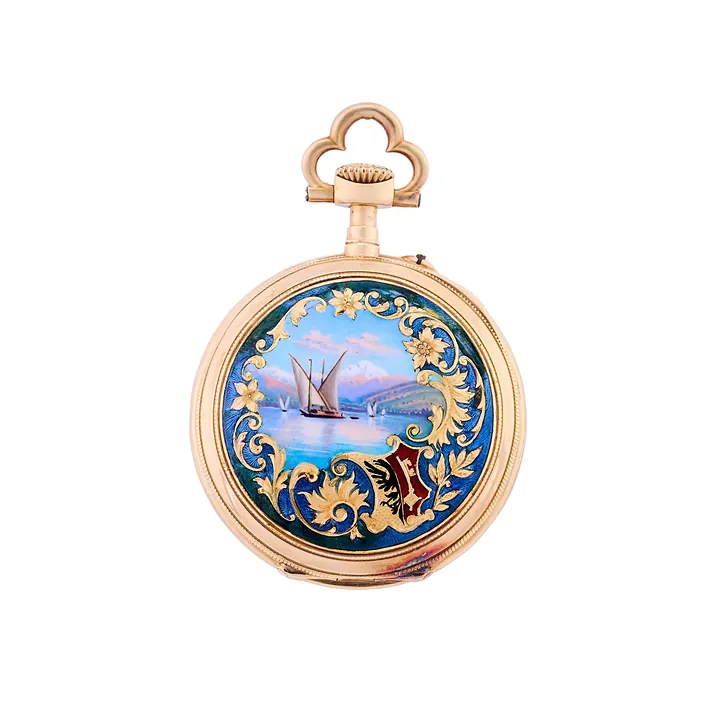
Vacheron Constantin “grand TIR de L’exposition Nationale, Genève 1896, c. 1896
Antiquorum auction archive, Geneva
Pocket Watches · c. 1940
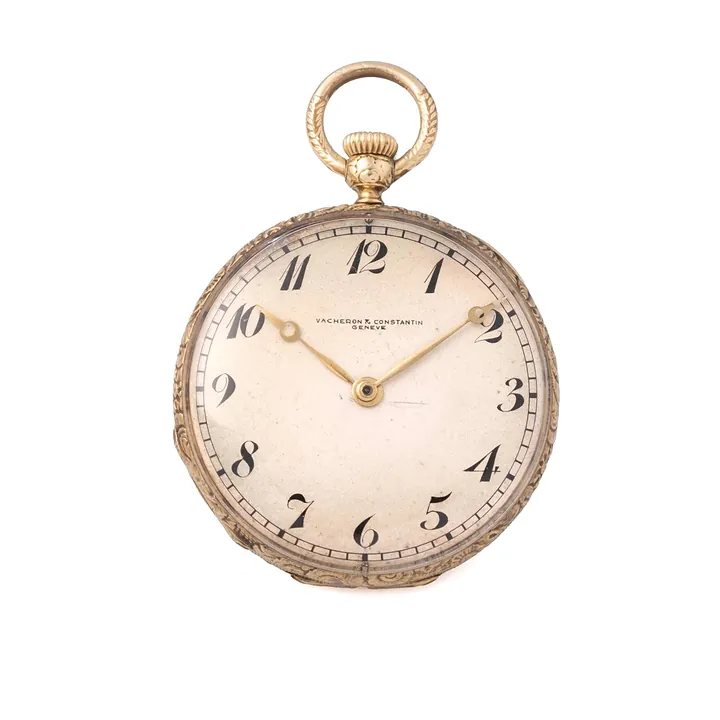
Vacheron Constantin pocket watch, ref. 345, c. 1940
Antiquorum auction archive, Geneva
Pocket Watches · c. 1945
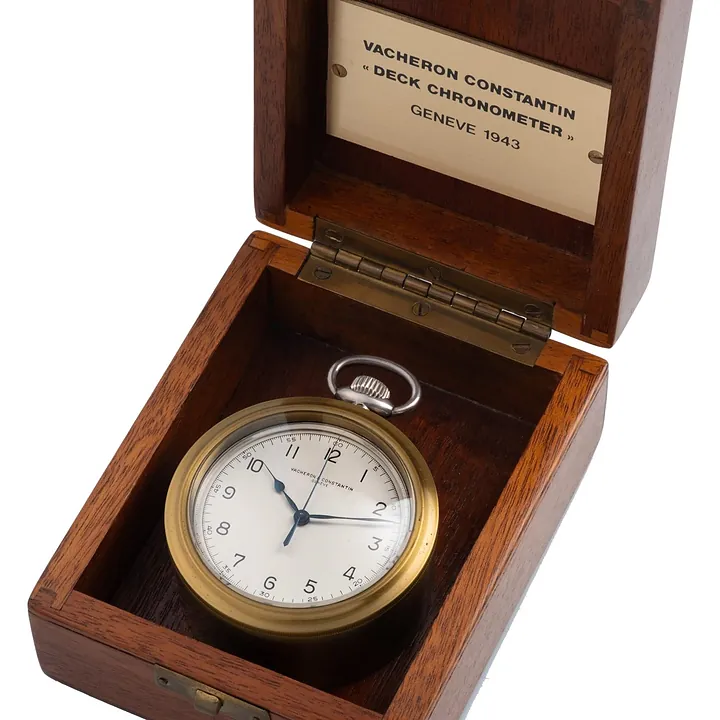
Vacheron Constantin pocket chronometer, c. 1945
Antiquorum auction archive, Geneva
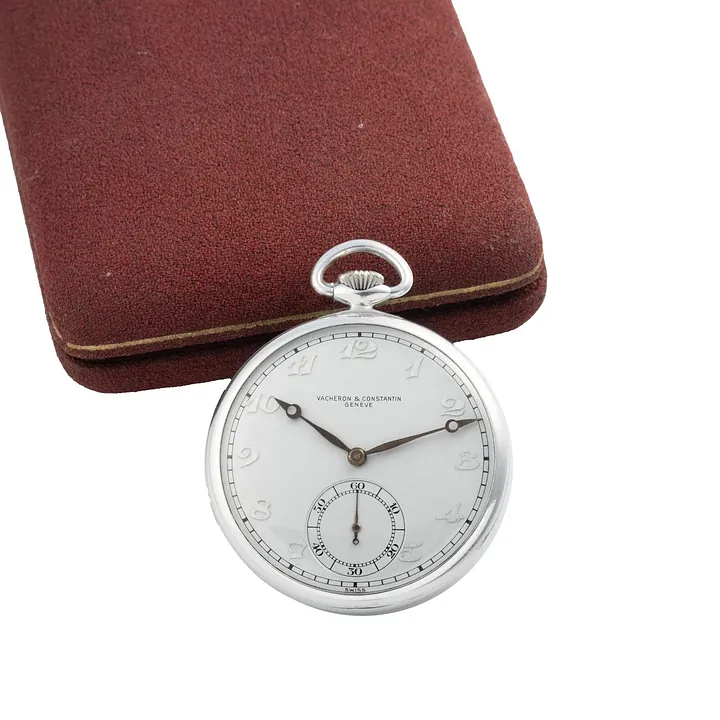
Pocket Watches · c. 1945
Vacheron Constantin watch, c. 1945
Antiquorum auction archive, Geneva

Wristwatches · 2008
Wristwatch by Breitling?, 2008
Museum Rotterdam

Wristwatches · c. 1990s
Audemars Piguet Bamboo, c. 1990s
Antiquorum auction archive, Geneva

Wristwatches · c. 1990
Audemars Piguet Huitieme Perpetual Calendar, ref. 25696PT, c. 1990
Antiquorum auction archive, Geneva

Wristwatches · c. 1990
Breitling Chronomat, ref. b13050.1, c. 1990
Antiquorum auction archive, Geneva